
It is a zongzi, and it is not a festival zongzi at all. 裹蒸 guǒzhēng is the rice parcel of 肇庆 Zhàoqìng, and the difference from the leaf-wrapped packets sold elsewhere in the delta at the Dragon Boat Festival is that Zhaoqing eats this one all year round, in a size and shape that has more to do with a pyramid than with the usual triangle. The wrapping is 冬叶 dōngyè, the large leaves of a local bamboo relative, laid flat in two layers, filled with soaked glutinous rice, split mung bean and a piece of belly pork, folded into a four-cornered cone, tied with a strip of bamboo, and boiled for six to eight hours. The result is dense, faintly green-scented, and closer to a steamed pudding than to a rice dish. The proportions are what make it: roughly two parts rice to one part mung bean, with the pork in the middle so that its fat renders into the bean layer during the long boil. A good one is savoury throughout, the rice thoroughly seasoned rather than plain, and the bean layer soft enough to spread. Because it is boiled for so long, it keeps for days without refrigeration, which is why it was historically travel food and why shops in Zhaoqing sell it steamed and ready rather than raw.
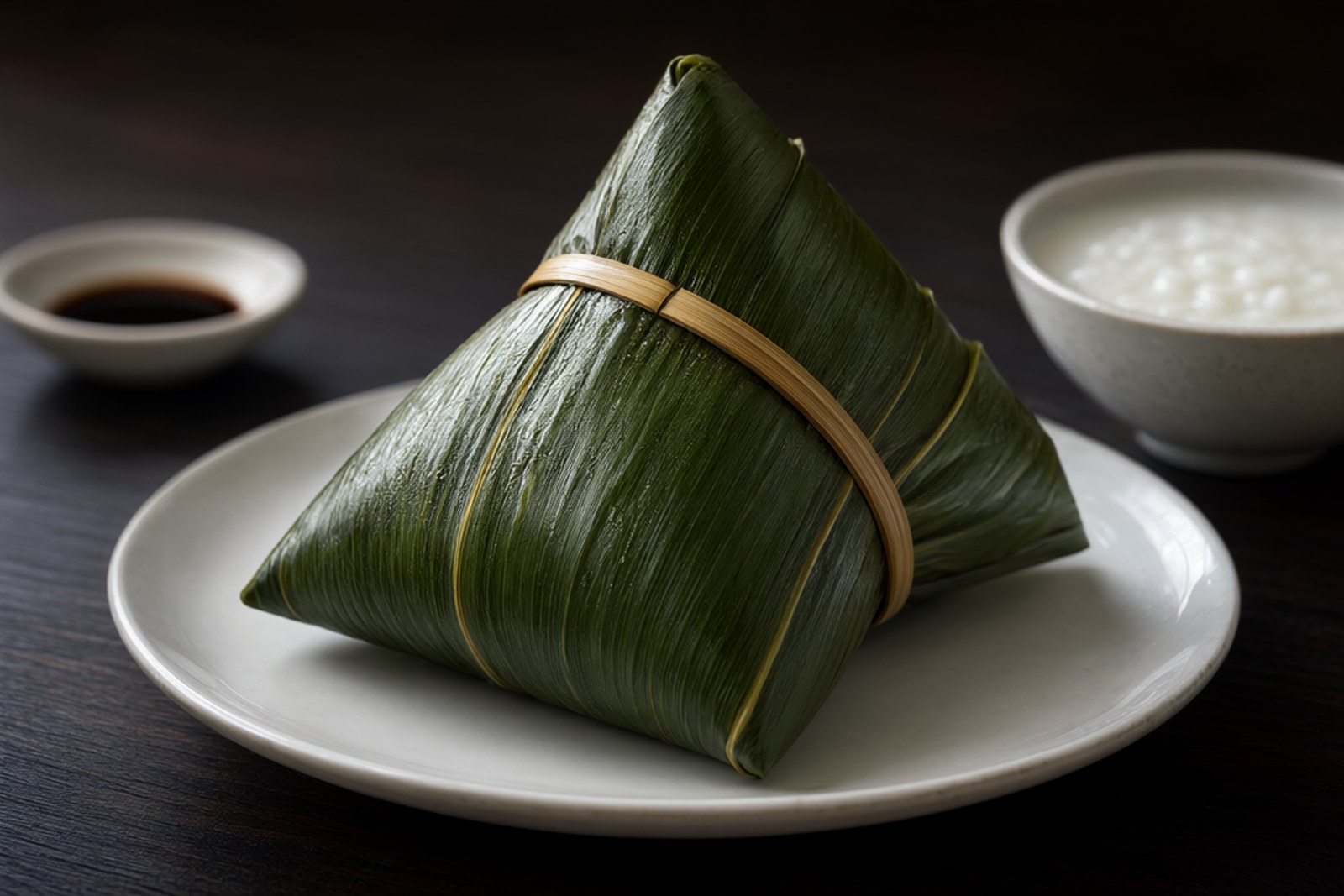
The leaves matter more than most recipes admit. 冬叶 is a broad, slightly waxy leaf that holds up to eight hours in boiling water without disintegrating, and it contributes a mild grassy note to the outer layer of rice. Substitutes wrapped in the usual 箬叶 ruòyè or in lotus leaf are sold, and they are perfectly edible, but the aroma is different and locals will say so. The tying is also part of the craft: a strip of the leaf’s own stem or a length of bamboo is wound around the cone and knotted so that the parcel keeps its shape while the rice swells. A badly tied one opens in the pot and becomes a soup of rice and bean.
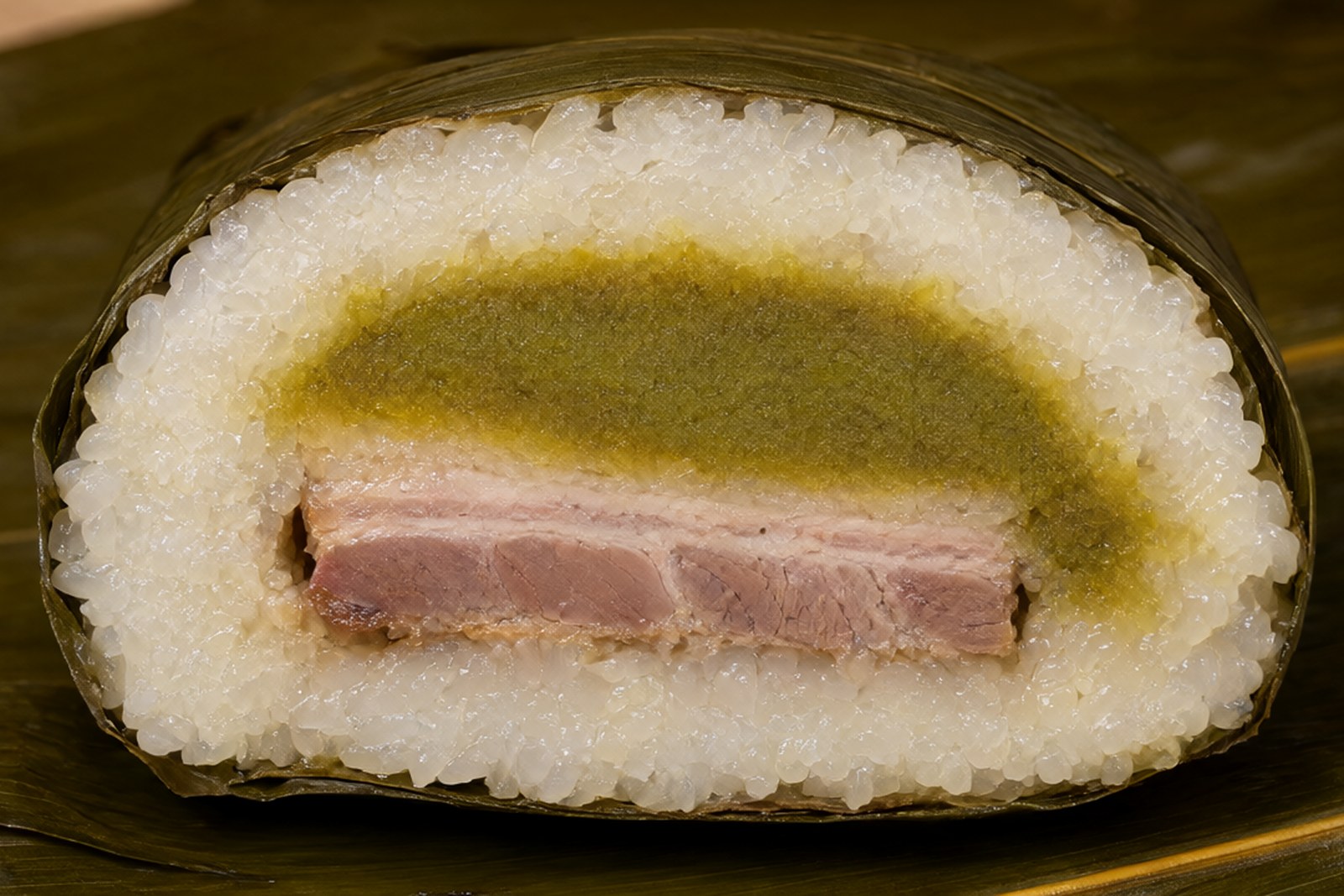
What comes out of the water is heavy for its size. Cut it open and the layers should be visible: a thin green-tinged crust of rice against the leaf, then pale rice, then the yellow-brown bean, and in the centre the pork, by now soft enough to break with a spoon. It is eaten hot, with nothing on it, though some shops offer a dish of soy or a scatter of white sesame. The flavour is mild and slightly sweet from the bean, and the texture is the main event: firm at the edges, collapsing in the middle.
A Pyramid, Not a Festival
The usual Cantonese 粽子 zòngzi is a festival object: small, wrapped in 箬叶, filled with a single piece of pork and a salted egg yolk, and eaten on the fifth day of the fifth month. 裹蒸 belongs to a different tradition. It is bigger, squarer, plainer in its filling and eaten whenever somebody wants one, and Zhaoqing people will tell you that the local one is a food rather than a custom. The name is the technique: 裹 guǒ means to wrap and 蒸 zhēng to steam or boil, and the older sources describe exactly this parcel rather than the festival packet.
The other local version worth knowing is 碱水粽 jiǎnshuǐ zòngzi, the alkaline parcel made with lye water, which contains no pork at all and is eaten cold dipped in sugar or syrup. It is the opposite end of the same idea: the same leaf-wrapped rice, no savoury filling, and a texture that is springy and translucent rather than dense. Both are sold from the same shops and both are eaten without ceremony.
Words and Names
裹蒸 guǒzhēng is the dish, and 肇庆裹蒸 Zhàoqìng guǒzhēng is the full name; the character 蒸 normally means steaming but here refers to the long boil. 粽 zòng is the general word for a leaf-wrapped rice parcel and 粽子 zòngzi is the festival version. 冬叶 dōngyè is the wrapping leaf, 糯米 nuòmǐ glutinous rice, 绿豆 lǜdòu mung bean, 五花肉 wǔhuāròu belly pork and 咸蛋 xiándàn salted duck egg. 碱水粽 jiǎnshuǐ zòngzi is the lye-water parcel, 箬叶 ruòyè the common wrapping leaf used elsewhere in the province, and 扎 zhā the tying.
What the Locals Know
Buy from a shop with its boiling pot visible, because a 裹蒸 that has been reheated twice is noticeably drier in the rice layer. Ask whether the leaves are 冬叶 or a substitute if the aroma matters to you, and buy the plain pork version rather than the ones with egg yolk and chestnut, which are recent additions aimed at visitors. They keep two or three days in a cool place and freeze well; steaming is the right way to bring one back. Sizes range from a small breakfast parcel to a fist-sized one, and prices run from about eight yuan for the small ones to twenty-five for the large.
flowcloud would say that the point of 裹蒸 is patience rather than flavour, since the leaf, the bean and the hours in the pot are all ways of making something plain taste like it took work, and it did.
Where to find it: the 裹蒸 shops of 端州 Duānzhōu, the old quarter of 肇庆市, and the stalls around 七星岩 Qīxīngyán and the 宋城墙 Sòng chéngqiáng, where they are steamed in tall stacks in the morning. Order one plain and ask for it cut open, buy a second to take away if you are travelling, and look for the shops that tie their own rather than the ones selling pre-packed parcels with printed labels.