
Zhou Ji Rice Noodle Shop
You can smell 周记粉店 (Zhou Ji Fen Dian) before you can see it, and what you smell is not chili. It is bone broth and lard — a soft, almost sweet animal smell that leaks out of the shopfront at half past seven in the morning and drifts the length of 县正街 (Xianzheng Street), where the lane is barely four metres wide and the bicycles have to go single file.
The shop has no sign you would photograph. It has a blue awning, a strip of light above a folding door, and a queue of about nine people which never seems to be longer or shorter than nine, whatever hour you pass. Some of them are in pyjama trousers. Some are in work shirts and have obviously walked here before their shift. One man in front of me is holding a small enamel pot, because he is buying for two people and one of them is presumably still asleep. Nobody in this line is a tourist. You can tell because not one of them is looking at the wall.
That is the whole argument for this shop. In a city that has spent the past decade turning itself into a destination, 周记 is still, fundamentally, a place where 长沙老口子 — old Changsha hands — go for breakfast.
A Shop Opened the Year the City Burned
The date on the wall, painted in characters small enough to miss, is 1938.
That year matters more in Changsha than almost anywhere in China, and not in a way anyone here talks about over breakfast. In November 1938, as Japanese forces approached, the city was set alight by its own side in a scorched-earth fire gone catastrophically out of control — the 文夕大火 (Wenxi Fire, named for the wen day of the old calendrical cycle on which it began). It burned for days and destroyed the great majority of the old city. Changsha is not a city with many dynastic buildings left. It does not have the old town that other provincial capitals have, because the old town is mostly ash.
The same year, a man named 周凤鸣 (Zhou Fengming) moved his family from 易俗河 in 湘潭 county to this lane to make a living. He started selling rice noodles. That is the entire founding story, as far as anyone has recorded it: not a vision, not a recipe handed down through the imperial kitchens — a family that needed income, in the worst year the city ever had, in a lane that survived because lanes sometimes do.
Eighty-plus years later the shop is still here, run by the second generation, and in 2018 the district government put its 制作技艺 — its production technique — into the 天心区非物质文化遗产 register. Say that out loud and it sounds grand. What it actually means is that a woman and two men are still doing, by hand, in a back room, at seven in the morning, the same eleven or twelve small operations a cook did here in 1940. The heritage is not a plaque. The heritage is the queue.
How a Bowl Gets Made
Here is what is unusual about 周记 if you are used to eating fast food anywhere else in the world: nobody brings you anything.
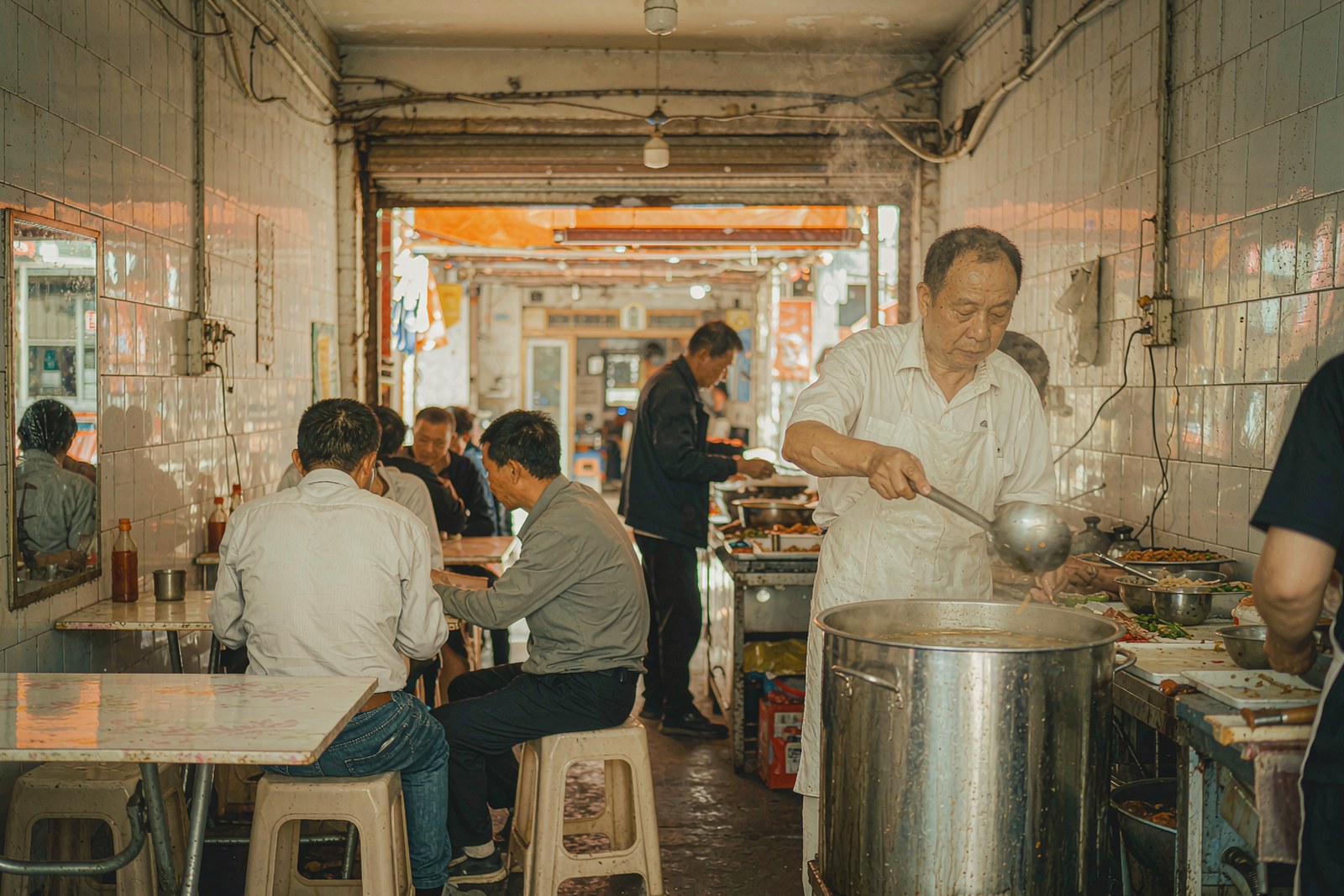
You order and pay at a till by the door, and you are handed a small paper ticket. You take that ticket to the back of the shop yourself — through the seating area, past the tables, into the steam — and you hand it to one of two people working a long stainless counter. The first is 下粉 (xia fen, the noodle man): he takes a portion of fresh 米粉 and drops it into a bamboo basket in a cauldron of boiling water, counts to himself, lifts it, and shakes it dry. The second is the 盖码 (gai ma) hand, who takes the bowl and lays the topping over the noodles with a spoon — 码子 (mazi), the word for everything that goes on top of the noodles in this city, a term worth knowing because it is the whole argument of Changsha breakfast.
From ticket to bowl is well under a minute. The noodles are not cooked to order in any theatrical sense; they are simply too perishable to be cooked any other way. Fresh 米粉 — the wet, folded sheets of rice noodle, not the dried sticks you might buy at home — will not keep. The shop gets through something in the region of four hundred kilos of them a day, which works out at close to two thousand bowls, and considerably more when the holidays come. Nothing about that number is artificial. It is just how many people walk through the door.
The broth is the other half of it. Bones, simmered long and hard, kept plain. Then, in the bowl, before the broth ever arrives, a small spoonful of lard (猪油, zhuyou) — and this is the detail that separates a Changsha bowl from the same noodles eaten a hundred kilometres away. It gives the broth a roundness and a faint sweetness that no amount of simmering replaces. You will not see the lard. You will absolutely taste it.
What to Order
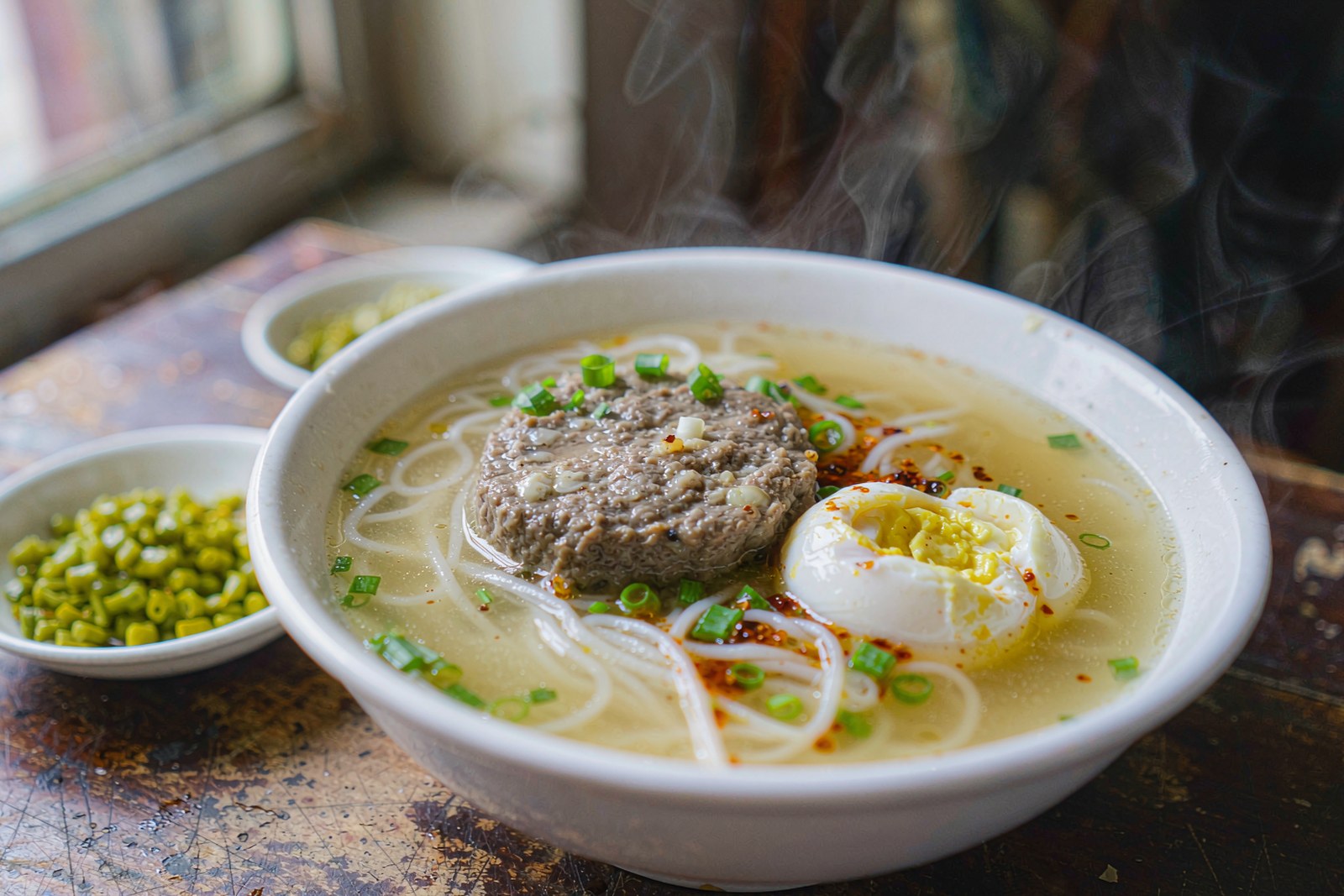
Ask what to get at 周记 and the answer has been settled for years: 原汤肉饼蛋粉, meat-patty-and-egg noodles in clear broth. It is the single most-ordered bowl in the shop, and there is nothing clever about it. A round patty of minced pork, seasoned with a little pepper and steamed rather than fried, sits on the noodles with a whole egg — a 肉饼蒸蛋. The patty has soaked up the broth by the time it reaches you; the egg is firm enough to hold together and soft enough to break with the back of a spoon. Eat them together, in one mouthful of meat and egg and noodle, and it makes complete sense that a city would queue for this.
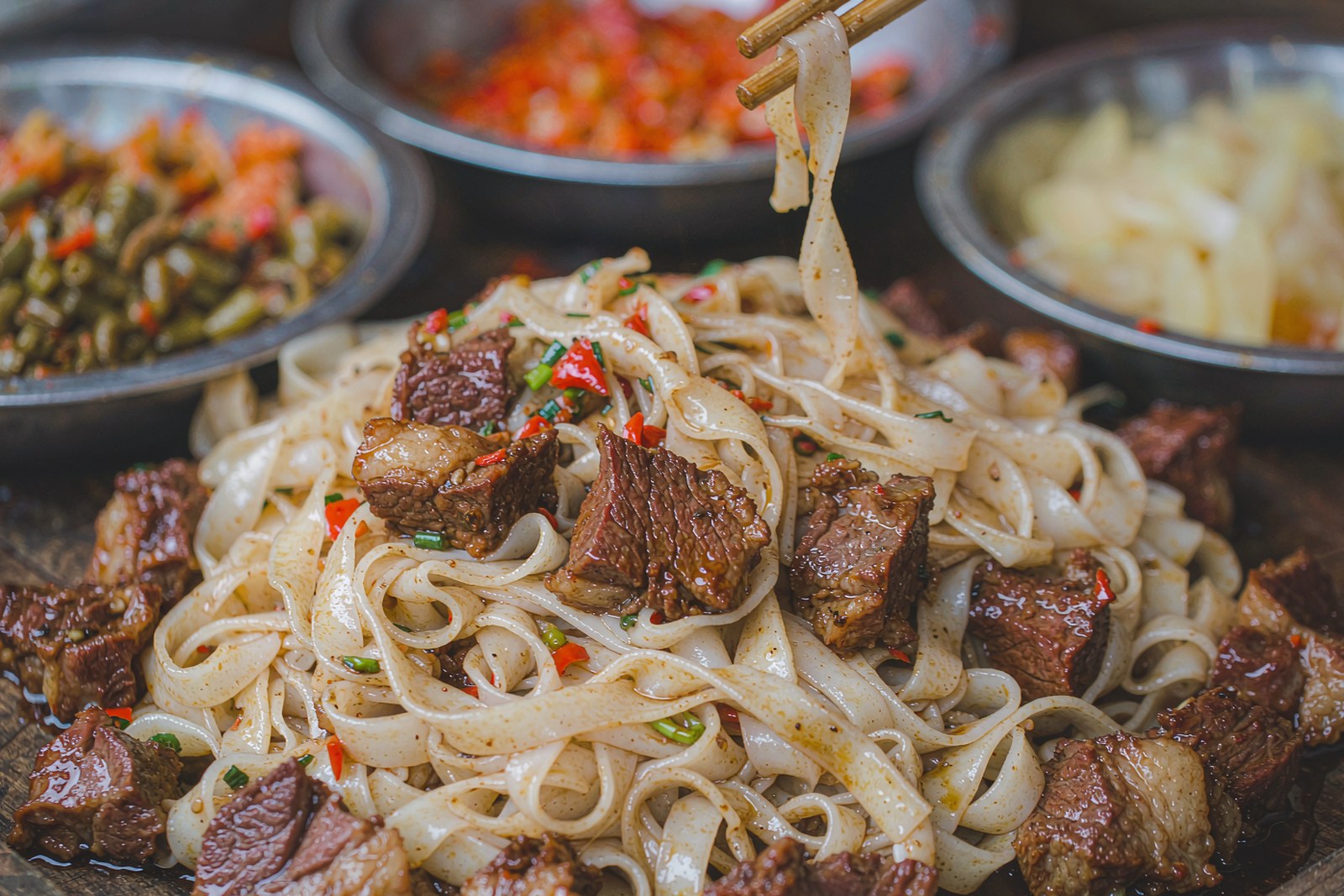
If you want to understand the range of the kitchen, order a second bowl. 牛腩粉, braised beef brisket, is the one locals argue about most — chunks of it, cooked long enough to be tender but not to be soft, sitting in a dark sauce that bleeds slowly into the clear broth and turns the last third of the bowl into something else entirely. 肉丝粉, shredded pork, is the plainest and possibly the truest: a bowl of noodles, a spoonful of shredded pork stewed in soy, and broth that tastes mostly of bones.
The topping menu divides, as it does everywhere in Changsha, between 煨码 (wei ma) — toppings braised in advance in a pot, soft and deep — and 炒码 (chao ma) — toppings stir-fried fresh when you order, brighter and sharper. 周记’s strength has always been on the braised side. Nobody here is putting on a wok show for you.
And then the condiment trays. On the counter past the till: 酸豆角 pickled long beans, 酸菜 pickled mustard greens, chopped chili, 榨菜, 腊八豆, sometimes a bowl of 油渣 — crackling. These are free and unlimited and they are also a trap. The first bowl you eat here should be eaten almost plain, because the whole point of a 原汤 bowl is that somebody has spent the morning making broth you can taste. Put the pickles in on the second visit.
The Street It Sits On
县正街 is a small lane in the south of the old city, between 蔡锷南路 and 人民西路, and it belongs to a cluster of streets — 高正街, 都正街 — that were the old town’s administrative and scholarly quarter. This is where the district 衙门 and the examination halls once were; the names are all officialdom and rectitude. In the twentieth century the neighbourhood fell into decay along with the rest of the old centre. In the last dozen years it has been quietly repaired: grey brick repointed, wooden window frames replaced, a few courtyard gates reopened, lanterns strung across the lane. The 古井 at the end still has water in it.
The result is a street that has been restored without being rebuilt, which is a rarer thing than it sounds. You can walk five minutes from here to 天心阁 (Tianxin Pavilion), the last surviving stretch of the old city wall, and look down at the ring road that runs where the wall’s base used to be. Then you can walk back down into the lane and eat breakfast at a shop that opened in the year the wall’s city burned.
It is worth being precise about what this place is not. 周记 is on every list now — the food media found it long ago, and it does appear on television, and a share of the queue on a Sunday is holding a phone. But the shop has not been re-engineered around them. The till is still at the door. The tables are still the kind with a branded-drink logo under peeling plastic. Nobody has added a wall of neon or an English menu or a “signature set”. The tourists came to it. It did not go to them.
嗦粉, and the Grammar of Breakfast
The Changsha word is 嗦粉 (suo fen) — to slurp noodles, with the emphasis on the sound. It is a verb, a meal, and a mild declaration of identity, and it has its own rules.
The first rule is that rice noodles are breakfast. Not lunch, not a late dinner, not a bowl you eat sitting down and finishing calmly: breakfast, standing if necessary, in the half hour before the day starts. The second rule is ordering discipline. You choose your 粉 — in Changsha, 扁粉 (bian fen, flat and wide) is the default for a 原汤 bowl, because the flat sheet holds the broth; 圆粉 (yuan fen, round) is for people who want more chew and less soup. You choose your 码子. You may choose to double it — 双码 — which is what the man with the enamel pot is doing. And then you stop choosing, because everything else on the counter is free.
The third rule, and the one visitors get wrong, is that the broth is the dish. In most of the world a bowl of noodles is judged by what is on it. Here it is judged by what is under it. A good bowl of Changsha 米粉 will be drunk dry, or nearly, and the last two spoonfuls — after the chili oil has swum down from the topping and the lard has melted into everything — are the best thing in the shop.
What the Locals Know
Come early. Before eight, ideally: the broth is at its freshest, the crowd is entirely local, and there is a table free. Between eleven and one on a weekend the queue doubles and the shop becomes a different, louder animal.
Come on a weekday if you possibly can. Monday morning at 周记 is one of the better experiences this city offers, and it costs about fifteen yuan.
Mind the ticket. Your food does not come to you — you take the paper to the back counter yourself, and there is no waiter to chase. If you sit down and wait, you will wait a long time and the staff will assume you are waiting for someone else.
Share a table. Seating is a commodity here and nobody considers it private; you will be joined, and that is normal, and the correct response is to move your bowl six centimetres and say nothing.
And eat the noodle while it is hot. 米粉 that has stood for five minutes is a different food: the starch slackens, the broth cools, and the thing that made the bowl worth the queue quietly leaves it. There is a reason that everyone in this city eats standing up when the tables are full. It is not impatience. It is chemistry.
Two Bowls, One Morning
The honest way to do this — the way I would send anyone — is to order two bowls and eat them in the wrong order.
Start with the 原汤肉饼蛋粉 and eat it slowly for the first half, before anything on the condiment counter touches it. That is the version of this shop that has been served since 1938, and it is a bowl with almost nothing to hide behind: broth, lard, noodles, pork, egg. If the broth is thin you will know within three spoonfuls.
Then order 牛腩粉, and this time do everything you were told not to do. Chili oil, pickled long beans, a spoonful of the sour mustard greens, the crackling if there is any. Stir it until the bowl goes opaque. This is how most of the people in the room are actually eating, and it is the other half of the city’s cooking: not delicacy, but volume and heat and salt, food designed for a morning that starts early and a day that will be long.
Between the two bowls you will have spent maybe thirty yuan and forty minutes, and you will have eaten the two ends of Changsha at once — the patient end, which simmers bones overnight and lets you taste it, and the loud end, which is what most of the world thinks the city is.
A Note on the Name
There are 周记粉店 branches and there are shops that share the surname, and the one you want is the original on 县正街 — the one with the blue awning and the paper tickets and the ticket counter at the back. Look for the 非物质文化遗产 plaque, which is small and dusty and hangs too high to read comfortably. It is the only piece of decoration in the shop, and it is the only one it needs.
Eighty-eight years ago a family moved to this lane to sell noodles in a city that had just burned down. The lane has been rebuilt around it three times since. The bowl has not changed.
Where to find it: 周记粉店 (Zhou Ji Rice Noodle Shop), 16 县正街 (Xianzheng Street), off 蔡锷南路, 天心区, Changsha — the original shop, near 高正街 and 都正街, five minutes on foot from 天心阁. Metro line 1 to 黄兴广场, exit 2, then about ten minutes’ walk. Open all day, but go at breakfast. Order the 原汤肉饼蛋粉 first. Take your ticket to the back counter yourself. Budget under twenty yuan for a bowl.