
Zhuhai’s Double-Shell Crab, One in a Hundred
斗门青蟹 Dòumén qīngxiè, the mud crab of Doumen, is a single animal with six names in Zhuhai, and the rarest of the six is the reason this page exists. Zhuhai is a prefecture-level city in Guangdong Province, on the western bank of the Pearl River estuary, connected by land to both Hong Kong, China and Macao, China; its 斗门区 Dòumén Qū Doumen District lies in the brackish country where the West River’s channels meet the tide, and the crab is grown there in ponds and tidal sluices rather than taken from the open sea. The six names mark six moments in one life, and the moment before the moult, the 重壳蟹 chóngké xiè, the double-shell crab, is counted at about one jin out of every hundred jin of crab.
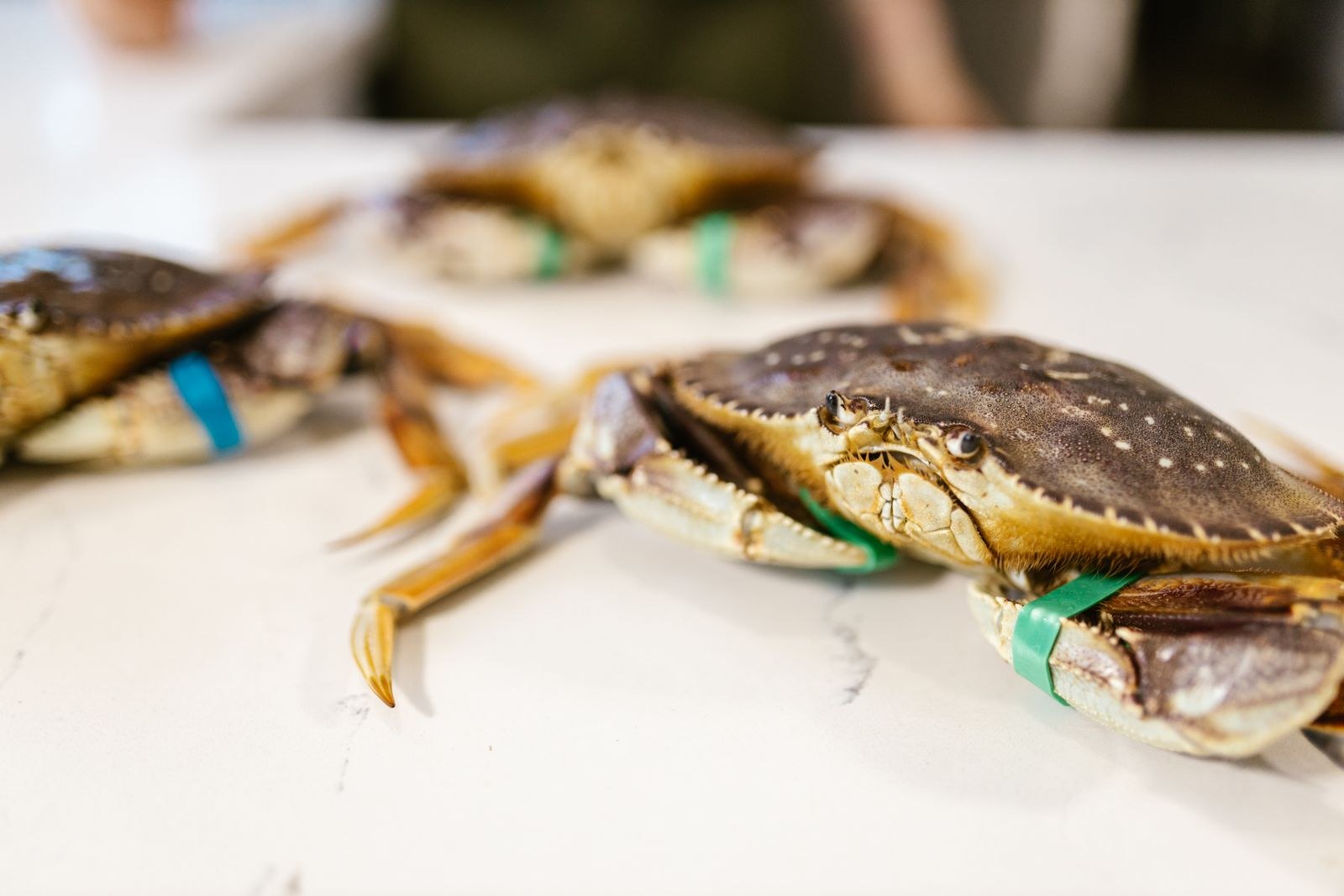
The naming is the local way of knowing the animal. A young female is 奄仔蟹 yǎnzǎi xiè, an immature female; a crab that has not yet filled out is 水蟹 shuǐxiè, a water crab; an adult male is 肉蟹 ròuxiè, the meat crab; a crab about to change its shell is 重壳蟹 chóngké xiè, the double-shell crab; an adult female is 膏蟹 gāoxiè, the roe crab; and a variant female whose roe and yellow fat spread through the whole body is 黄油蟹 huángyóuxiè, the butter crab, the ceiling of the market. The district and the provincial and city press all set the six out in the same order, and it is a useful thing for a visitor to hold on to, because the price of a Doumen crab is decided less by its size than by which of the six names it is wearing.
Why the double-shell crab belongs to Doumen is a question of the water in one town. Around 乾务镇 Qiánwù Zhèn Qianwu Town the mix of fresh and salt is said to drive the crab to shed its hard shell while keeping the soft one underneath, so that for a short window the new shell has set and the old one has not yet come away; the flesh is thick, the roe is yellow, and the soft shell can be chewed rather than cracked. The district’s own account puts the return at about one jin of double-shell crab for every hundred jin of mud crab, and that figure is a ratio and nothing more: no annual output of double-shell crab has ever been published, so it is not multiplied out into a production number here. The cooking is deliberately short. The crab is steamed whole after ginger is dropped into boiling water to cut the smell, or salt-baked, and the eating is a small piece of theatre, because the outer hard shell lifts away to reveal a red soft shell, and the soft shell breaks to show the golden roe packed beneath it. The district lists the double-shell crab among the four famous dishes of its intangible-heritage table.
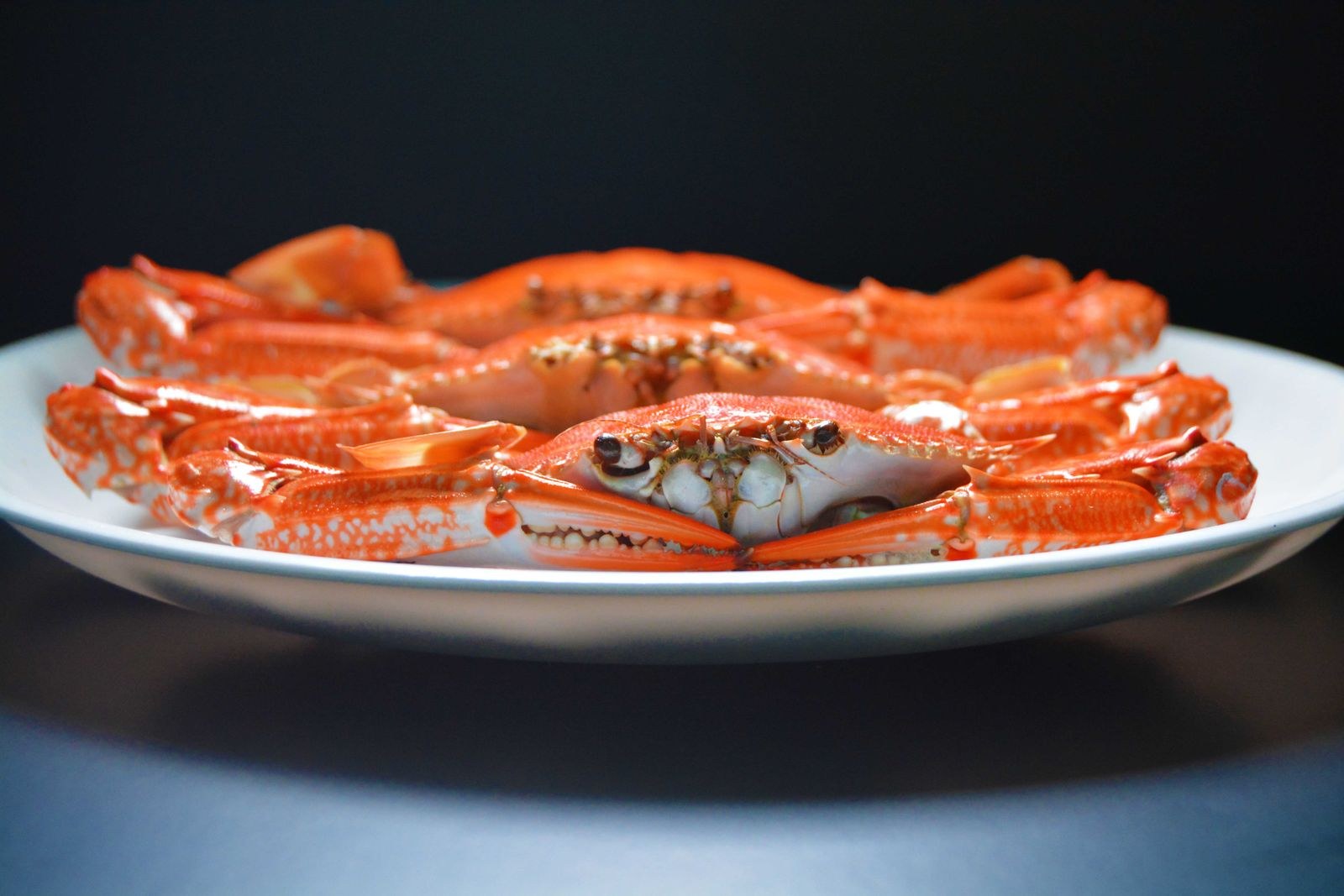
Season and village give the crab its shape. The Doumen season opens in July and runs to October, the eighth and ninth lunar months are reckoned the best of it, and the wider window is given as the third lunar month through the tenth, so it is a long season rather than a single month. In 大海环村 Dàhǎihuán Cūn Dahaihuan village in Qianwu, the crab ponds cover 1,300 mu, and the village reported more than 650,000 jin of crab and more than 60 million yuan of output in 2024; it was named a one-village-one-product specialist village in 2022 and is applying to register a trademark for its live crab. The prices belong to 2024 and to their markets, and are kept that way. In August 2024 the Baitengtou wholesale market quoted roe crab at about 150 yuan a jin, double-shell crab at about 180, the immature female at about 160 and the meat crab at about 120; in October 2024 a Zhuhai report found double-shell crab selling for more than 300 yuan a jin in Xiangzhou and for about 200 in Doumen. A different month and a different place are not one price, so neither is printed as today’s, and no current figure has an official source; any 2026-10 number should be read as a snapshot that moves.
The market is where the crab meets its newest customers. 白藤头水产批发市场 Báiténgtóu Shuǐchǎn Pīfā Shìchǎng, the Baitengtou aquatic wholesale market in Baiteng Subdistrict, is the largest in Zhuhai and the second largest in South China, and its annual turnover is given by the district as close to 5 billion yuan and by state media as more than 6 billion yuan, up 20 per cent on the year; the two accounts are set out here with their sources rather than merged. Since the Hong Kong vehicles northbound and Macao vehicles northbound arrangements began on 1 July 2023, the market has logged more than 150,000 vehicle entries and more than 400,000 visitors from Hong Kong, China and Macao, China over a year, and in the summer the retail section’s daily turnover rose by 30 to 40 per cent. A seafood consumption quarter of about 120,000 square metres in four phases is being built around the market, and its first phase, the Baiteng Fishing Fun Circle night market, opened as the city’s first seafood-themed night market. The difference from Taishan mud crab, written up elsewhere on this site, is the angle rather than the animal: Taishan’s page is about a brackish crab and its geographical indication, while Doumen’s is about the same animal’s life cycle, about the one stage counted at a jin in a hundred, and about a market whose licence plates changed in July 2023. The supports Zhuhai holds on the food map are the brackish estuarine fishery at the western mouth of the Pearl River, the two national geographical indications the city carries, Baijiao sea bass and the yellowfin seabream of Jinwan District, the deep-sea marine ranches of the Wanshan Archipelago, and the port-side eating life next to Macao, China; this page is the estuarine half of that.
Words and Names
The six names are 奄仔蟹 yǎnzǎi xiè the immature female, 水蟹 shuǐxiè the water crab, 肉蟹 ròuxiè the meat crab, 重壳蟹 chóngké xiè the double-shell crab, 膏蟹 gāoxiè the roe crab and 黄油蟹 huángyóuxiè the butter crab. 斗门区 Dòumén Qū is Doumen District and 乾务镇 Qiánwù Zhèn Qianwu Town, the crab’s home ground, with 白藤头水产批发市场 Báiténgtóu Shuǐchǎn Pīfā Shìchǎng the Baitengtou wholesale market where most of it is sold. Hong Kong, China and Macao, China are written that way throughout this column, and the visitors who come north through the ports are described as coming north, not as crossing a border. The site’s Taishan mud crab page and the Hainan pages in the same family keep their own waters; this page keeps the six names and the one in a hundred.
What the Locals Know
To eat the crab well, follow the names and the water. The season opens in July and runs through October, with the eighth and ninth lunar months the best, so the reliable window is the autumn; ask for the crab by the name you want, because a double-shell crab is not a big crab but a crab at a particular moment, and a stall that cannot tell you which of the six it is selling is not one to buy from. Steamed and salt-baked are the two treatments that matter, and both are short; anything heavier hides the roe. The soft shell of the double-shell crab really is eaten, and that is the point of the whole page.
A day that makes sense of the crab ends at the market. The crab ponds of 乾务镇 Qiánwù Zhèn Qianwu are working water and take no visitors, so the honest way to see the trade is to reach the wholesale market in the early morning, when the boxes come in and the crabs are tied, and to eat a double-shell crab at a table the same day, either steamed with ginger or salt-baked. What the record refuses is stated plainly: no per-name production figure for the district and no total farming area, since the only village figure is the 1,300 mu at Dahaihuan and the only rate is the one in a hundred; no current price, because the 2024 numbers are the newest with a source and the rest move on a 2026-10 snapshot; and no botanical or zoological name for the crab, because none was found in an official source.
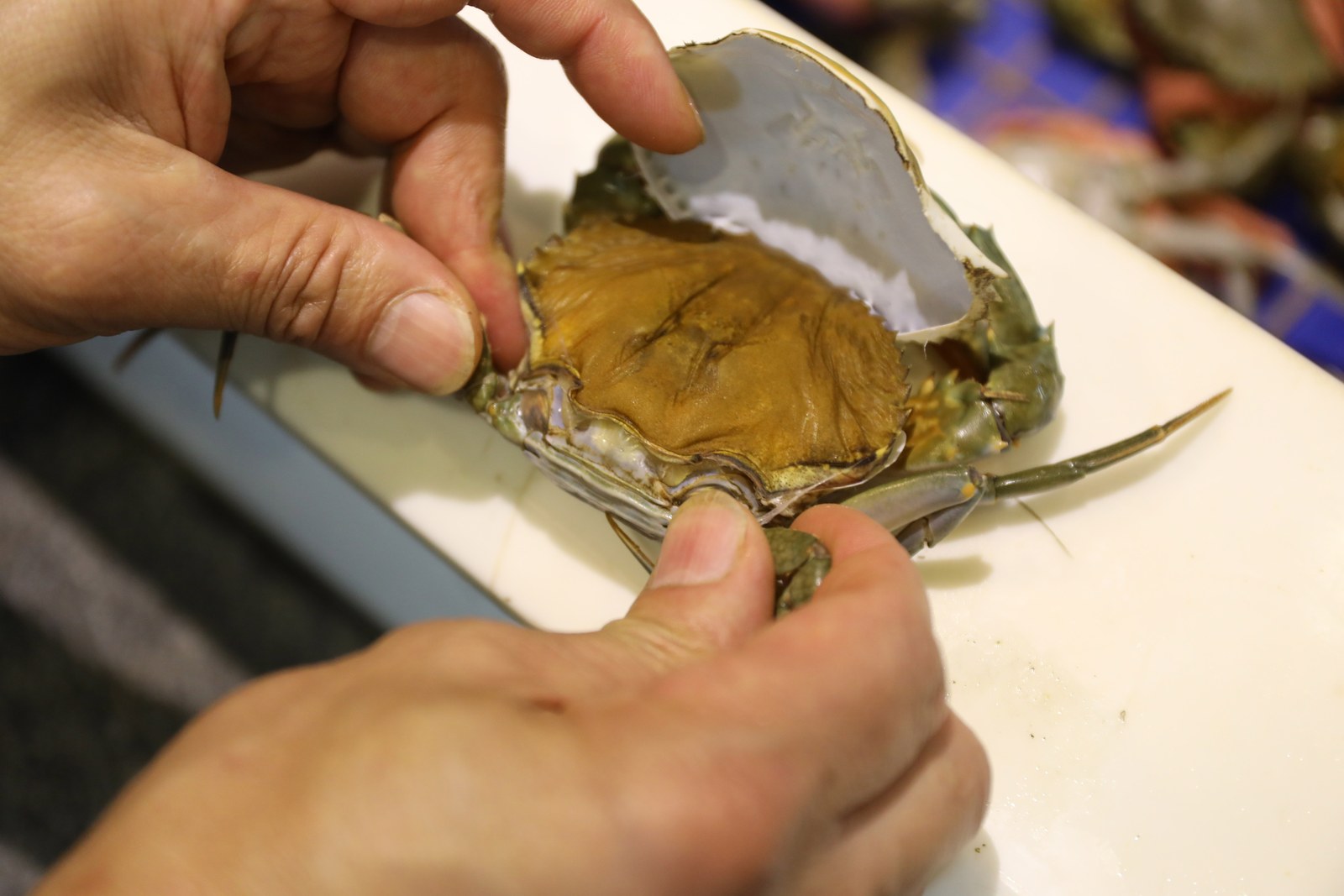
flowcloud would say that Doumen’s mud crab is one animal carrying six names across its life, from the immature female and the water crab to the meat crab, the double-shell crab, the roe crab and the butter crab, and that the rarest of the six, the double-shell crab caught between an old hard shell and a new soft one, is reckoned at about one jin in every hundred and sold through the Baitengtou wholesale market, where Hong Kong and Macao licence plates have come north since July 2023.
Where to find it: live and cooked 斗门青蟹 Dòumén qīngxiè at the 白藤头水产批发市场 Báiténgtóu Shuǐchǎn Pīfā Shìchǎng wholesale market in Baiteng Subdistrict and in the restaurants of 斗门区 Dòumén Qū Doumen District, 珠海市 Zhūhǎi Shì Zhuhai, Guangdong Province, with the ponds of 乾务镇 Qiánwù Zhèn Qianwu Town behind them; the season runs from July to October with the eighth and ninth lunar months the best, the double-shell crab is counted at about one jin in every hundred and no output for it is published, the newest sourced prices are the 2024 figures and everything else moves on a 2026-10 snapshot that fluctuates, and steamed and salt-baked are the two ways it is done.