
The sound is what you notice first, and then the fact that it does not stop. Bamboo in a breeze is not a rustle so much as a continuous dry murmur, thousands of leaves moving against each other at once, and in the 蔡伦竹海 Càilún Zhúhǎi, the Cailun Bamboo Sea, there is enough bamboo for the murmur to have a tide to it. A lodge inside the scenic area means you wake up in that, open a window onto a slope of green stems, and go to sleep still hearing it. There is no traffic noise to compare it to, because there is no traffic; the road up is one road, and after it the hills take over.
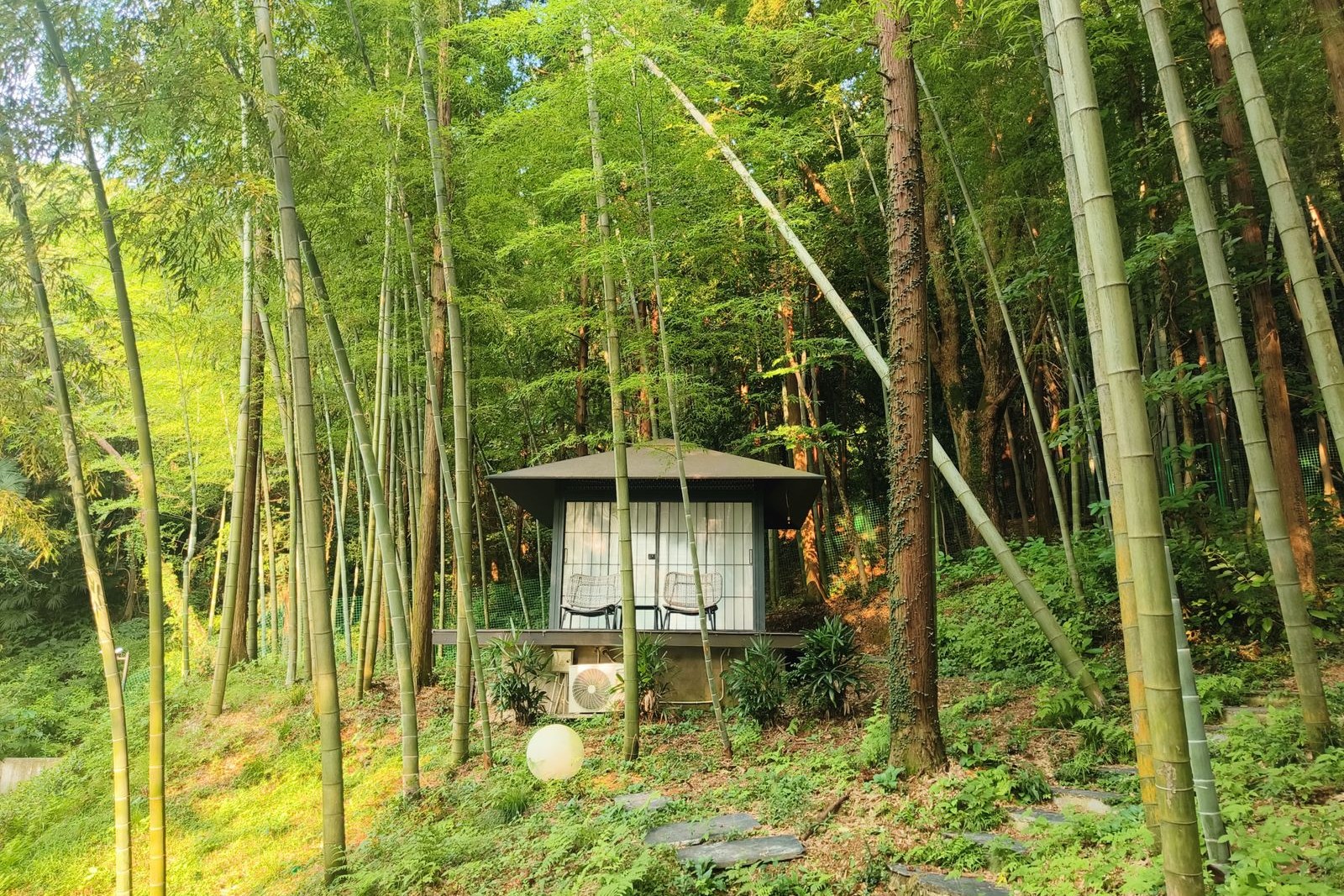
The bamboo sea covers some 16 万亩 mǔ, about 11,000 hectares, of continuous grove spread over more than two hundred hills in 黄市镇 Huángshì Zhèn and the neighbouring townships of 耒阳市 Lěiyáng Shì, and it is described — with reasonable justification — as the largest unbroken bamboo forest in the country. The whole area is about 100 square kilometres, of which the core is roughly 66. It is administered as a 4A scenic area and is being pushed towards 5A, which means the infrastructure is decent and the crowds, so far, are not. The 耒水 Lěi Shuǐ river runs along the edge of it, and the roads wind through the groves, past the old hamlets where families still make paper by hand the way 蔡伦 Cài Lún is said to have taught them in the year 105.
Practicalities
Price. Accommodation inside and just outside the bamboo sea is farmhouse-scale rather than hotel-scale. A double room in a 农家乐 nóngjiālè or a small lodge runs roughly ¥120 to ¥300, usually with meals available at ¥40 to ¥80 a head, and the few newer boutique-style properties at the top of the range ask ¥300 to ¥500 for considerably more comfort. Rates barely move with the season, because the season here is spring shoots and autumn colour rather than summer beach weather; the exception is the National Day week.
Address. Properties cluster along 蔡伦竹海大道 Càilún Zhúhǎi Dàdào and around 黄市镇 Huángshì Zhèn, between the entrance at 株山村 Zhūshān Cūn and the higher ground towards 大河滩 Dàhétān. When booking, ask how far the property is from the entrance gate rather than from the town, because the area is large and the internal roads are slow.
Rooms. Expect plain wooden or tiled rooms with a bed, a fan, a mosquito net in summer and hot water that is reliable but not instant. Air conditioning is common now, and genuinely wanted in July. The quality is honest rather than polished; the two things people complain about are damp in the wet months and insects, both of which are inherent to sleeping in a forest. Bring repellent, expect the odd gecko, and ask for a room on an upper floor if damp bothers you.
Getting there. The bamboo sea is about 38 kilometres from 耒阳市 Lěiyáng Shì centre and roughly 12 kilometres from the 公平 Gōngpíng exit of the 京港澳 Jīng-Gǎng-Ào expressway. 耒阳西站 Lěiyáng Xī Zhàn has high-speed services, and from there it is a taxi or a booked transfer of about an hour; buses run from 耒阳市 Lěiyáng to 黄市镇 Huángshì Zhèn but are infrequent. A car is close to essential — the sights inside the grove, the 观景楼 guānjǐnglóu viewing tower, 张良洞 Zhāngliáng Dòng and 大河滩 Dàhétān, are spread over many kilometres of hill road. If you bring one, note that private vehicles pay an entry fee of around ¥30.
flowcloud would say that the Cailun Bamboo Sea is one of the few places in this part of China where the attraction is genuinely the air, and that a night inside it rather than a day trip out of Leiyang is the difference between visiting a forest and staying in one.
Where to stay: inside the grove rather than in Leiyang town, on a slope with a view of the hills rather than of the car park, and at a property that cooks — the local bamboo shoots, smoked pork and river fish are the reason to eat in. Ask about the mosquito situation before booking, confirm whether the room has hot water at all hours, and check whether the road up is passable after heavy rain. Bring cash, because small farmhouses here are not always set up for cards.