
彩桥村 Cǎi qiáo cūn is a village on the 后水湾 Hòu shuǐ wān side of 新盈镇 Xīn yíng zhèn, the fishing township at the western end of 临高县 Lín gāo xiàn, and the first thing to settle about it is the administrative name, because a good deal of what circulates online gets it wrong. The 彩桥记忆红树林湿地旅游度假区 Cǎi qiáo jì yì hóng shù lín shī dì lǚ yóu dù jià qū, the Caiqiao Memory mangrove wetland resort, is in 新盈镇, on the stretch of the lagoon where 临高县 meets 儋州市 Dān zhōu shì; the villages on the Lingao side of that line are 彩桥村 and 和贵村 Hé guì cūn, and on the Danzhou side are 东场村 Dōng chǎng cūn and 泊潮村 Bó cháo cūn. It is not in 皇桐镇 Huáng tóng zhèn, which is an inland township in the same county whose landmark is the 古银 Gǔ yín waterfall, and a guest who books a room on the assumption that the mangroves are up there will spend the day driving in the wrong direction. The distances worth having are these: about 4.1 kilometres from 新盈港 Xīn yíng gǎng, about 2.2 kilometres from the 新盈红树观景台 Xīn yíng hóng shù guān jǐng tái, about 5.3 kilometres from the sand beach at 光村银滩 Guāng cūn yín tān over in 儋州, and about 28.7 kilometres from 临高南站 Lín gāo nán zhàn. The last of those is the one that decides how a visitor gets here. This is ground you drive to.
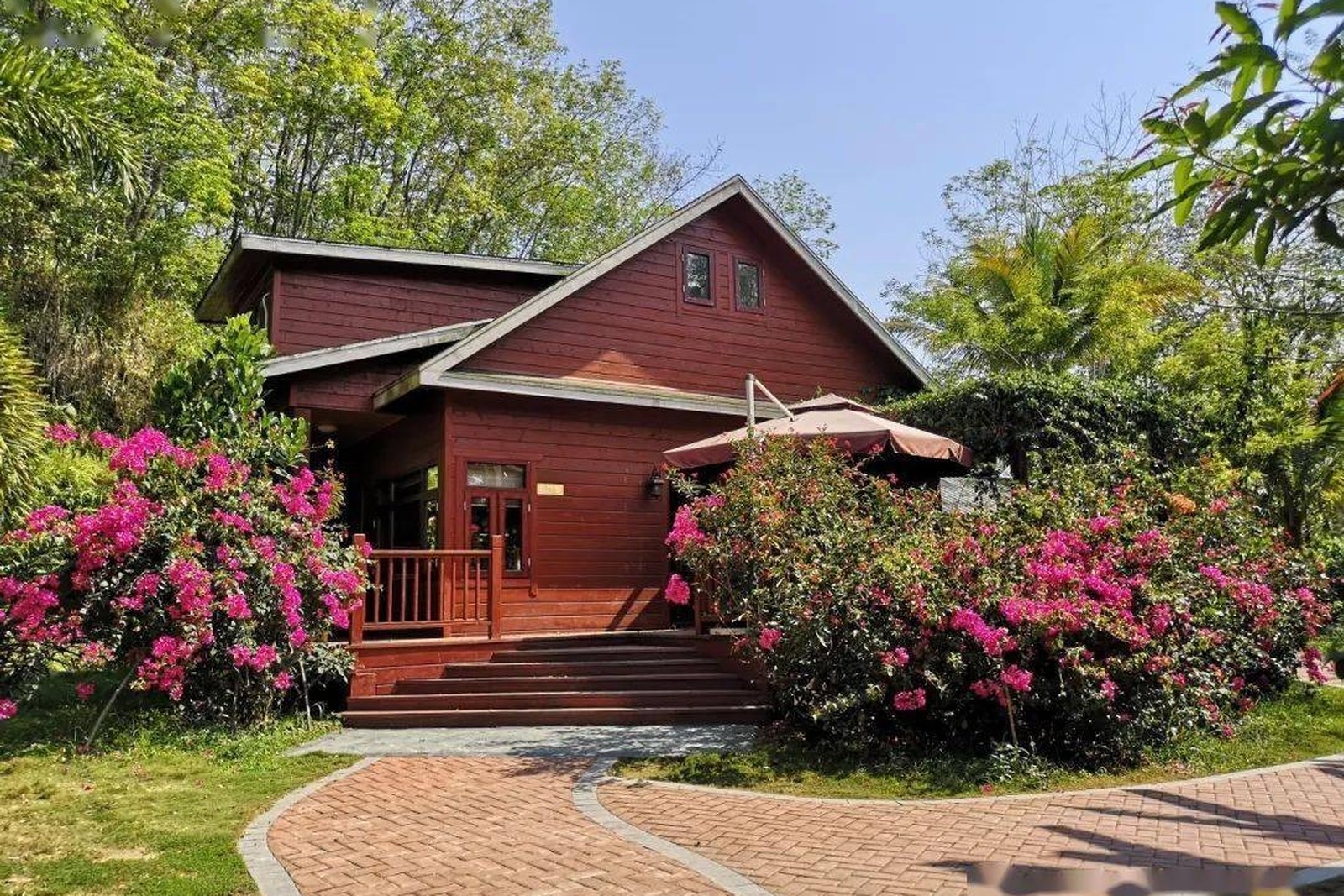
What the walkway crosses is the reason to come, and the numbers behind it need handling with care because three different protected areas overlap on this water and each has its own figure. The 临高新盈湿地县级自然保护区 Lín gāo Xīn yíng shī dì xiàn jí zì rán bǎo hù qū, the county-level wetland reserve, covers 3,437 hectares with a mangrove component of 126 hectares and a canopy closure above 0.8, and its flora is listed as thirteen families, sixteen genera and eighteen species of mangrove plants, split into eight true-mangrove and five semi-mangrove families. The 海南新盈红树林国家湿地公园 Hǎi nán Xīn yíng hóng shù lín guó jiā shī dì gōng yuán, the national wetland park, lies astride the 儋州 Dān zhōu boundary and covers 507.05 hectares, of which 197.76 hectares, about 39 per cent, is mangrove, with twelve families and eighteen species recorded and more than a hundred species of birds. The 彩桥红树林县级自然保护区 Cǎi qiáo hóng shù lín xiàn jí zì rán bǎo hù qū, the Caiqiao county-level reserve, covers 1,263.37 hectares in two patches and is the oldest of the three, established by the county government in 1986; older survey material for it lists nineteen families, twenty-two genera and twenty-seven species of mangrove plants, and the same source records frankly that the reserve has never had fixed boundaries, zoning, staff or a budget. A reader can hold all three by treating them as one landscape counted three ways: somewhere between 126 and 198 hectares of mangrove in the immediate area, and between eighteen and twenty-seven species depending on which boundary and which survey you use. The birds are less ambiguous and more spectacular. The area recorded more than a hundred species, the 后水湾 Hòu shuǐ wān is a wintering ground for dozens of migratory species, and in January 2003 specialists from the Chinese Academy of Forestry found the black-faced spoonbill, 黑脸琵鹭 hēi liǎn pí lù, in the 后水湾 area – a national second-class protected bird that is the emblem of this coast. The lagoon itself is about 156 square kilometres of sheltered water, and inside it sits 邻昌岛 Lín chāng dǎo, also called 邻昌礁: a reef platform of three or four square kilometres that is entirely covered at high tide and entirely exposed at low, with the mark called 将军水印 jiāng jūn shuǐ yìn on the rock. It is the clearest demonstration on this coast of what a two-and-a-half to three metre tidal range does to a shallow bay.
The resort built on the edge of all that is a small, deliberately old-fashioned thing, and it is worth being clear about what it is and is not. 彩桥记忆 Cǎi qiáo jì yì describes itself as a comprehensive holiday area built on the mangrove wetland and the local 哩哩美 lī lī měi song tradition, with a retro or nostalgic theme and a rural-ecological character, and its components are a memory-themed dining area, a fisherman-culture 土窑 tǔ yáo pit-cooking area, an old-salt coffee house, a lovers’ boardwalk, a boat pier, a birdwatching platform, a lighthouse-themed lookout and a vegetable-picking plot. It opens from 8:00 to 18:00, and there is also a self-drive camping ground on the site. What it is not is a hotel district. There is no large hotel inside the mangrove core, and the reviews that describe the place honestly say exactly that: guests comment on the trees and the air and on there being a scattering of farm restaurants, and one older review complains of driving thirty-seven kilometres to find a few farmhouses and no signage on a narrow road, which is a fair warning about the last mile. The other thing to see on this water is not on the resort’s land at all. Beside 和贵村 Hé guì cūn there is a small station called 鹭港小站 Lù gǎng xiǎo zhàn, also described as a birdwatching post, where people sit with tea and watch the mangroves, and a tall straight 防潮坝 fáng cháo bà, a tide defence dyke, drives through the mangrove and cuts the bay in two. On the eastern side of that dyke is open mangrove with the egrets on it; on the western side the tide comes up and almost drowns the trees, with the egrets still standing in the tops. One bank, two pictures, twice a day.
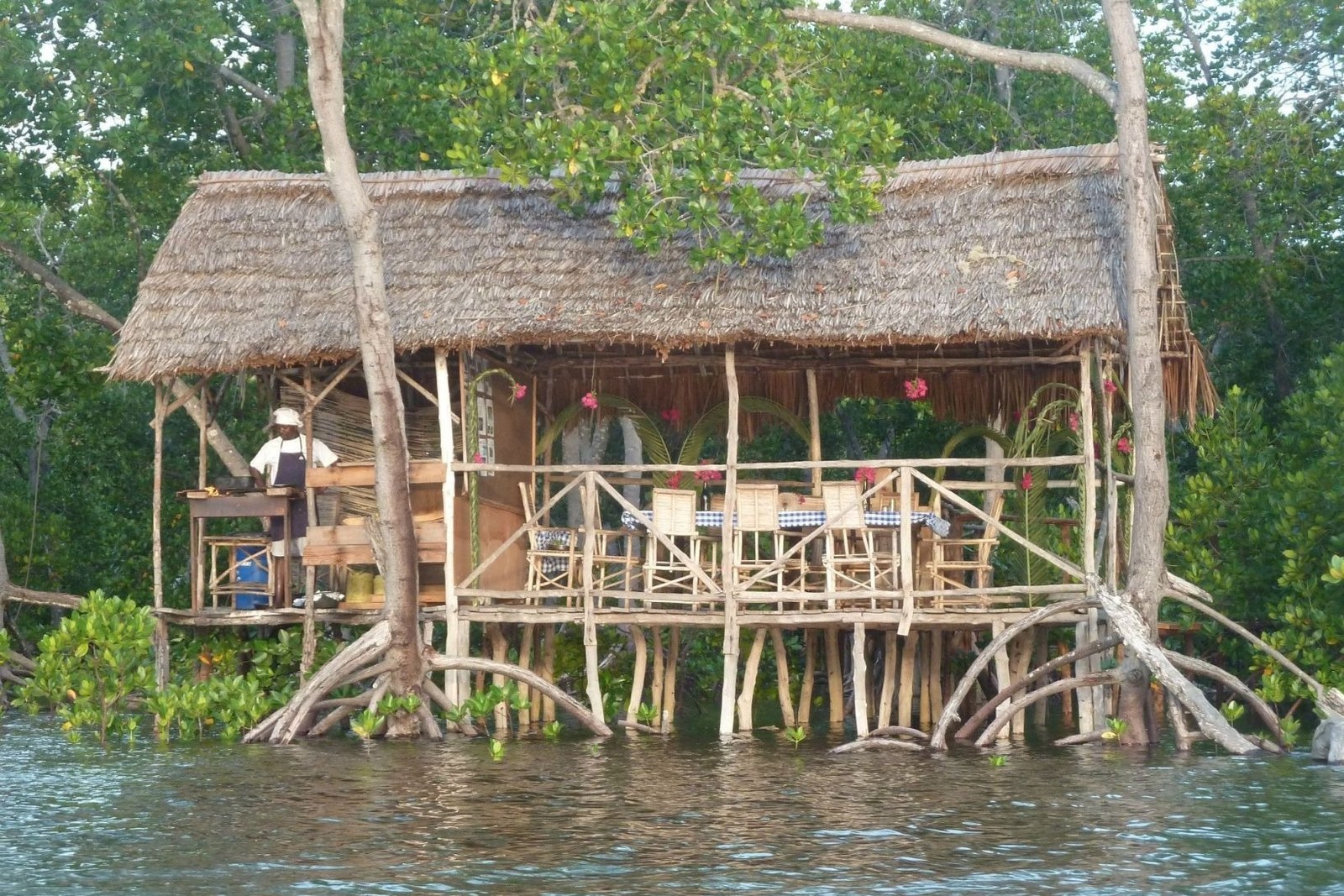
A bed here comes in two forms, and the difference between them is not price so much as what you are looking at. The first is 彩桥记忆民宿 Cǎi qiáo jì yì mín sù, the Caiqiao Memory guesthouse, which opened in 2024 with fourteen rooms a hundred metres or so from the old-salt coffee house and within about 250 metres of the mangrove reserve, close enough that the protected area is a walk rather than a drive; it has its own restaurant and coffee house, its rooms are described as thirty-square-metre doubles and twenty-to-thirty-square-metre twins with a river view, breakfast is included for two, and it scores about 9.3 out of 10 on a few dozen reviews. The second is 白鹭公馆 Bái lù gōng guǎn, Egret House, a comfort-grade property at 和贵村 Hé guì cūn on the 新盈镇 side, which sits about three kilometres from the reserve proper and sells itself on the birdwatching ground rather than on proximity, with a lift, a cafe, a games room, fishing, hiking and a garden. Between them they set the shape of the market: somewhere around 250 to 400 yuan a night, a handful of rooms in each, and no large hotel to compete with. The camping ground on the resort’s land is a third form and nothing in the material sets a price for it, so it is mentioned here as an option rather than quoted. Getting here is the part to plan rather than improvise. The 海南环岛旅游公路 Hǎi nán huán dǎo lǚ yóu gōng lù brings a driver along the coast past the mangrove and then off on its 新盈 Xīn yíng spur; the highway’s sightseeing coach on the 澄迈、临高火山渔港之旅 line stops at 新盈红树林(彩桥记忆)as well as at 临高角, which makes a car-free visit possible on that one service. Beyond it there is no published bus service or fare to 彩桥, and the honest advice is a car or a hired one. The seasons matter more here than on the coast. The area’s average temperature is about 23.5 degrees with roughly 1,750 millimetres of rain a year, the tide is a diurnal one with a mean range of two and a half to three metres, and the water is slightly alkaline with a visibility of half a metre to a metre, which is a polite way of saying it is a silty lagoon rather than a reef. Winter is the bird season, when the migrants are in and the spoonbills and egrets are the reason people come, and the summer is hot, wet and typhoon-prone. The 赶海 gǎn hǎi here is real and productive – the lagoon carries fish, prawns, crabs, sandworms, snails and oysters – but it is a tide-table activity, not a fixed daily one.
What the Rooms Are Like
A room beside this reserve is a farmhouse-standard room with a view, and the honest description is modest. The newer one is the better of the two documented examples: a thirty-square-metre room with a window onto the water channel, a bed with two pillows and a firm mattress, split air conditioning, a kettle, a television, a desk, a bathroom with a shower and running hot water from a boiler or a tank, and breakfast for two included, at a property with a restaurant and a coffee house on the ground floor. The other is a small comfort-grade block with a lift and a garden, closer to the villages than to the reserve. Neither is a resort, and neither pretends to be: there is no pool, no lobby bar and in the guesthouses no room service. What the money buys instead is the thing the coast cannot sell, which is that at six in the morning the trees outside are full of birds and there is nobody else on the walkway. Two practical notes. The first is damp. This is a lagoon in a wet part of the island, the ground is soft and the air is thick, and a ground-floor room in a brick building can smell of it after a wet spell; ask for an upper floor even in the cheap tier. The second is food. There is one restaurant inside the resort’s own compound and a few farm kitchens scattered along the lanes, and after eight in the evening a guest without a car is entirely dependent on whatever the host is willing to cook – which is usually something, and usually good, but needs asking about at check-in rather than at nine at night.
Practicalities
Price. A room near the 彩桥 mangrove runs about 250 to 400 yuan a night, which is the whole documented range in this small market: the 彩桥记忆民宿 from about 268 yuan including breakfast for two, and 白鹭公馆 in 和贵村 from about 250 to 298. There is no large hotel in the reserve area and no upper tier to compare against, so the choice is about which side of the water you want to sleep on rather than about grade. The self-drive camping ground is a third option for which no reliable price was found. Winter, from November to April, is both the bird season and the season the rooms fill; the wet months are cheaper. Treat every figure as a range and check the live rate.
Address. The lodges are in 新盈镇 Xīn yíng zhèn in 临高县 Lín gāo xiàn, at 彩桥村 Cǎi qiáo cūn and 和贵村 Hé guì cūn on the 后水湾 Hòu shuǐ wān side of the county where it meets 儋州市 Dān zhōu shì, on the 306 provincial road, about 4.1 kilometres from 新盈港 Xīn yíng gǎng and about 28.7 kilometres from 临高南站 Lín gāo nán zhàn, with the neighbouring villages of 东场村 Dōng chǎng cūn and 泊潮村 Bó cháo cūn across the water in 儋州.
Rooms. Ask for an upper floor, because this is lagoon ground and the damp lives low. Ask whether the window looks at the water channel, at the mangrove or at a courtyard wall, since that is the whole difference between two rooms at the same price here. Ask whether the property has a lift if you are carrying bags, since one of the two documented addresses does and a farmhouse will not. Ask what the kitchen will do for dinner, with what notice, and whether anything else is open within walking distance after eight. Ask about the 防潮坝 and the birdwatching spot by name, because a host who knows the tide will send you to the right side of the dyke at the right hour and a guest who guesses will get the flooded half. And ask whether the resort’s restaurant and coffee house are open on the day you arrive, since a small operation on a rural site keeps rural hours.
Getting there. The 海南环岛旅游公路 Hǎi nán huán dǎo lǚ yóu gōng lù runs along this coast and hands a driver onto its 新盈 Xīn yíng spur, which wraps around the mangrove towards 新盈港; the highway’s sightseeing coach on the 澄迈、临高火山渔港之旅 line calls at 新盈红树林 (彩桥记忆) and at 临高角解放公园 on the same loop out of 海口 Hǎi kǒu, which is the only documented car-free way in. 临高南站 Lín gāo nán zhàn on the 海南西环高铁 Hǎi nán xī huán gāo tiě is the rail arrival and is about 28.7 kilometres away, which means a taxi or a car for the last leg. No reliable source was found for a bus service or a fare to 彩桥村, so a car is the assumption to plan on, and the narrow lanes in the last kilometre are worth taking slowly.
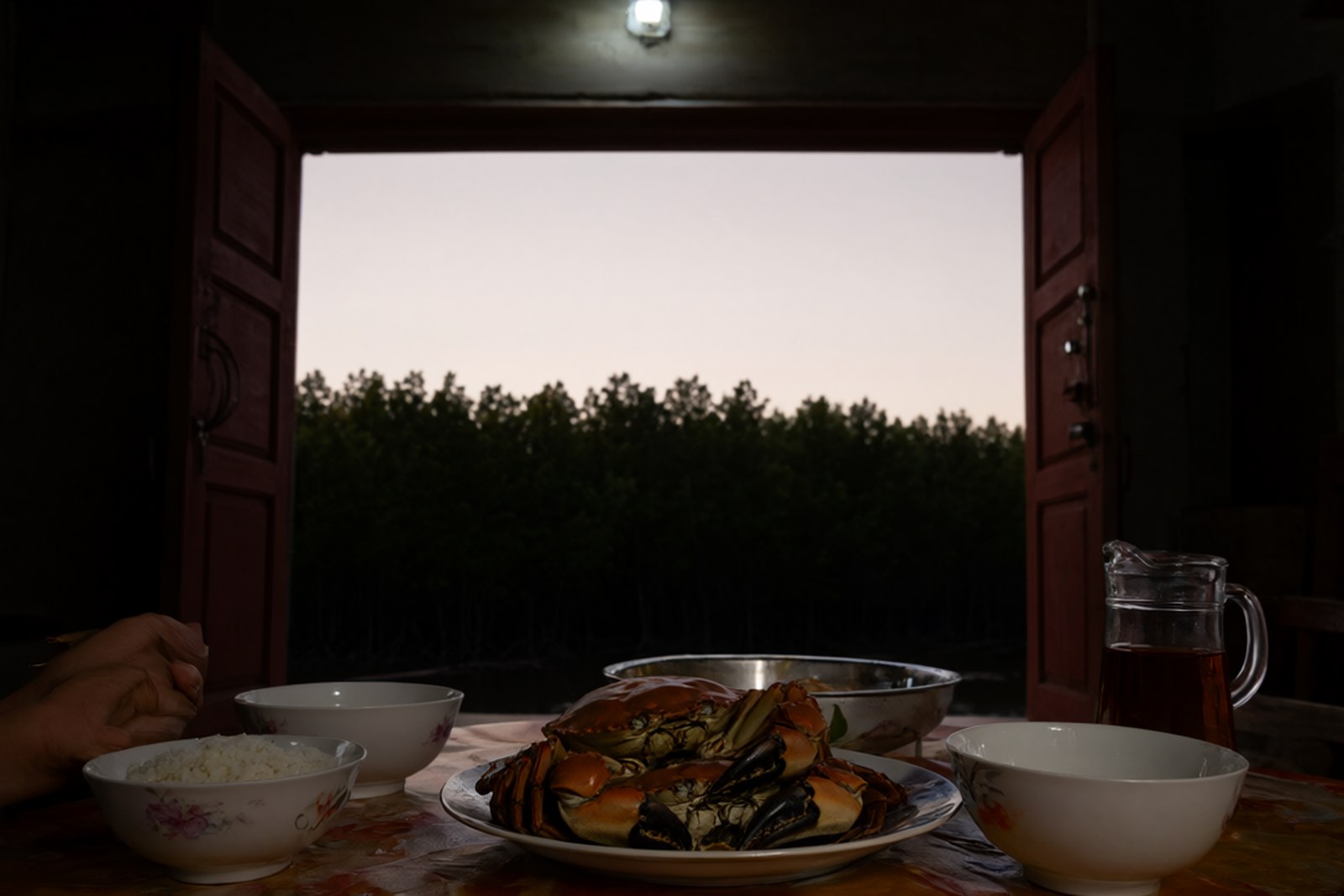
Where to stay: an upper room at one of the small lodges at 彩桥村 Cǎi qiáo cūn or 和贵村 Hé guì cūn in 新盈镇 Xīn yíng zhèn, within a short walk of the 后水湾 Hòu shuǐ wān mangroves and the 彩桥记忆 Cǎi qiáo jì yì resort, where the walkway, the birdwatching station and the tide dyke are all reached on foot. Take a room that looks at water, come in winter for the birds, arrive by car or by the highway coach rather than by bus, and cross the dyke at low tide and again at high to see what one bank does with two different seas.
flowcloud would say that a lagoon which drowned a village’s rice crop twice a year and then, in 2005, stood between 彩桥村 and a typhoon without losing a house or an animal, has already answered the question of what it is for – and that the only way to sleep beside a wall like that is to accept a farmhouse room, get up before the birds do, and let the tide set the day’s schedule.