
Guangzhou is the provincial capital of Guangdong in southern China, and its third city centre stands in 天河区 Tiānhé Qū, Tianhe District, where the new city axis runs down to the Pearl River: 珠江新城 Zhūjiāng Xīnchéng, Zhujiang New Town. The plan was drawn in 1993, the State Council approved the central business district in December 2005, and the 2010 Asian Games finished it; today, on the district government’s account, it is among the densest clusters of 300-metre buildings in the country. This piece is about sleeping inside that skyline: the hotels stacked through the top floors of the twin towers – written here only as the tower hotels – and the cheaper flats in their shadow along the axis and across the river.
The plan took twenty years to become a place. In 1993 the city ran an international design competition and adopted the American Thomas firm’s scheme for the first master plan – the platform accounts add a Manhattan-derived grid of more than 400 small blocks – and in 1997 the Asian financial crisis stalled the land sales. Plan reviews culminated in the 2003 version, which consolidated the blocks, raised the greenery and laid in a walking system and several metro lines. In December 2005 the State Council approved the central business district: the wider Tianhe CBD planned at 20 square kilometres, 12 already built and 8 reserved for the international finance city, while Zhujiang New Town proper is 6.44 square kilometres of planned land – two areas of two different things. In 2010, with the Asian Games, Huacheng Square, Haixinsha and the four major public buildings opened, and the Canton Tower – the subject of its own article on this site – lit up across the river. By 2021 the district reported the built 12 square kilometres producing 347.142 billion yuan of GDP, second among the country’s CBDs, in 124 office towers.
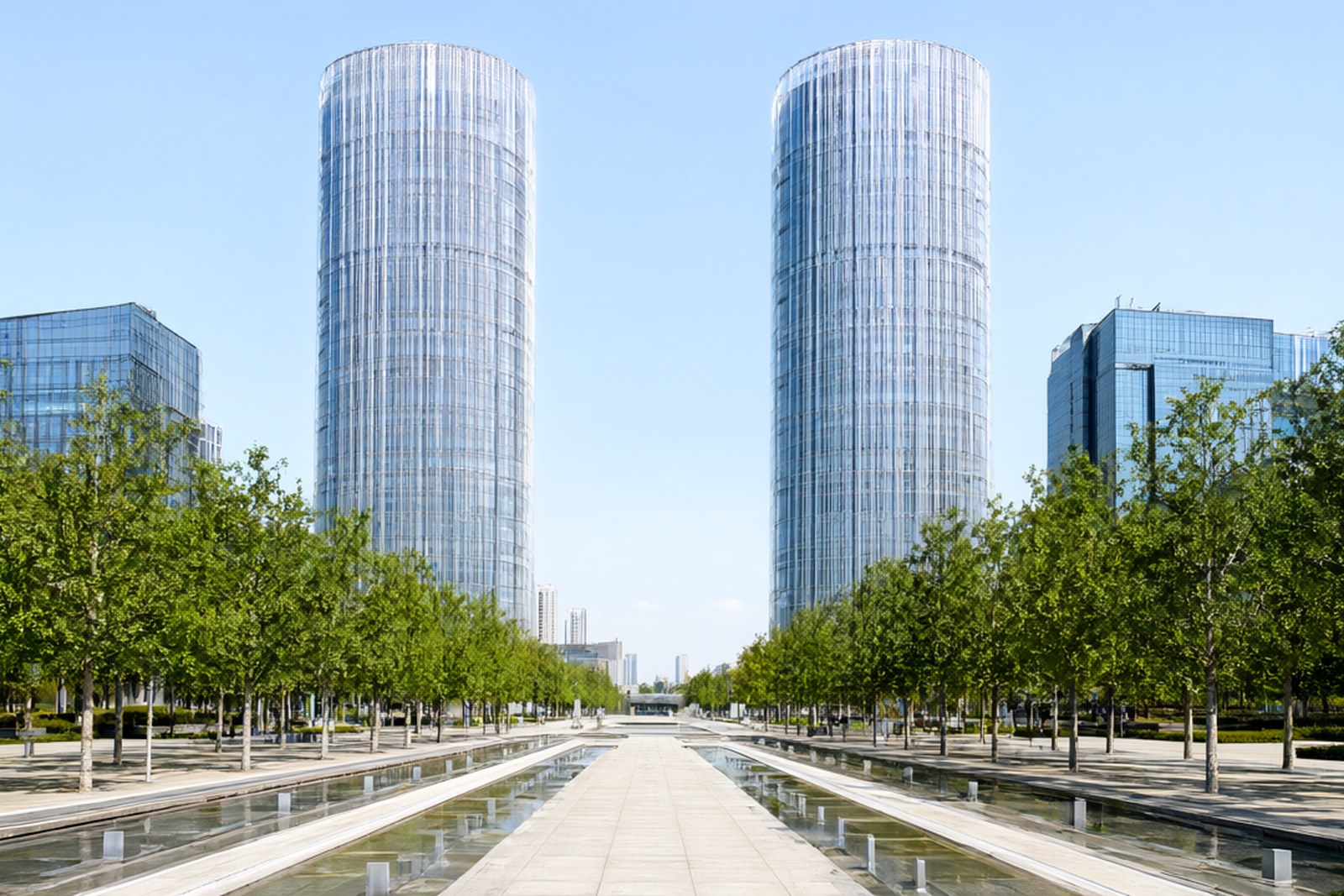
The twin towers flank the square. The West Tower, the 广州国际金融中心 Guangzhou International Finance Centre, stands about 440 metres on the district government’s figure – platform notes give 440.75 – topped out in 2009, with the hotel inside it opening in July 2012 by the platform accounts: a lobby on the seventieth floor, rooms running up towards the hundredth. The East Tower, the 周大福金融中心 Chow Tai Fook Finance Centre, is 530 metres in both the official and the platform counts and entered operation in 2019; its hotel opened that September, lobby on the ninety-fifth floor, rooms through the top ten-and-odd floors, lifts running about twenty metres a second. All of the hotel-floor detail is platform-sourced and is written as such. Travel writers like to call these among the tallest five-star hotels anywhere; the superlative is theirs, and the platforms’ star tags are not official ratings either. What the altitude does to the market is simple: check-in is the sightseeing, and the window is a private observatory you sleep in.
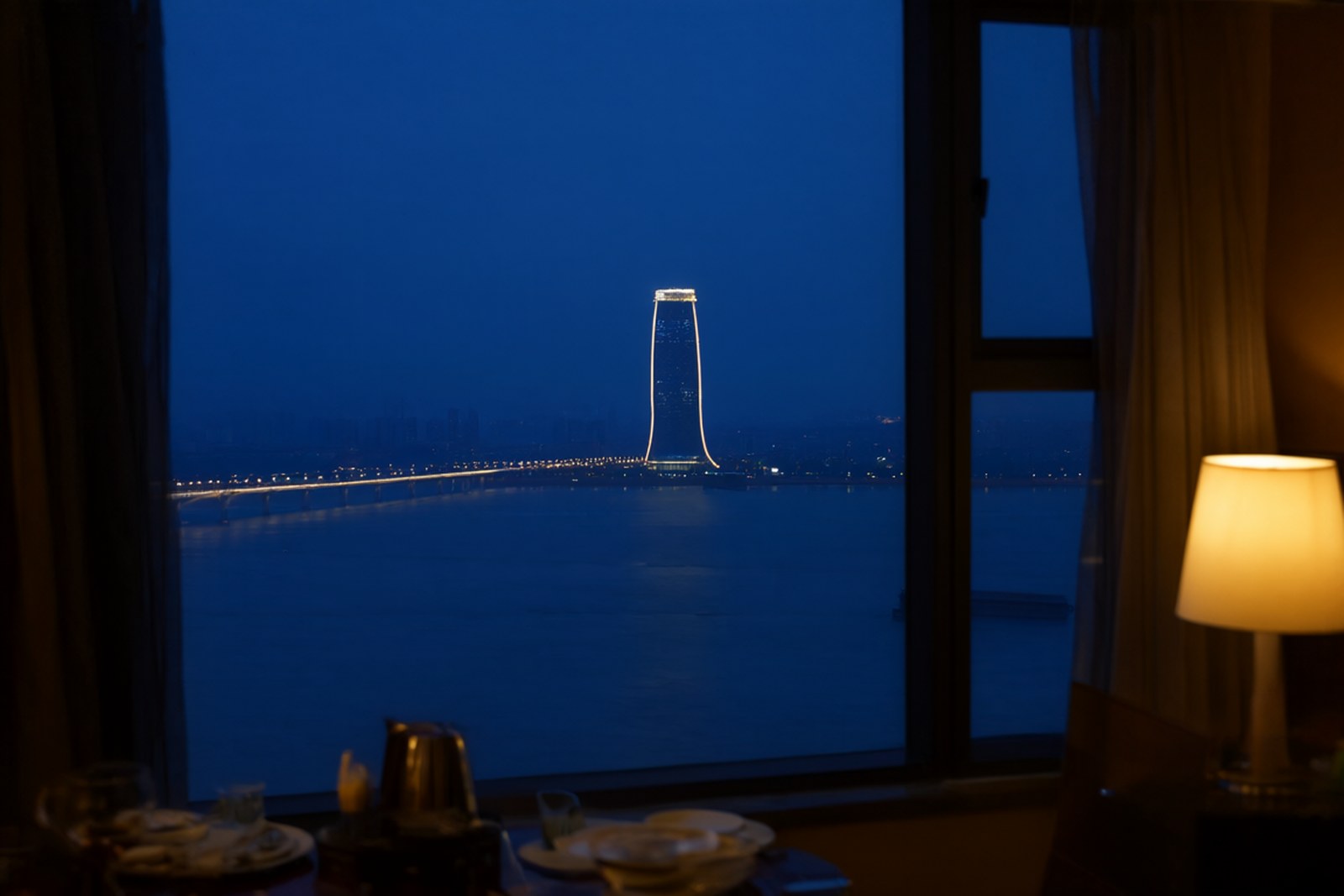
In an October 2026 platform snapshot the tower hotels’ main band ran from about 1,500 to more than 5,500 yuan a night, and the readings for the hotel inside the West Tower ran past five thousand yuan that month – but those readings fell inside Canton Fair weeks, which climb steeply over the quiet season, so they read as a ceiling, not a price. Lower down, apartment-style hotels and flats inside the New Town traded at about 500 to 1,700 yuan, and river-view flats at the tower’s foot on the Haizhu side started from about 538 yuan in the same snapshot. The booking logic is the window: river-view rooms frame the Pearl River, the tower’s light show and the bridge light bands; city-view rooms look back up the axis. Rain and mist discount both.
Four boundaries place the piece. That article on this site rides the lift to the observation deck and argues about which bridge frames the tower best; this one is about sleeping inside the skyline it looks back at – the hotels stacked through the top floors of the twin towers, and the cheaper beds in the tower’s shadow. The White Swan bought its river frontage in 1983, at ground level, with a three-storey waterfall; the tower hotels buy the same river with four hundred metres of altitude, and their lobby is the observation deck. The Garden Hotel anchors Huanshi East Road, the city’s first business district; the tower hotels anchor the third – Zhujiang New Town, drawn on paper in 1993 and finished in time for the 2010 Asian Games. Dongshankou’s guesthouses top out at three storeys of red brick; here the lifts alone pass thirty storeys before the lobby. Against this batch’s Xiguan piece: the arcade city sleeps at ground level, and this one sleeps in the air, where the amenity is the floor number.
What the Rooms Are Like
The rooms are tiered by the glass: river-view king and twin rooms that frame the Pearl River and the tower’s light, city-view rooms that look back up the axis, corner suites with glass on two sides, and top-floor suites whose selling point is the atrium below or the river bend at eye level. Exact room counts and investment figures for the tower hotels are not confirmed in government or operator sources, so any precise number is the platform’s own. Three checks earn their cost: the facing, stated in landmarks rather than trusting the words river view; the floor, in numbers; and whether the quoted rate is a fair-week rate.
Practicalities
Price. In an October 2026 platform snapshot the tower hotels ran from about 1,500 to more than 5,500 yuan a night, Canton Fair weeks above all of it; New Town flats about 500 to 1,700, tower-foot river-view flats on the Haizhu side from about 538. Every figure floats.
Address. 广州市天河区珠江新城 Guǎngzhōu Shì Tiānhé Qū Zhūjiāng Xīnchéng, Zhujiang New Town, Tianhe District, Guangzhou – the tower hotels stand on the two sides of Huacheng Square on the new city axis, the flats along the axis and, across the river, at the Canton Tower’s foot.
Rooms. River-view and city-view tiers stacked through the tower tops, corner suites with glass on two sides, and apartment-style flats behind – the brands are not named here because the window, not the name, sets the price, and no official room count is confirmed.
Getting there. Metro 珠江新城 Zhūjiāng Xīnchéng, Zhujiang New Town, on Lines 3 and 5, is the axis station; the APM line’s 大剧院 Dàjùyuàn, Grand Theatre, station stands some two hundred metres from the West Tower’s hotel lobby by the platform’s measure – navigate on the day – and the APM line runs on under Huacheng Square to the Canton Tower station across the river. Baiyun airport is about 45 minutes away by car by the guides’ account.
Where to stay: a tower-hotel river-view room from about 1,500 yuan in the quiet season if the altitude is the point, a New Town flat from about 500 to 1,700 if the skyline without the tower-hotel price is the point, and a tower-foot flat from about 538 if the light show is the point and the bed is not – because the window is the product and the floor is the price.
flowcloud would say that the city’s hotel history is a lift ride – a garden at street level in 1985, a lobby on the seventieth floor in 2012 – and that the correct way to sleep here is to pay for the floor and treat everything below it as the observation deck’s free annex.