
The house has no ground floor. You climb a set of timber steps to a veranda that runs the length of the building, take your shoes off at the top, and step onto a floor of split bamboo that gives slightly under your weight. Underneath, through gaps in the boards, you can see the piles the house stands on and, further down, the family’s chickens working through the dirt. The walls are bamboo and timber, the roof is thick with palm thatch, and there is no glass in the window opening, only a wooden shutter propped open with a stick. Somewhere below, water is running. Above, and behind, and on both sides, is 五指山 Wǔzhǐshān — the mountain itself, on whose western slope this village sits — and there is nothing between you and it. This is 初保村 Chūbǎo Cūn, in 毛阳镇 Máoyáng Zhèn, and it is the last place on Hainan where you can sleep in a Li village that was not built for you.
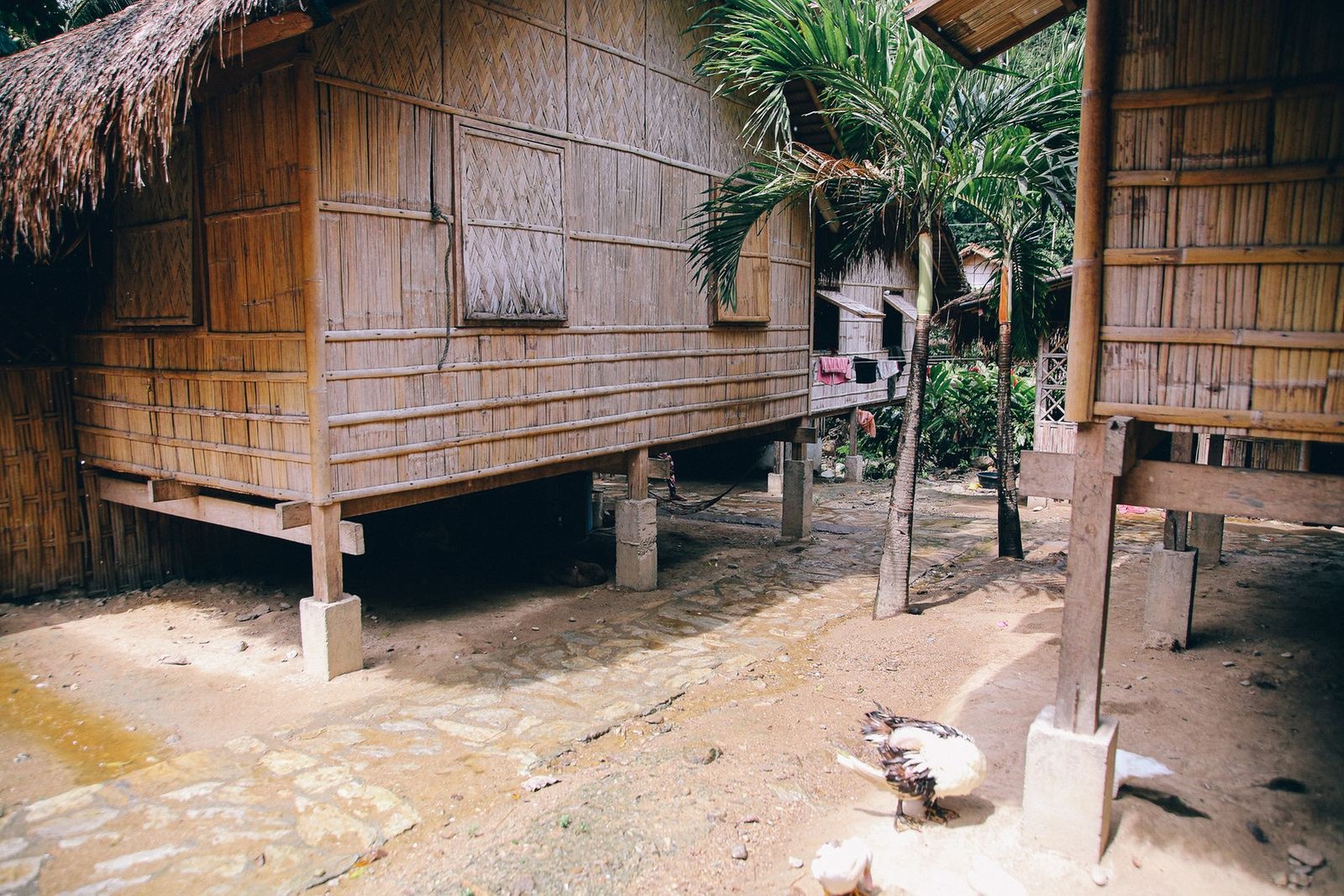
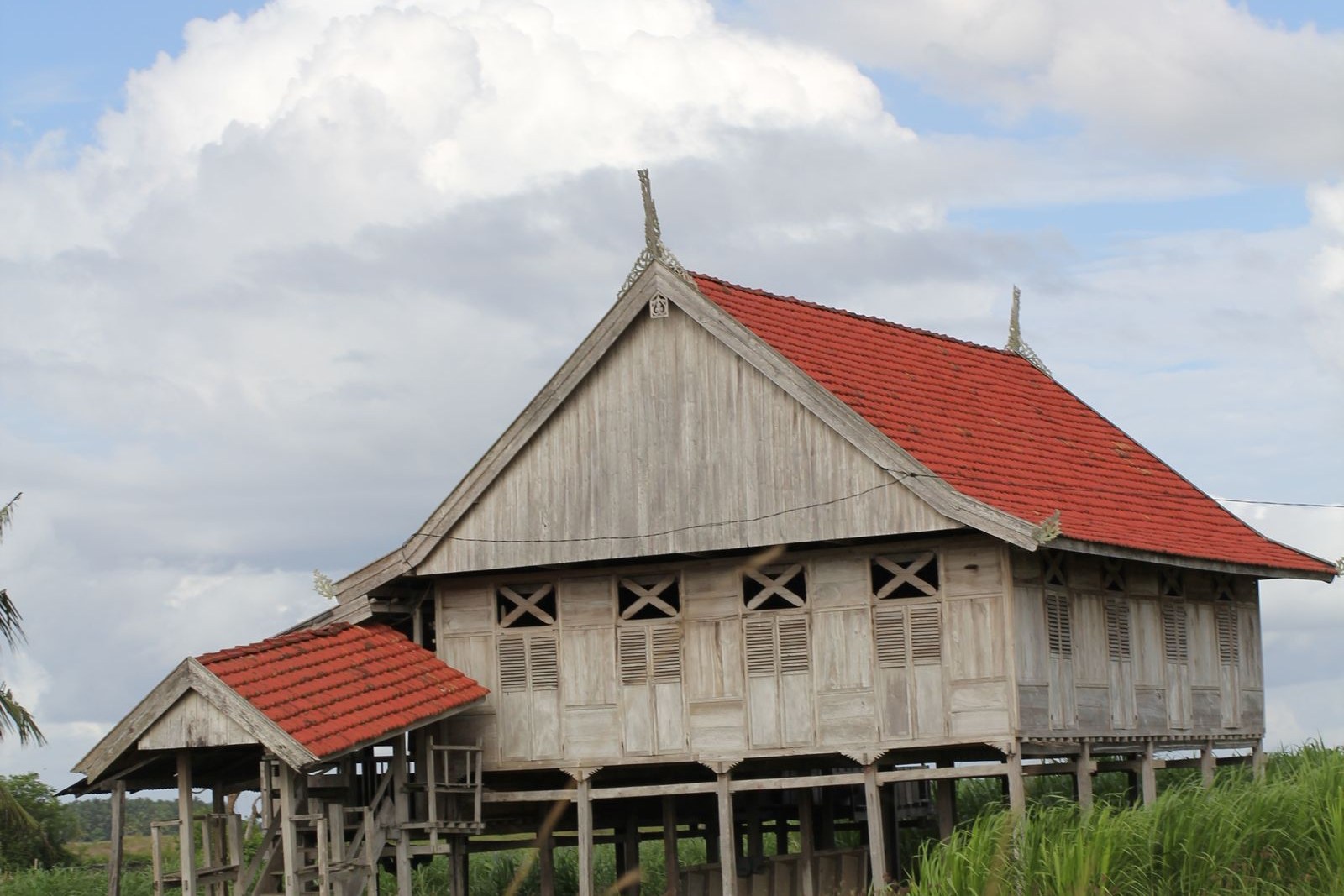
The village is small. Some fifty-odd households, a few hundred people, the houses set along the slope in three loose rows, each one raised on piles with the ground beneath used for storage, animals or a patch of vegetables. What makes 初保 unusual among Li settlements is exactly this construction: most traditional 黎族 Lízú houses on Hainan are 船形屋 chuánxíng wū, boat-shaped houses, their roofs curved like an upturned hull and their eaves sweeping almost to the ground. 初保 built 干栏 gānlán instead — 吊脚楼 diàojiǎolóu, the stilted houses of the mainland south-west, lifted clear of the ground on timber piles with a proper veranda. Nobody has a definitive answer for why, only a set of theories about damp, termites, storage and status, and the village has been called the best-preserved settlement of its kind on the island for long enough that it is now studied as much as visited. The older women still weave 黎锦 Lí jǐn, the Li brocade, on tension looms in the shade under the houses, and some of them will show you how the thread is dyed.
Practicalities
Price. Guest rooms in the village are simple and priced accordingly, roughly ¥80 to ¥150 for a bed, and some households will include dinner and breakfast for a little more. There is no hotel here, no lobby and nobody at a desk; you are a guest in a working village, and payment is often by phone transfer to the family.
Address. 初保村 Chūbǎo Cūn is in 牙合村委会 Yáhé Cūnrán, 毛阳镇 Máoyáng Zhèn, on the western side of 五指山市 Wǔzhǐshān Shì, on the slopes facing 鹦哥岭 Yīnggēlǐng. It is about forty kilometres by road from the city centre, which is an hour of mountain driving.
Rooms. This is not a hotel standard and does not pretend to be. Expect a raised wooden floor, a mat and a thick quilt, a mosquito net, a fan, an extension lead, and a shared washroom outside that is basic and clean. Wifi is unreliable to nonexistent. There are hot-water flasks in the main house and the family will top yours up. Bring a torch, a towel and long sleeves; nights at this altitude are cooler than the coast and mosquitoes are a real feature of the place after rain.
Getting there. Either drive, which takes about an hour from 五指山市 Wǔzhǐshān Shì on the road towards 毛阳 Máoyáng, or take a bus from the city to 毛阳镇 Máoyáng Zhèn and arrange a lift up to the village, since the last stretch is not on a bus route. The 五指山革命根据地纪念园 Wǔzhǐshān gémìng gēnjùdì jìniànyuán, the memorial park to the 23-year guerrilla campaign that held these mountains, is on the same side of the city, so the drive can be broken with a stop.
flowcloud would say that a village like Chubao survives because it sits far enough off the road to be inconvenient, and that the price of sleeping in one of its houses is not money but the willingness to be a guest rather than a customer.
Where to stay: stay in the village if you want to understand how these houses work — how cool the floor stays in June, how the smoke from the kitchen moves under the roof, how loud rain is on thatch. Take a guesthouse in 水满乡 Shuǐmǎn Xiāng instead if you need a private bathroom and a firm plan for breakfast, and visit Chubao as a day trip. If you do stay, ask first, pay fairly, and do not photograph people’s homes without asking; this is a village with a working life, not an open-air museum.