
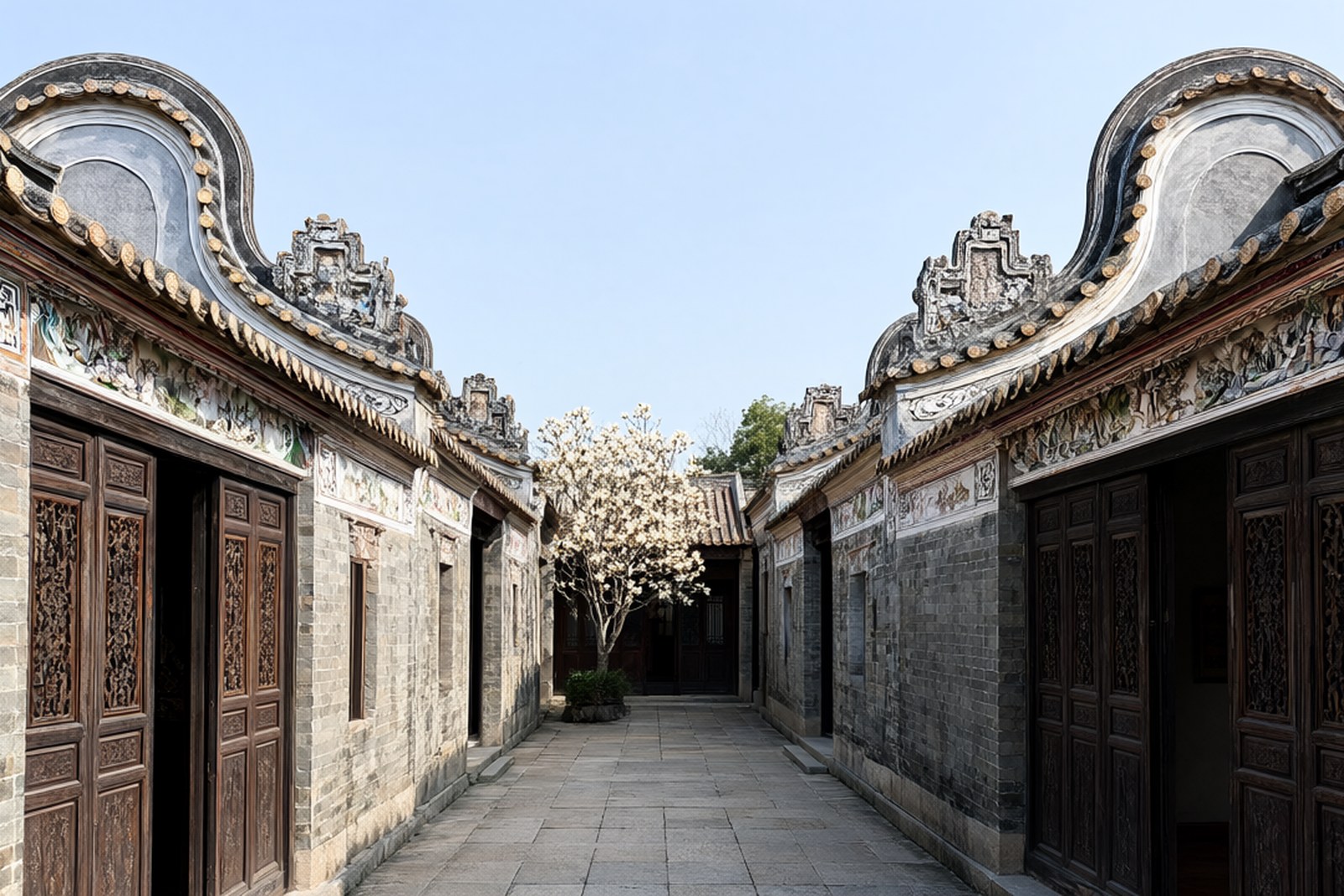
大湾镇 Dà wān zhèn is a town in the south-east of 郁南县 Yù nán xiàn in 云浮市 Yún fú shì, and the reason to take a room in it rather than in the county town or in 连滩 is that the town itself is the sight. 大湾古建筑群 Dà wān gǔ jiàn zhù qún, the old house group, is a national protected site: forty-seven surviving buildings from the Ming and Qing, a stretch of merchant and clan architecture along the 南江 Nán jiāng that the trade literature calls the most complete expression of Ming-Qing domestic and ancestral building in the area, and which the local description sums up as a museum of 岭南 Lǐng nán folk art. A guest who sleeps here is a lane away from it rather than an hour’s drive, and the hour is the whole argument, because these lanes are only themselves before the day visitors arrive and after they leave.
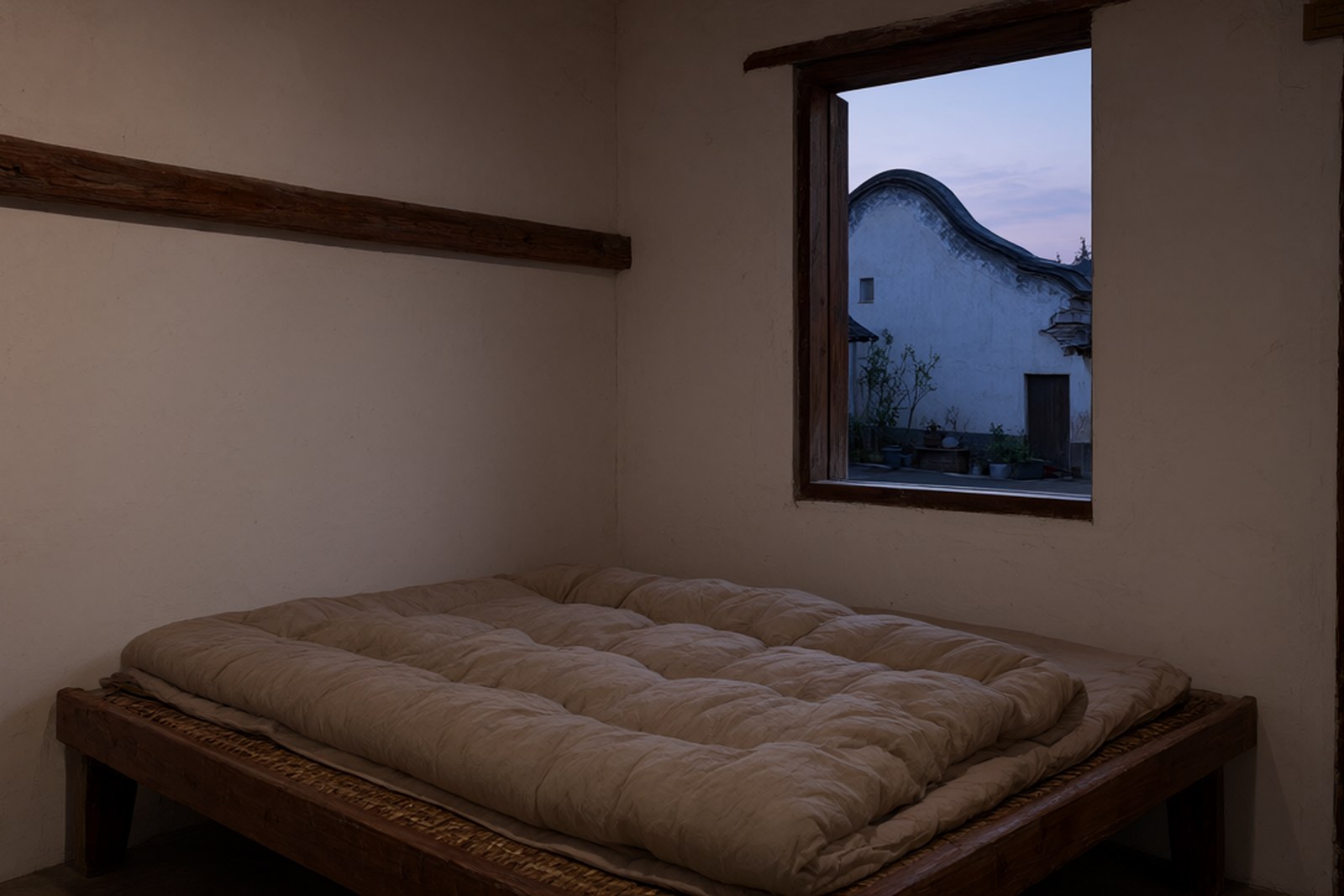
The county that holds the village is the same one the 南江 runs through, and it is worth being clear about the geography because three separate places in this batch sit inside it. 郁南县 Yù nán xiàn is described in the county’s own materials as the heartland of 南江文化 Nán jiāng wén huà; 大湾 is in its south-east, 连滩 is the market town twenty minutes away, and the county town of 都城 Dū chéng is on the 西江 Xī jiāng in the north. The official deep-tour line runs the whole western side of the prefecture in one sequence, and 大湾 is the second stop on it, which means a guest who sleeps here is one short drive from the third and one long one from the first. That is the practical shape of the argument for this village: not that it is the best thing on the route, but that it is the most convenient place on it to spend a night. What a visitor can actually see from the window is a specific set of building, and it is worth describing the vocabulary because it is what makes this village different from the other old villages in the prefecture. The 镬耳山墙 huò ěr shān qiáng – the wok-ear gable wall, a curve of brick that rises above the roof ridge and steps down in an ear shape – is the silhouette the whole group is known for, and it is the same profile a visitor sees over the rooftops of 广东’s ancestral halls and merchant houses generally, but here it comes in rows. The 灰塑彩绘 huī sù cǎi huì, plaster relief and painted decoration, is the second signature: moulded and painted panels on gables, lintels and interior partitions, which is a technique that survives better on the coast and in the delta than it does inland, and which was evidently worth paying for in a river town on the 南江. Inside, the carved timber runs to 福禄寿 fú lù shòu – fortune, prosperity and longevity – in dense panels, and the named house in the sources is 李耀汉大屋 Lǐ Yào hàn dà wū, a compound that mixes 广府 Guǎng fǔ and 客家 Kè jiā building practice. The report is explicit that no authoritative list exists for the other forty-six buildings, so this article names the one and describes the rest as a group rather than inventing names for them. The site is open in the daytime, 8:00 to 18:00.
The reason the group survived is worth a sentence, because it is the same reason the villages of this county look the way they do. 郁南 was 西宁县 Xī níng xiàn for most of its history and shared the 罗定直隶州 with today’s 云浮 and 罗定 under the collective name 三罗 Sān luó, and the 南江 was the trade road that connected all three to the 西江 and thence to 广州 Guǎng zhōu. A river town whose merchants could afford plaster relief and carved panels built them, and a river town that kept its money in trade rather than in rebuilding kept them standing; the twentieth century passed over this bend of the 南江 more lightly than it did over the delta, which is why forty-seven buildings are still there to be counted rather than three. The county’s own list puts 大湾, 连滩’s arcades, 光二大屋 and 兰寨 together as one heritage landscape, and the 磨刀山 site eight kilometres from 连滩 as its prehistoric bookend. The county the town sits in is what turns a single village into a stay of several days, and it is the 南江 culture belt rather than a single site. The official deep-tour line runs 磨刀山遗址 Mó dāo shān yí zhǐ, then the 大湾古建筑群, then 连滩古镇 Lián tān gǔ zhèn with 光二大屋 Guāng èr dà wū and 兰寨古建筑群 Lán zhài gǔ jiàn zhù qún, then 长岗坡渡槽 Cháng gāng pō dù cáo and the 罗定 town sights. A guest staying at 大湾 is on the second stop of that line with the third twenty minutes away, which is the practical form of the argument for sleeping here. The county’s other ground is further out and worth knowing about: 大王山国家森林公园 Dà wáng shān guó jiā sēn lín gōng yuán and 大河国家湿地公园 Dà hé guó jiā shī dì gōng yuán near the county town of 都城 Dū chéng, and the 无核黄皮 wú hé huáng pí orchards whose two mother trees were planted in 1934, which the food column handles. Then there is the part of the stay that is genuinely practical, because a national protected village in a county like this is not a hotel district and a guest has to plan for it. The sourced stock in the county is economy-grade and the honest position is that mid-to-high-end accommodation is essentially absent outside the prefecture city, the springs at 新兴 and the town at 罗定; the report also records that no reliable international-brand list exists for the county town at all. In and around the 大湾 and 连滩 area the names the sources carry are small: 郁南连滩宾馆 at 连滩镇连滩大道 67 号, a 2020 building with seventy-two rooms from about ¥101 to ¥109; 怡家便捷公寓 on 河堤四路 from about ¥105 to ¥108; 印象汇酒店 near 兰寨 from about ¥168; and 郁南福盈门 from about ¥100. Around the old house group itself the beds are farmhouse rooms and small minsu rather than hotels, the kind of address that appears on a platform one season and is gone the next, and the sources give no names that can be repeated here with confidence. So the instruction is the one this site gives everywhere and which matters most in a place like this: book by the position rather than by the brand, ask for the photographs of the actual room, and confirm on the phone that the room you have seen is the room you are getting.
A guest who wants a lift and a lobby should book at 连滩 or in 罗定 and drive over; a guest who wants the lanes at six in the morning should accept a farmhouse and be specific with the host about what they are getting. Treat every figure as a band and check the live rate. The calendar and the movement are the last two things that decide how good the stay is. On the calendar, the county’s own year runs through the 无核黄皮 harvest in summer, the 禾楼舞 hé lóu wǔ and the 飘色 piāo sè processions and the drum-and-dragon customs of the villages, and the October rice harvest that turns the terraces behind 兰寨 gold; the lanes of 大湾 are at their best in the dry winter months when the grey brick is not running with water. On movement, the town is on 508 乡道 508 xiāng dào and the 广昆 Guǎng kūn expressway’s 连滩/东坝 interchange is the nearest fast road, about twenty minutes away by car; the county town of 都城 is a drive north, 连滩 is about twenty minutes, and 磨刀山遗址 near 河口镇 is further west again. Nothing here is walkable except the village itself, which is the point, and a guest with a car can put the old houses, the arcades at 连滩, the compound at 光二 and the terraces at 兰寨 into one unhurried day. A guest without one should be prepared to hire a driver for that day, because the county buses run between towns and not to sights. One more piece of timing is worth knowing: the old houses are lived in, which means a visitor who arrives during a family’s own festival or a funeral will find lanes closed and courtyards busy, and a visitor who asks a household before photographing inside a door will find the whole day goes better. That is not a rule the site can enforce and it is the one thing about this village that a booking cannot arrange. The practical version of it is to walk the lanes early, keep the camera in the bag until you are invited, and treat the two hours around noon as the time to be somewhere else – which is exactly when the day visitors arrive and the light in the narrow streets goes flat anyway.
What the Rooms Are Like
A minsu beside a village like this is a farmhouse with rooms in it, and it is worth being plain about what that means because the price is low and the expectations should be set to match. The common pattern is a family building of two or three storeys behind a courtyard, with a tiled floor, white or bare-brick walls, a bed with a firm mattress and a quilt rather than a duvet, split air conditioning that in winter is the heater and in summer is the only thing between you and the mosquitoes, an electric kettle, a wall-mounted television, a shower with a boiler on the wall or a roof tank, and a window that either looks into the old lanes or onto a courtyard where the family keeps things. The better conversions add a proper panel shower, a timber floor, a window onto the tiled roofs of the old houses and a tea table by it, and they charge maybe half again as much for it. Two local notes are worth taking seriously. Damp is the county’s real weather and the older buildings carry it – a ground-floor room in a solid masonry house can be cold and slightly wet in a way an upper room is not – so ask for an upper floor even in the cheap tier. And ask what the household does about food, because several of these places will cook dinner for guests with a day’s notice and will not do it without one, and the alternative in a town this size after eight in the evening is nothing at all.
Practicalities
Price. A room in a farmhouse stay around 大湾镇 Dà wān zhèn runs about ¥100 to ¥200 a night, with the small inns at 连滩 in the same band – 郁南连滩宾馆 from about ¥101 to ¥109, 怡家便捷公寓 from about ¥105 to ¥108, 郁南福盈门 from about ¥100 and 印象汇酒店 near 兰寨 from about ¥168 – and the converted rooms with a view of the old lanes at the top of it. Mid-to-high-end stock is effectively absent from the county, so the choice is between a good cheap room and a plainer one rather than between grades. The 春节 Chūn jié week, the village festival days and the summer fruit season are the times it fills. Treat every figure as a range and check the live rate.
Address. The stays are in and beside 大湾镇 Dà wān zhèn in 郁南县 Yù nán xiàn, on and around 508 乡道 508 xiāng dào, with the 大湾古建筑群 Dà wān gǔ jiàn zhù qún and its 镬耳山墙 lanes immediately adjoining; the small inns of 连滩镇 Lián tān zhèn are about twenty minutes away, the county town of 都城 Dū chéng is a drive north on the 西江 Xī jiāng, and the 广昆 Guǎng kūn expressway’s 连滩/东坝 interchange is the nearest fast road.
Rooms. Ask for an upper floor, because the ground floor of a solid masonry house in this county is the damp one, and ask whether the window looks into the old lanes or at a courtyard wall, since on this ground the view is the only thing that distinguishes two rooms at the same price. Ask whether there is hot water in the evening or only a roof tank, ask whether the room is heated rather than only cooled if you are here between November and March, and ask whether the household will cook dinner, with what notice, and whether there is anywhere else to eat within walking distance after eight. Ask for the photographs of the specific room rather than the property, because in a market of small houses the listing picture is often the best room and not the available one, and ask the host to write 大湾, 连滩 and 磨刀山 in Chinese for a driver.
Getting there. The town is reached by county road off the 广昆 Guǎng kūn expressway, whose 连滩/东坝 exit is the nearest interchange, about twenty minutes by car; 连滩车站 Lián tān chē zhàn takes the long-distance services towards the 珠三角 Zhū sān jiǎo and is the bus arrival for the area, and 郁南县 Yù nán xiàn is about an hour and a half by road from 云浮市 Yún fú shì and roughly three hours from 广州 Guǎng zhōu. There is no high-speed station in the county – the fast rail arrival is 云浮东站 Yún fú dōng zhàn on the 南广 Nán guǎng line – and the county buses run between towns rather than to the sights, so a car or a hired one is the ordinary way to reach the old houses and to move between them.
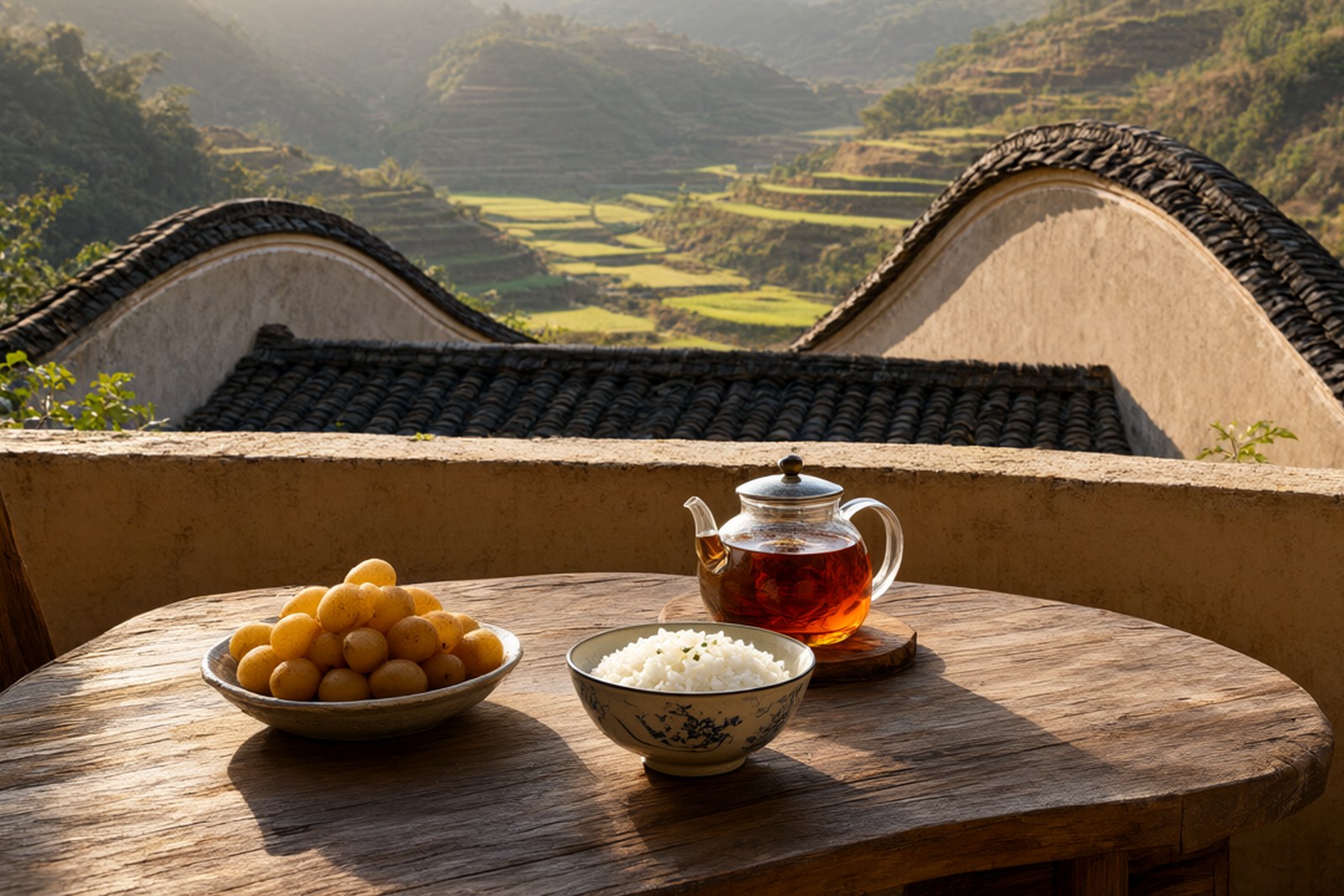
Where to stay: a farmhouse room beside the lanes of 大湾镇 Dà wān zhèn in 郁南县 Yù nán xiàn, close enough to the 大湾古建筑群 Dà wān gǔ jiàn zhù qún that the walk through the old houses starts at the door. Take an upper room with the lanes in the window, walk the gable-wall streets before breakfast and after the coaches leave, hire a car for the day that takes in 连滩, 光二大屋 and 兰寨, and ask the household to cook dinner rather than driving out for it.
flowcloud would say that a village which has kept forty-seven buildings across four hundred years, and which is still lived in rather than roped off, offers the visitor exactly one thing no museum can – the sound of somebody’s kettle at six in the morning from behind a wall that was laid in the Ming – and that paying for a bed on the inside of that wall is the only way to hear it.