
Dongshankou Villa Stay
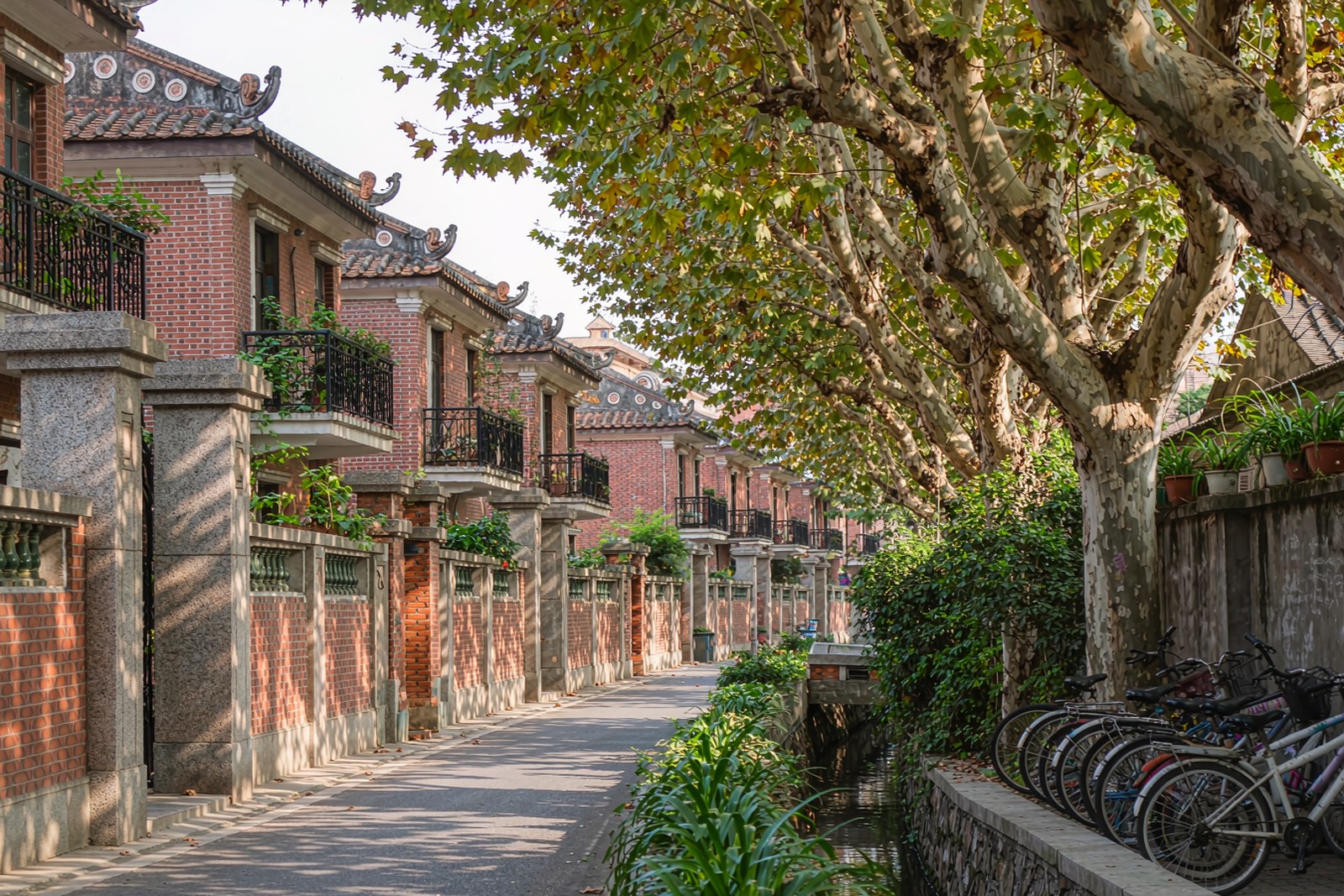
You come up out of the metro into a normal busy Guangzhou street, and then you turn left, and within two hundred metres the buildings drop to two and three storeys and turn red. Red brick, dark window frames, coloured glass, garden walls with banana palms and banyan trees spilling over them, and a canal running quietly along the middle of it. It is a hundred metres from a six-lane road and it is silent. This is 东山口 and 新河浦, and it is the only place in Guangzhou where you can sleep in a 1920s villa in a garden and walk to a dim sum restaurant in ten minutes.
Why There Are Four Hundred Villas Here
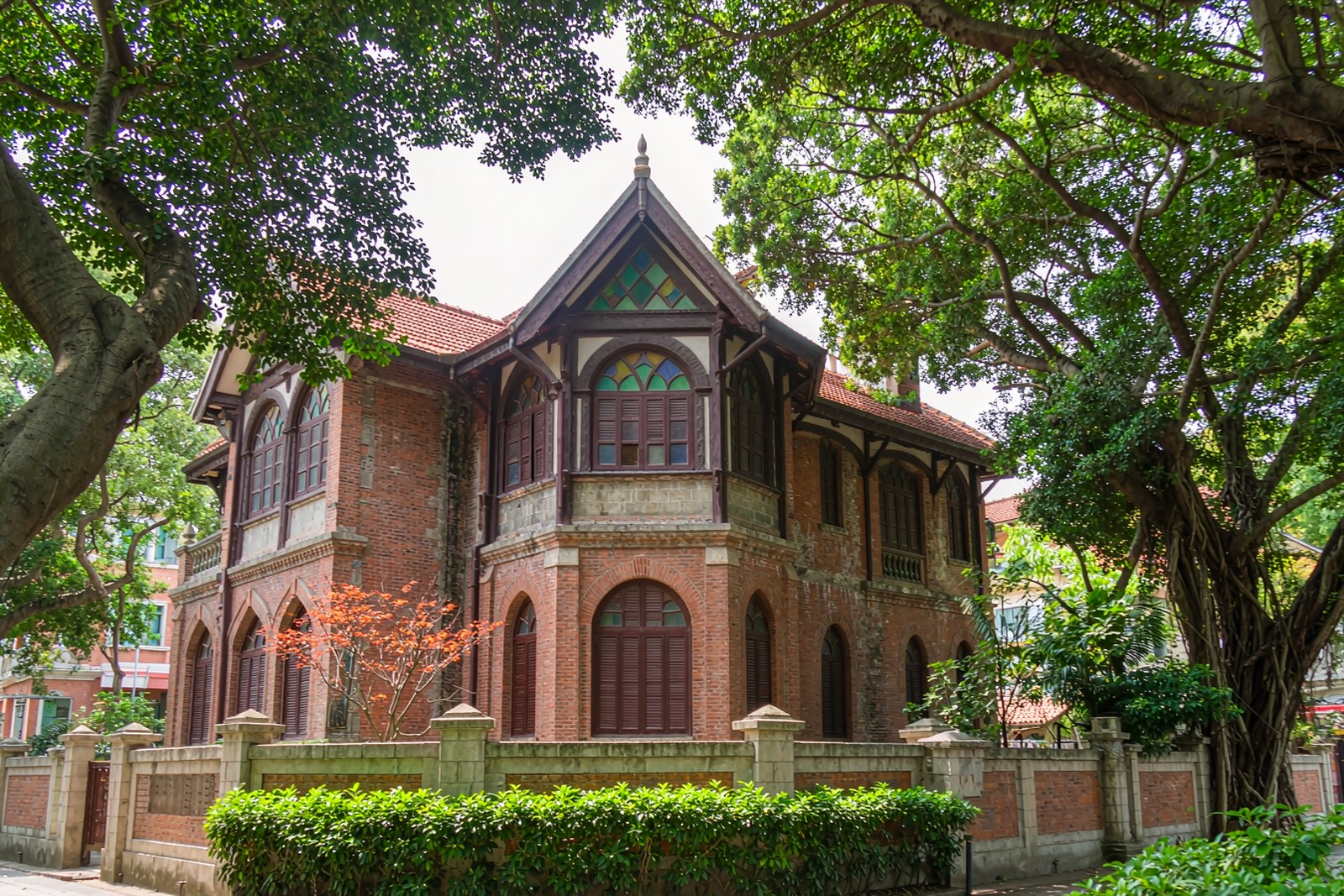
东山 — “east hill” — was outside the walled city of Guangzhou, farmland with a couple of temples on it, until the late nineteenth century. Then the foreign concessions on 沙面 filled up and the missionaries came east, followed by the Chinese merchants and officials who had made money in the 南洋 trade and wanted to live where the air was better and the church and the school were. From about 1910 to 1937 they built, and they built to a plan: low-rise, detached, gabled, with a garden and a wall.
The result is the largest surviving group of courtyard-style modern buildings in the city — somewhere between three and four hundred of them, mostly 清水红砖 (qīngshuǐ hóngzhuān) fair-faced red brick, with Roman arches over the openings, 满洲窗 (mǎnzhōu chuāng) windows of coloured and etched glass set in dark timber frames, and the occasional tower or curved balcony borrowed from whichever treaty port the owner had last seen. In 2006 the area was formally designated a historic and cultural conservation district, which is why it still exists at all; a city that has rebuilt itself as thoroughly as Guangzhou does not keep things by accident.
A handful are famous and are usually referred to together as 五大侨园, the five gardens of the returned overseas Chinese. 春园, three three-storey houses, where in 1924 the delegates to the Third Congress of the Communist Party — 陈独秀, 李大钊, 毛泽东 and the Comintern’s Maring among them — lived and worked; it is a museum now. 逵园, formerly 葵园, a single red-brick house with a moulded “1922” on the gable, which is the one you will almost certainly end up in because the ground floor is an art gallery and the first floor is a café. 简园, belonging to 简琴石 of the Nanyang Brothers Tobacco Company, with a curved Nanyang-style balcony and carved columns. 明园, two identical three-storey houses behind a Roman portico and a bamboo grove, with wartime air-raid shelters under the bamboo running towards 培正路. And 隅园, English in its bones and local in its details — the owner, 伍景, was a naval architect who designed four of the Guangdong fleet’s cruisers, and the neighbours described the house as 西曲中词, a western tune with Chinese words.
Walking the area is the point, and it takes about two and a half hours if you do the loop from 东山口 station through 署前路, 庙前西街, 均益路, 东华东路, 东山大街, 新河浦路, 恤孤路 and back down 龟岗大马路 to 东山湖公园, where the lake is one of the old city’s eight scenic views.
What You Sleep In
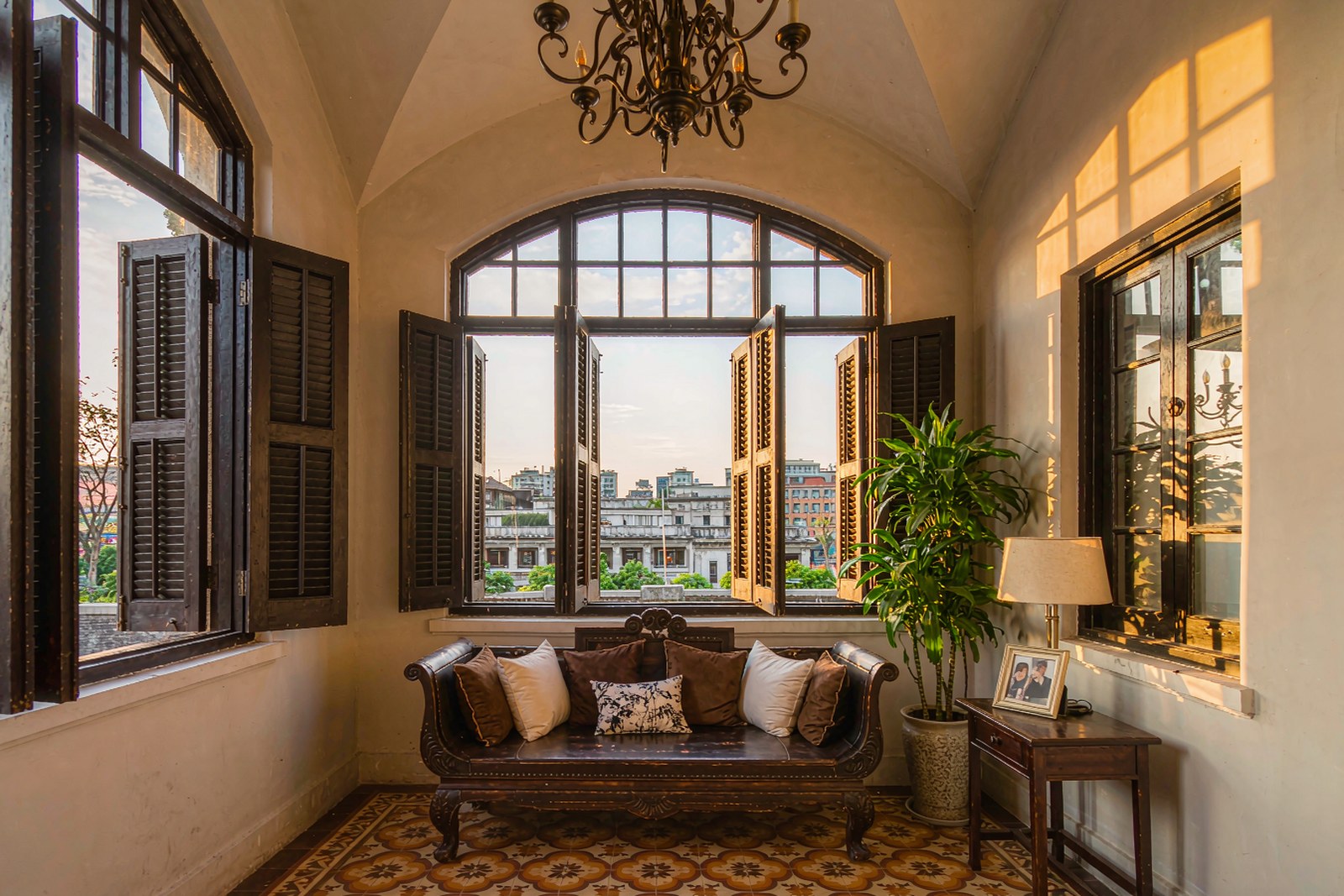
The interiors are the surprise. From the street these look like they should be cramped and slightly damp; inside, the good ones are high-ceilinged, with the original or restored timber floors, the original windows, deep casement shutters, and rooms sized for a family that employed staff. Most have been converted by architects rather than hoteliers, which shows in both directions: the proportions and light are far better than a hotel’s, and the breakfast situation is a kettle and a bag of coffee.
觉园1984 at the heart of the 东山口 villa quarter, about a hundred metres from the metro — a three-storey standalone red-brick villa that used to be called 禄园, restored and run as a small guesthouse with a garden. ¥480 and up.
东山别院, on 瓦窑后街, opened in 2015 in a 民国 villa a few steps from the 中共三大会址 memorial. It is the most deliberately period of the group — the interiors are held to a 1930s register rather than updated out of it. ¥400 and up.
Urban Nomad 都市游牧, in 新河浦 proper, is a century-old villa turned into a design-led guesthouse with a strong idea behind it about movement and temporary belonging. ¥300 and up, and the best value of the named houses.
壹舍生活馆, on the edge of the district near 中华广场, is a five-storey old western-style house done by a design studio and run as a combined guesthouse and lifestyle space. ¥430 and up.
Beyond those, the district has a deep bench of privately let whole villas — a two-bedroom flat of about eighty square metres in a converted 1931 villa typically runs ¥500–700 a night, with a ¥600 deposit collected offline, check-in from 14:00 and check-out at 12:00. If you are a group of four this is by some distance the best accommodation deal in central Guangzhou.
For anyone who wants a lift and a front desk rather than a wooden staircase, the same streets also hold ordinary business hotels at ¥220–340 (a 汉庭 near 东山口 station is around ¥256, a 三寓宾馆 around ¥334) and one design-brand hotel at about ¥633, which is worth knowing if the villa idea turns out to be more charming in photographs than in a July rainstorm.
Practicalities
Price. The named villa guesthouses run from about ¥300 (Urban Nomad 都市游牧) through ¥400 (东山别院) and ¥430 (壹舍生活馆) to ¥480 and up (觉园1984). Privately let whole villas — typically a two-bedroom flat of about 80 square metres in a converted 1931 house — are ¥500–700 a night, with a ¥600 deposit collected offline rather than through the platform. Ordinary business hotels in the same streets are ¥220–340; the one design-brand hotel is around ¥633.
Address. 东山口 and 新河浦 historic district, 越秀区 (Yuèxiù), Guangzhou. 觉园1984 (formerly 禄园) stands in the villa quarter about 100 m from 东山口 metro station; 东山别院 is on 瓦窑后街; Urban Nomad 都市游牧 is in 新河浦 proper; 壹舍生活馆 is nearer 中华广场 on the 中山三路 side. The main walking streets are 新河浦路, 恤孤院路, 培正路 and 龟岗大马路.
Rooms. 觉园1984 is a three-storey standalone red-brick villa with a garden and a handful of rooms; 东山别院 holds its interiors to a 1930s register; Urban Nomad is design-led and smaller again; 壹舍生活馆 occupies five floors of an old western-style house. In the privately let villas expect high ceilings, original timber floors, single-glazed windows and a kitchen, with check-in from 14:00 and check-out at 12:00.
Getting there. Metro line 1 or line 6 to 东山口站, exits E or F, then five minutes on foot into the core of the district; bus 811 to 培正路站 for the five gardens. Do not plan to drive in — the lanes are narrow, parking is scarce and mostly on the perimeter, and the metro is faster from anywhere in the city.
What It Refuses to Be
It refuses to be a hotel district. There is no lobby, no concierge, no bell desk, and in most of these houses nobody on site after ten at night. You are staying in somebody’s building.
It refuses to be air-conditioned onto a global temperature. The walls are brick and the windows are single-glazed, and in August you will be aware of the weather in a way that a sealed tower block does not allow.
And it refuses to be entirely public. A great many of these villas are still private homes, occupied by families who have been there for generations. The conservation-district signage asks visitors not to go through gates, and it means it.
The Name of the Place
东山 Dōngshān is “east hill” — 东 dōng, east, 山 shān, hill — because it lay east of the old walled city on higher ground. 新河浦 Xīnhépǔ is the neighbourhood, 新 xīn new, 河 hé river, 浦 pǔ a riverbank or inlet, after the canal that still runs through it. 洋楼 yánglóu, “foreign building”, is the local word for this whole typology of house, and 侨 qiáo — as in 华侨, overseas Chinese — is what half the street names here are quietly about. 东山口 Dōngshānkǒu is simply the mouth of Dongshan, the crossroads at the metro station.
What the Locals Know
Get off at 东山口 on line 1 or line 6 and use exit E or F. Five minutes on foot and you are in the middle of it. Bus 811 to 培正路站 puts you at the five gardens.
Do not try to drive in. The lanes are narrow, parking is scarce, and there are better ways to spend an afternoon. Park on the perimeter if you must.
Food is at 龟岗大马路 and 庙前西街. 广州酒家’s 东山 branch for 早茶, 客语 for cheap Hakka, the wet market on 东山口 for fruit, and 逵园’s first-floor café for the middle of the afternoon.
Come in spring if you can. The 木棉 on 烟墩路 and the 紫荆 on 寺贝通津 flower in March and April and the whole district turns pink and scarlet.
Walk west to 东山湖 in the last hour of light. The lake, the plane trees and the old people dancing badly by the water is the most Guangzhou thing available.
flowcloud would say that the only honest way to visit a city with four hundred surviving garden villas is to sleep in one, because a district built by people who wanted to live well in a garden is not visible from the pavement.
Where to stay: 东山口 / 新河浦 historic district, 越秀区 (Yuèxiù), Guangzhou — about four hundred fair-faced red-brick villas built between roughly 1910 and 1937, the largest surviving cluster of courtyard-style modern buildings in the city, designated a conservation district in 2006. 觉园1984 (formerly 禄园), a three-storey red-brick villa about 100 m from 东山口 metro, ¥480 and up; 东山别院, 瓦窑后街, opened 2015, ¥400 and up; Urban Nomad 都市游牧, 新河浦, ¥300 and up; 壹舍生活馆 near 中华广场, ¥430 and up. Privately let whole villas — a two-bedroom flat of about 80 sq m in a converted 1931 house — typically ¥500–700, with a ¥600 deposit, check-in from 14:00 and check-out at 12:00. Ordinary hotels in the same streets run ¥220–340. Nearby: 春园 and the 中共三大会址 memorial, 逵园 (gallery on the ground floor, café above), 简园, 明园, 隅园, 东山湖公园, and dim sum at 广州酒家’s Dongshan branch. Getting there: metro line 1 or line 6 to 东山口站, exits E or F, five minutes on foot; bus 811 to 培正路站 for the five gardens. Leave the car outside the district — the lanes are narrow and parking is very limited.
We are still eating our way through Dongshankou Villa Stay. Guides are on the way.