
From the window you can see the temple roof, which is the reason to stay here. The lanes around 祖庙 Zǔmiào, the ancestral temple of 佛山 Fóshān, run narrow and dense for several blocks, and the old buildings that line them are 竹筒屋 zhútǒng wū, literally bamboo-tube houses, one room wide and three or four deep, with a light well at the back and a shop on the ground floor. A handful of these have been converted into small hotels, and the result is a room whose front window looks out over grey tiled roofs, ceramic ridge figures and the tops of the old trees in the temple courtyard. The temple itself is two or three minutes on foot. The trade-off is equally clear: the lane outside is a working one, and you will hear the shutters go up at seven.
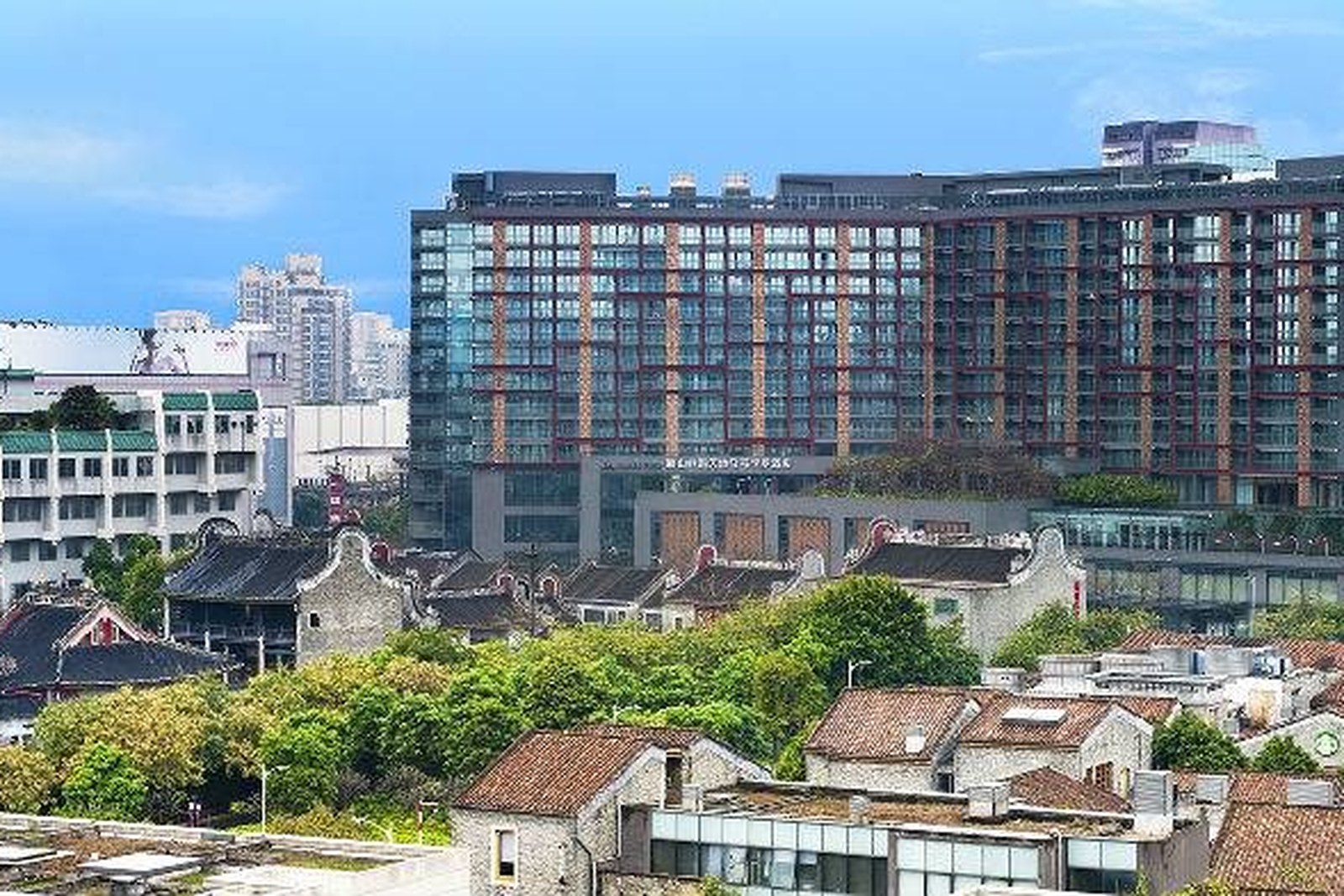
The district has been the centre of the city for something like six hundred years, and the 祖庙 Zǔmiào still functions as a temple rather than only as a monument, which shapes the whole area. Around it are the 岭南天地 Lǐngnán Tiāndì redevelopment, a restored grid of lanes with shops and restaurants, the older markets, and a street pattern that predates the modern city by centuries. Staying in the middle of it means that the pottery workshops, the ancestral halls, the biscuit shops and the temple are all within a fifteen-minute walk, and that the metro station for the rest of Foshan is also within that walk, which is unusual for an old quarter this intact.
What the Rooms Are Like
A bamboo-tube house is a long, thin building, and the room you get depends on where in the tube it sits. Front rooms look onto the lane and take the noise and the daylight; middle rooms have no window to the outside at all and borrow light from a light well, which makes them quiet, dim and genuinely cool in summer; rear rooms often open onto a small courtyard. Widths are modest, three to four metres, and the ceiling heights are generous, so the good conversions have built upwards rather than outwards. Bathrooms in converted houses vary widely in quality, and some of the smaller properties have shared or semi-shared facilities, so this is worth confirming. Air conditioning has been retrofitted nearly everywhere, and the older the building, the more visible the pipework.
Practicalities
Price. A double room runs roughly ¥260 to ¥600 a night. The lower end buys a windowless middle room, which is quiet but dark; the upper end buys a front room with a view over the temple roofs and, in one or two properties, a small roof terrace. Rates rise on festival days and during the 春节 Chūnjié period, when the temple is at its busiest and the whole quarter fills.
Address. The converted hotels cluster in the lanes around 祖庙 Zǔmiào and the adjoining 岭南天地 Lǐngnán Tiāndì, in 禅城 Chánchéng, the old core of 佛山 Fóshān, a short walk from the temple, the market streets and the 祖庙 metro station.
Rooms. Ask which part of the tube the room occupies, because the difference between a front window and a light well is larger here than the price gap suggests. Ask whether the bathroom is en suite and whether it has a window; ask whether there is a roof terrace and whether it is usable at night. A room above a shop will hear the shop, and the lanes are also used by scooters from early in the morning.
Getting there. The old core is in 禅城 Chánchéng, about twenty minutes by taxi from 佛山站 Fóshān Zhàn and around forty minutes from 广州南站 Guǎngzhōu Nán Zhàn, the high-speed station, which is connected to Foshan by metro. 佛山沙堤机场 Fóshān Shātí Jīchǎng is a small city airport within the urban area. If you arrive by car, note that the lanes around the temple are narrow and closed to through traffic, so park in one of the lots off the main boulevards and walk in.
flowcloud would say that a room over the temple lanes is bought for the morning light on the roof tiles, since the ceramic figures on a Lingnan ridge are best seen from above and from a window across a lane.
Where to stay: in a converted bamboo-tube house in the lanes around 祖庙 Zǔmiào, on the second or third floor, in a front room with a window across the roofs if you can get one. Confirm before booking whether the bathroom is en suite, whether the room has an outside window at all, and whether the property has a roof terrace, because those three answers decide whether the room is quiet or merely dark.