
From the yard the horizon is bamboo in every direction, which is the only reason anybody comes. 广宁 Guǎngníng is the bamboo county of western Guangdong, and the 竹海 zhúhǎi, the bamboo sea, is a working plantation of 毛竹 máozhú that runs over the hills for kilometres, with farmhouses and small homestays scattered through it. Staying in one means sleeping in a village house at the edge of the grove, eating what was dug or killed that day, and walking out in the morning into a forest of stems that are taller and denser than anything the word bamboo usually suggests. The county town is half an hour down the valley, and beyond it there is nothing at all.
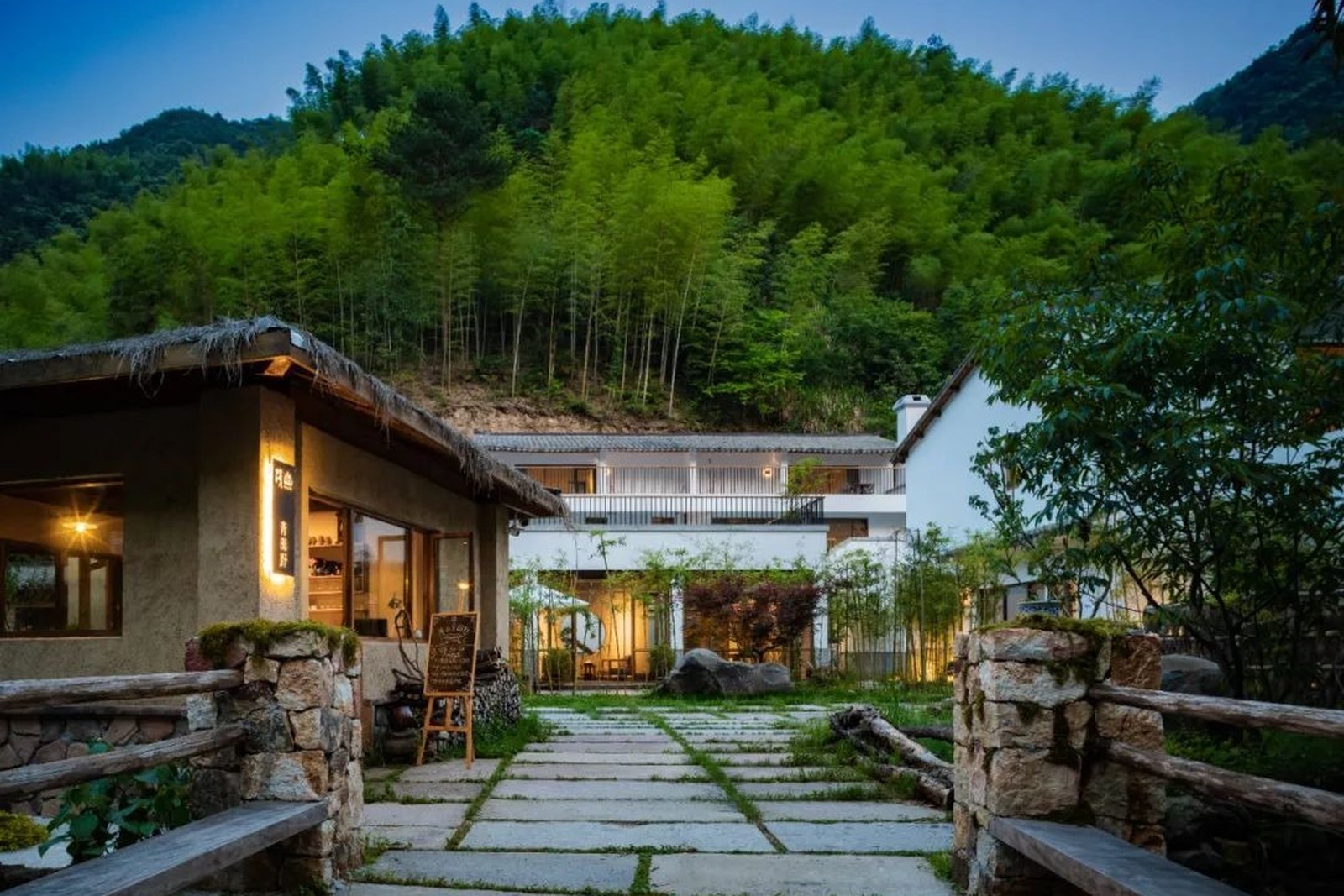
The plantation is managed rather than wild, and that shapes the stay. Groves are thinned by hand, shoots are selected in early summer, and the cut culms go to scaffolding, baskets, paper and furniture; a stand that has been worked for a century is orderly in a way a wild one is not, with paths between the clumps and a floor kept clear. In the season from late May to early July the shoots come up overnight and the whole village is out digging them, which is the best time to be here and also the wettest, since the rain is what starts them. Outside that window the grove is quiet, green and considerably cooler than the plain below.
What the Rooms Are Like
A 农家乐 nóngjiālè homestay in Guangning is a family house with a few spare rooms, and the standard is simple and clean rather than comfortable in the hotel sense. Expect a hard bed, tile floors, an air-conditioning unit, a shower and a shared or en suite bathroom depending on how the family has extended the building. The newer ones have been built for guests and have en suite bathrooms and balconies facing the grove; the older ones are genuine farmhouses, which is warmer in the way that matters in February and noisier in the way that matters when the rooster starts. Meals are eaten with the family at a round table, and the menu is whatever the garden and the grove produced that morning.
Practicalities
Price. A double runs roughly ¥120 to ¥350 a night, usually with breakfast and often with one or both other meals included if you ask. Prices are low and are not much affected by the season except in the shoot weeks, when the county fills with people coming to eat fresh 笋 sǔn and the better houses book out.
Address. The homestays are scattered through the villages of the 竹海 zhúhǎi around 广宁县 Guǎngníng Xiàn, an hour or so northwest of 肇庆市 Zhàoqìng Shì, along the rural roads above the 绥江 Suí Jiāng. The exact village matters, because the road in from the county town is slow and a house ten minutes further up the valley is ten minutes further from everything.
Rooms. Ask whether the bathroom is en suite and whether there is hot water on demand rather than a tank that runs out. Ask whether the room has air conditioning and a mosquito screen, since a house at the edge of a wet grove needs both. If you want to cook or to eat with the family, say so in advance, because the arrangement is informal and depends on the household.
Getting there. 广宁县 Guǎngníng Xiàn is about an hour and a half by road from 肇庆市 Zhàoqìng Shì and around two hours from Guangzhou, with buses from the county town to the villages several times a day. A car is much easier than public transport, since the grove roads are narrow and the villages are not on a useful bus line. If you are coming for the shoot season, book the room and the meal at the same time.
flowcloud would say that a night in the bamboo is worth it for the sound, since a grove of that many stems moves in the wind like something breathing and no recording of it is convincing.
Where to stay: in a family homestay in one of the villages of the 竹海 zhúhǎi in 广宁县 Guǎngníng Xiàn, an hour northwest of 肇庆 Zhàoqìng, ideally in the shoot season from late May to early July. Confirm whether the bathroom is en suite and whether meals are included, arrange a car rather than relying on the buses, and ask the family to take you out digging if you are there when the shoots are up.