
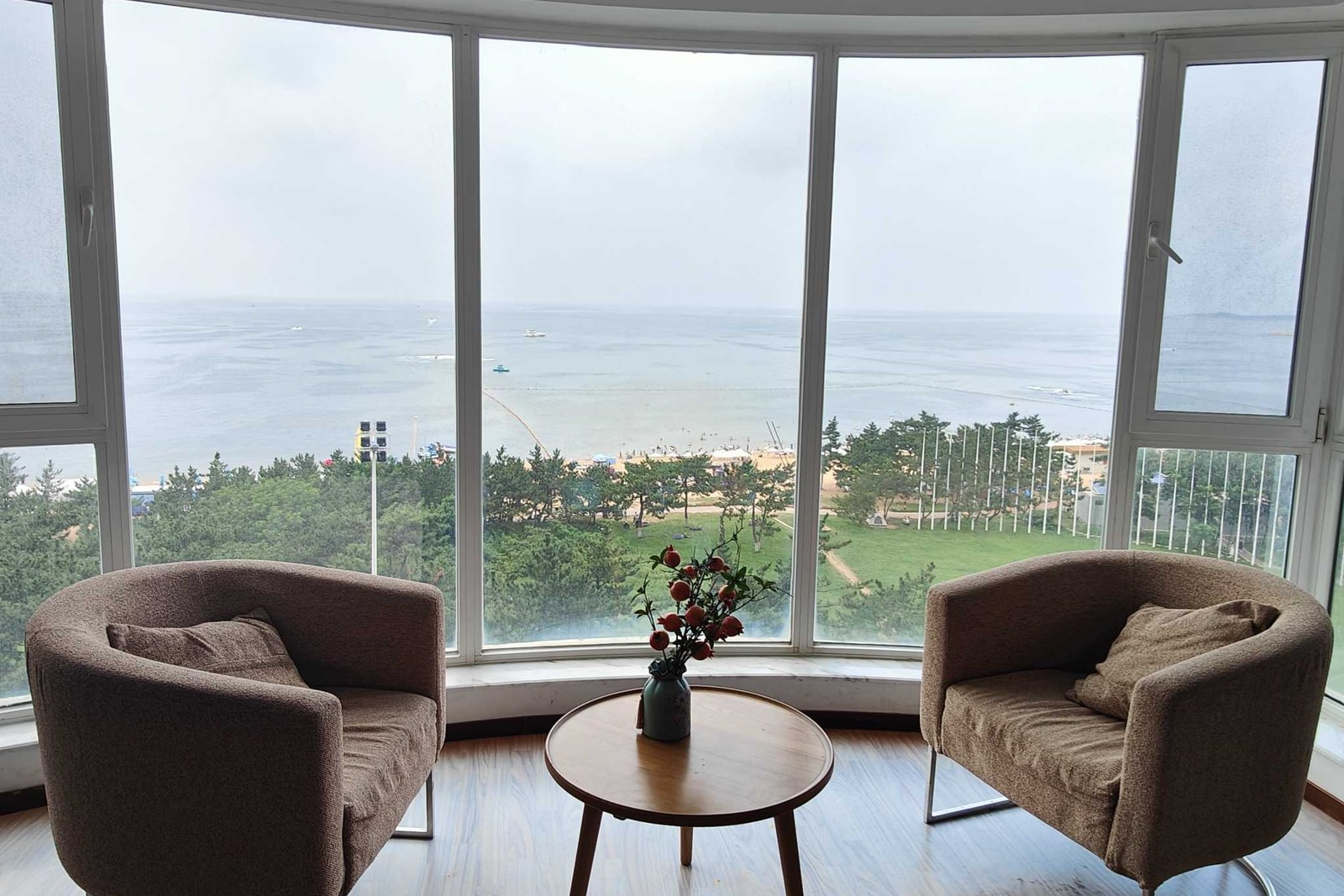
The strait is not blue and the view is better for it. From a high floor on the western shore of 海口市 Hǎikǒu Shì, the water of 琼州海峡 Qióngzhōu Hǎixiá, the Qiongzhou Strait, is usually a dull grey-green, worked over by the wind, with the coast of the mainland somewhere out there on a clear day and nothing at all on a hazy one. To the south the bay curves away toward 西海岸 Xīhǎi’àn and the new hotels; to the north the port, the breakwater and the ships. This is a working stretch of water in front of a working city, and the hotels that line it sell the view honestly: you are looking at a shipping lane and a harbour, and at night at the lights of both.
The waterfront itself was rebuilt over the last two decades. What used to be the port edge is now 滨海大道 Bīnhǎi Dàdào, a long boulevard with hotels, apartment towers and public promenades along it, and the section between 万绿园 Wànlǜyuán, Evergreen Park, and 世纪大桥 Shìjì Dàqiáo, the Century Bridge, is the part that the city treats as its front room. The bay hotels sit in this band. The advantage is that you can walk out of the lobby and be on a sea wall with a running track and a cycleway on it, and that almost every west-facing room gets the sunset over the water.
What the Rooms Are Like
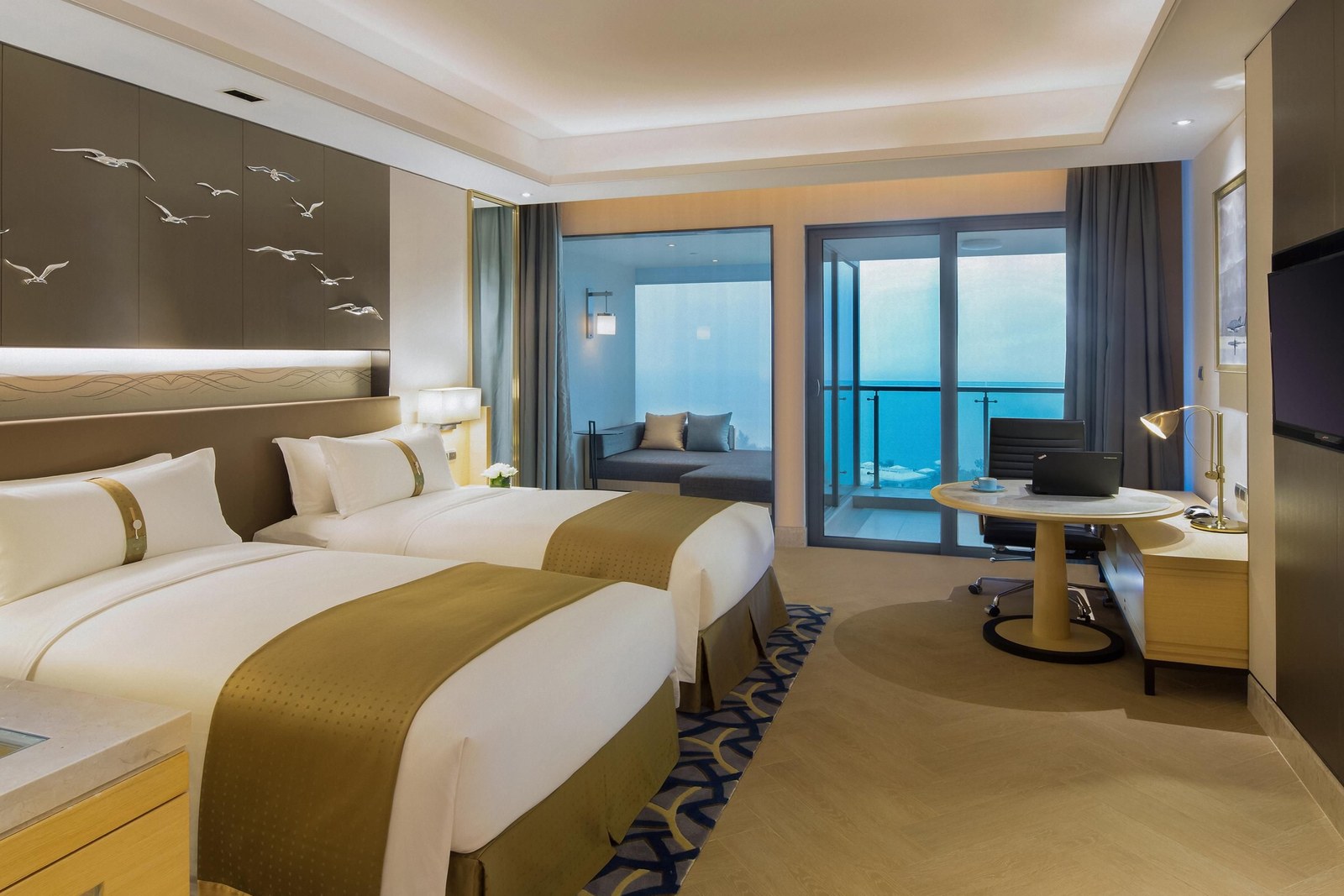
These are the big international-standard towers, and the room is what that phrase leads you to expect: a carpeted box, a large bed, a desk, air conditioning that you will want to leave running, a bathroom in stone, and a window wall. The variable is the window. Rooms on the sea side face the strait and the sunsets; rooms on the city side face a road, an office block and, in the better ones, a corner of 万绿园. Floors matter too, since the boulevard’s traffic is audible up to about the sixth floor and effectively gone above the fifteenth. Higher and sea-facing is the whole point of staying here; a low city-facing room in a Haikou Bay hotel is an expensive ordinary room.
Practicalities
Price. Sea-facing doubles run from about ¥450 in the low season to well over ¥1,200 on a peak winter weekend or during the 春节 Chūnjié period, when the mainland arrives en masse. City-facing rooms are typically thirty to forty per cent cheaper. Rates include breakfast in most of the towers, and the buffet is a serious operation with a local section that is worth eating from.
Address. The band of hotels along 滨海大道 Bīnhǎi Dàdào in 龙华区 Lónghuá Qū and 秀英区 Xiùyīng Qū, between 万绿园 Wànlǜyuán and the 世纪大桥 Shìjì Dàqiáo, on the west side of the city centre. Some properties name themselves after the bay and sit a block or two inland, which is worth checking before booking: a sea view is guaranteed only by a sea frontage.
Rooms. Specify sea-facing, and specify a high floor. Ask for a room away from the lift lobby and, if the hotel has one, away from any rooftop bar. The harbour lights are bright enough that good blackout curtains matter more here than in most hotels, and the wind off the strait makes a balcony usable on fewer days than the pictures suggest.
Getting there. 海口美兰国际机场 Hǎikǒu Měilán Guójì Jīchǎng, the airport, is on the east side of the city, thirty to fifty minutes by road depending on traffic; the 环岛高铁 huándǎo gāotiě, the island ring railway, stops at 海口东站 Hǎikǒu Dōng Zhàn in the east of the city, from which the bayfront is twenty to thirty minutes by taxi. The 海口站 Hǎikǒu Zhàn, the main-line station, is west of the centre and close to the bay hotels, which is convenient if you arrive on the ferry from 徐闻 Xúwén with a car.
flowcloud would say that a Haikou Bay room is bought for a single hour of the day, since the strait is at its best just before it goes dark and everything else the room does is ordinary.
Where to stay: on the sea side of 滨海大道 Bīnhǎi Dàdào, between 万绿园 Wànlǜyuán and 世纪大桥 Shìjì Dàqiáo, on the fifteenth floor or above, facing the strait. Confirm in writing that the room is sea-facing rather than bay-area, ask for a western exposure rather than one looking east at the port, and if the hotel advertises a rooftop pool, check whether it is heated in winter, because the wind off the water is real.