
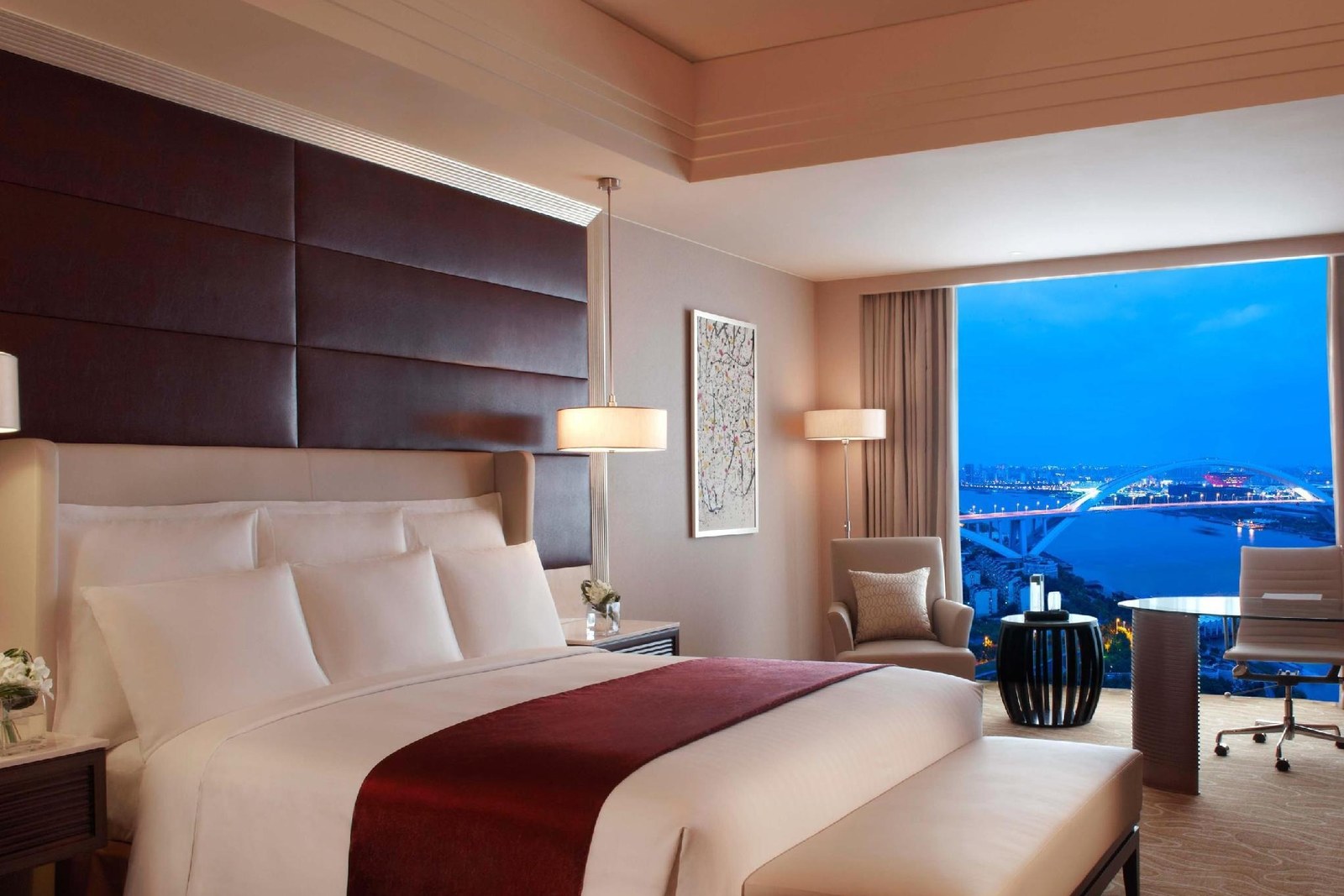
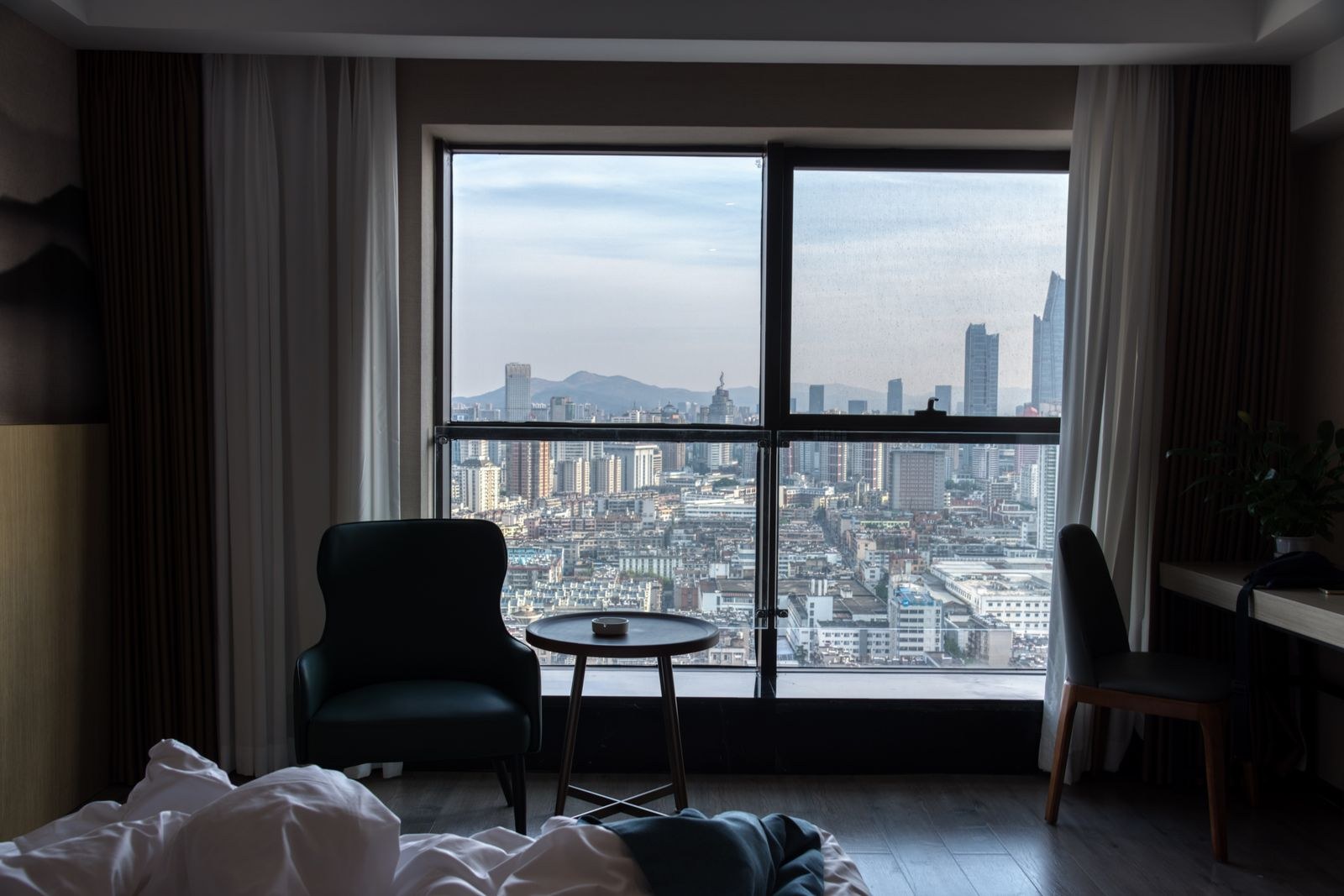
From a high floor the city reads like a diagram. The 湘江 Xiāng Jiāng, the Xiang River, comes down through the middle of 衡阳 Héngyáng in a wide grey band, crossed by bridges, worked by barges, and lined on both banks with the long stone embankments that every Hunan river city builds. On the west bank there is a wooded ridge with a pagoda of a temple on it that is barely ninety-seven metres above sea level and nonetheless counts as the first peak of a famous mountain. On the east bank there is the confluence, where the 蒸水 Zhēng Shuǐ comes in and the river bends, and on a hill above that confluence is a rock with a college on it. A riverside room in the centre of Hengyang puts all of that in one window.
Hengyang is a proper city rather than a tourist town — the second largest in Hunan by population, a transport junction where two major railways meet, and a place with an industrial history rather than a scenic one. That is part of the appeal. The old commercial core sits on the west bank in 雁峰区 Yànfēng Qū and 石鼓区 Shígǔ Qū, where 解放路 Jiěfàng Lù and 中山路 Zhōngshān Lù carry the shops, and where the food is at its best: fish-noodle shops opening at six, night stalls filling the alleys off 进步巷 Jìnbù Xiàng after dark, and 石鼓书院 Shígǔ Shūyuàn and 回雁峰 Huíyàn Fēng both within a couple of kilometres of each other. Almost everything a visitor wants is inside that strip, which makes the west bank the only sensible place to sleep.
Practicalities
Price. A river-view room in one of the city’s larger hotels runs roughly ¥280 to ¥600, the top of the band buying height, a front-facing window and breakfast. The mid-range is dominated by domestic chains at ¥180 to ¥320 a night, which in Hengyang buys a room that is new, clean and entirely standard. Business-traveller hotels near 衡阳东站 Héngyáng Dōng Zhàn are cheaper, around ¥160 to ¥280, but sit in a district of car parks and slip roads; only stay there if you are changing trains.
Address. The riverside hotels run along 湘江北路 Xiāngjiāng Běi Lù and 湘江南路 Xiāngjiāng Nán Lù, with the best concentration in 石鼓区 Shígǔ Qū near the academy and in 雁峰区 Yànfēng Qū opposite the old town. Anything in those two districts is walkable to the sights and a short taxi from the stations; anything described as being at 华新开发区 Huáxīn Kāifā Qū, the new district in the south-west, is a 20-minute drive from all of it.
Rooms. Standard Chinese city-hotel rooms — tiled or timber floors, air conditioning that earns its keep in July and August, a kettle, and in the better properties a desk by the window and a decent shower. River view is worth asking for explicitly and worth confirming faces the water rather than the interior courtyard; a high floor is what you are paying for, so ask for one. There is no need for a resort here. This is a city hotel to sleep in and walk out of.
Getting there. 衡阳东站 Héngyáng Dōng Zhàn takes the high-speed trains and is about 20 minutes from the riverside districts by taxi, around ¥25 to ¥40; 衡阳站 Héngyáng Zhàn, the classic station, is much closer to the old town and served by bus 103, 104 or 161 to 船山大桥 Chuánshān Dàqiáo. From 长沙 Chángshā the high-speed train takes well under an hour and from 广州 Guǎngzhōu roughly three, which makes Hengyang an easy stop between the two.
flowcloud would say that Hengyang is the rare city whose best view is also its most ordinary one, since half a million people cross that river every day without looking at it.
Where to stay: on the west bank, high up, facing the water, and within walking distance of 解放路 Jiěfàng Lù so that breakfast is a bowl of fish noodles rather than a hotel buffet. Ask for a river-facing room on an upper floor, check whether the window opens, and confirm the walk to 石鼓书院 Shígǔ Shūyuàn on a map before booking. If you are arriving by high-speed rail and leaving the same way, weigh the extra taxi against how much of the city you actually want at your feet.