
The creative-district beds string three places into one evening’s loop: the 1850 garden, the industrial-heritage park and the lantern-lit waterside village. 可园 Kě Yuán, Keyuan Garden, stands in 莞城街道 Guānchéng Jiēdào, the Guancheng subdistrict, the city’s old core; 鳒鱼洲 Jiānyúzhōu, the Jianyuzhou Cultural and Creative Park, is a former industrial quarter on its own road a short drive away; and 下坝坊 Xiàbàfāng, the village the city’s media call “Dongguan’s Gulangyu”, lies across the water in 万江街道 Wànjiāng Jiēdào, the Wanjiang subdistrict. The anchor bed between them is the Park Liwan hotel – 朴澍湾 Pǔshùwān in Chinese – in Building 12 at 8 Jianyuzhou Road, a dormitory block of a 1980s rice-and-flour factory rebuilt as a guesthouse. No rail reaches the loop directly – Metro Line 2 skirts the core at Hongfu Road station, a fifteen-minute taxi from the village by the platform guides – so the whole circuit is a cab crawl of short hops, which is exactly the scale the beds here were chosen for – close enough that the loop works on foot for the determined and by taxi for everyone else.
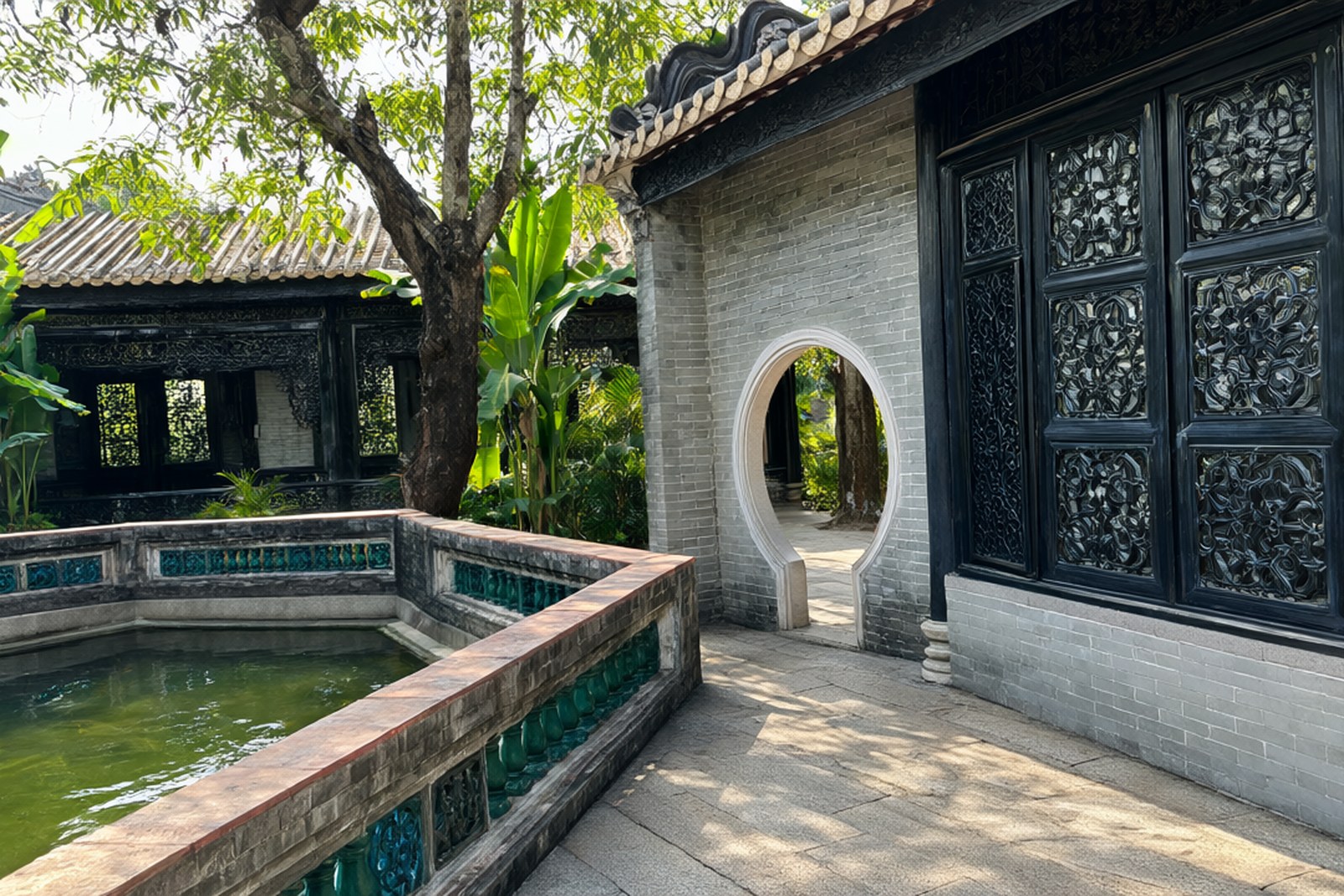
The garden sets the register for everything else. Keyuan was begun in 1850, the thirtieth year of Daoguang, and stands with 清晖园 Qīnghuī in Shunde, 梁园 Liángyuán in Foshan and 余荫山房 Yùyīnshānfáng in Panyu as one of the four great gardens of Guangdong’s Qing dynasty; the museum that keeps it prints its address as 32 Keyuan Road, Guancheng. It matters to a sleeper twice over: it is the daylight half of this article’s loop, and it is the design source of the city’s luxury flagship – the InterContinental across town in this same batch borrows the garden for its lobby, and its own destination page sends guests here for the original. Note the frame and keep it honest: museum, park and village sit in three different subdistricts, 10-to-15-minute taxi hops apart – an estimate; navigate.
The village is the evening half, and its credentials are official. 下坝坊, in 万江街道坝头社区 Bàtóu Shèqū, the Batou community, is a Guangdong provincial historic-cultural village that keeps its late-Qing-through-1980s streetscape whole – 詹氏宗祠 Zhānshì Zōngcí, the Zhan clan ancestral hall, a three-bay three-hall courtyard with wok-ear fire walls, still holds a gilt Ming-emperor plaque by the official-media account – and the streets read as the “living museum of Lingnan waterside culture” the city’s own copy calls it.
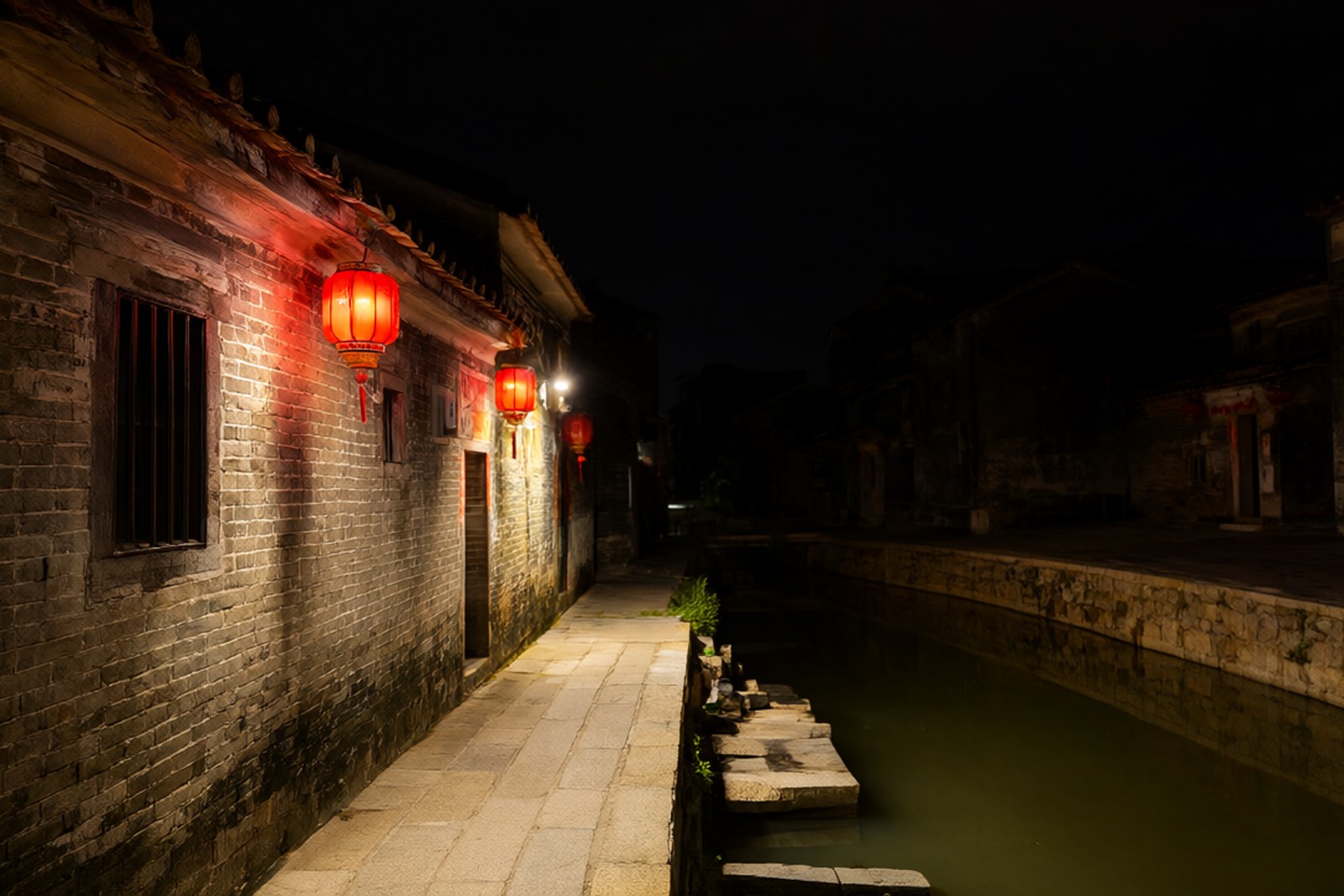
The village’s founding is officially fluid: the official media print a Ming-era settlement from Jiangxi in a 2021 account and a Qing-era migration in a 2022 one, and the village age runs from “more than 500 years” (2022) to “600 years” (2025) in the same outlets – this article carries both lines and takes no side. 下坝灯影 Xiàbà Dēngyǐng, the Xiaba lantern reflections, is one of Wanjiang’s new eight sights; entry is free; and a 5.247-million-yuan upgrade on the province’s public-resources platform, launched in 2025 with completion planned for 10 February 2026, is explicitly a fine-tuning around a 15-per-cent visitor-growth target – polish, not demolition.
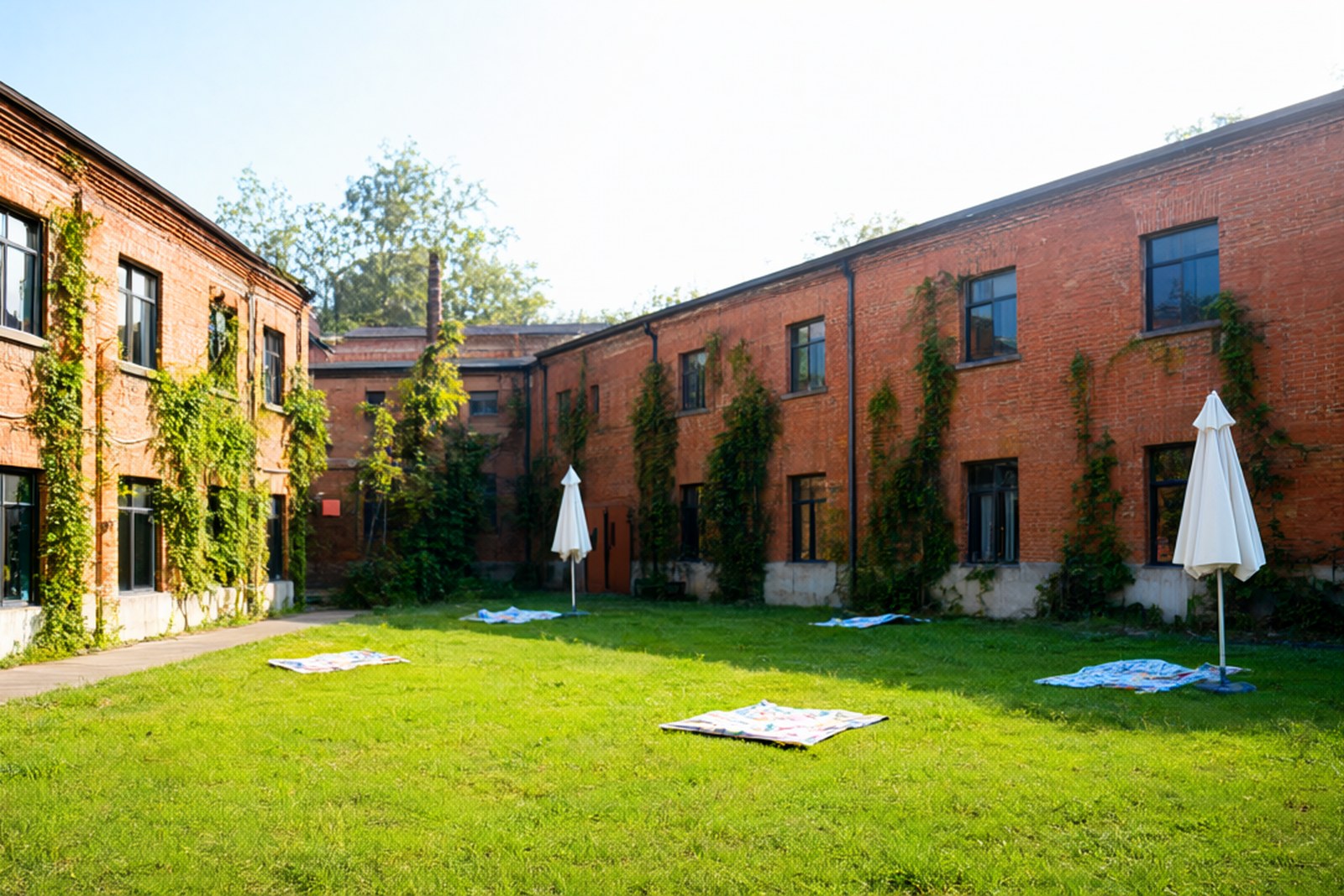
The bed itself is the park’s own conversion story. The Park Liwan hotel – filed on Ctrip as the “Dongguan Memory Jianyuzhou Cultural and Creative Park” branch and once listed as the “Xiabafang” branch, one house with two shelf names – occupies Building 12 at 8 Jianyuzhou Road, inside a creative park the platforms file as one of the city’s most characterful industrial heritage sites; the dormitory-block origin travels on community posts, so this article prints it softly. The kit is modern: smart-room controls, robot delivery, a Chinese-and-Western buffet breakfast, a book bar, a children’s play area and a garden with picnic lawn. The platform tags it three-star without any government grading notice behind the tag, and on the snapshot date it sat at No. 1 on Ctrip’s own comfort-hotel hot-sale ranking for the Dongguan Memory cluster.
What the Rooms Are Like
Sixteen room types sort into three moods. The 雅逸 Yǎyì, 静逸 Jìngyì and 隐逸 Yǐnyì king and twin rooms are the quiet core, the conversion’s own calm; the 景逸 Jǐngyì king adds 270-degree windows and a 100-inch projection, the cinema pick; and the family floor runs a super-king, parent-child suites – a slide-equipped Paul Frank suite, a bear-explorer theme room, a Nezha room – and a chess-and-mahjong suite at the social end. No reliable total room count is published on any platform, so this article prints none. The village offers the counter-choice: guesthouses in converted old houses, 见栈 Jiànzhàn, the 东江之星 and 莞家 houses among them on platform listings, quoting 220 to 400 yuan in the low season; none publishes a verifiable room count or opening year either, so they travel here as a group, not as listings.
Practicalities
Price. On 1 October 2026 the snapshot read: from 297 yuan on Ctrip (4.7 across 1,658 reviews), 267 on Tongcheng (4.8) and 230 on RollingGo, with the Taiwan-market platform printing about HKD 419 a night with taxes and breakfast on its November 2025 snapshot; village guesthouses 220 to 400 low season by platform guides. Every figure is a snapshot that floats.
Address. 东莞市莞城街道鳒鱼洲路 8 号 12 号楼 – Building 12, 8 Jianyuzhou Road, Guancheng subdistrict, inside the cultural-creative park between the Keyuan museum and the Xiabafang village; phone 21271888 on the Ctrip listing. The platform measures put 旗峰公园 Qífēng Gōngyuán park 5.4 kilometres off and the Dongguan-Huizhou intercity’s 西平西 Xīpíngxī, Xiping West, station 6.7.
Rooms. Ask which family your room sits in – the 逸-series quiet rooms, the projection room or the parent-child suites are three different stays. Ask whether breakfast is in the rate, since the buffet is the house’s own line item. And if the village night is the real goal, decide before booking whether the park’s quiet or the lane’s lanterns should be the last thing you see.
Getting there. Metro Line 2 to 鸿福路站 Hóngfúlù Zhàn, Hongfu Road station, then a taxi of about fifteen minutes – the platform-guide estimate; buses X13 and 29 stop at 坝头桥东 Bàtóuqiáo Dōng, Batouqiao East, a five-minute walk from the village; the intercity’s Xiping West station is 6.7 kilometres off. The three anchors – garden, park, village – are taxi hops of 10 to 15 minutes apart; navigate.
Where to stay: a 景逸 Jǐngyì projection room if the night should end in a private cinema, a parent-child suite if the slide decides the vote, and an in-village old-house guesthouse if the lantern reflections are the point and the star count is not – all inside one fifteen-minute taxi triangle around the 1850 garden in 莞城街道 Guānchéng Jiēdào, 东莞市.
flowcloud would say that a city which machined the world by day has learned to keep its old quarters for the night shift, and that the correct way to sleep here is behind whichever window faces the water, because the lanterns of Xiabafang have rehearsed their reflections since the Ming and do not need a second take.