
The room is upstairs at the back of a shophouse on an arcade street, and the floorboards are the original ones, which you can tell because they have been walked into shallow hollows over about a hundred years. The window is a pair of wooden shutters with a French colonial shape to them, painted the green that all the shutters on this street are painted. Open them and you are looking at the back of the next shophouse and a slice of courtyard with a lime tree in it. Close them and the room is a dark, cool box that smells of old timber and salt, and it is about eleven degrees cooler than the street.
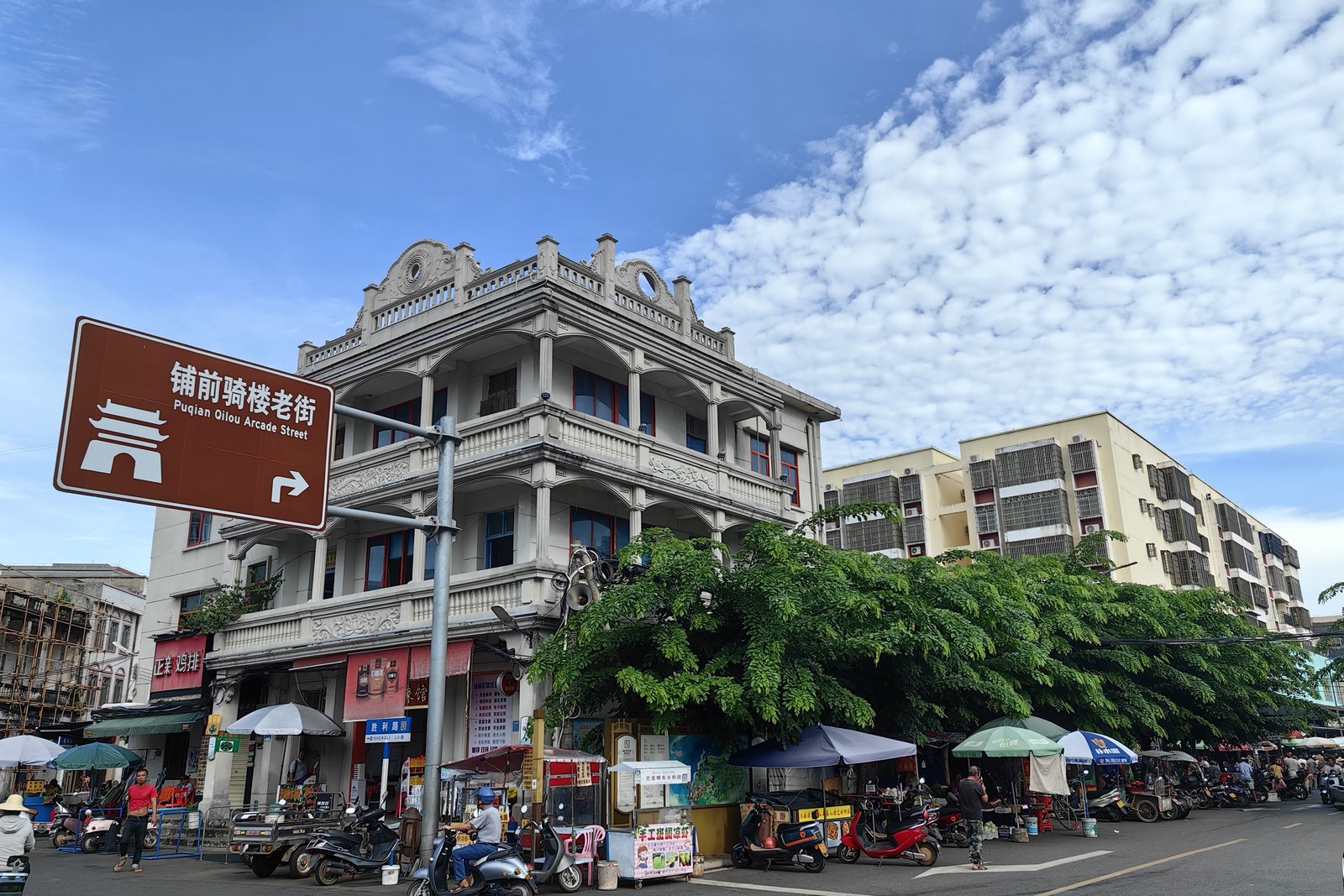
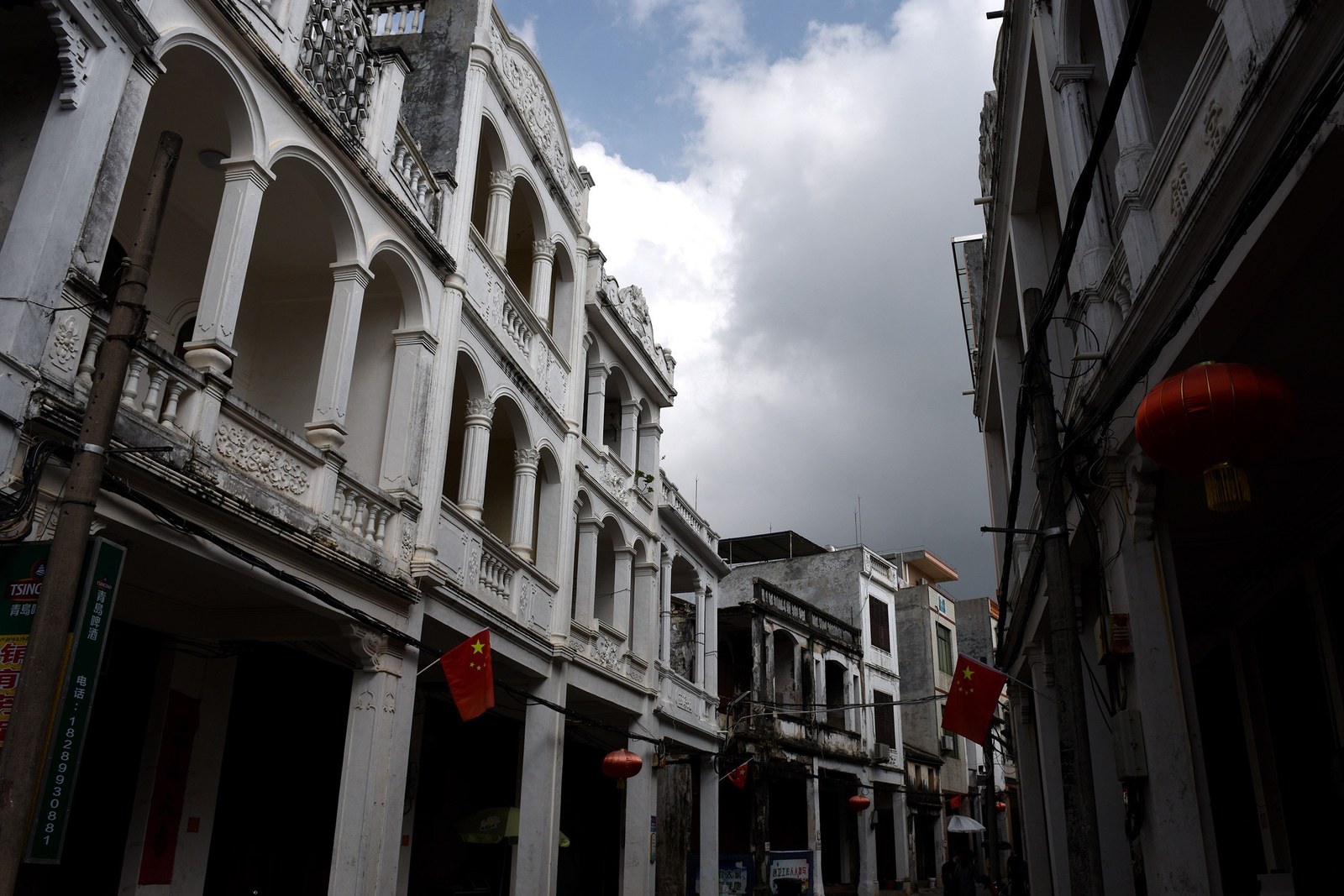
铺前 Pùqián is the old port at the northern tip of 文昌 Wénchāng, in 海南 Hǎinán, and its 老街 lǎojiē — the arcade old street — is one of the least self-conscious historic streets I have slept on in China. There is no entrance fee, no ticket office, no lanterns strung for photographs. There is a row of two-storey shophouses with arched colonnades running along both sides, some of them restored, more of them quietly falling down, and behind the colonnade are families who have lived there for four generations and who will sell you a bowl of 糟粕醋 zāopò cù out of the front room.
The Street and Its History
The architecture is 南洋 Nányáng — South Seas — which means it was paid for by people who left. In the late nineteenth and early twentieth centuries, men from this coast went to 新加坡 Singapore, 马来亚 Malaya, 泰国 Thailand and 印尼 Indonesia to work, and the ones who did well sent money home, and the money became these shophouses: a Chinese plan, a tropical arcade, European shutters, decorative parapets. The same story is written on the streets of 海口 Hǎikǒu, 文昌, 琼海 Qiónghǎi and 北海 Běihǎi, but 铺前’s version is short enough to walk in ten minutes and quiet enough to feel like a place rather than a set.
At the southern end of the town stands 溪北书院 Xīběi Shūyuàn, an academy founded in 1893, with a courtyard, a lecture hall and a set of steles, and it is the single best-preserved building in the area. A ten-minute walk north puts you on the waterfront where the fishing boats come in, and beyond that the 海文大桥 Hǎiwén Dàqiáo sweeps across to the mainland — a twenty-first-century piece of engineering planted next to a street of 1920s shophouses, which is the whole condition of Hainan in one view.
The Inn
There are perhaps a dozen rooms to rent on the old street, in three or four shophouses, and they are all small. Mine had a double bed, a fan, a split air conditioner that was installed with obvious reluctance, a bedside table, and a bathroom that had been fitted into what used to be a store cupboard, which means the ceiling is low and the shower is over the drain and the whole thing is a little bit of a negotiation. There was no desk. There was a chair on the landing outside, in the arcade light, which is where I ended up doing all my writing.
What the place has instead of facilities is the street. The family who run it live downstairs and eat dinner at seven, and the smell comes up through the boards — garlic, dried fish, the sharp sour lift of the vinegar pot — and around eight somebody puts a television on, and at ten the shutters opposite come down one at a time. In the morning the shop next door opens at half past five and starts boiling the bones for its broth, and if you sleep through that you have slept through the best alarm clock in Hainan.
Practicalities
Price. Rooms on the old street run ¥120–260 a night for a double, and the upper end buys you the restored shophouse with the better bathroom and the attic window over the arcade. There is rarely a seasonal spike, because 铺前 has not yet been discovered in the way its neighbour towns have. Some of the families will do a monthly rate of ¥2,000–3,000 in the quiet months.
Address. 铺前老街 (Pùqián lǎojiē), the arcade street in 铺前镇 (Pùqiánzhèn), 文昌 (Wénchāng), northern tip of 海南 (Hǎinán), a few hundred metres from the ferry landing and about two kilometres from the 海文大桥 (Hǎiwén Dàqiáo). The inns are unnumbered; ask for the one above the 糟粕醋 shop, or simply walk the street and look for the signboards.
Rooms. Doubles and a few twins, all small, all with air conditioning and a private bathroom, none with a lift. The upstairs rooms at the back are quieter and darker; the rooms over the arcade get the light and the street noise. Hot water comes from an electric heater and runs out after two showers — stagger them.
Getting there. 铺前 is the one place in 文昌 Wénchāng that is easier to reach from 海口 (Hǎikǒu) than from Wenchang’s own rail station. From 海口美兰 (Hǎikǒu Měilán) airport it is roughly fifty minutes by car over the 海文大桥 (Hǎiwén Dàqiáo), which makes the town a plausible day trip and a very good overnight. From 文昌 (Wénchāng) high-speed rail station it is about seventy minutes by road around the top of the island. There is a local bus, and it is slow.
flowcloud would say that the best rooms on a historic street are always the ones that have not been renovated yet, because a hundred years of somebody else’s cooking coming up through the floorboards is a form of hospitality no architect can specify.
Where to stay: The old-street inns of 铺前 (Pùqián), 文昌 (Wénchāng), at the northern tip of Hainan. Doubles ¥120–260 a night, monthly ¥2,000–3,000 in the quiet season. About fifty minutes by road from 海口美兰 (Hǎikǒu Měilán) airport over the 海文大桥 (Hǎiwén Dàqiáo), or seventy minutes from 文昌 (Wénchāng) high-speed rail station. Ask for an upstairs back room, stagger your showers, and treat the 溪北书院 (Xīběi Shūyuàn) academy at the south end of town as the thing to see before breakfast.