
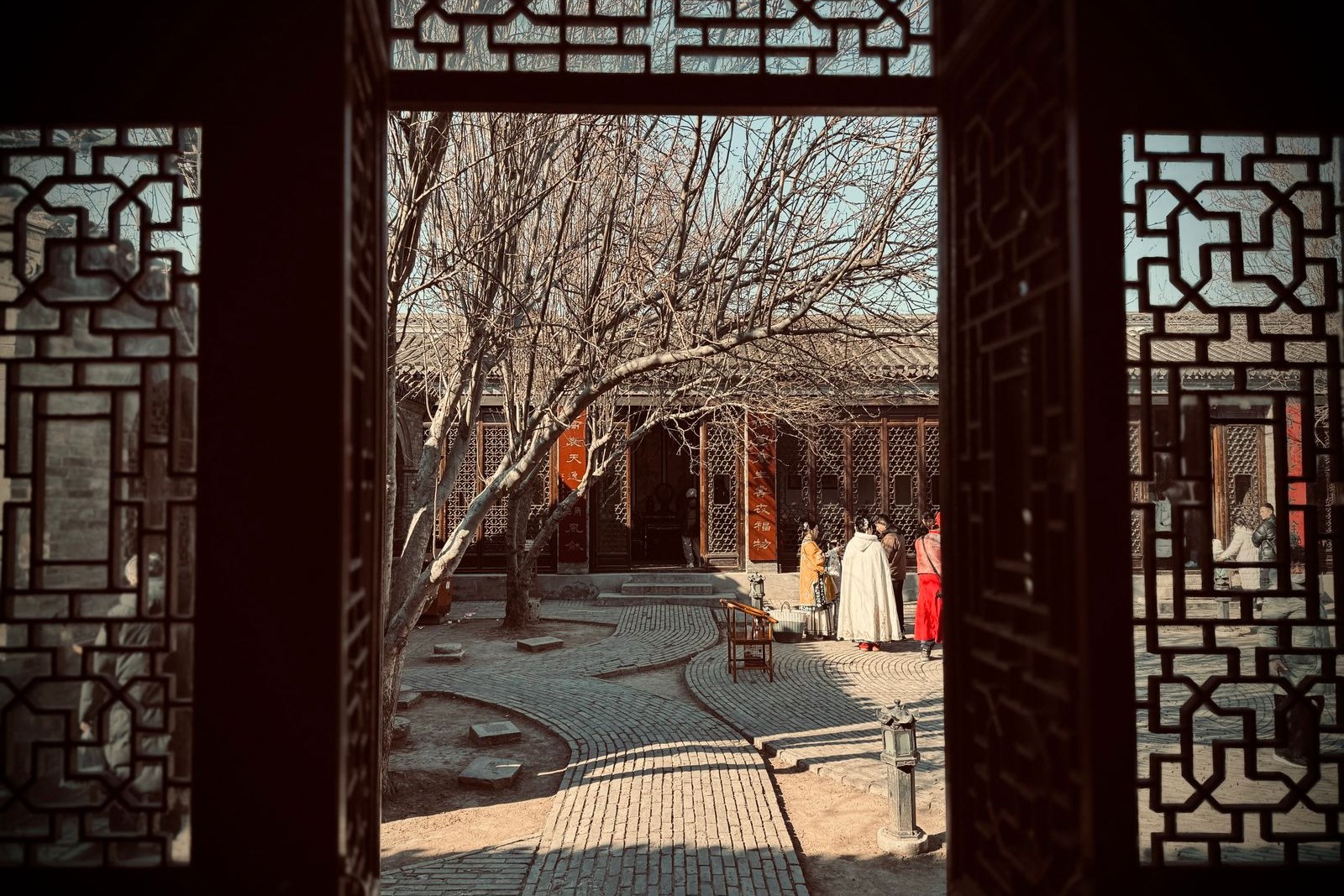
The street frontage gives nothing away. Behind a blank wall with a narrow doorway, a few steps off the restored arcades of 小公园 Xiǎogōngyuán, the building opens into a courtyard with a tree in it, a stone floor, a few chairs and a tea table, and around it the rooms of what was once a merchant’s house. This is the older building type of the city, the 四点金 sìdiǎnjīn or 驷马拖车 sìmǎ tuōchē courtyard plan that prosperous Chaoshan families built when they were doing well and that is still the standard against which local architecture is measured. The street wall is deliberately plain; the money was spent inside, on the carved beams, the stone jambs, the roof tiles and the depth of the courtyard. A handful of these houses have been restored as small hotels, and staying in one is the quietest way to be in the middle of the old town.
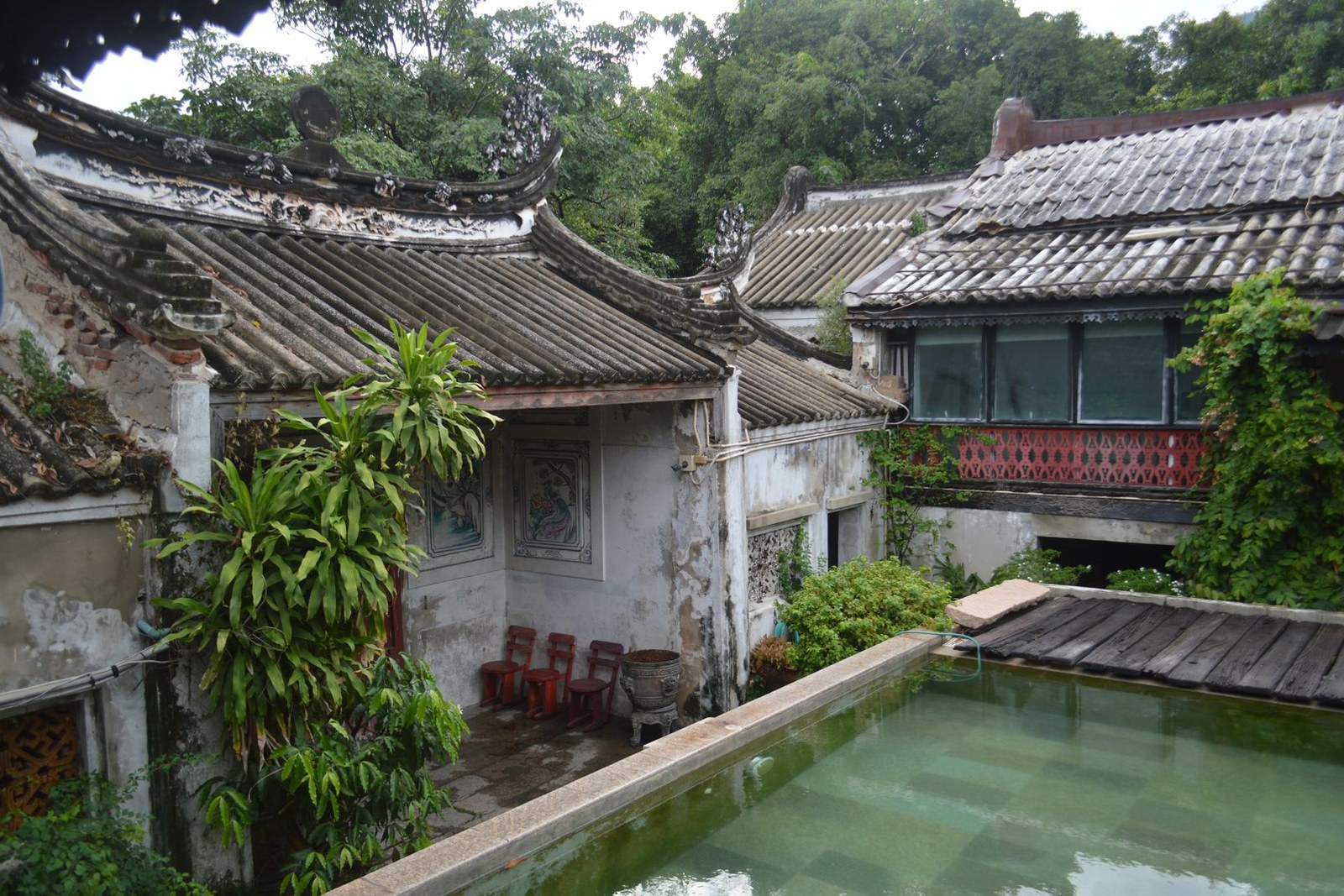
The plan is a letter or a rectangle of rooms around an open centre, with the main hall on the far side facing the entrance and the family rooms along the sides. Two features are worth knowing before you book. The first is the courtyard itself, which is not decorative: it brings light and air into the middle of a deep building and it collects the rain, which drains away under the floor. The second is the 天井 tiānjǐng, the small open court, and the resulting cross-ventilation, which is why these houses are noticeably cooler than the streets in summer without any mechanical help. Restoration work in the old town has been uneven, and the best courtyard conversions are careful about which parts they replace; the worst are simply new buildings behind old walls. Ask which one you are booking.
What the Rooms Are Like
Rooms are arranged around the court, and where yours sits determines what kind of stay you have. The main hall rooms are the largest and the most formal, with the carved beams and the high ceiling; the side rooms are narrower and lower; the rooms nearest the entrance get the noise from the street through the door. All of them open onto the courtyard rather than onto a corridor, which means that you cross open air to reach the bathroom in some houses and that you will hear the rain. Windows tend to be small and timber-framed, and daylight arrives mainly from the court, so the rooms are genuinely dark in the middle of the day, which many guests find restful and some find gloomy. Air conditioning has been retrofitted in most, and the older the house, the more visible the pipework.
Practicalities
Price. A double room runs roughly ¥250 to ¥600 a night, with the main-hall rooms at the top of the range and the side rooms well below it. Families booking two or three rooms around one side of the court often get a better rate than the same rooms booked separately, and a few houses will rent the whole courtyard for a group. Rates hold through the winter, which is the local high season, and soften in the hot and wet summer months.
Address. The courtyard conversions sit in the lanes behind the main arcades of 小公园 Xiǎogōngyuán, in 金平区 Jīnpíng Qū, within walking distance of the market streets, the harbour front and most of the old town’s food. The exact location matters less than the lane, because the old quarter is dense and a handful of streets carry most of the traffic.
Rooms. Ask whether the room opens onto the courtyard or onto a corridor, which side of the court it is on, and whether the bathroom is inside the room or across the open air. Ask about air conditioning and about heating, because a stone and timber house is cold in winter by southern standards and not every conversion has solved it. If the house has a second storey, ask whether it is original or added, since a new upper floor over an old courtyard is a different building.
Getting there. The house is in the centre of 汕头市 Shàntóu Shì, ten to twenty minutes by taxi from 汕头站 Shàntóu Zhàn, the railway station, and around forty minutes from 揭阳潮汕国际机场 Jiēyáng Cháoshàn Guójì Jīchǎng. The lanes are too narrow for anything but a small car, so a taxi will usually stop on the nearest main street and you will walk the last hundred metres. There is no parking at the door.
flowcloud would say that the courtyard house asks a guest to choose between light and quiet, and that the people who sleep best in one are the people who decide on the first morning that the dark is the point.
Where to stay: in a restored courtyard house in the lanes behind 小公园 Xiǎogōngyuán, in a room that opens onto the court rather than a corridor, ideally on the main hall side. Confirm before booking whether the bathroom is en suite, whether the house has heating for the winter, and whether the upper floor is original, and ask the hosts to leave the courtyard light on in the evening, because the rooms themselves go dark early.