
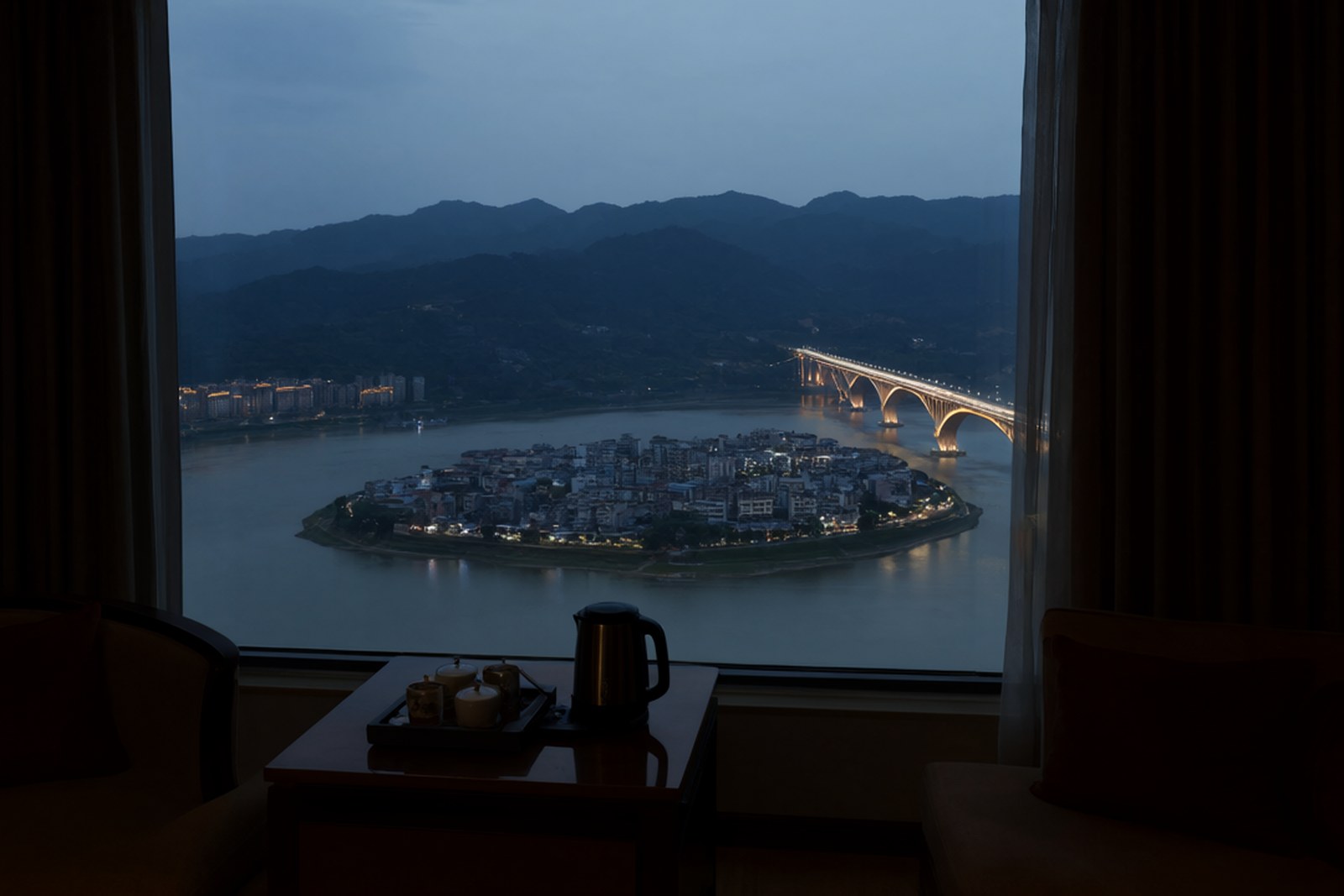
韶关市 Sháo guān shì is the town at the top of 广东 Guǎng dōng where the province narrows into the 南岭 Nán lǐng passes, and the first thing a hotel booking has to understand about it is that the city centre is not on one river but between two. The 浈江 Zhēn jiāng, which locals call the 东河 dōng hé – the east river – has the old town on its left bank, and the 武江 Wǔ jiāng, the 西河 xī hé – the west river – has the newer half of the city on its right. The two meet at the southern tip of the peninsula and become the 北江 Běi jiāng, one of the three great river systems of the 珠江 Zhū jiāng delta, and the local phrase for the result is 三江六岸 sān jiāng liù àn: three rivers, six banks. The practical consequence, for anyone choosing a room, is that a great many windows in this city have water in front of them, and the room you want is the one that gets the right water.
The second thing worth knowing, and it decides where you sleep, is that 韶关 has two railway stations and they are thirteen kilometres apart. 韶关站 Sháo guān zhàn, the high-speed station, is in 武江区 Wǔ jiāng qū and is the first stop the 武广 Wǔ guǎng line makes after it comes down out of 湖南 Hú nán – the first high-speed station in the province, measured from the border. 韶关东站 Sháo guān dōng zhàn, in 浈江区 Zhēn jiāng qū, is the ordinary station and takes the slow trains. A third, 丹霞山站 Dān xiá shān zhàn, stands out at 周田镇 in 仁化县 on the 赣韶 Gàn sháo line, which is a detail worth filing because it is the reason a visitor can arrive here and be at the foot of the red cliffs the same afternoon. Between them the two city stations split the trade in a way that tells you immediately which half of town is for arriving and which half is for staying. The walkable half is 浈江区, and it is older than it looks. Before the railway reached it, the river system was the road, and the bank of the 浈江 upstream of the confluence was the port: 百年东街 bǎi nián dōng jiē, the Hundred Year East Street, was the point where 中原 zhōng yuán goods coming south over the passes met goods going down to the 珠三角 Zhū sān jiǎo, and by the late Qing and the Republic it was the busiest trading street at the junction of the three provinces of 广东, 湖南 and 江西 Jiāng xī. The old accounts call it 老板街 lǎo bǎn jiē, the street of the bosses, and give it four great trading houses – 常丰, 慎安, 和昌 and 阜民 – and one great sauce yard, 隆盛酱园. Half the street lived out over the water: 吊脚楼 diào jiǎo lóu, stilted houses with their legs in the mud, lined the bank in long rows until they were swept out of the record by a flood. The street was rebuilt from 2011 with its 南洋骑楼 nán yáng qí lóu – Southeast Asian arcade – frontages kept, eight hectares of shops and lanes where the trading houses were, and it is where the hotels of the old town now stand.
The landmark on that bank is the thing every visitor photographs, and the numbers behind it are better than the building. 风采楼 Fēng cǎi lóu was put up in 1497 by the prefect of 韶州, 钱镛 Qián Yōng, in honour of 余靖 Yú Jìng, a minister of the Northern Song from this prefecture who was praised by 宋仁宗 Sòng Rén zōng in a line the city has been quoting for nine hundred years – 风采第一,广南定乱,经略无双 – first in bearing, the man who settled the south, without an equal in strategy; the two characters 风采 on the board are taken from a poem by 蔡襄 Cài Xiāng and the brushwork on the plaque is the work of the Ming scholar 陈白沙 Chén Bái shā, written with a 茅龙笔 máo lóng bǐ, a brush made from bundled straw. The building has been destroyed and rebuilt several times, moved and re-erected in reinforced concrete in 1934, and now stands about twenty-two metres tall over a round arch that traffic drives through, on the same axis as the river.
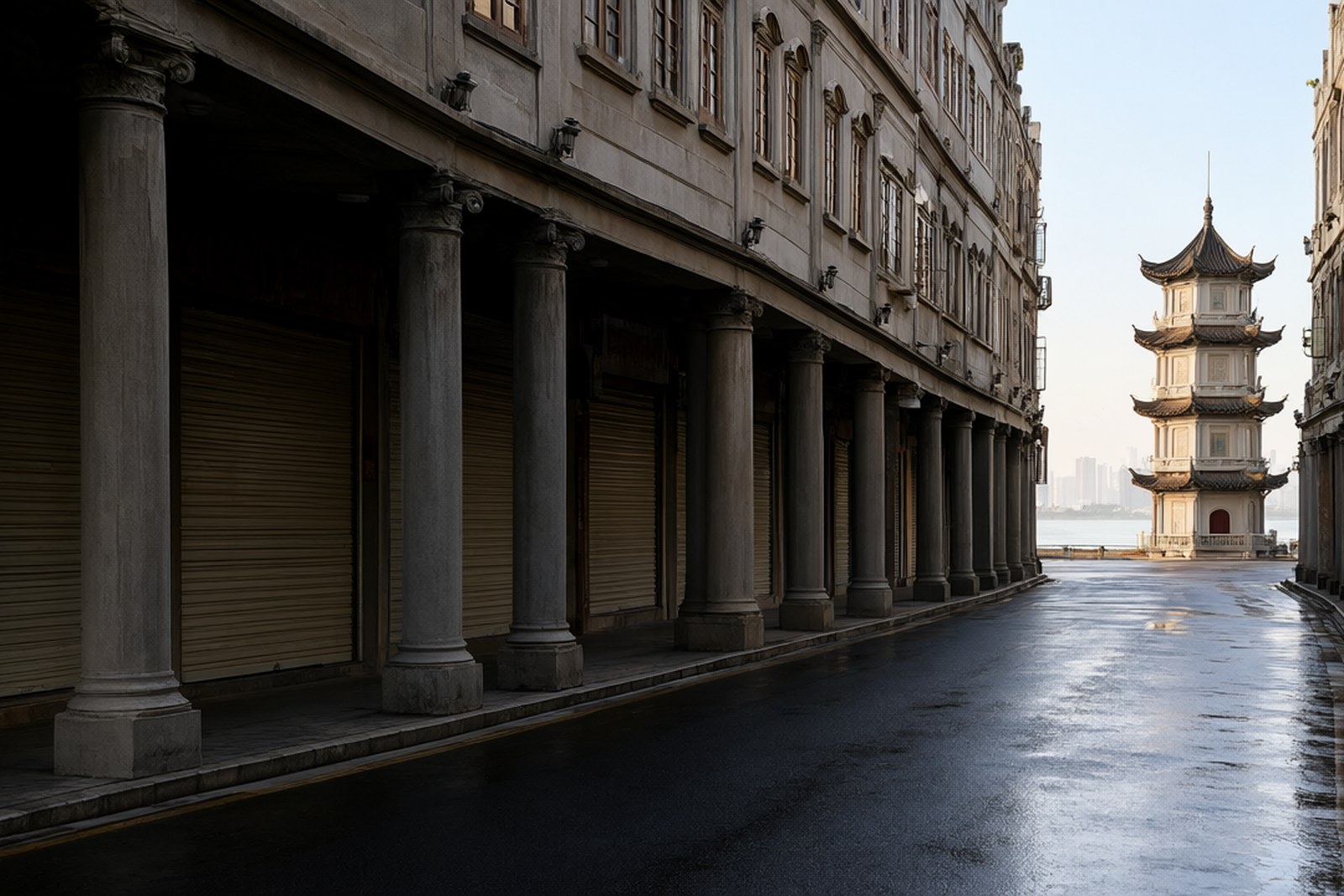
And what is inside walking distance of a room here is more than a hotel row: the 韶州府学宫 Sháo zhōu fǔ xué gōng, the prefectural Confucian hall, is less than a hundred metres from the arcades and keeps its 大成殿 dà chéng diàn; the 濂溪书院 Lián xī shū yuàn and the 广州会馆旧址 Guǎng zhōu huì guǎn jiù zhǐ, a guild hall first built in 1756 with a gate tower rebuilt in the 咸丰 Xián fēng years, are in the same block; 广富新街 Guǎng fù xīn jiē is the 广式 Guǎng shì terraced row the city points at when it talks about its own architecture; 太傅庙 Tài fù miào is a few lanes off. The view across the water, meanwhile, is a rebuilding of a view that was lost: 通天塔 Tōng tiān tǎ stands on the island at the exact point where the 浈江 and the 武江 meet, first built in 1546, destroyed in the fighting of 1854, counted for three centuries among the 曲江二十四景 Qǔ jiāng èr shí sì jǐng, the twenty-four views of 曲江, under the name 中流塔影 zhōng liú tǎ yǐng, the shadow of the tower in midstream. The new tower is thirty-nine metres, octagonal, nine storeys, and the hotel rooms on the south side of the old town look straight at it.
The last thing that matters about the ground is what it connects to. 韶关 is a long, thin prefecture wrapped around the northern edge of the province, and its sights are all out of town: the red cliffs at 仁化, the monastery at 曲江, the pass and the migration lane at 南雄, the springs and the forest at 乳源. Every one of them is a day trip from the city and none of them is walkable, which is exactly the argument for a bed here. 南华寺 Nán huá sì is about twenty kilometres out in 曲江区, an easy half day; the 丹霞山 shuttle leaves from a stop a hundred metres outside the high-speed station and takes about seventy minutes for roughly twenty-one yuan, and 韶关东站 has the same connection in fifty minutes from a stop fifty metres from the exit, first bus at 06:50 and one every fifteen to thirty minutes after that. There are inter-county buses to 乳源, 南雄 and 翁源, the 韶关丹霞机场 Sháo guān dān xiá jī chǎng opened in November 2021 about twenty-nine kilometres out with a coach link to the stations, and there is a 国庆 guó qìng tourist loop bus that runs the city sights in one line from 中山公园 through 风采楼 and 百年东街 to the parks. What a city hotel buys you is the ability to come back from any of that to a bath, a bowl of food and a river with lights on it. And the practical case for the 浈江区 old town over the newer towers in 武江区 is simply that everything above is on foot from a room there: the arcades, the 府学宫, the 风采楼 and the embankment, with a bus stop for the 丹霞山 connection a short taxi ride away.
What the Rooms Are Like
The stock here is ordinary Chinese city hotel stock and it is worth being specific about it, because the range is wider than the price difference suggests. The chain properties do the volume: a 丽枫酒店 grade building near the east station, a 7天 grade building on the walking street whose front door is forty-four metres from the 百年东街 arcades, eighty-three from the 府学宫 and a hundred and thirteen from 风采楼. A room in that class is eighteen to thirty square metres, tiled or laminate floor, a big bed or two singles, air conditioning, a kettle, a small desk, a shower over a tray, and in the newer ones a window wall and a card-entry lift. The best of the cluster is one step up: a 江景 jiāng jǐng room on a high floor of a 浈江 岸 or 武江 岸 tower, sold as a grade, with the river filling the window and the 通天塔 or the bridge in it. Older city hotels run cheaper and smaller and put the money into a dining room instead of the fittings. It is worth knowing which of the three grades you are buying, because on this ground the floor and the direction are worth more than the fixtures: a tenth-floor room facing the water at this price is a better room than a seventeenth-floor room facing the next building. Two small things decide the rest of the stay. The first is breakfast, which in this city means rice noodles from a shop on the street rather than a hotel buffet, and a guest who eats out has understood the place better by nine in the morning than one who does not. The second is traffic: the embankment roads carry cars late, so a river-facing room on the third floor hears the bridge all night while the same room on the twelfth hears the water.
Practicalities
Price. A double in central 韶关 runs about ¥88 to ¥300 a night, which is the range the city’s own chain stock occupies – the bottom of it is an older building on an inside room, the top is a higher-grade chain or a good river-facing room, and the 江景 rooms sit at the top of that. Weekends in the 丹霞山 season, the 春节 Chūn jié week and the first week of October are the only times the price moves much. Treat every figure as a range, not a quotation, and check the live rate for the nights you want, because the platforms reprice by the day and by the promotional channel.
Address. The old-town hotels are in 浈江区 Zhēn jiāng qū – 东堤中路 dōng dī zhōng lù and 风采路 fēng cǎi lù, the riverside and walking-street cluster, with the arcades, the 府学宫 and the 风采楼 all inside a few hundred metres; the newer and quieter stock is in 武江区 Wǔ jiāng qū, around the district government, 粤北人民医院 Yuè běi rén mín yī yuàn and 惠民南路 huì mín nán lù; 韶关东站 is two kilometres from the old town and 韶关站 thirteen and a half, and the airport about twenty-nine kilometres north-east of the centre.
Rooms. Ask for the river side and a floor above the tree line, and ask which river, because 浈江 and 武江 give you two different towns – the 浈江 side has the arcades and the old bank under it, the 武江 side has the wider water and the newer skyline. Ask whether the window looks at the confluence and the 通天塔, since that is the view worth paying for and the back of the same building is a car park. Ask for a kettle and a hot-water flask rather than a minibar, ask whether the hotel runs a shuttle to 韶关站 or 韶关东站, and ask the desk to write 百年东街, 风采楼 and 丹霞山 in Chinese for a driver, because the place names here are short and easy to confuse over the noise of a street.
Getting there. 韶关站 Sháo guān zhàn on the 武广 high-speed line is in 武江区 Wǔ jiāng qū and is the first stop in 广东 coming down from 湖南; 韶关东站 Sháo guān dōng zhàn, the ordinary station, is in 浈江区 Zhēn jiāng qū about two kilometres from the old town; 丹霞山站 Dān xiá shān zhàn at 周田镇 in 仁化县 is thirteen kilometres from the 丹霞山 gate and about twenty minutes by bus. 韶关丹霞机场 Sháo guān dān xiá jī chǎng opened on 27 November 2021 and has a coach link to the stations. By road the city is on the 京港澳 Jīng gǎng ào and 韶赣 Sháo gàn expressways, about three hours from 广州 Guǎng zhōu, and the inter-county buses for 乳源, 南雄, 翁源 and 乐昌 leave from the city bus stations, so a car or a bus rather than a train is the ordinary way to reach the sights.
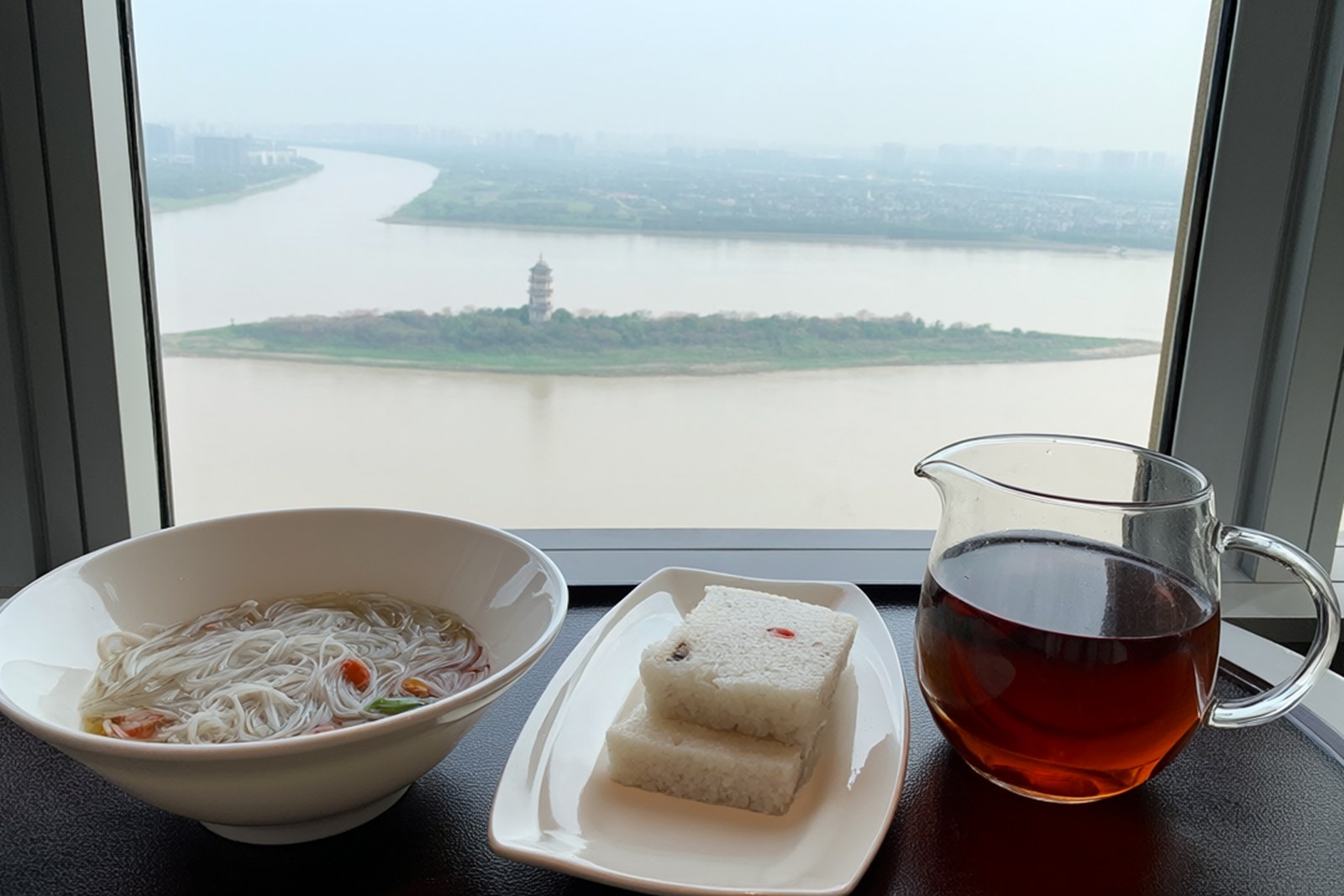
Where to stay: a high-floor river-facing room in the 浈江区 old-town cluster, in the block between 东堤中路 and 风采路 where the 百年东街 arcades, the 府学宫 and the 风采楼 are all a short walk along the embankment. Take the 江景 grade rather than the inside room, walk the arcades before breakfast and the embankment after dinner, and use the city as the base for 仁化, 曲江, 南雄 and 乳源, all of which are day trips rather than walks.
flowcloud would say that a town which three rivers have cut into six banks, which lost its stilted riverside houses to a flood and rebuilt its old trading street anyway, and which moved a five-hundred-year-old pavilion rather than demolish it, has already decided that the water is the address – and that a room high enough to see two rivers become one is the only room worth booking here.