
Chongqing is a municipality of southwest China; Yuzhong is its central district on the peninsula where the Yangtze meets the Jialing River, and the district’s townscape falls into two halves the locals call the upper and lower city. 十八梯 Shíbātī, Shibati, is the seam between them: the slope of lanes running from the back of the Jiefangbei quarter down towards the Yangtze, laid out anew as the Shibati traditional quarter and entered, in 2025, on the national list of tourism and leisure streets in its fourth batch, with its E zone unveiled the same year. This piece is about sleeping on that slope – a courtyard house on the old lanes at one end of the ladder, a duplex attic with a soaking tub at the other, and between them the minsu belt of 南纪门 Nánjìmén, Nanjimen, and 白象街 Báixiàng Jiē, Baixiang Street. The thesis is the slope itself: rooms here are reached by steps, the evening ends earlier than it does by the river, and the walk home is downhill from everything.
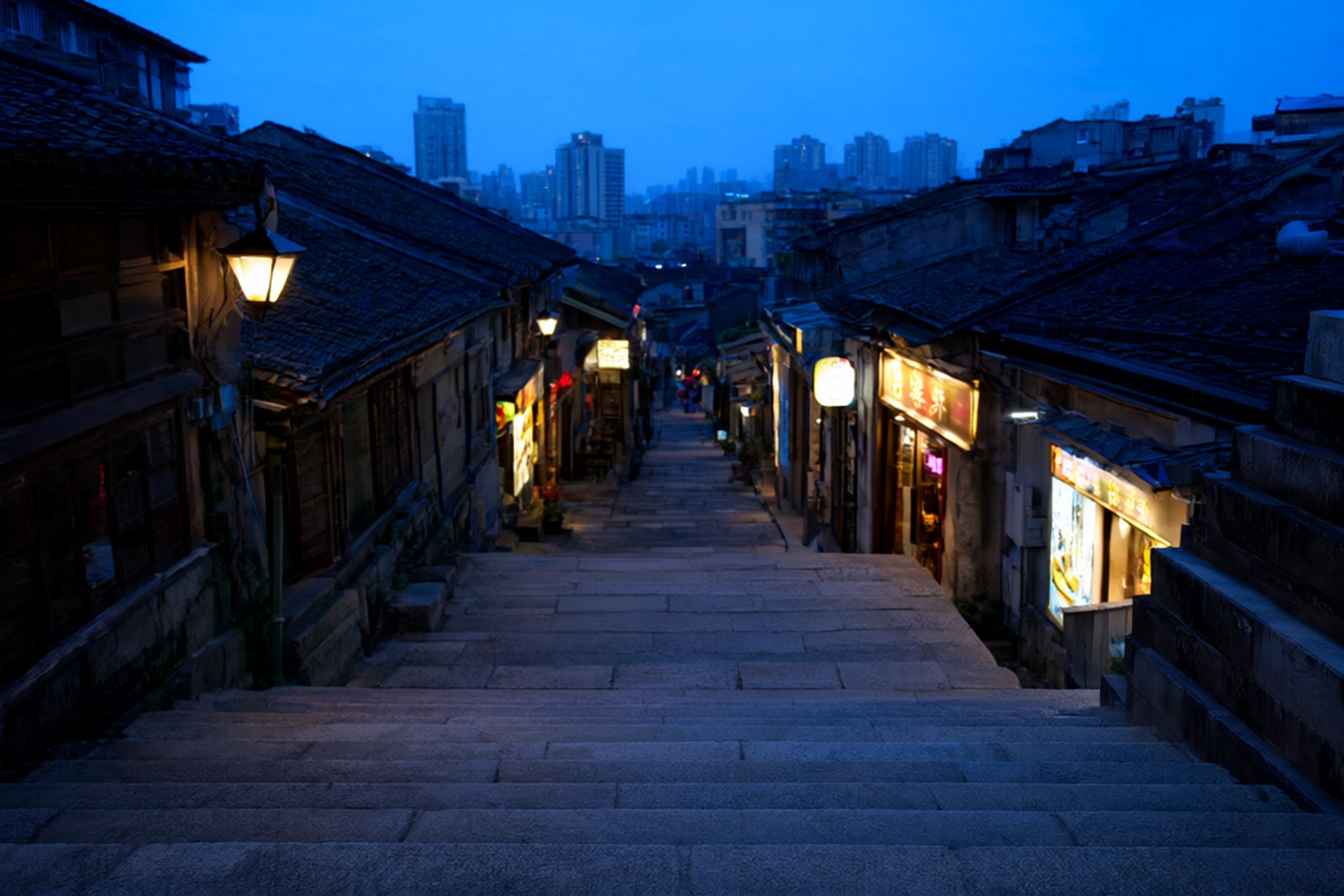
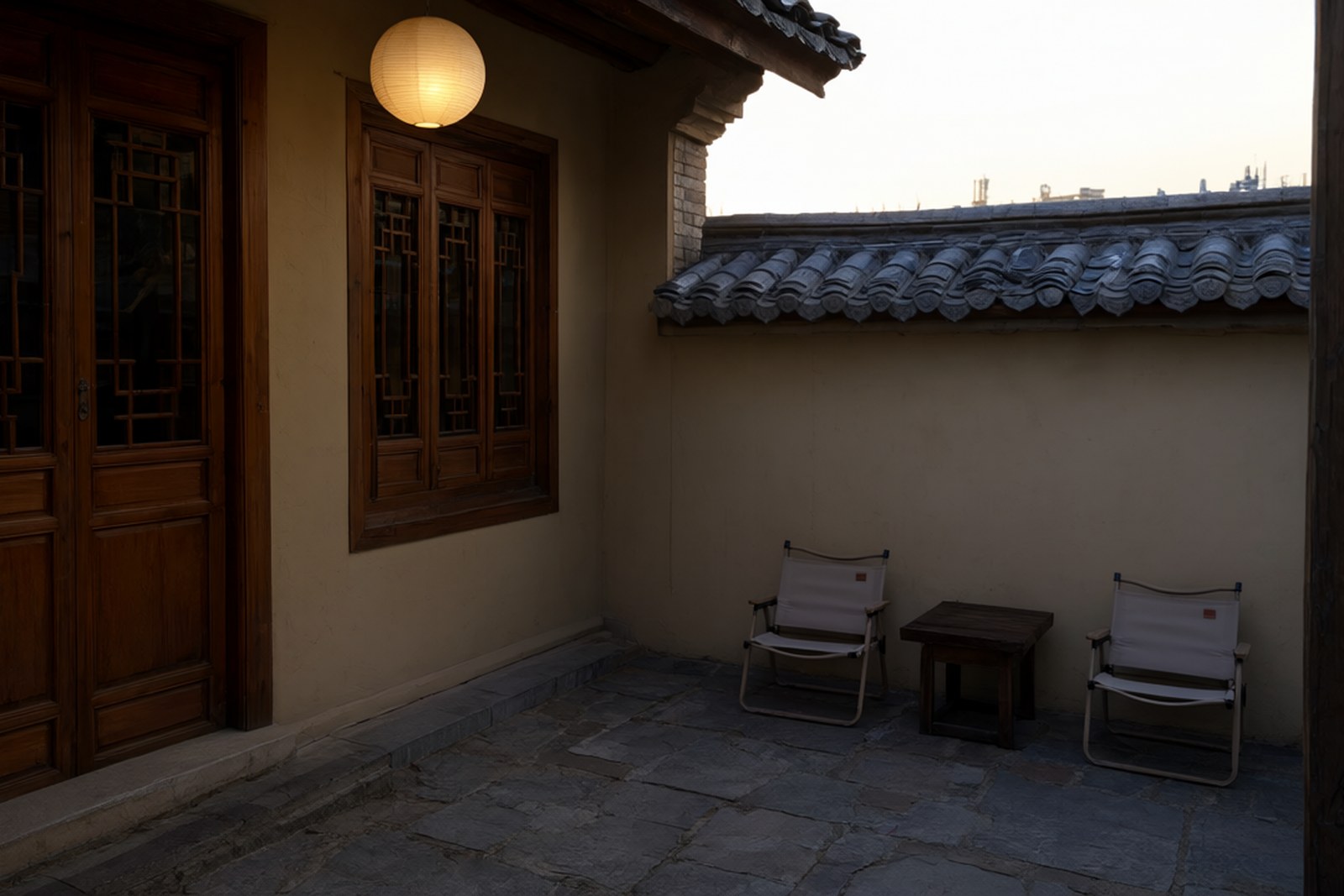
At the top of the ladder sit two standalone houses, both new openings, described as the platforms describe them. 璞境 Pújìng, Pure Realm, at 15 善果巷 Shànguǒ Xiàng, Shanguo Lane, is a whole detached house on the lane itself, from about 768 yuan a night, pet-friendly by the platform’s label, with rooms named for deep sleep, for the panorama over the steps and for the old lane. 观隐·十八居 Guānyǐn Shíbājū, Guanyin Shibaju, at 凤凰台 Fènghuáng Tái, Fenghuangtai, 10 attached 5, on 解放西路 Jiěfàng Xī Lù, Jiefang West Road, runs from about 1,381, with duplex attic suites carrying private soaking tubs, a tea room, a garden and free parking by the platform’s listing. Neither is a hotel floor in the ordinary sense: both are single buildings on lanes that existed long before the restoration, and the platform tags are the platform’s own, not official ratings.
Below them the slope is cheap, and cheaper the further down it goes. The Nanjimen and Baixiang Street minsu belt trades at about 160 to 320 yuan a night in the 2026 platform guides; 揽江宿 Lǎnjiāngsù, Lanjiangsu, keeps a 45-square-metre flat at 229 Jiefang West Road for about 400 to 500; and the chains around Jiaochangkou sell rooms from about 180 to 350 within a short walk of the north gate by the guides’ measure. The quarter is free to enter and its hillside memory hall free without reservation; the old tunnel’s historical exhibition inside it is separately ticketed and is a history-education exhibition, which is all this piece needs to say of it. The quarter’s lights run, by the platform guides’ account, from 18:30 to 22:00 – earlier than the government-scheduled performance on the Jialing side – and every operational figure here is subject to the on-site notices on the day.
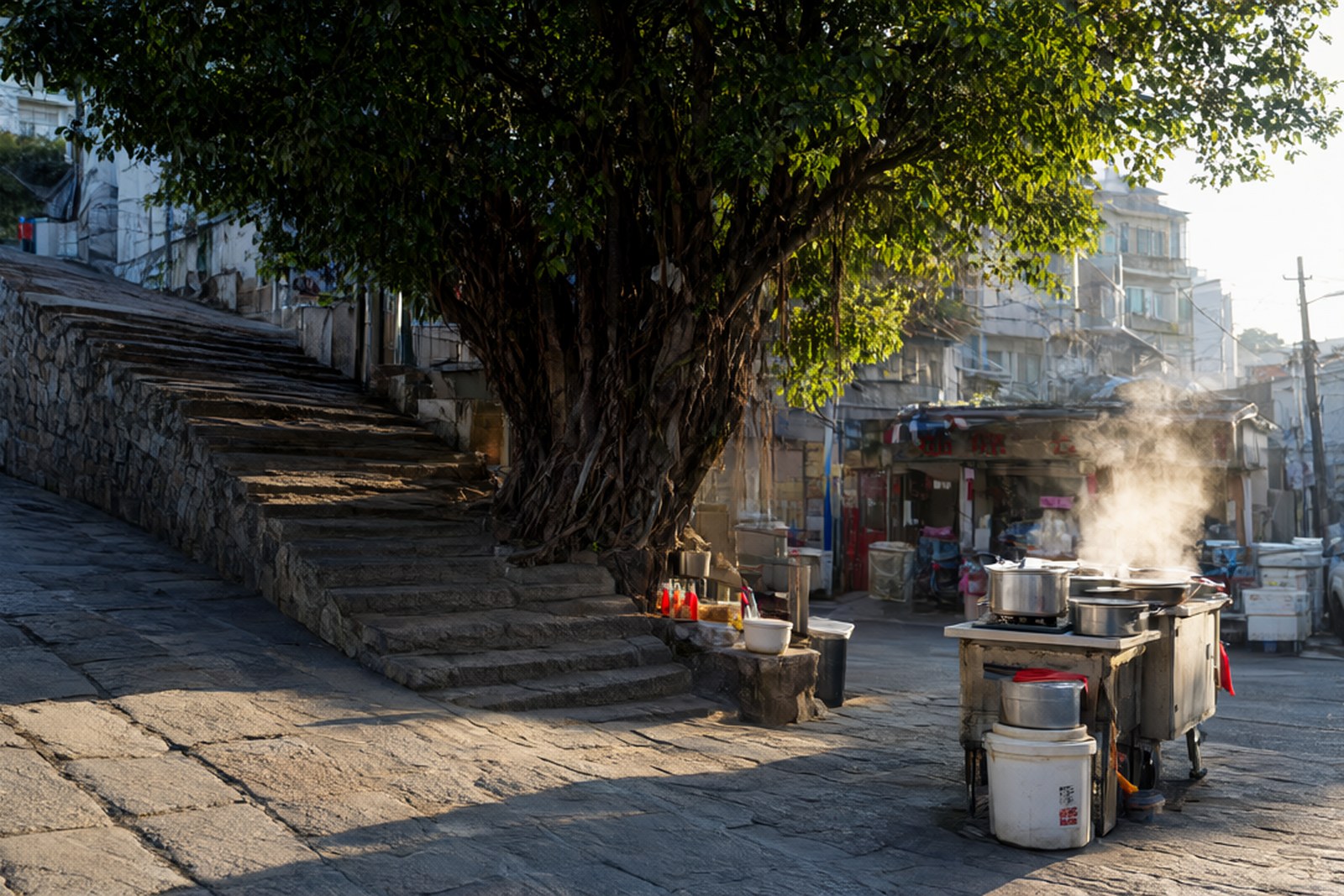
The slope is the experience, and the descent is the planned route. The walking guides run it from the north gate viewing platform by Jiaochangkou down the main stone steps, past the hillside memory hall, the old-well square and the restored stilt-house lanes to the lower gate on the riverside road – two to three hours of downhill, with a self-paid viewing lift for anyone who would rather not earn it. Enter after five in the afternoon, the guides suggest, and you collect the daylight view and the lit lanes in one pass before the 22:00 lights-out. The quarter does not stand alone: the restored hillside footpath system links it towards 山城巷 Shānchéng Xiàng, Shancheng Lane, along a cliff-side line the district government reports as about eight kilometres and basically connected.
Four boundaries place this piece. Against the walled garrison town of Dapeng in Shenzhen, covered elsewhere on this site: Dapeng is a Ming fort with walls, and Shibati is a slope – no walls, just steps, and the old street is a 2020s restoration of a hillside lane network. Against Chikan in Jiangmen: Chikan’s arcades sit on a flat river plain, while Shibati’s lanes climb and half the rooms look down onto roofs. Against this batch’s Jialing-side piece: that one buys a window on the government-scheduled performance; this one stays on the Yangtze slope, where the lanes go dark at 22:00 and the evening is quieter for it. And against the stilt houses themselves: Hongyadong is a stacked facade you photograph, and Shibati is a neighbourhood you sleep inside.
What the Rooms Are Like
Expect a room inside a building that predates the booking platform. The courtyard houses sell a handful of rooms each, named for what they face – the steps, the lane, the sunset – and the slope apartments above Nanjimen and Baixiang Street are ordinary flats converted a floor at a time, which makes the building, the floor and the route from the lane count more than any category name. The duplex attics with soaking tubs are the signature product at the top of the ladder. Exact room counts are not confirmed in government or operator sources. Confirm three things when booking: whether the room is reached by steps alone with luggage, whether the attic bath is a soak or a shower, and whether breakfast exists at all.
Practicalities
Price. In an October 2026 platform snapshot the slope ran from about 160 to 1,381 yuan a night: the Nanjimen and Baixiang Street minsu belt at about 160 to 320, slope-side flats at about 400 to 500, the chains around Jiaochangkou from about 180 to 350, and the standalone lane houses from about 768 and 1,381. Holidays climb above these levels; every figure is a snapshot that floats.
Address. 重庆市渝中区 Zhōngqìng Shì Yúzhōng Qū, Yuzhong District, Chongqing, the lower city around the Shibati traditional quarter – the lane houses at 善果巷 15 号 Shànguǒ Xiàng 15 Hào, 15 Shanguo Lane, and 凤凰台 10 号附 5 号 Fènghuáng Tái 10 Hào Fù 5 Hào, Fenghuangtai 10 attached 5, the flats at 解放西路 229 号 Jiěfàng Xī Lù 229 Hào, 229 Jiefang West Road, and the minsu belt around 南纪门 and 白象街, Nanjimen and Baixiang Street.
Rooms. Two shapes dominate: the standalone courtyard house, a handful of rooms named for their outlook with duplex attic suites at the top, and the converted slope apartment, an ordinary flat on a mid-rise floor. Exact room counts for individual properties are not confirmed in government or operator sources, so any precise number is the platform’s own; pin down the building, the floor and the route from the lane before paying.
Getting there. Metro 较场口 Jiàochǎngkǒu, Jiaochangkou, on Lines 1 and 2, is the approach the guides recommend, exits 3, 4 or 11, three to five minutes on foot to the north gate by the platform’s measure and best confirmed by navigation; Line 1 runs direct from the Chongqing North station direction. Drivers navigate to the quarter’s B or D underground car parks, where the platform guide reports a 24-hour cap of about 25 yuan, with the on-site notices governing. Trains run roughly 06:30 to 23:00 with announced holiday extensions.
Where to stay: a lane-house room from about 768 yuan if the courtyard and the view down the slope are the point, a converted flat around Nanjimen or Baixiang Street from about 160 to 320 if the budget is the point, and the duplex attic at about 1,381 if the soak after the descent is the point – because on 十八梯 Shíbātī, Shibati, the room you book is measured in steps, and the walk home is downhill.
flowcloud would say that the quarter’s own lights go out two hours before the river’s do, and that the correct way to sleep in the lower city is in a courtyard room at a quarter of the circle’s price, because the slope you climb to Jiefangbei is the same one that keeps the prices down.