
The most modern place in Zhuhai is not on the water. 唐家湾镇 Tángjiāwān Zhèn, Tangjiawan Town, sits at the northern foot of 凤凰山 Fènghuáng Shān, Fenghuang Mountain, in 香洲区 Xiāngzhōu Qū, Xiangzhou District, in 珠海市 Zhūhǎi Shì, Zhuhai City, a prefecture-level city of 广东省 Guǎngdōng Shěng, Guangdong Province, and is administered by the 珠海国家高新技术产业开发区 Zhūhǎi Guójiā Gāoxīn Jìshù Chǎnyè Kāifā Qū, the Zhuhai National Hi-Tech Industrial Development Zone. It was listed as a Chinese historic and cultural town in May 2007, and the sources call it the first town of modern Chinese history. The roll of names that came out of it is genuinely improbable for a single township: 唐绍仪 Táng Shàoyí, first premier of the Republic, whose garden still stands; 唐廷枢 Táng Tíngshū, founder of the Kaiping mines and of the China Merchants Steam Navigation Company; and 唐国安 Táng Guó’ān, first president of Tsinghua. Zhuhai is also the home town of 容闳 Róng Hóng, Yung Wing, the father of Chinese students abroad, and that study-abroad thread runs through the town’s own museum, which the sources call the first of its kind in the country. About five kilometres to the south-west, in the same town, lies 会同村 Huìtóng Cūn, Huitong Village, laid out in the Qing under the Yongzheng reign, in 1732, by 莫与京 Mò Yǔjīng, whose courtesy name Huitong gave the village its name, when he led the Mo, Bao and Tan families to a new site among hills he thought too beautiful to leave empty. Between the arcade street and the village with the gate tower, this is where the beds of old Zhuhai are.
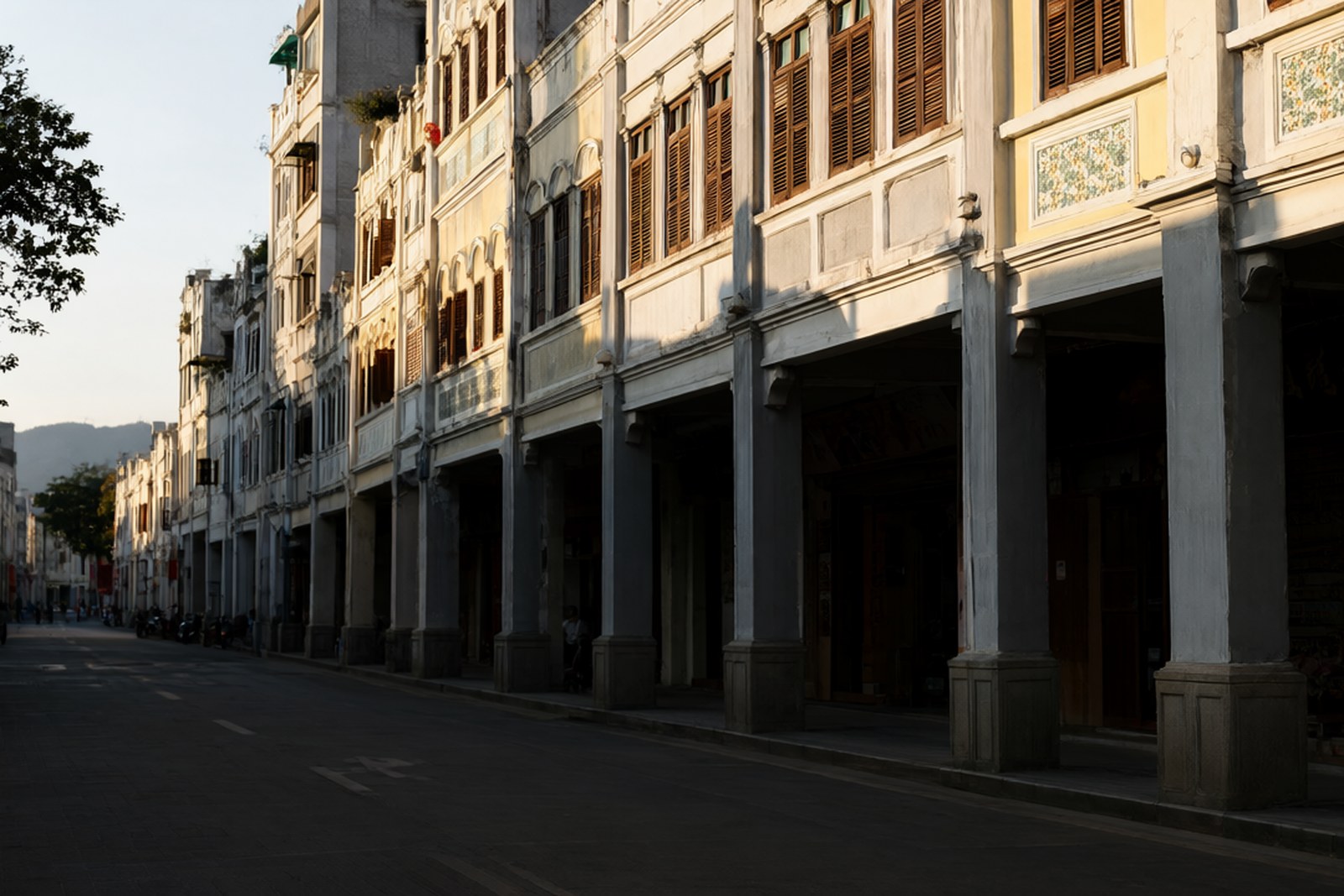
The place to stay is not a hotel but a row of old houses on 山房路 Shānfáng Lù, Shanfang Road, the spine of the old town and the street the local phrase calls half a volume of modern history. Ancestral halls, merchant houses and private villas along it have been turned into small inns, and in an October 2026 snapshot they ran as a compact ladder: 山房客栈 Shānfáng Kèzhàn, Shanfang guest house, at 山房路 263 号 Shānfáng Lù 263 Hào, from about 257 yuan, with doubles, tatami rooms, a six-person room and hostel beds sharing bathrooms; 龙庆门民宿 Lóngqìngmén Mínsù, the Longqingmen guest house, at 龙庆街一巷 3 号之一 Lóngqìng Jiē Yī Xiàng 3 Hào Zhī Yī, from about 337; 鼎森贤居民宿 Dǐngsēn Xiánjū Mínsù, Dingsen Xianju, at 丽泽巷 25 号 Lìzé Xiàng 25 Hào, from about 360, with family suites and a whole-villa option; 老同学民宿 Lǎotóngxué Mínsù, the Old Classmates guest house, at 前环路 38 号 Qiánhuán Lù 38 Hào, from about 369; 里苑·唐家小院 Lǐyuàn Tángjiā Xiǎoyuàn, Liyuan Tangjia courtyard, at 鸭塘巷 6 号 Yātáng Xiàng 6 Hào, from about 527, whose categories include a slope-roofed double, loft tatami rooms and a whole-house booking with a tea courtyard; and 学镜堂客栈 Xuéjìngtáng Kèzhàn, the Xuejingtang guest house, at 山房路 64 号 Shānfáng Lù 64 Hào, from about 606, with garden and terrace suites. Two more sit just off the main lane, 栖居精品民宿 Qījū Jīngpǐn Mínsù, Qiju, at about 554, and 漾阁·泊心别苑 Yànggé Bóxīn Biéyuàn, Yangge Boxin, at about 813, and 梧桐居 Wútóng Jū, Wutongju, at 山房路 277 号 Shānfáng Lù 277 Hào, tops the list at about 910. None of them is a hotel floor: they are a few rooms to a house, and the price is set as much by the size of the courtyard as by the season.
Huitong, down the road, is the second half of the story and the better one to tell. The village keeps 38 traditional Guangdong houses together with the Mo ancestral hall, the Jilu house and the Qixia villa, laid out in the three-streets-and-eight-lanes grid the sources describe, with about 7,897 square metres of historic building inside the core. It was a compradore village rather than a farming one: 莫仕扬 Mò Shìyáng, 莫藻泉 Mò Zǎoqüán and 莫干生 Mò Gānshēng, three generations of the Mo family, served as compradores for the Swire trading house in Hong Kong, China, over sixty-one years, and the money they sent home built the village and its most unusual structure. 栖霞仙馆 Qīxiá Xiānguǎn, the Qixia villa, went up in 1920, by the sources’ later reckoning, as a garden retreat that mixes a Chinese gate tower built for watchkeeping with a Western gatehouse, a hall modelled on the Swire office, and, in its grounds, a Chinese hexagonal pavilion, a Japanese hip-and-gable thatched pavilion and an Indian-style li-chi pavilion all at once. The detail that makes the village famous is what the family did with it: they bought a diesel generator from Hong Kong, China, and wired the whole village, and they brought in a film team every few months to screen films in the garden, so that by 1922 Huitong had become the first village in the Xiangshan area with electric light and moving pictures. The ancestral hall is now a village history museum and the old Tiaomei Mo hall an arts centre, and since 2020 a development company has run a revival programme that has brought in a courtyard guest house, 花筑·隐庐 Huāzhù Yǐnlú, a hand-made tea-cake shop and other small businesses; the sources put cumulative visitors at about 800,000 by 2023. The village is free and open at all hours, and there is camping in the fields around it as well, at 山野间·会同营地 Shānyějiān Huìtóng Yíngdì on Jinhui University Road and 大热荒野会同古村露营地 Dàrè Huāngyě Huìtóng Gǔcūn Lùyíngdì beside the village farm.
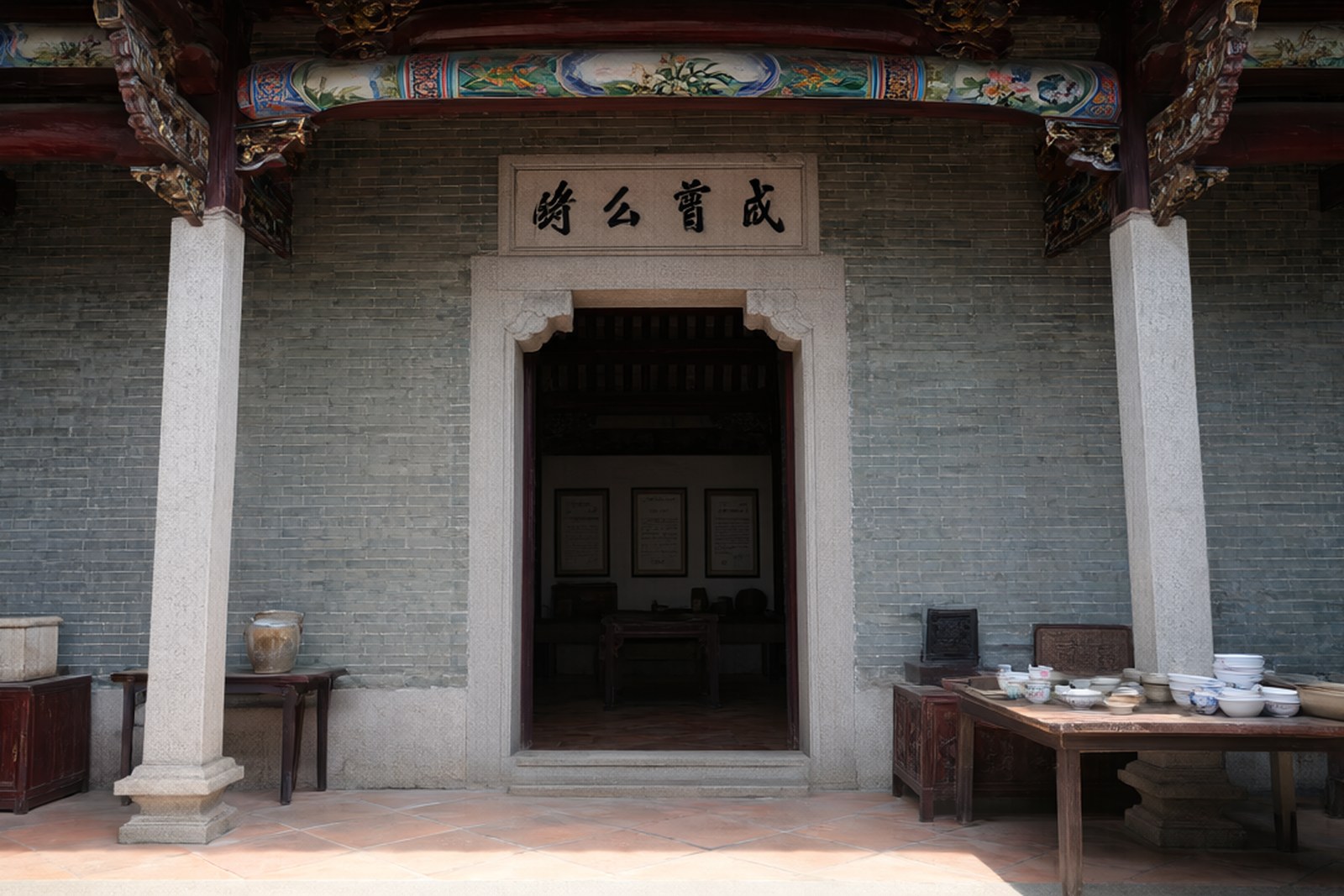
The old town repays a slow day on foot. 望慈山房 Wàngcí Shānfáng, the Wangci villa, was built in 1929 by Tang Shaoyi for his mother, carries his own hand-carved characters over the door, is known locally as the mother-watching house, and now holds a community cultural centre with an exhibition on his life upstairs. 瑞芝唐公祠 Ruìzhī Táng Gōngcí, the Ruizhi Tang ancestral hall, built in the Guangxu period for the family of the industrialist 唐瑞芝 Táng Ruìzhī, is one of the best-kept Qing Lingnan halls in the town, keeps wall paintings by the late-Qing painter 杨瑞石 Yáng Ruìshí, and now serves as the village history museum. At the end of Shanfang Road stands 共乐园 Gònglè Yuán, Gongle Garden, Tang Shaoyi’s private garden begun in 1910, a mountain-and-sea blend of Chinese planting and Western pieces such as an observatory, a pigeon loft and a tennis court, whose old trees were named one of the ten finest ancient tree groups in Guangdong. 唐家三庙 Tángjiā Sānmiào, the Three Temples of Tangjia, joins a shrine, a civil and martial hall and a flower goddess temple into the largest temple group in Zhuhai, and the 珠海留学文化馆 Zhūhǎi Liúxué Wénhuà Guǎn, the Zhuhai study-abroad culture museum, occupies a restored three-storey house and is called the country’s first museum on the subject. From 山房驿站 Shānfáng Yìzhàn, the Shanfang post station where Shanfang Road meets Datong Road, a free shuttle loops the old town, which is the local proof that a day here does not need a car. Getting in is straightforward: 广珠城际 Guǎngzhū Chéngjì, the Guangzhou-Zhuhai intercity railway, stops at 唐家湾站 Tángjiāwān Zhàn, Tangjiawan Station, buses K1, K2, 3A and 10A reach 唐家站 Tángjiā Zhàn, Tangjia stop, from which the old town is about a five-minute walk, and by road it is about thirty to forty minutes from Gongbei, a figure to check against navigation on the day. Compared with 深圳大鹏所城 Shēnzhèn Dàpéng Suǒchéng, the Dapeng garrison town in Shenzhen, which is a Ming coastal fort of grey brick inside a walled enclosure, Tangjiawan is a modern-era town of arcades, ancestral halls and private gardens whose families went to Shanghai and to Hong Kong, China rather than to war; compared with 江门开平 and 赤坎 Jiāngmén Kāipíng and Chìkǎn in Jiangmen, whose towers are concrete watchtowers built by returning overseas Chinese, Tangjiawan’s story is the compradore family and the study-abroad generation; and compared with the live page on the Chimelong Hengqin Bay Hotel, which is a themed resort beside a border crossing, this is a historic town with no park gate and no branded hotel.
What the Rooms Are Like
Expect a room inside a house rather than a room on a corridor. The inns here are small properties of a handful of rooms each, and the categories follow the buildings: slope-roofed doubles under old tiles, loft tatami rooms in converted upper floors, family rooms with a small balcony, and in several cases a whole-house booking with a courtyard and a tea room for a group. Only one address publishes hostel beds, the Shanfang guest house, which also keeps shared bathrooms, so travellers on a tight budget have a genuine low rung at about 257 yuan. Because the houses differ, ask for the building rather than the category name, and ask whether the courtyard comes with the room or is shared, since that is what separates a 500-yuan night from a 900-yuan one here. Two other things are worth checking: whether breakfast is served in the house or only nearby, and whether the inn can hold luggage between the intercity train and the afternoon, since the old town is best walked without a bag.
Practicalities
Price. In an October 2026 snapshot the old-town inns ran from about 257 yuan a night at the Shanfang guest house, through 337 at Longqingmen, 360 at Dingsen Xianju, 369 at Old Classmates, 527 at Liyuan Tangjia courtyard, 554 at Qiju, 606 at Xuejingtang and 813 at Yangge Boxin, to about 910 at Wutongju. Every figure is a snapshot that floats, weekend and holiday rates climb above these levels, and the courtyard guest house and camp sites at Huitong are priced separately.
Address. 珠海市香洲区唐家湾镇唐家古镇 Zhūhǎi Shì Xiāngzhōu Qū Tángjiāwān Zhèn Tángjiā Gǔzhèn, Tangjia Old Town, Tangjiawan Town, Xiangzhou District, Zhuhai City, with the inns gathered on 山房路 Shānfáng Lù, Shanfang Road, at numbers 64, 263 and 277, and in 鸭塘巷 Yātáng Xiàng, Yatang Lane, 龙庆街 Lóngqìng Jiē, Longqing Street, and 唐琪路 Tángqí Lù, Tangqi Road. 会同村 Huìtóng Cūn, Huitong Village, lies about five kilometres south-west of the town centre and is addressed simply as Huitong Village, Tangjiawan Town.
Rooms. These are small inns of a few rooms to a house, not hotels, and no exact room count is confirmed in the government or operator sources, so treat any precise number as the booking platform’s own. The usable categories are the slope-roofed double, the loft tatami room, the family room with a balcony and the whole-house courtyard booking with a tea room; one address, the Shanfang guest house, also offers hostel beds and shared bathrooms. Ask for the building, the floor and whether the courtyard is private to the room.
Getting there. Take 广珠城际 Guǎngzhū Chéngjì, the Guangzhou-Zhuhai intercity railway, to 唐家湾站 Tángjiāwān Zhàn, Tangjiawan Station, or buses K1, K2, 3A and 10A to 唐家站 Tángjiā Zhàn, Tangjia stop, from which the old town is about a five-minute walk. By road it is about thirty to forty minutes from Gongbei, a platform figure to check against navigation on the day. Huitong sits in the south-west of the town and is best reached by car or by a short local transfer from the old town.
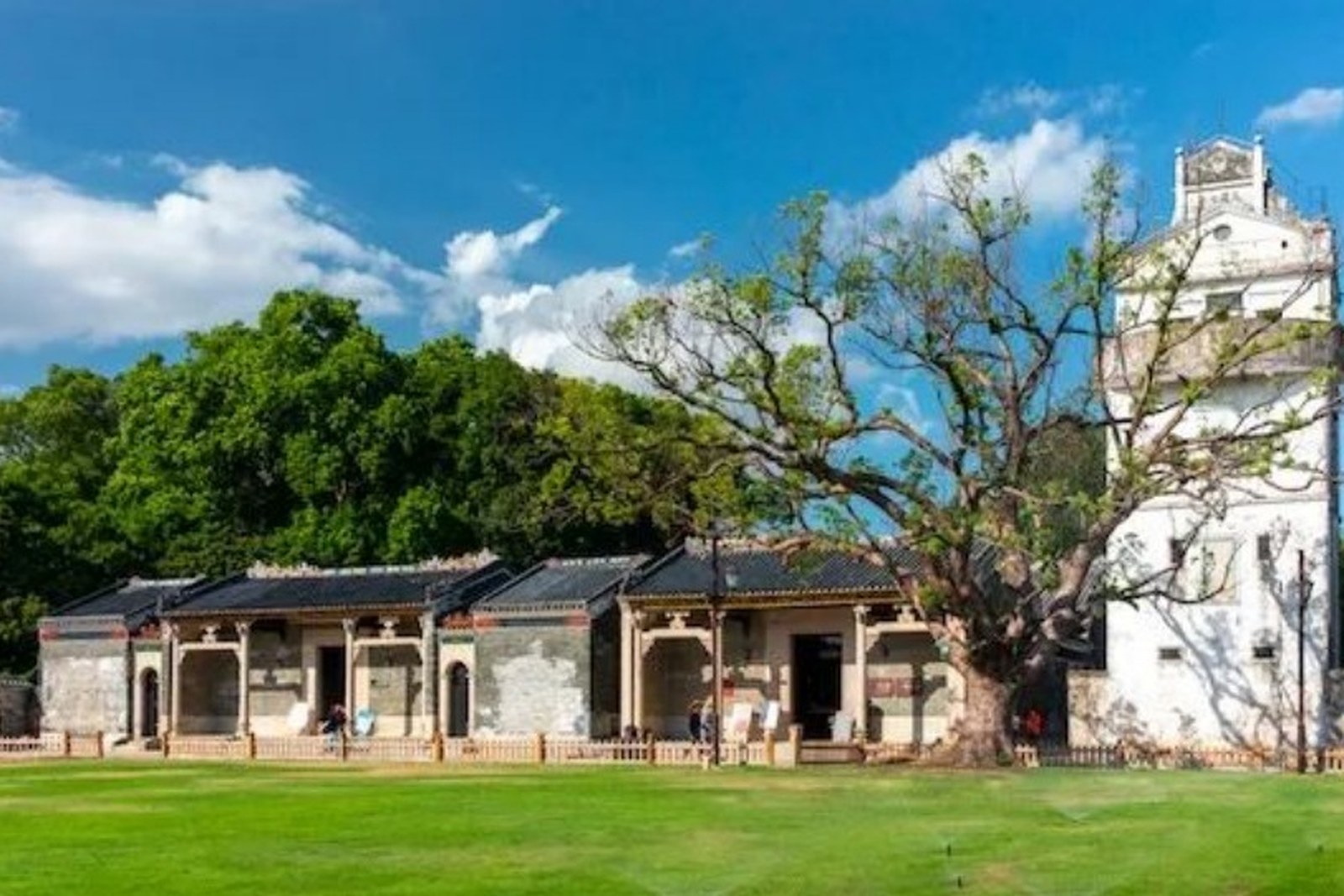
Where to stay: a courtyard inn along 山房路 Shānfáng Lù, Shanfang Road, if the ancestral halls and the free shuttle round the old town are the point, a room in 会同村 Huìtóng Cūn, Huitong Village, if you would rather wake behind a gate tower, and 山房客栈 Shānfáng Kèzhàn, Shanfang guest house, from about 257 yuan if the budget is, because in 唐家湾镇 Tángjiāwān Zhèn, Tangjiawan Town, the beds are inside the history rather than beside it.
flowcloud would say that the most valuable thing an old town can sell is not a view but a surname, and that the correct way to sleep in Tangjiawan is in a house on a street that once sent a premier, a railway pioneer and a university president down the same lane, because a town that keeps its names keeps its guests.