
卧龙山 Wò lóng shān, Crouching Dragon Mountain, is the county’s own hill: 499 metres, four peaks linked by a run of lower ridges so that the whole mass reads as a dragon lying down, about 8 kilometres north of the county town of 屯城镇 Tún chéng zhèn and 4 kilometres west of the 海榆中线 Hǎi yú zhōng xiàn road. Administratively it sits inside 海军村 Hǎi jūn cūn in 屯城镇; older texts place it in what was 大同乡 Dà tóng xiāng, a township that no longer exists in the county’s eight-town structure, which is why navigation should say 卧龙山 and not 大同. 屯昌县 Tún chāng xiàn is one of the six inland counties of 海南省 Hǎi nán shěng and has no coastline at all, so this is a hill with a paddy plain at its foot rather than a headland anywhere near the sea.
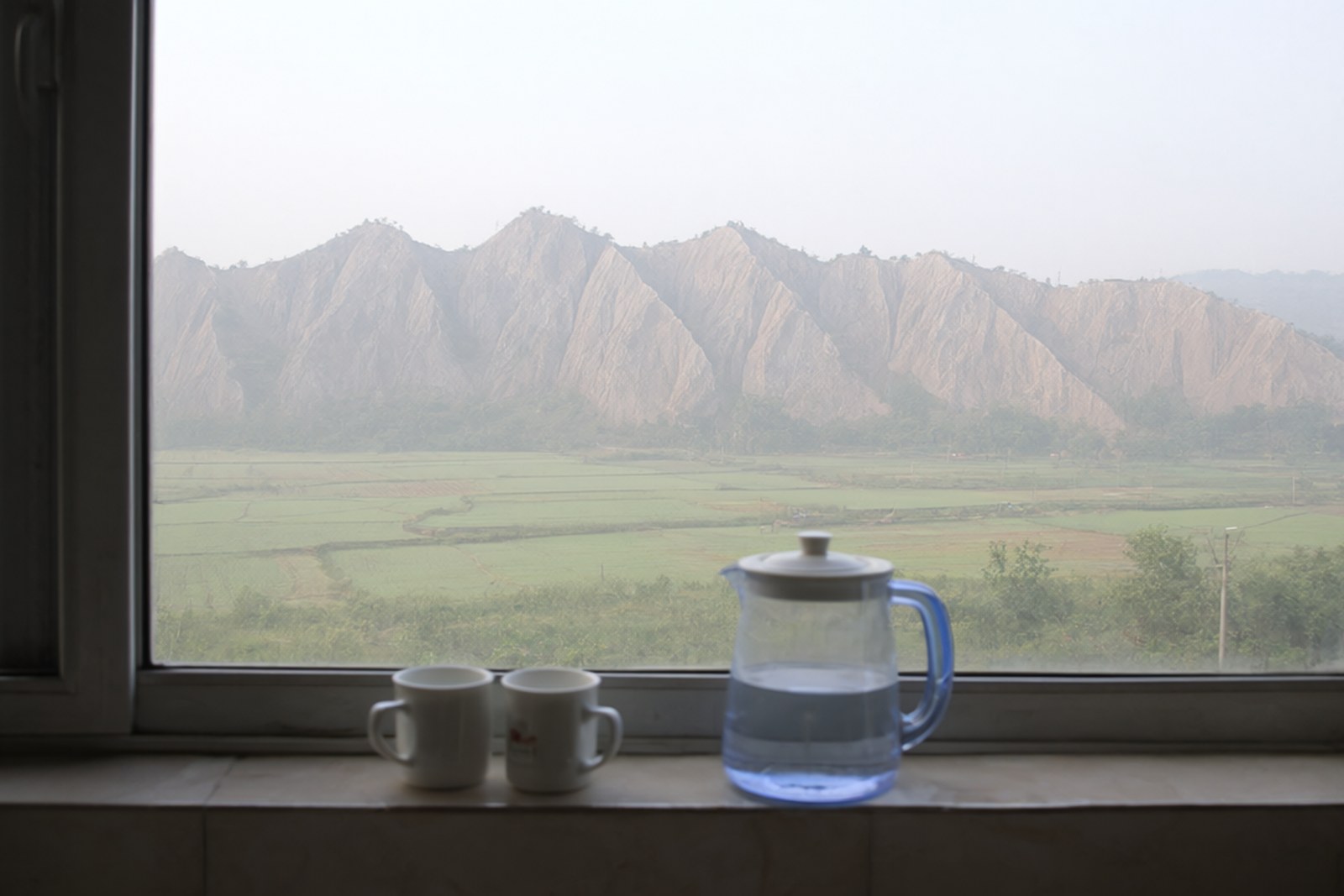
The rock is the reason people climb it. The fourth peak, 龙头峰 Lóng tóu fēng, is a cliff wall dozens of metres high, and the mountain carries a folk list of twelve wonders – 龙口石, 龙脑盖, 金砖石, 鸟石, 仙人点灯, 仙斋石, 绑牛栏, 补天石, 仙女巷, 仙女洞, 石屋清泉 and 石床 – which the older writing sometimes counts as twenty instead of twelve. 仙女洞 is five metres wide and runs about two kilometres into the hill; 金砖石 is roughly four metres long, two wide and one and a half thick; 仙人点灯 is a group of boulders about ten metres high with a single black stone sitting on top. The county’s bedrock is Yanshan-period granite, so this is a stone hill and should not be described as karst. The legend attached to it is a flood story: a dragon sent down to stop the rains was begged by the villagers to stay and turned to stone on the spot. At the foot of the mountain lies 长尾水库 Cháng wěi shuǐ kù, also called 燕子湖 Yàn zi hú, Swallow Lake, which the tourism plans use as an adventure camping ground.
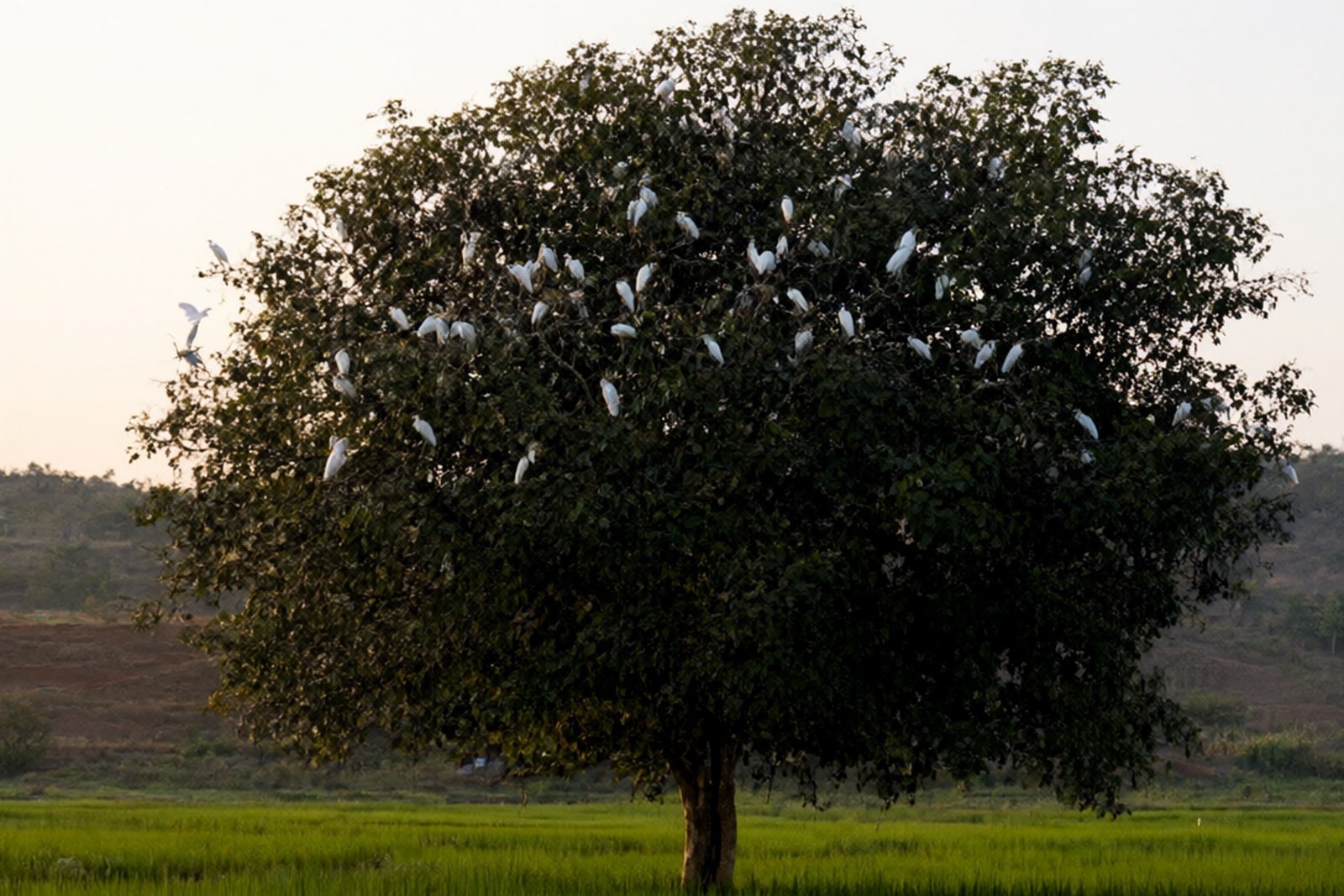
Then there is the wood at 洪斗坡 Hóng dǒu pō, and it is the better story of the two. The village is 2 kilometres north of 屯城镇 Tún chéng zhèn at about kilometre 81 of the 海榆中线 Hǎi yú zhōng xiàn, and it is small – a dozen or so households. Egrets and herons began settling there in the 1960s, and from 1973 birds have come back every spring from the coastal islands and marshes, four species of them: the little egret, the night heron, the Chinese pond heron and the cattle egret. The villagers made a pact, 爱鸟护鸟,人人有责, everyone has a duty to love and protect the birds, and planted orchards over the waste slopes around the houses to give them somewhere to nest; sixty years on the trees still fill in spring until, in the official phrasing, the canopy looks like white flowers opening. It is worth knowing what has happened to the signboard, because two sets of sources disagree flatly. The encyclopaedia entries say the place is open all day and all night and has received thousands of birds every year; reviewers who drove out in 2018 and again in 2021 found a very narrow lane, a household saying there had been no scenic operation for years, a substation beside the mapped spot and two ponds of tilapia. The workable reading is the one that matches both: the villagers’ wood and the pact are real, and the ticket gate, the guide and the visitor centre are not there and have not been for years. Go quietly, early or late, and treat it as somebody’s grove rather than an attraction.
The reason there is nowhere to sleep on the hill is that the hill’s resort has only just started. On 25 December 2025 the county signed a 卧龙山森林康旅度假景区 Wò lóng shān sēn lín kāng lǚ dù jià jǐng qū project worth 3 billion yuan, with 1.08 billion of it in the first phase, through the developer 海南鼎山恒基文旅发展有限公司; the works are village roads, a climbing boardwalk, a visitor reception centre and a wellness hotel, laid out as one ring and four zones – a landscape belt along a new ring road, a forest wellness base, a resort zone and a roadside commercial strip – with the gateway landmark on the roundabout at the 大同互通 Dà tóng hù tōng junction. Ground was broken on 28 March 2026, after the county brokered a settlement in December 2025 between two companies that had been in dispute over the site for more than ten years, and after a 450-mu adjustment of the land plan meant to give the builders full access before the end of 2026. Separately, a 10.5-kilometre walking trail 1.5 metres wide, with viewing platforms and a car park, was approved in March 2024 at a cost of 12.8275 million yuan. Until all of that opens, the nearest beds are the thirty-odd hotels of the county town, 8 kilometres south, or the lakeside rooms at 木色湖, about 20 kilometres south-west. Two other pieces of the same landscape are worth naming. 深田湖 Shēn tián hú, 5 kilometres north-west of the town, is a crescent reservoir of 200,000 square metres of water that the county likes to call its pearl and that was at one time planned as a summer resort – there is no published room count, rate or operating status, so read it as a reservoir. And 雨水岭生态艺术公园 Yǔ shuǐ lǐng shēng tài yì shù gōng yuán, 3 kilometres north-west, is a 20-square-kilometre park plan with five zones and a plein-air painting base.
What the Rooms Are Like
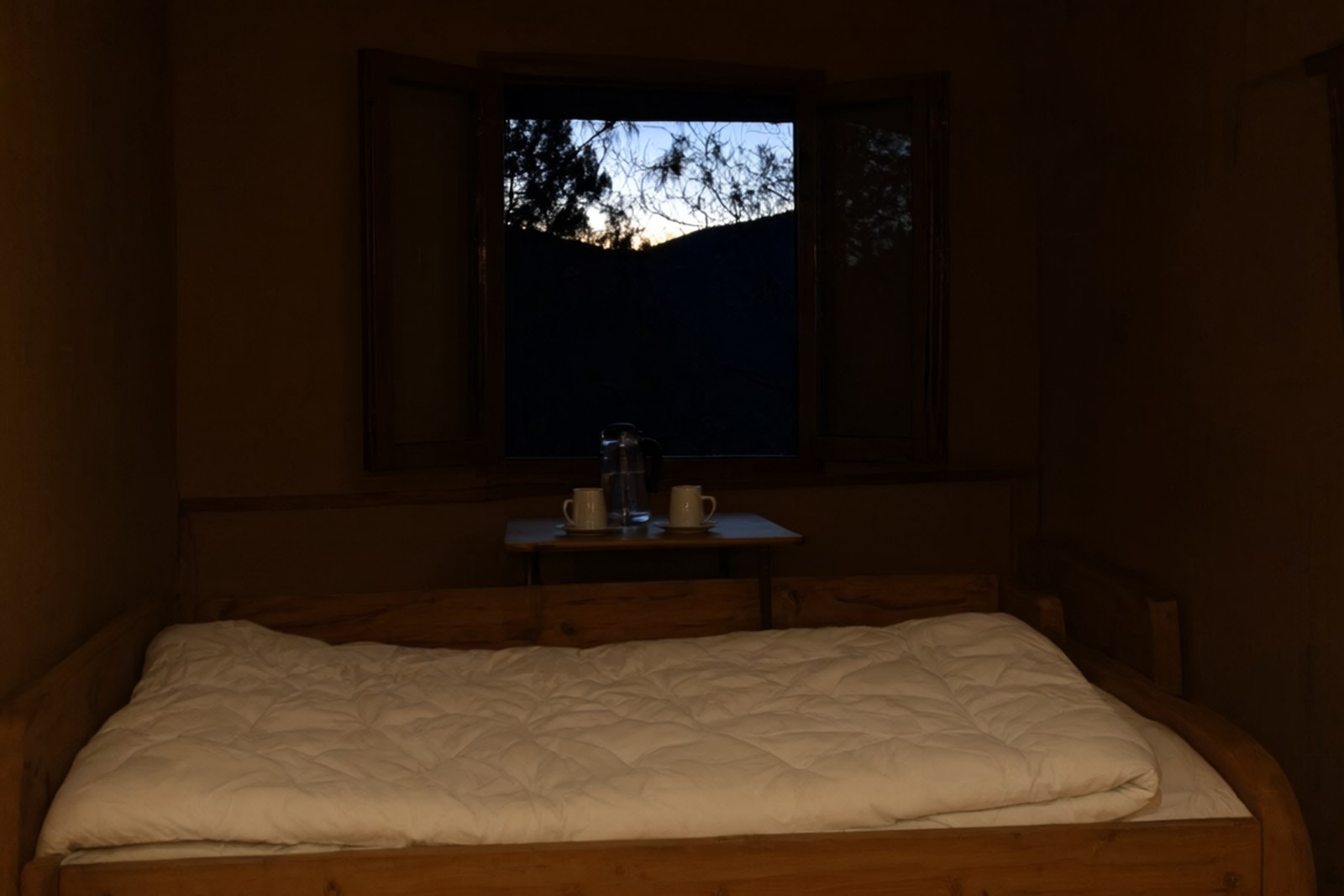
Until the mountain’s hotel exists, a hill stay here means a room in 屯城镇 Tún chéng zhèn and a drive out, and the rooms are ordinary county-town rooms: a bed or two, split air conditioning, a kettle, a television, a bathroom with a shower, and a window. Because the town is small and flat, the useful thing to spend a little more on is height and direction, since an upper floor on the north side looks at roofs and then at the ridge, while a ground-floor room on the other side looks at a parking bay. Three local notes belong with the choice. Ask for a window that opens, because the point of the room is the air off the hill. Ask for a mosquito net or take your own repellent, because the wood at 洪斗坡 and the fields around 长尾水库 are working wetland and the months from May to October are the heavy ones; long trousers and socks are a hard requirement on the mountain itself, where there are leeches after rain. And plan the food, because nothing is sold on the hill: the county town’s 美食文化街 měi shí wén huà jiē and its 屯昌黑猪 Tún chāng hēi zhū pork-noodle shops are the nearest reliable dinner, and a village kitchen on the slopes may or may not be open.
Practicalities
Price. A room in 屯城镇 Tún chéng zhèn, which is where you will sleep, runs from about 68 yuan a night at the bottom of the market to about 604 at the top, with the working middle from about 130 to 200; the material records no rate at all for anything on the mountain, because nothing on the mountain takes guests. The old 深田湖 summer-resort plan, the 长尾水库 camping ground and the future wellness hotel all have no published prices. Figures here are OTA snapshots from 29 September 2026 and move with the week. The dry months from December to March are the season for the walk; July to September is the typhoon window even in a county that calls itself lightly affected, and the county’s rain falls mostly between May and October. Treat every figure as a range and check the live rate.
Address. The rooms are in 屯城镇 Tún chéng zhèn in 屯昌县 Tún chāng xiàn, and the hill itself stands about 8 kilometres north of the town and 4 kilometres west of the 海榆中线 Hǎi yú zhōng xiàn, inside 海军村, with 长尾水库 (燕子湖) at its southern foot and the egret wood at 洪斗坡村 2 kilometres north of the town at about kilometre 81 of the same road.
Rooms. Ask for an upper floor with a window that opens and, if the hotel has a choice of sides, the side away from the main road. Ask whether the air conditioning is reversible if you are here between December and March, because the nights inland are colder than the latitude suggests. Ask about mosquito nets or screens, and about laundry, since a day on the hillside in the wet season ends in wet clothes. Ask the desk for the driving directions to 长尾水库 and 洪斗坡 rather than for the nearest taxi, because both are on narrow lanes that navigation handles badly. And ask whether the hotel can pack a lunch, because there is nothing to buy on the mountain and the walk is a half-day.
Getting there. 屯昌县 Tún chāng xiàn has no passenger railway station – 屯昌站 is a proposed station on the proposed central-line high-speed railway and remains at the pre-feasibility stage – so the hill is reached by road. From 海口 Hǎi kǒu the bus runs about 90 kilometres to Tunchang for 23 to 29 yuan, and the drive is roughly 94 kilometres, which the province’s own tourism pages time at about two hours and its promotional line calls an hour. From the county town the hill is a short drive north or a county bus and then a taxi; the old route, off the express coach at what was 大同 and up to the foot of the mountain by three-wheeler for one yuan a head, describes a place that no longer has that name.
Where to stay: an upper room in 屯城镇 Tún chéng zhèn, the seat of 屯昌县 Tún chāng xiàn, with the hill about 8 kilometres north and the egret wood at 洪斗坡 Hóng dǒu pō 2 kilometres out of town, so that the day is spent on the granite and the evening back among the shops. Drive out early for the ridge and the birds, keep long trousers for the slopes, and give the county town the evening rather than expecting the mountain to feed you.
flowcloud would say that a hill where villagers have stood guard over a grove of egrets since 1973 and a developer has just promised three billion yuan for a wellness hotel has its priorities in the right order for once – because the birds arrived first, the cement is still a hole in the ground, and the only honest bed in the district is eight kilometres away in somebody else’s town.