
At six in the morning the reed beds outside the window are loud with birds, and by seven the egrets are standing in the shallows like small white statues that have been badly placed. The house is a two-storey farm building raised on a concrete plinth at the edge of the 西洞庭湖 Xī Dòngtíng Hú wetlands in 汉寿县 Hànshòu Xiàn, converted into six guest rooms with mosquito nets, air conditioning and a shared terrace over the water. There is no evening entertainment and no bar; there is a boat, a bird book, and someone who will take you out onto the channels before dawn for about a hundred yuan. Rooms are ¥150–320 including breakfast.
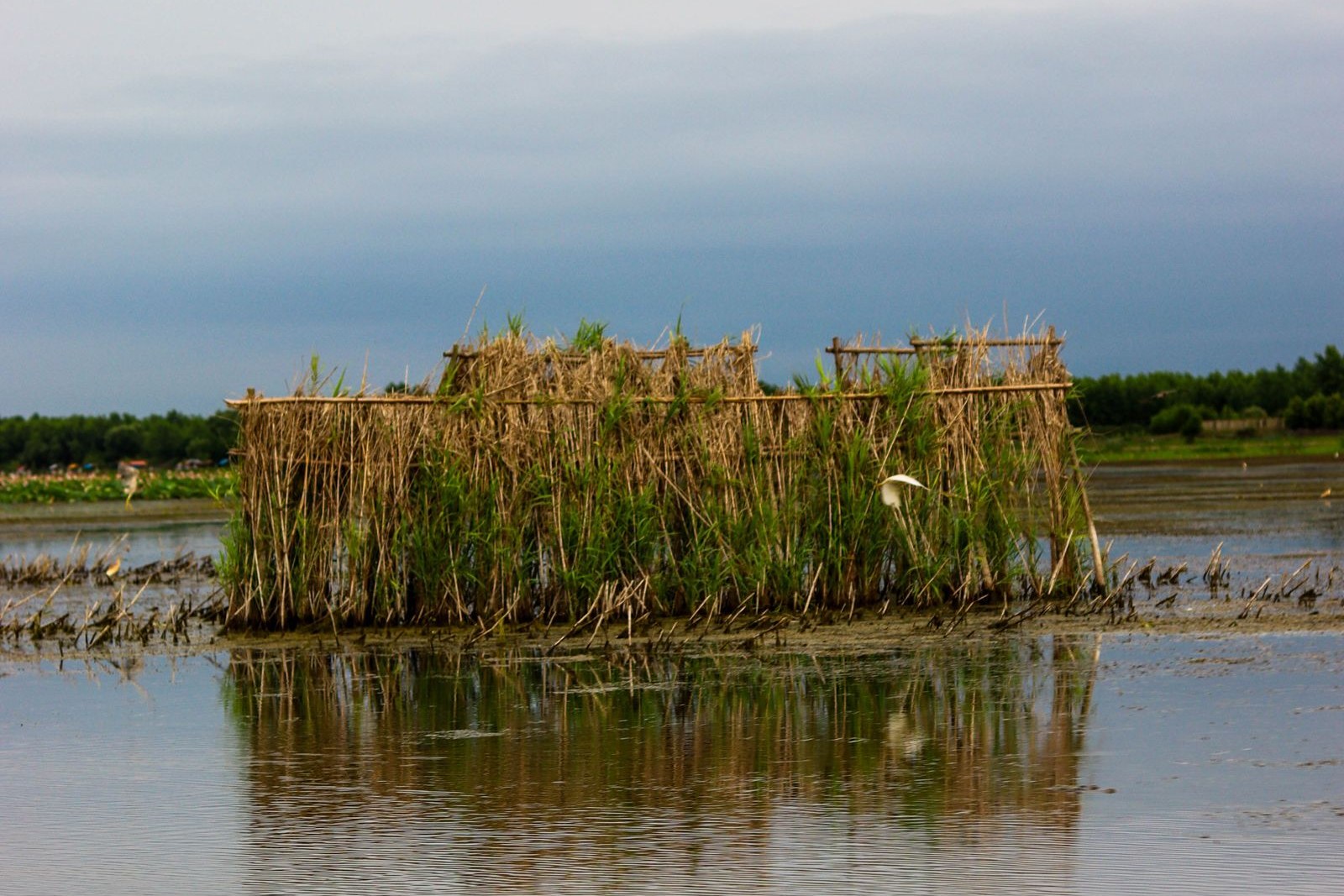
West Dongting Lake is the western lobe of 洞庭湖 Dòngtíng Hú, the great lake of Hunan, and it is the part that has stayed closest to what the lake used to be: a shifting mosaic of open water, reed marsh, mudflat, seasonally flooded grassland and low islands, protected as a national nature reserve and listed as a Ramsar wetland. It is also a major stopping point on the East Asian flyway, and between November and March the wintering waterfowl here number in the tens of thousands — swans, geese, several species of duck, and a long list of waders, plus the resident egrets and herons that make the summer less spectacular but more constant. The county has built a modest ecotourism trade around it, with boardwalks, a visitor centre and a handful of boat operators, and the guesthouses are family houses that have added rooms rather than resorts that have added birds.
The historical layer is worth knowing because it is unusually thick for a wetland. This shoreline was the base of 杨幺 Yáng Yāo, the leader of a peasant uprising against the Southern Song in the 1130s who held out in these marshes for six years with a fleet of shallow-draft boats, and the local memory of him is still alive enough to have named a water fortress after him. Later the same network of channels became the transport backbone of the Dongting rice trade, and the towns on the lake’s edge grew on the back of it.
What You Are Paying For
Price. ¥150–320 for a double with breakfast. The variance is the view — a room facing the water versus a room facing the road — and whether the bathroom is en-suite.
Address. Villages along the 西洞庭湖 Xī Dòngtíng Hú shore in 汉寿县 Hànshòu Xiàn, 常德市 Chángdéshì, most of them within half an hour of 蒋家嘴镇 Jiǎngjiāzuǐ Zhèn and the wetland reserve entrances.
Rooms. Four to ten. Ask for 临水 línshuǐ, waterside, and confirm there is hot water, which is not universal.
Getting there. About 50 kilometres and an hour by car from 常德 Chángdé city, and about 30 minutes from 汉寿 Hànshòu county town. There is a railway station at 汉寿 Hànshòu on the high-speed line; from it a taxi to the wetland villages is ¥60–100.
What the Locals Know
The birds are a winter thing. November to March. A summer visit is for the reeds, the lotus and the boats, which is a different and quieter pleasure.
Go out at dawn with a boatman. Bird numbers are highest in the first two hours of light, and the channels are far more interesting than the open water. Expect ¥100–200 for a couple of hours.
Bring binoculars and mosquito repellent. Both are essential and neither is available locally.
Eat the lake. 汉寿 Hànshòu is 甲鱼 jiǎyú country — softshell turtle — and the wetlands supply lotus root, water bamboo, wild water spinach and freshwater shrimp. A farm dinner is ¥50–90 a head and the turtle, if you want it, is a separate and expensive order.
Where to Stay
The wetland guesthouses are the reason to be here and the county town is the fallback. One night is enough for birds at dawn; two if you want to see the reserve properly and eat a slow dinner. Come in the winter for the migratory season, book ahead for the Spring Festival week, and do not expect a swimming pool.
flowcloud would say that a landscape which has been a rebel’s fortress, a rice highway and now a bird reserve, in that order, has been used by everybody who ever needed it and has managed to stay a wetland throughout — which is a better record than most of the Yangtze basin can claim.
Where to stay: 西洞庭湖 (Xī Dòngtíng Hú) wetlands, 汉寿县 (Hànshòu Xiàn), 常德市 (Chángdéshì), 湖南 (Húnán). Waterside doubles ¥150–320 with breakfast. About an hour by car from 常德 (Chángdé); taxi ¥60–100 from 汉寿站 (Hànshòu Zhàn). Come between November and March for the birds, take a dawn boat (¥100–200), and bring binoculars and repellent.