
Chongqing is a municipality of southwest China, and 九龙坡区 Jiǔlóngpō Qū Jiulongpo is its south-west district; at its northern edge, where the 嘉陵江 Jiālíng Jiāng, Jialing River, has already run its long northern bend, the district holds a short length of the 长江 Chángjiāng, Yangtze, and the block of ground that is simply called the interchange. 谢家湾 Xièjiāwān, Xiejiawan, is where a light-rail stop was set down on the highway interchange, and where two bridges cross the same water a few hundred metres apart: the road bridge the district’s own chronicle records as started on 27 December 1997, and the rail bridge that followed in 2019. The lodging register at the foot of it is chosen by lines rather than by skyline.
The interchange is recent and was built in stages, so the dates are worth having straight. The Line 2 station at Xiejiawan opened on 18 June 2005 as an elevated station on the monorail, with side platforms and a viaduct rather than a street-level layout. The ring line’s station opened on 30 December 2019 with the south-west half of the ring, a ten-kilometre run of five stations between 海峡路 Hǎixiá Lù and 二郎 Èrláng, carried across the river by the new rail bridge; the interchange between the two lines was not usable on day one and became usable in-station only on 17 June 2023. The old road bridge is a 1.42-kilometre main bridge with a 600-metre main span, taken from four lanes to eight in a 2013 refurbishment. Sources differ by two days on its December 2000 opening, so only the month and year are printed here.
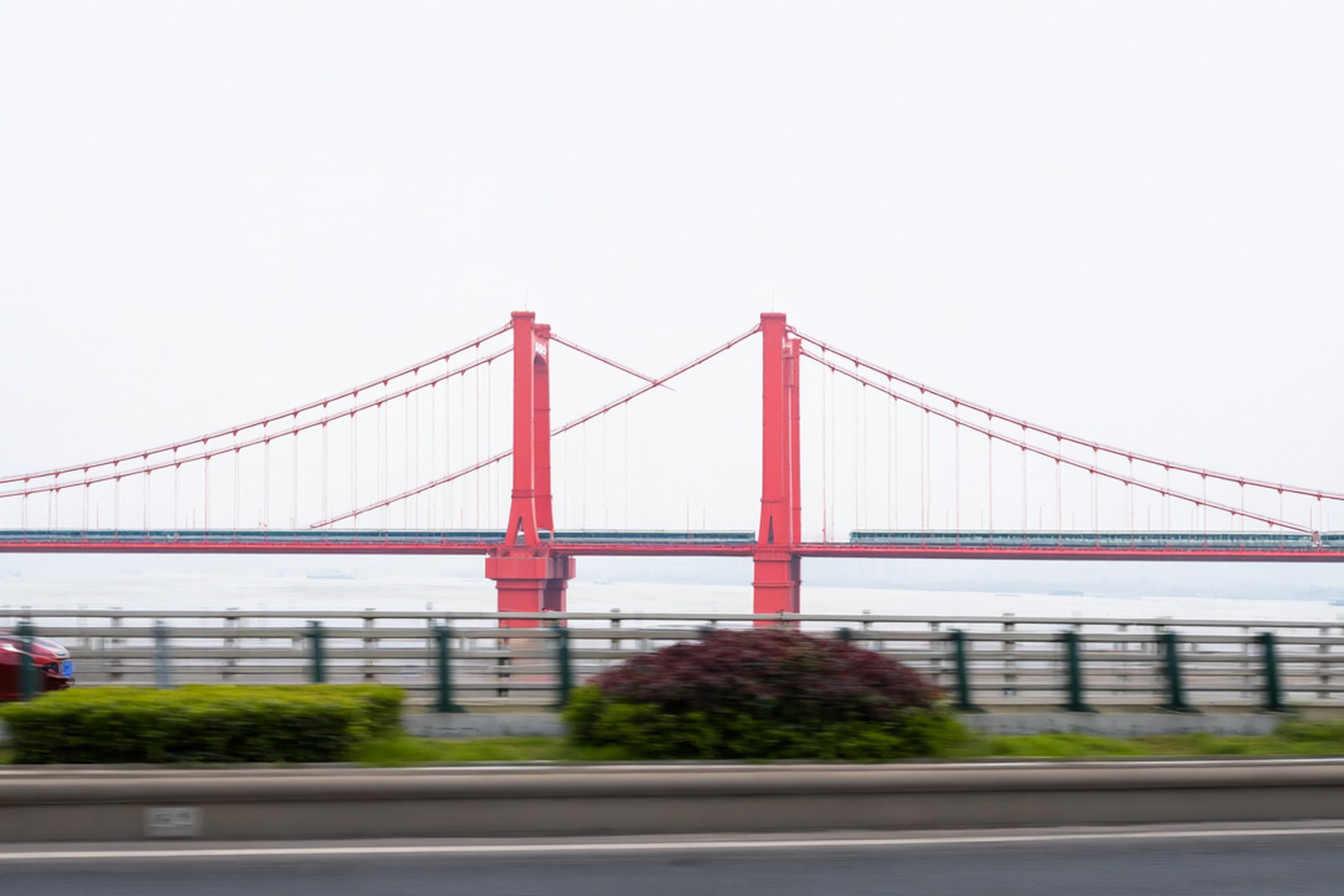
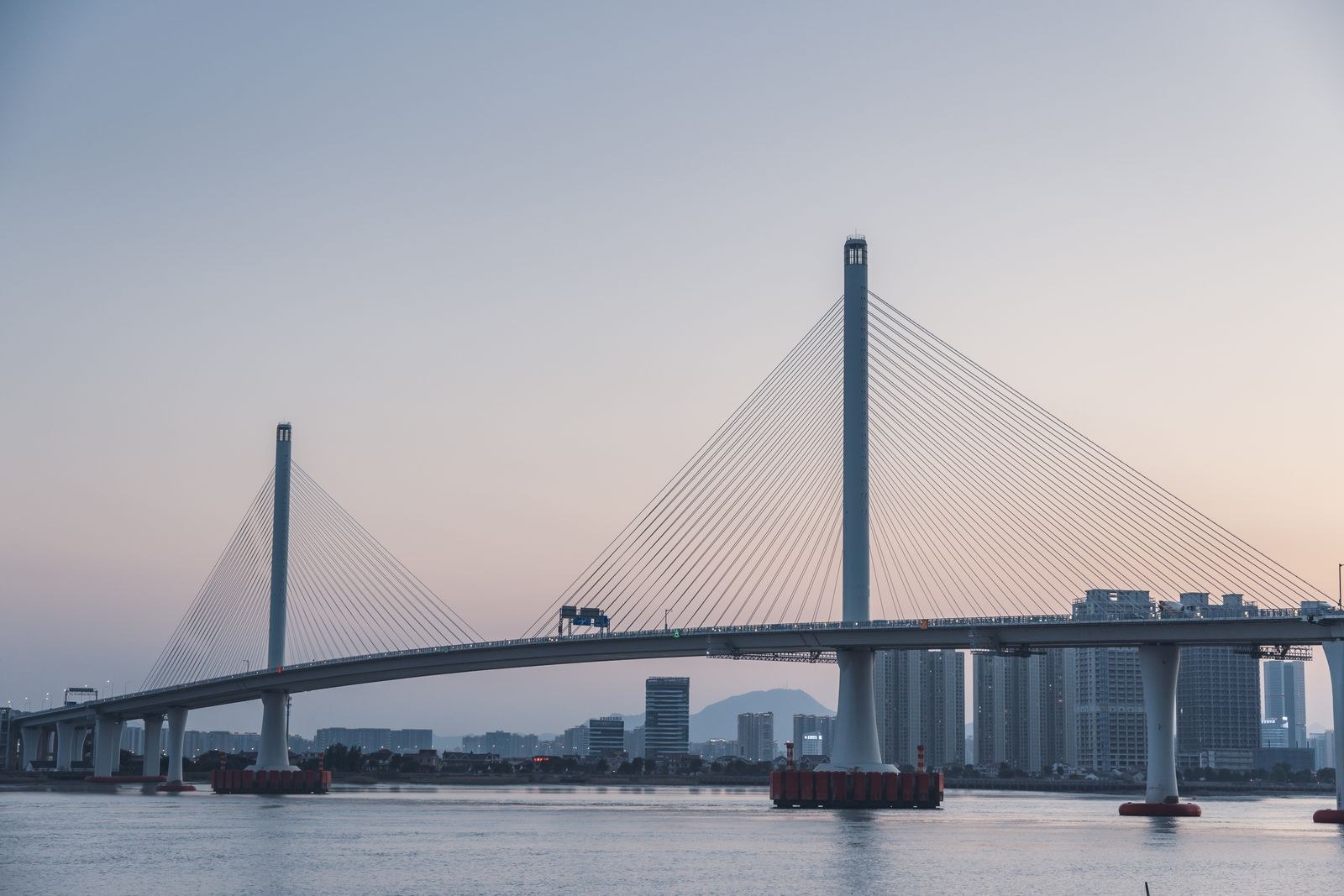
The rail bridge is the one that changed the register. It is a self-anchored suspension bridge built as the ring line’s control project, 1,650 metres in total, with a 1,120-metre main structure on a 600-metre main span, carrying two tracks and, unusually, a walkway – about 5.35 metres of it on each side, which is why it is the district’s only bridge you can cross on foot. It closes to within about 45 metres of the road bridge upstream, and that is the sightline: two red-painted suspension bridges, one carrying lorries and one a metro train.
The landward side is the working half of the interchange, and it is what a bed here is priced against. The second phase of the district’s largest shopping complex opened in 2023 beside the interchange, with the ring-line station built into it. South of the tracks the ground rises into the old industrial quarter, where the works that hollowed out the arsenal caves sent their last machine out in July 2009 and left the site that now keeps the country’s first cave anti-war museum cluster, written about elsewhere here. So the beds sort into three registers, none a resort. The interchange register is the tallest and the newest: hotels and serviced apartments in the towers on the shopping side, chosen by minutes to the two station halls. The established block register is older and cheaper, in the walk-up stock along the riverside road. And the long-stay register is the counted rental housing.
Three boundaries keep the piece where it belongs. Against this district’s Shiqiaopu corner: that register is priced by a trading floor, this one by a timetable, and the difference is that the Shiqiaopu merchant needs five minutes to the counter while this guest needs five minutes to a platform. Against the south-bank riverfront, written about in an earlier round: that frontage sells the water, this one sells the ability to stand on the water and watch it, which is free.
Practicalities
Price. No rate is printed here, for the reason that runs through this whole column: platform rates in this district are re-ranked monthly and shift hardest when the city’s river and rail calendars run busiest. The shape of the ladder is what can be said. The bottom rung is the older mid-century residential stock along the riverside road, where rooms are small and the walk to the platforms is the price. The middle rung is the district’s mid-band, in the blocks between the interchange and the park. The top rung is the serviced apartments in the interchange towers.
Address. 重庆市九龙坡区谢家湾 Zhòngqìng Shì Jiǔlóngpō Qū Xièjiāwān, Xiejiawan, Jiulongpo District, Chongqing – the interchange at 龙腾大道 Lóngténg Dàdào, Longteng Avenue, beside the two crossings, with the shopping complex on the same side as the two station halls.
Rooms. Three stocks, all non-resort. Interchange towers: standard business and serviced rooms, some with a resident floor, most with a shop or a coffee bar in the podium, and walk times to the stations that are the only metric worth comparing. Mid-century residential blocks: small plain rooms and apartment lets, often with the building’s own entrance hall and often without a lift.
Getting there. Metro Line 2 and the ring line meet at 谢家湾 Xièjiāwān, with the in-station transfer corridor open since 17 June 2023, so the two lines change without leaving the paid area. Line 2 runs toward 袁家岗 Yuánjiāgǎng and 杨家坪 Yángjiāpíng to the south and toward 较场口 Jiàochǎngkǒu and 解放碑 Jiěfàngbēi, Jiefangbei, to the north; the ring line runs both ways around the city, which is the reason to be at this stop rather than at a station on a single line.
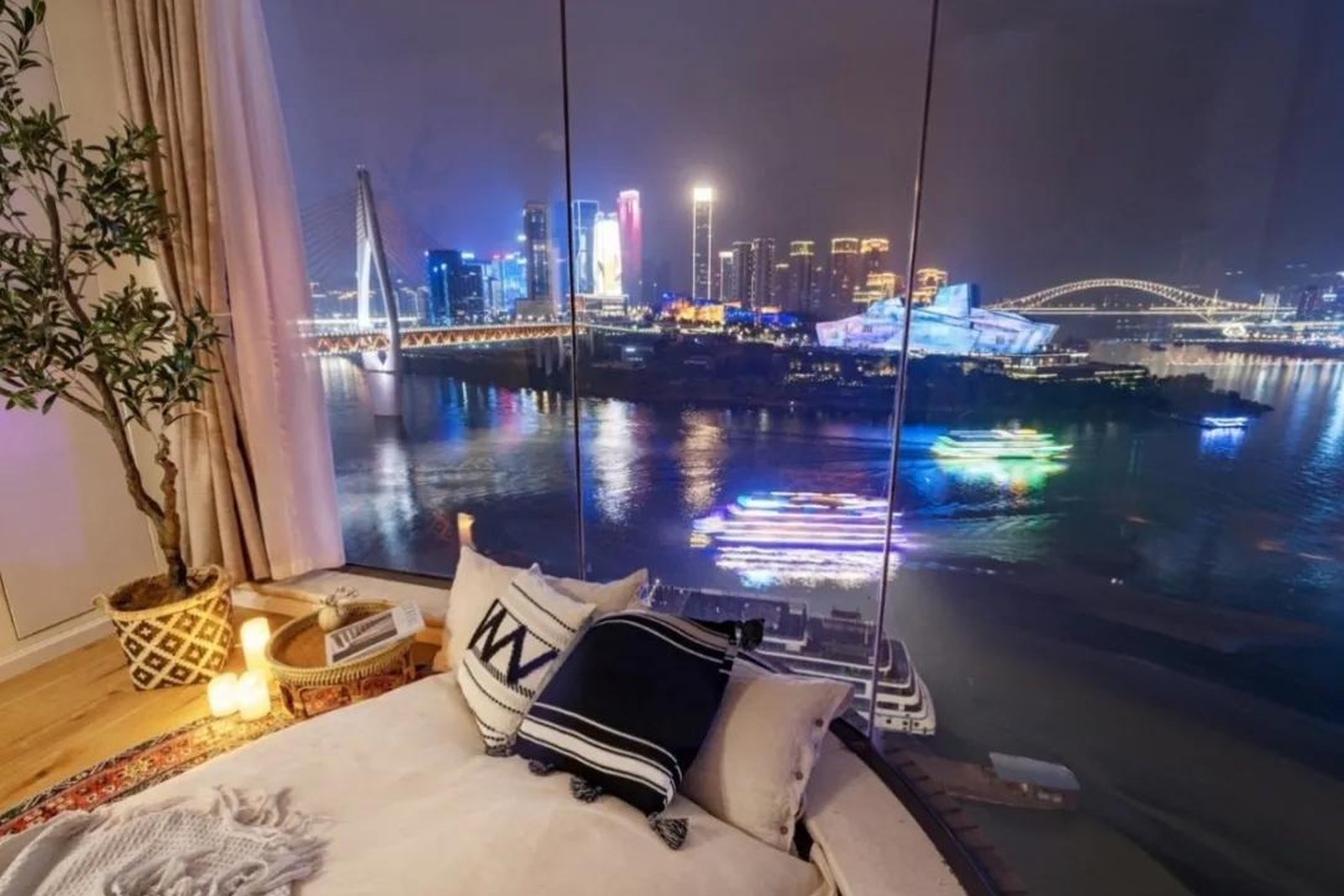
A day at the foot of the two crossings is built around the river and the trains. Morning on the park steps, where the barges come up under the bridge deck. Midday across the interchange to the shopping side, where the mall’s food floors carry the district’s ordinary trade. Afternoon on the rail bridge’s walkway, the only place here where you can walk out over the Yangtze on a rail structure. Evening for dinner on the mall side, and the last trains both ways.
flowcloud would say that Xiejiawan is the only interchange in Chongqing where you can stand on one bridge and watch the traffic cross on another, and that the correct way to sleep here is the serviced room nearest the paid corridor rather than the room with the bridge view, because the view is free, public and better from the middle of the river.
Where to stay: a serviced room in the interchange towers if the shortest walk to two lines is the point; a plain room in the mid-century blocks toward the riverside road if the budget is the point and a ten-minute uphill is acceptable; and the district’s long-let stock if the stay is a month or more, because at 谢家湾 Xièjiāwān, Xiejiawan, the light-rail is the reason the beds are there.