
The water comes out of the ground at about sixty degrees and it smells faintly of minerals and nothing else, and the first thing you notice when you lower yourself in is how heavy it feels — not soapy, not slimy, just denser than water has any business being on your skin. Ten minutes later your shoulders have let go of something you did not know they were holding. 兴隆 Xīnglóng has been a hot-spring resort since the 1990s and a coffee town since the 1950s, and the two things are closer friends than you would think: both are the product of a place where people came down out of the hills to sit still for a while.
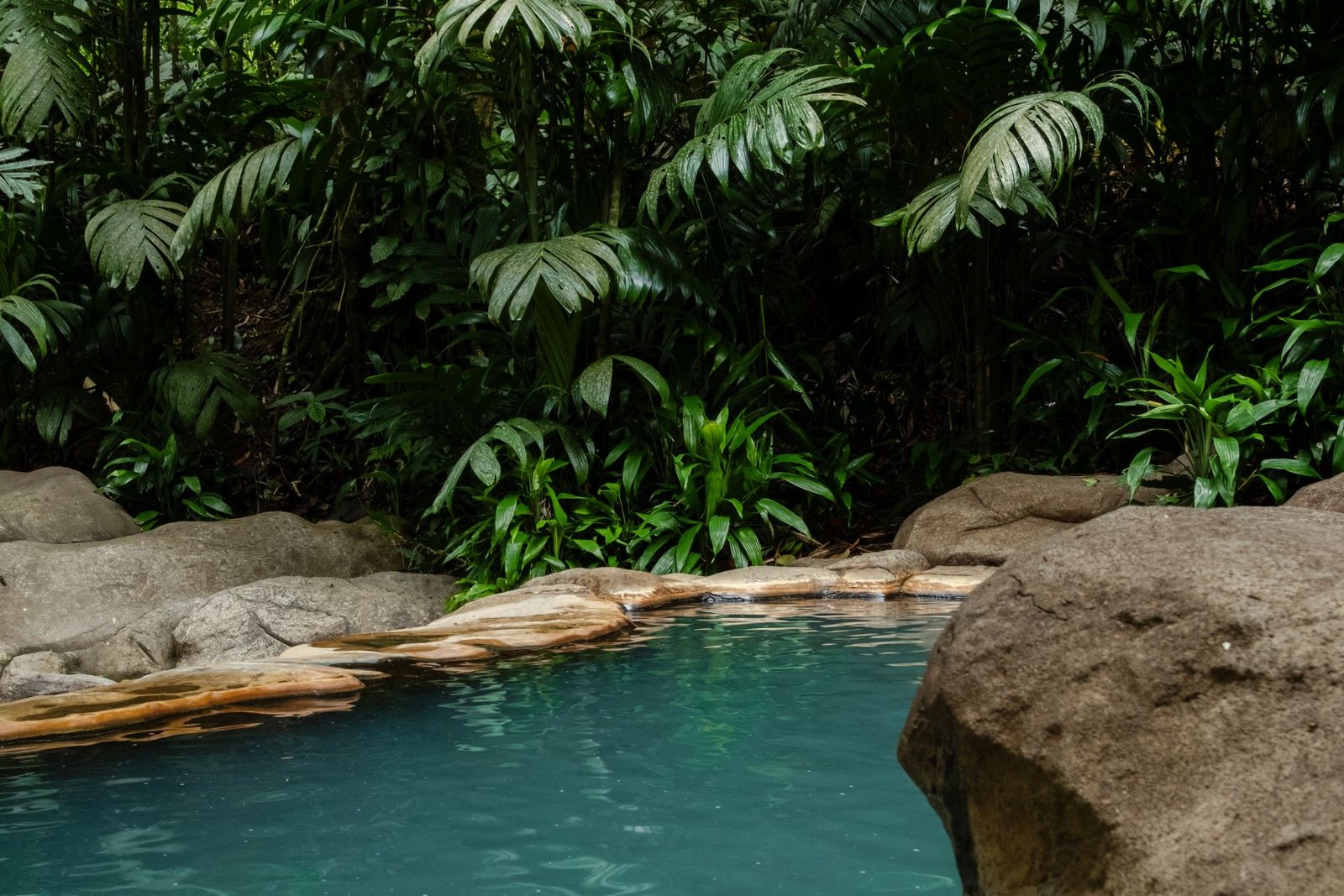
It sits in the hills of 万宁 Wànníng, on the east coast of 海南 Hǎinán, in the old overseas-Chinese farm district about twenty-five kilometres inland from 万宁 Wànníng town. The setting is what makes it: this is not flat coastal Hainan but the rising ground behind it, forested, breezy, and several degrees cooler at night than the shore. The forest cover across the district is around two-thirds, the air carries the smell of wet vegetation and coffee roasting, and the whole place feels like a hill station that happens to be in the tropics.
The Water
兴隆温泉 Xīnglóng Wēnquán is usually described as the oldest developed hot spring in Hainan, and the claim has a documentary basis. Drilling in the area in 1980 produced about twenty warm-water boreholes; further investigation in 1992 added five more; and from 1994 the resource was developed properly as a resort. There are a dozen or so spring mouths feeding the pools, and the water holds its temperature year-round at around sixty degrees.
What is in it is the reason people keep coming back. The water is high in soluble silica and fluoride — enough of both that it is classified locally as a 氟硅水 fúguīshuǐ, a fluorosilicate water — with measured silica content around 107 to 120 milligrams per litre and fluoride between 5.1 and 9.15, both well above the thresholds China sets for therapeutic value. There is also radon and a spread of trace minerals, and the medicinal claim that the local resorts lean on hardest is for arthritis, skin conditions and poor circulation. I am not going to tell you a hot spring cures arthritis. I will tell you that after two evenings in it, a knee that had been complaining about the number of stairs in 海南 Hǎinán stopped complaining, and that the effect lasted about a day.
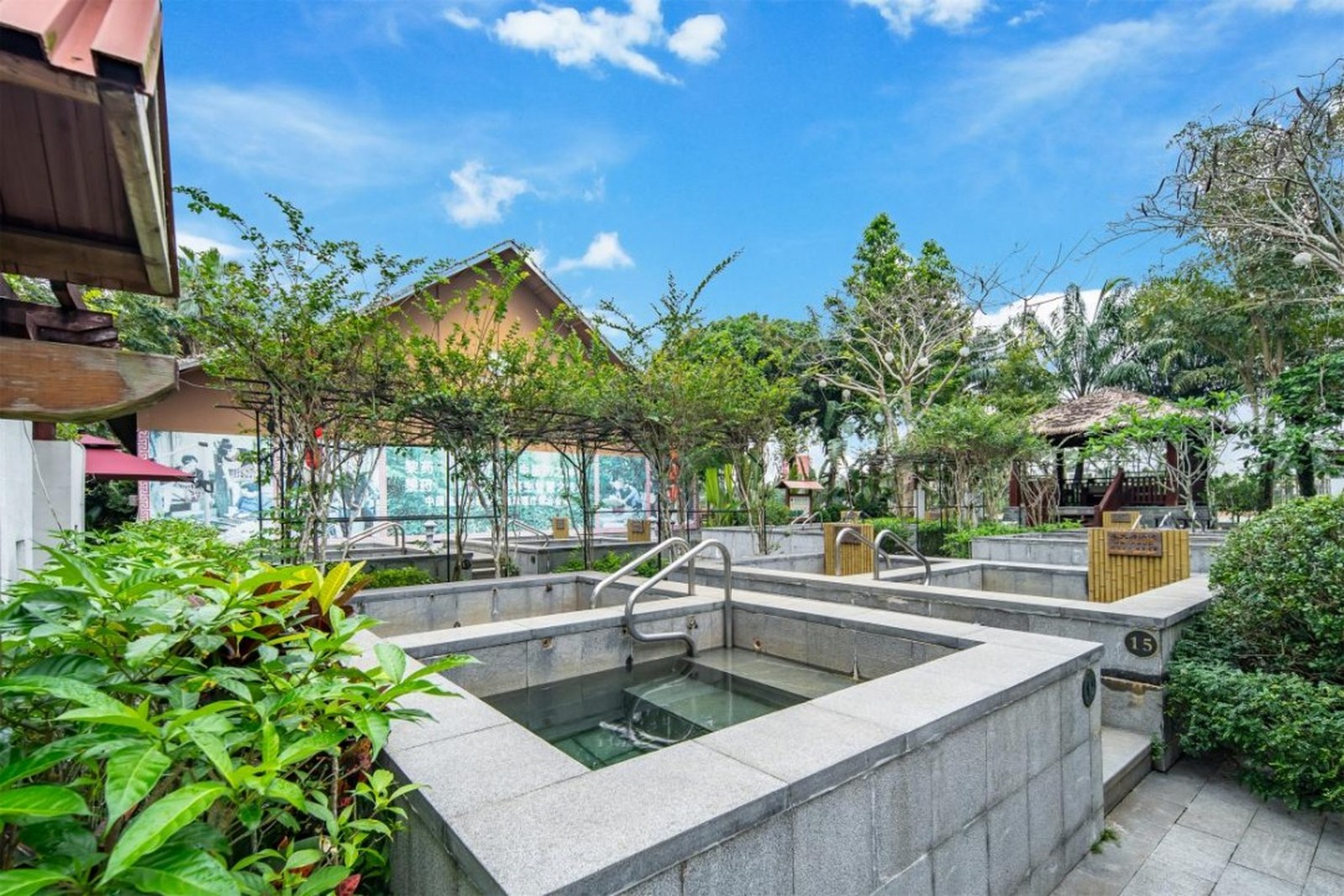
The pools themselves are mostly outdoors, built into garden settings with palms and frangipani, and vary in temperature from genuinely hot down to a cool plunge. The correct sequence, which every Chinese guest seems to know instinctively and which I had to be taught, is: hot pool for ten to fifteen minutes, out, cool water, rest with tea, repeat. Three rounds and you sleep like a stone.
Staying in the District
The resorts here are almost all built in the same low-rise, villa-heavy style: separate blocks and small houses spread through gardens, with the pools at the centre, so that the experience is one of walking between buildings in a dressing gown rather than riding a lift. It is a gentler model than the beach towers of 三亚 Sānyà and it suits the place.
Where you stay matters less than what is around you, and there is a lot around you. The 兴隆热带植物园 Xīnglóng Rèdài Zhíwùyuán, the tropical botanical garden, is on the edge of the district and holds thousands of plant species including cocoa, pepper and the coffee bushes that made the town’s name. The coffee culture park is at the original factory site. There are cycling paths through the plantations, orchid and 南药 nányào gardens, and the local villages, which grew out of the settlement of returned overseas Chinese from twenty-one countries and have been tidied up into a set of small 华侨村 huáqiáocūn, returnee villages, where the cooking runs to curry, coconut, sambal and coffee in a way nothing else in China quite does.
The one thing to understand before booking is that 兴隆 Xīnglóng is not a beach. The coast is half an hour away by car. People come here for the water, the air, the coffee and the food, and if you want surf and sand in the same trip you should split your stay between here and the coast.
Practicalities
Price. Garden-view and villa-style rooms in the mid-range hot-spring resorts run about ¥300–600 a night, and the better properties with their own spring-fed pools go from about ¥600 to just over ¥1,200 in the high season. Entry to a hot-spring pool as a non-resident is typically ¥100–150 for a session. Rates are noticeably lower between May and September and roughly double over 春节.
Address. 兴隆 (Xīnglóng), 万宁 (Wànníng), east 海南 (Hǎinán), in the hills roughly 25 km inland from 万宁 (Wànníng) town and about 40 minutes from the coast at 石梅湾 (Shíméiwān). The resort strip runs along 温泉大道 (Wēnquán Dàdào), the hot-spring road, which is where most of the properties stand.
Rooms. Mostly low-rise villa blocks and small houses spread through gardens, with doubles, family rooms and a few larger suites; the better properties have private plunge pools or a small number of spring-fed soaking tubs. Ask for a room away from the road and near a pool, and confirm whether the hot spring is on site or a shuttle ride away — several hotels sell hot-spring access rather than providing it.
Getting there. 万宁 (Wànníng) has a station on the island’s east high-speed rail loop, about twenty minutes from 海口美兰 (Hǎikǒu Měilán) airport and an hour from 三亚 (Sānyà); from 万宁 (Wànníng) station a taxi or the local bus to 兴隆 (Xīnglóng) takes forty to fifty minutes. By road, take the ring expressway to the 万宁 (Wànníng) exit and follow the signs inland. There is no need for a car once you are in the district — everything is a short ride apart — but having one makes the plantations and villages much easier.
flowcloud would say that the point of a hot spring is to make you stop moving long enough to notice where you are, and that a district built by people who came from twenty-one countries and planted coffee and built baths in the hills has already worked out the correct pace for a holiday.
Where to stay: Xinglong Spring Resort hotels, 兴隆 (Xīnglóng), 万宁 (Wànníng), east Hainan. Villa-style rooms from about ¥300 a night, better properties with on-site spring-fed pools ¥600–1,200; non-resident hot-spring entry ¥100–150 a session; roughly double over 春节 and cheapest from May to September. Forty to fifty minutes by taxi from 万宁 (Wànníng) high-speed rail station, or about 40 minutes by car from the coast at 石梅湾 (Shíméiwān). Take three rounds in the pools before dinner, eat the local 咖喱鸡 (gālíjī, curry chicken) and 千层糕 (qiāncénggāo, layer cake) that the returnee families still cook, and drink the town’s coffee in the morning like everybody else does.