
Xue’er Mountain House, a School Reborn in the Forest
学而山房 Xué’ér Shānfáng, the Xue’er Mountain House, stands inside the 黎母山 Lǐmǔ Shān forest park of 琼中黎族苗族自治县 Qióngzhōng Límé Miáozú Zìzhìxiàn – an autonomous county answering directly to Hainan province, so the park and the house are the whole address – on the ground of a school that the forestry company built and then left behind. The buildings began life in the 1950s and 1960s as the children’s school of the Hainan Limu Mountain Forestry Company; they spent years abandoned, stone schoolhouses gone to weeds with a leaking roof, and they are now a rainforest guesthouse of tatami rooms and tea spaces, a four-coconut rural-tourism site in Hainan’s own grading, and a house with no air conditioning and no television in any room.
The school’s parent tells you what kind of forest this is. The Limu Mountain forest park descends from the 国营海南黎母山采伐场 Guóyíng Hǎinán Lǐmǔshān Cǎifáchǎng, the state logging farm founded in 1958, renamed the Hainan Limu Mountain Forestry Company in 1988 as one of Hainan’s four great forest-industry enterprises, closed to logging in 1994, and made a national forest park by the state forestry administration in December 2002. The children’s school was that enterprise’s own school, and when the school moved away the buildings sat and rotted – the provincial government’s own 2020 account describes stone schoolhouse, overgrown weeds, leaking roof. The rebirth is dated 2016 onwards in the provincial and People’s Daily client accounts, which name the founder as 张春丽 Zhāng Chūnlì, a teacher and head of a training school in Haikou who spent more than three months searching before she found the abandoned campus and leased it with the help of the local authorities. A second published line exists and is printed here beside it: a 2026 “rainforest and you” symposium report credits 海南大学 Hǎinán Dàxué teacher 张宝琴 Zhāng Bǎoqín with improving the buildings from 2015, organising butterfly-theme study camps from 2016, and rebuilding the house as a rainforest homestay from 2018 on a keep-the-old-texture principle. The two names are never publicly reconciled; this article takes the provincial government and People’s Daily line as its main one and carries the symposium account as the second.
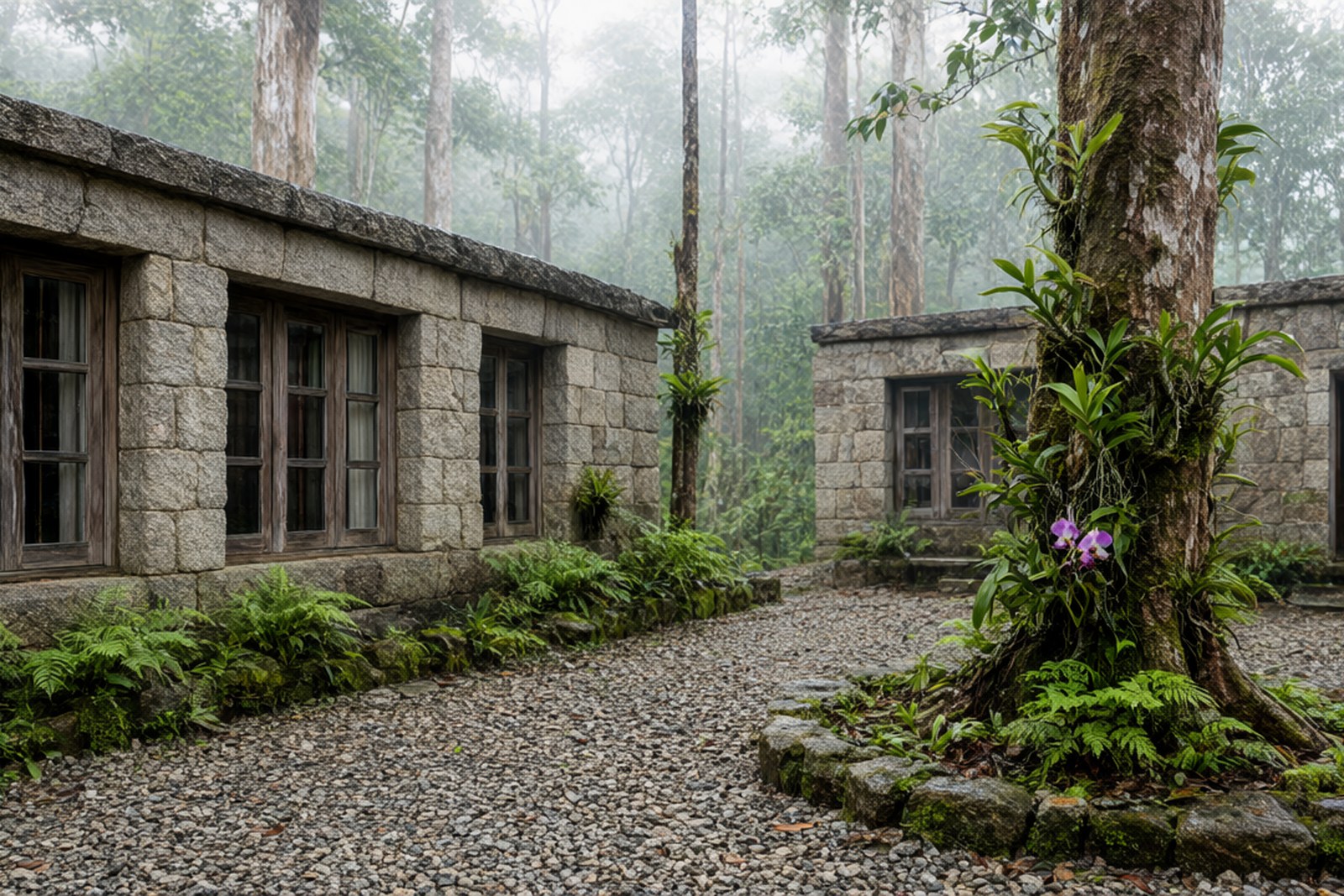
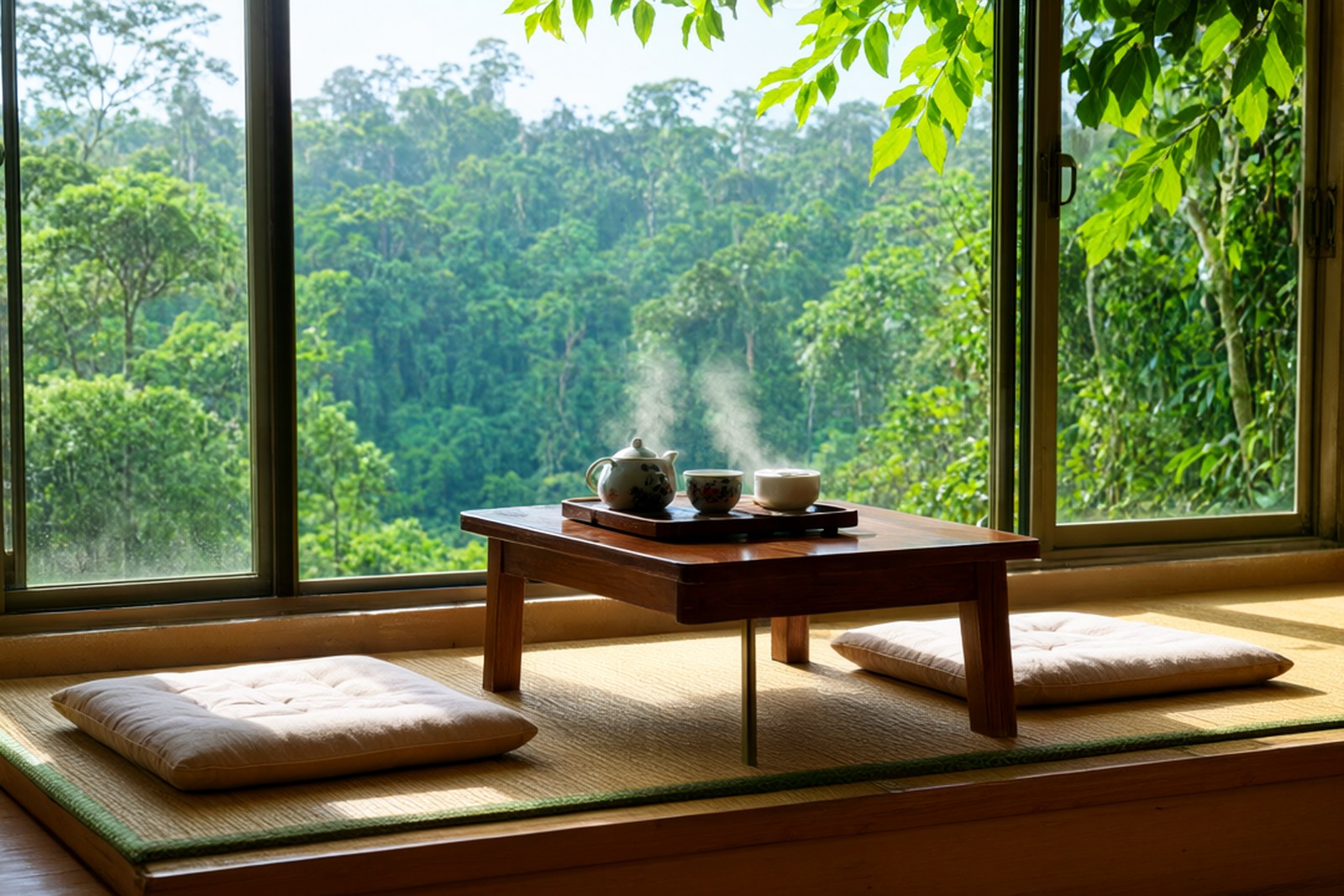
What the rebuilding kept is the reason to sleep here. The old doors and windows stay, the granite-block walls stand as they were built, the courtyard is gravel and old trees carrying orchids and ferns on their branches, and floor-to-ceiling glass pulls the forest into the rooms without cutting a single wall of it away. The house teaches as it lodges: it is at once a guesthouse, an ecological study base, an outdoor base for universities, companies and trade associations, and a research-team education site, and by the provincial government’s 2020 count it had already run 117 study sessions. Ten years of work add up, in the symposium report’s figures, to more than 150 nature-and-art study events with over 5,000 participants drawn from Beijing, Shanghai, Hubei, Jiangsu, Zhejiang and Guangdong, and the shelf of honours runs from national forest-and-grassland science base to Hainan study base to a place among Hainan’s ten best guesthouses. In 2021 the slow variety show 完美的夏天 Wánměi de Xiàtiān series two filmed its third stop here, with the founder telling People’s Daily’s Hainan channel that the house was glad to be “a window through which people discover Hainan”.
The house’s grades tell its decade in two steps, and the order matters. In August 2021 Xinhua’s county-tourism report recorded 学而山房 rated at Hainan’s copper guesthouse level – 铜宿级, the bronze rung of the province’s gold-silver-copper village guesthouse ladder; in 2023 the official fifth-batch provincial village guesthouse list, as republished by the Hainan free-trade-port talent work network, carried 琼中学而山房民宿 among its fifteen silver-grade houses. Copper in 2021, silver in 2023: an upgrade line, not a contradiction, and both years are printed so neither grade masquerades as current forever. The mountain nights do their part too – guests’ 2022 Ctrip travel notes, a platform source, record rooms without air conditioning or television that fill up on holidays because the Limu Mountain night runs cool, with tents pitched below the house for overflow.
What the Rooms Are Like
A room here is a schoolroom rebuilt, and the room names say so. The Tongcheng snapshot lists twelve-plus types across the house: the 上达 Shàngdá tatami king and twin rooms, the 观山 Guānshān glass king room and panoramic family room, the 知天 Zhītiān courtyard suite, a family landscape suite, the 上达 tea-dwelling rooms 乐水 and 乐山, the 下学 Xiàxué loft king, loft twin and tatami twin rooms, and a starlight tent room with shared bathroom at the budget end. The names 上达, 下学 and 知天 belong together – they are the three phrases of the Analects’ 宪问 chapter, “learning below and reaching above; heaven knows me” – and though no published source states that the naming quotes the text, the room-name pattern is the evidence, and this article labels it an inference. What no room has is a television or an air conditioner, by design and by the mountain’s own climate; what the house does have is food, with guests’ Ctrip reviews on the 30 September 2026 snapshot calling the cooking genuinely good and fresh, and the “meals need to be booked with the house ahead” detail that circulates on platforms and travel notes being a guest-sourced line, best confirmed when you book.
Practicalities
Price. On 30 September 2026 the house quoted from 778 yuan on Tongcheng at 4.6, from 1,189 on Ctrip’s same-day rate at 4.5 across 85 reviews – with Ctrip’s date-flexible rates on the same page from about 543 to 578 – and the Meituan page at 4.5 carried no rate; RollingGo lists the house in English as Xue’er Mountain House, Limu Mountain Park, Qiongzhong. In the same park the budget alternatives quoted 215 yuan up at 好逍遥客栈 Hǎoxiāoyáo (4.5), the newly opened 雅居民宿 Yǎjū from 975 at 4.9 with its rainforest-oxygen king rooms, and 雷哥的民宿 Léigē from 641. Every figure is a snapshot that floats.
Address. The address is the story: 琼中黎族苗族自治县黎母山森林公园场部原林业公司子弟学校 Lǐmǔshān Sēnlín Gōngyuán – the original forestry-company children’s school at the park headquarters compound, as Ctrip and RollingGo both file it, with Meituan pinning it 550 metres south-west of the park management office on provincial road 307. The Limu Mountain National Forest Park itself is about 1.5 kilometres away on foot by Ctrip’s measure.
Rooms. Ask for tatami or for the glass-wall 观山 rooms by name, because the twelve-plus types split between floor-seating rooms and ordinary-bed rooms and the difference is the stay. Ask whether meals are included or booked ahead with the house, since the mountain has no restaurant strip and the guest reviews that praise the cooking also assume you arranged it. And ask about the shared-bathroom tent room if the price is the draw, because the starlight tent is the one type without its own facilities.
Getting there. The house is about 40 to 50 kilometres from the county seat 营根 Yínggēn – the park’s own old website said 50, the travel-guide line says 40, and a Ctrip drive-time pin from the county bus station lands at 44.2 – with the last stretch a climbing road of some twenty kilometres by platform travel notes, an hour to an hour and a half of driving by the estimate here; navigate. From Haikou the park is 165 kilometres by the old website’s figure, roughly two and a half hours by the central expressway, an estimate, or take the Qiongzhong-Haikou coach to Yinggen and drive the rest. There is no railway in the county: the trip is car or coach-plus-car, and any page offering a high-speed rail transfer to a Qiongzhong station is wrong.
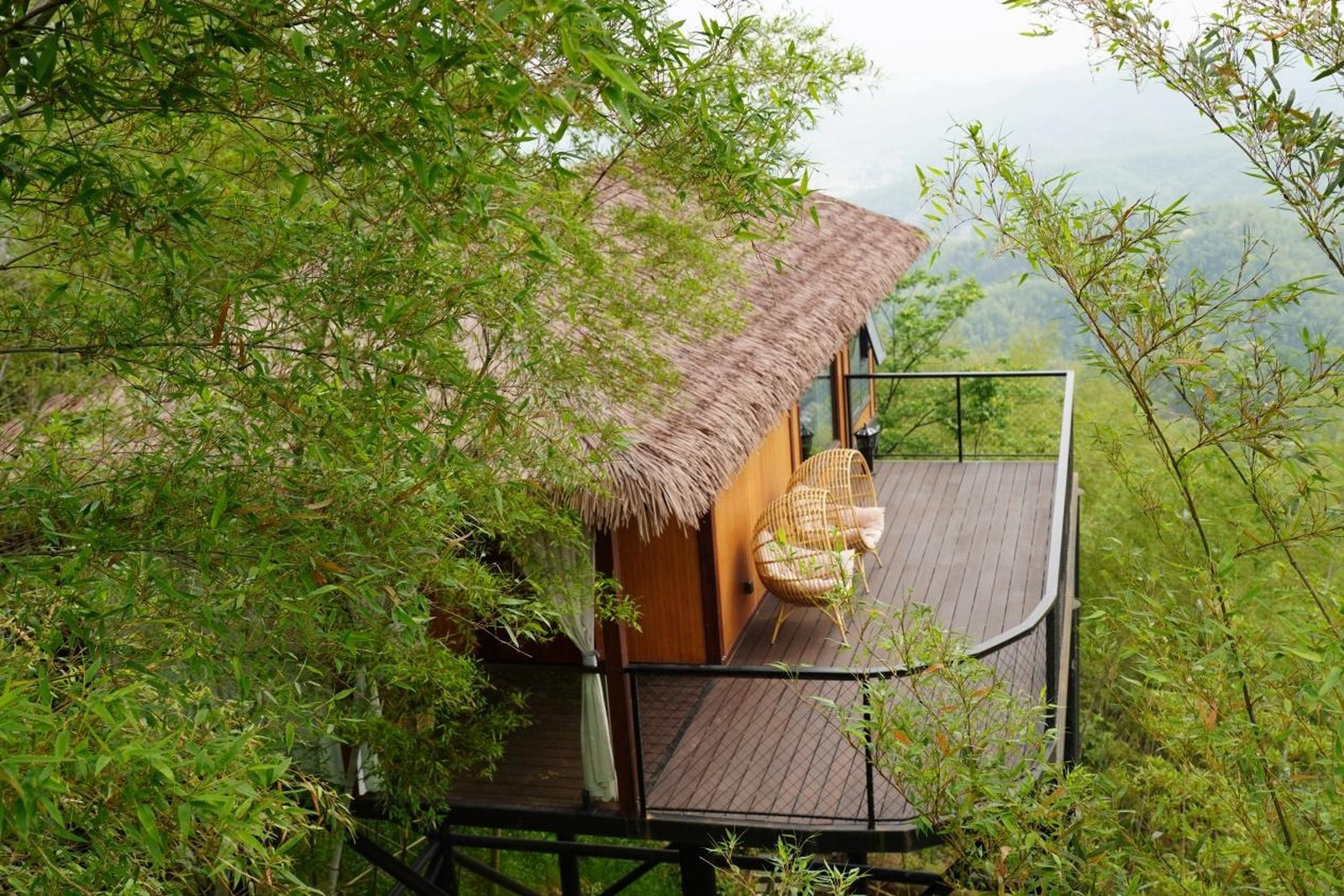
Where to stay: a tatami room in the 上达 Shàngdá line if the schoolhouse-to-tatami conversion is the reason you came, the 知天 Zhītiān courtyard suite if you want the whole gravel-and-orchard rectangle to yourself, and the budget tent room if the forest is the point and the bathroom is not – all at 学而山房 Xué’ér Shānfáng, 黎母山森林公园, 琼中黎族苗族自治县, inside the park of the mountain the Li people call their ancestress.
flowcloud would say that a company which spent thirty-six years felling this forest has had its school spend the last ten teaching it back, and that the correct way to sleep here is on the tatami with the glass open, because the syllabus is the rainforest and the rainforest holds class all night.