
Chongqing is a municipality of southwest China, and 九龙坡区 Jiǔlóngpō Qū Jiulongpo is its south-west district; its urban origin point sits a few hundred metres from the 嘉陵江 Jiālíng Jiāng, Jialing River, at 杨家坪 Yángjiāpíng, Yangjiaping, where the road out of the old city meets the ring road. The walking street and the lanes around it still work as a street rather than as a themed reconstruction, and the rooms above them are the plainest, most local lodging register in west-bank Chongqing – older walk-ups over counters, family rooms over the ring road’s arcades, the stock that has never charged what the mall towers to the north charge. The value of a room here is set by one question: how quickly can you walk down to the food and back.
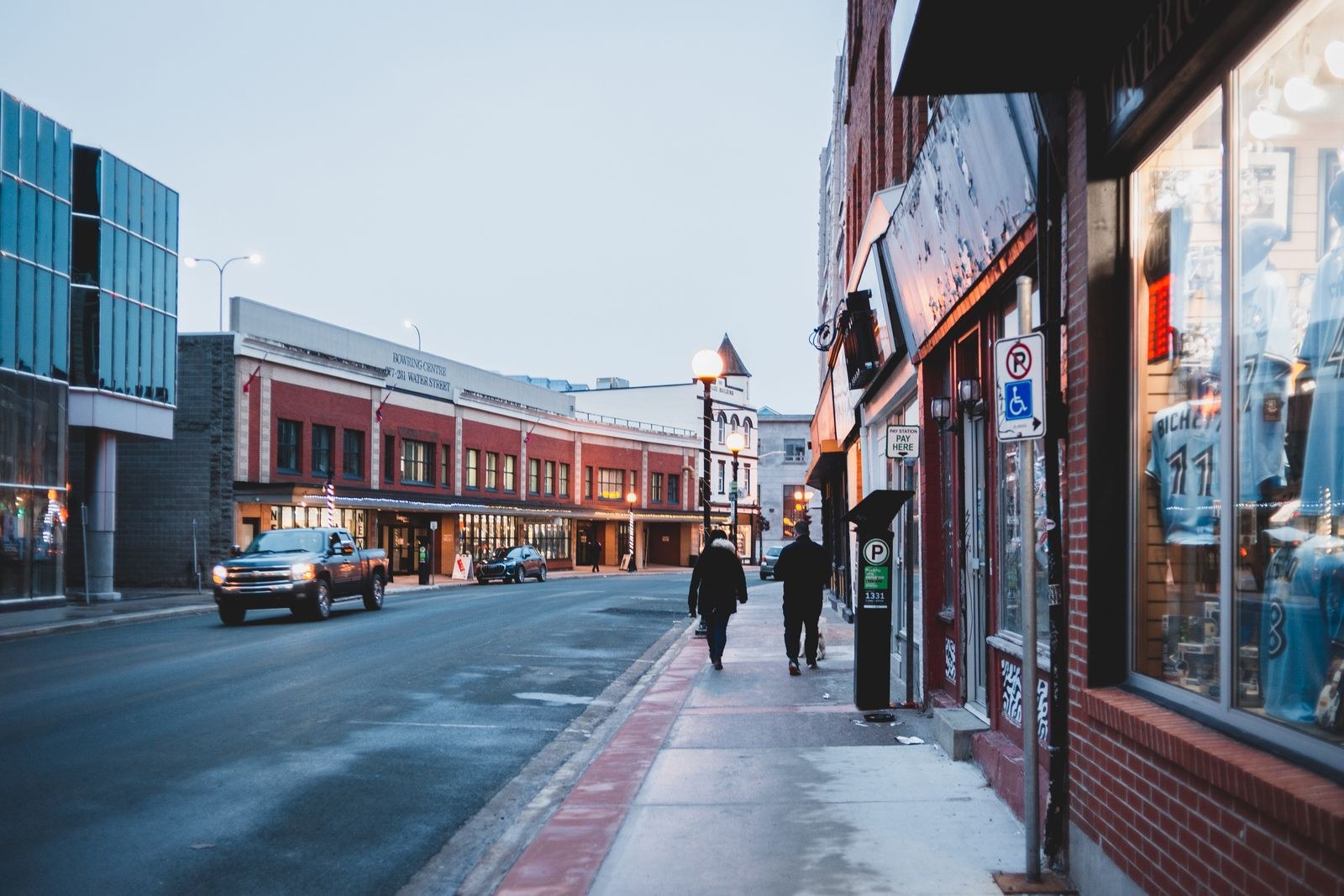
The district’s centre here is older than the walking street. It grew on a crossroads roundabout where the sugar and wine and grain companies and the big state industrial plants put their workers, in streets of four- and five-storey red-brick walk-ups of the period’s cheap-housing kind. A 1991 shopkeeper’s account in the district’s own press puts the individual-business count around the roundabout below eighty and the registered population at a little over twenty thousand. In 1991 the 杨家坪地下商场 Yángjiāpíng dìxià shāngchǎng, the Yangjiaping underground market, opened, converted out of an air-raid-civil-defence project and described as the city’s earliest underground mall; in 2018 its first three phases closed for redesign. The lanes above it are where the rooms are.
In 2002 the district set a commercialisation strategy and made the core commercial district its lead project; the walking street opened in 2003 on 18.9 hectares with 55,000 square metres of pedestrian floor, a ring road around it and a planned 680,000 square metres of floor on the surrounding parcels, which the district’s own retrospective calls the third pedestrian commercial district of the old city. The district’s own account, published at its 75th anniversary, put daily footfall over 300,000 and counted 1,955 businesses – promotional numbers.
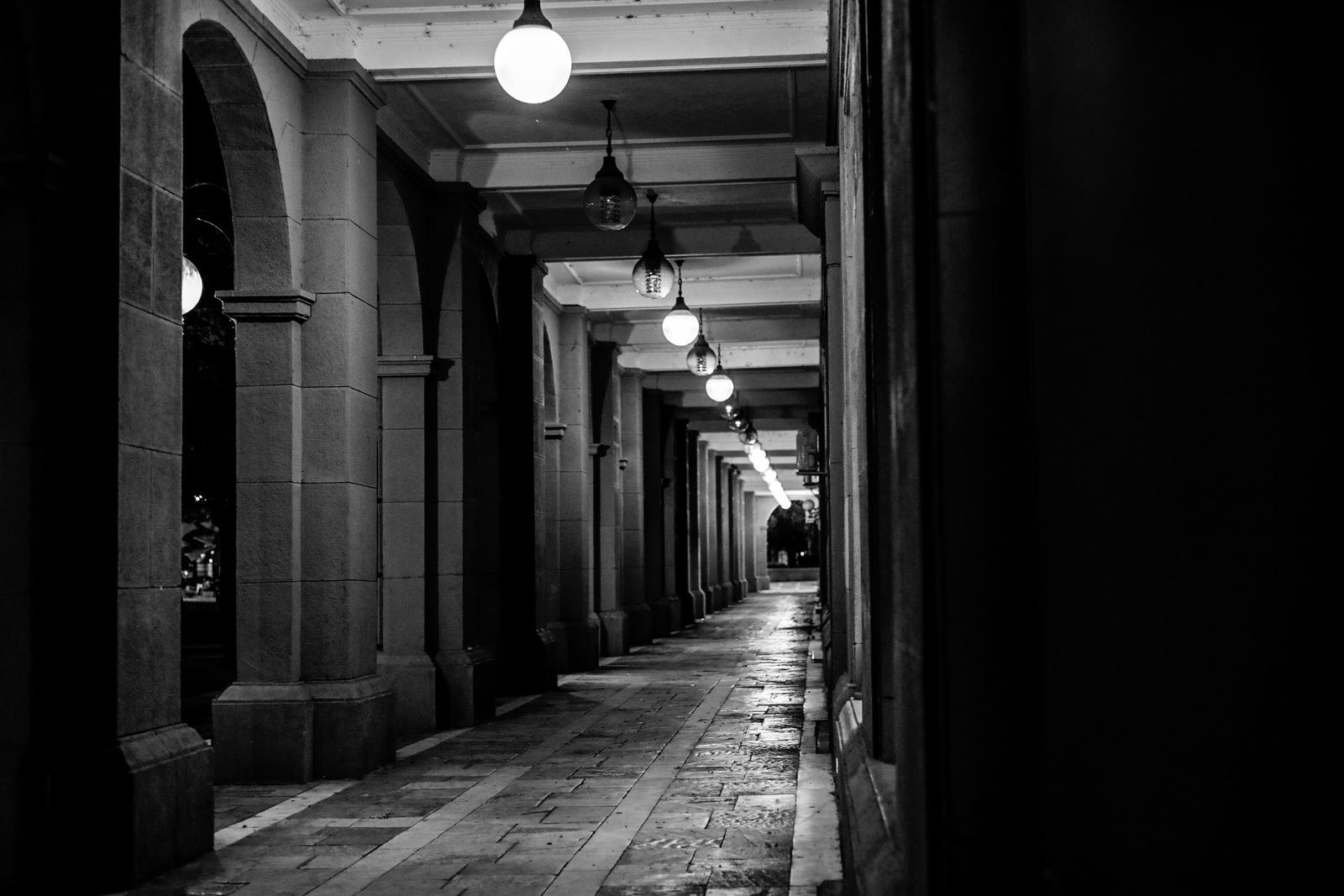
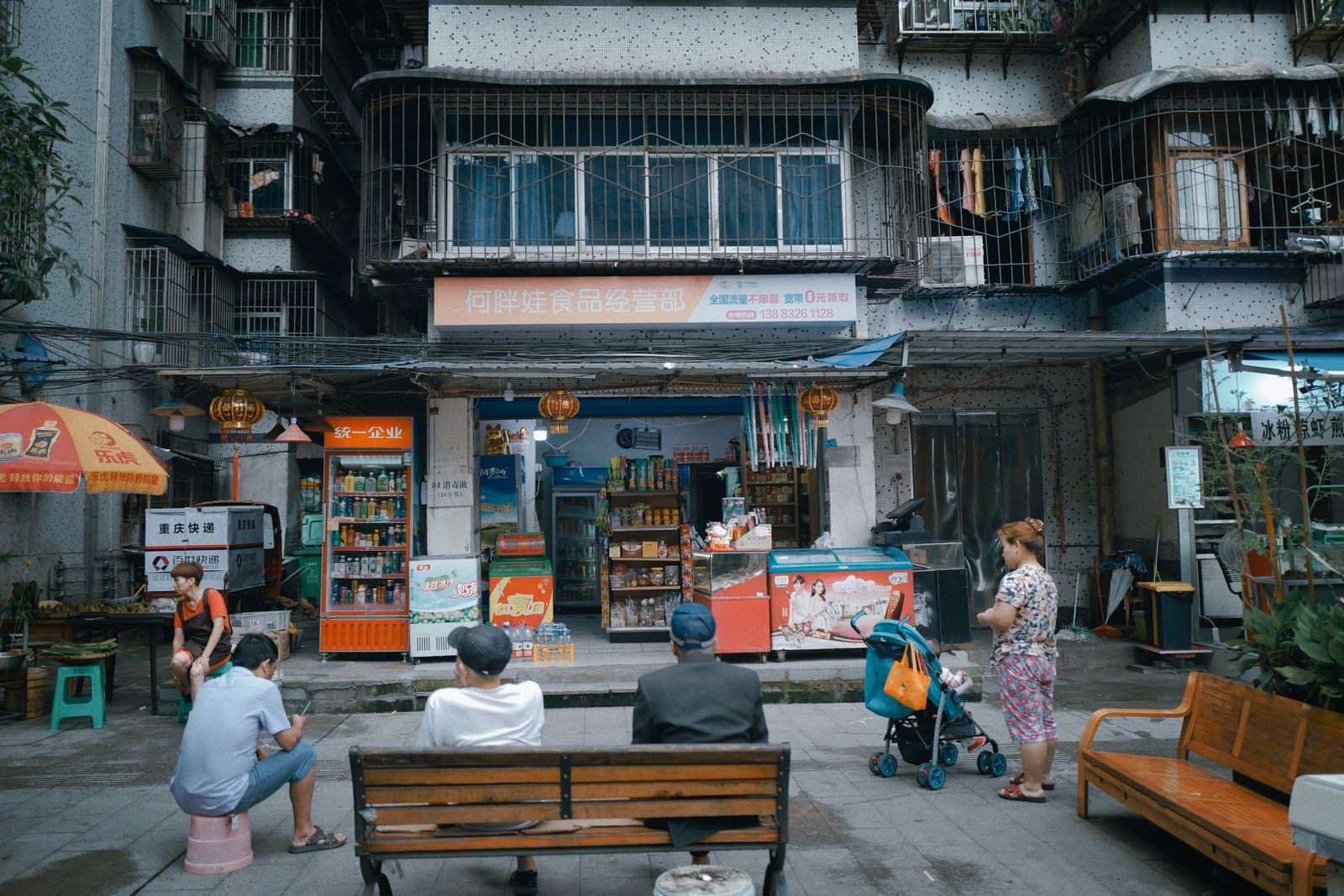
What replaced the old skyline is the 九龙门 Jiǔlóng Mén, the Nine Dragons Gate: four nineteen-metre red columns with a ringed top and a central pillar, unveiled on 19 September 2019 on the site of a glass tower that had become a safety liability, standing where Metro Line 2’s elevated track passes between 袁家岗 Yuánjiāgǎng and 杨家坪 Yángjiāpíng. A pedestrian district that has already rewritten its own hard landscaping twice in fifteen years is not a preserved thing. The value here is the continuity of the counters, and that is where the beds are: family-run rooms above the pedestrian lanes with a shop on the ground and a stair the width of a cupboard; older walk-up stock behind the ring road, where the balconies still hold drying racks; and the modern mid-band toward the mall complexes. The people who open the counters sleep above them, which is why this street can still be walked at night.
Three boundaries hold the piece. Against the tower-lobby register on the other banks: that market sells the skyline, and this one has none – the landmark here is a red gate the metro passes through, not a tower you look from. Against the Shiqiaopu corner, which sells proximity to a trading floor: this street sells proximity to a street, and its night trade is small eating rather than wholesale. Against this district’s reworked estate: Yangjiaping is the unrenovated register, older and lower and cheaper.
Practicalities
Price. No figure is printed here, because the room rates on the pedestrian floor are re-ranked monthly by the platforms and shift with the trade calendar. The shape of the ladder is what can be said. The bottom rung is the family rooms above the lanes, priced as a plain night’s sleep and as close to a hostel as this district gets. The middle rung is the older walk-up stock behind the ring road, where room size and the lift decide the difference. The top rung is the modern mid-band toward the mall complexes.
Address. 重庆市九龙坡区杨家坪 Zhòngqìng Shì Jiǔlóngpō Qū Yángjiāpíng, Yangjiaping, Jiulongpo District, Chongqing – the pedestrian floor and the lanes feeding it, with addresses on 步行街 Bùxíngjiē, the walking street itself, 珠江路 Zhūjiāng Lù, Zhujiang Road, and the 环道 Huándào ring road.
Rooms. The stock is old, local and small. Expect family rooms over the pedestrian lanes, some with the shop’s own noise below; rooms in older walk-ups behind the ring road, where the balcony drying rack is a good sign the building is unrepurposed; and newer mid-band rooms toward the mall complexes. Confirm whether the room faces the pedestrian floor or a service lane, because the noise difference at midnight is enormous.
Getting there. Metro Line 2 stops at 杨家坪 Yángjiāpíng at the pedestrian floor itself, with the elevated track and the 九龙门 Jiǔlóng Mén columns over the square; the same line reaches 解放碑 Jiěfàngbēi, Jiefangbei, and 磁器口 Cíqìkǒu, Ciqikou, directly. Buses converge on the ring road from 大渡口 Dàdùkǒu, Dadukou, and the west bank generally; parking is underground in the mall complexes. From 江北国际机场 Jiāngběi Guójì Jīchǎng, Jiangbei International Airport, allow a long taxi ride.
A day on this street is decided by when you want to be outside it. Early morning belongs to the counters: shutters up, deliveries down the ring road, the noodle shops starting their steam. Midday belongs to the lane, not the floor. Afternoon belongs to the shade of the arcade. The evening belongs to whichever end of the street you ate at, because the point of a room here is that you could not have walked home. Then the street goes quiet earlier than the district’s newer blocks, and the bed – small, plain, over somebody’s shop – is the cheapest thing in this part of the city.
flowcloud would say that Yangjiaping is the only pedestrian street in Chongqing where the cheapest bed in the district puts you directly over the counters that keep the street alive after the malls close, and that the correct way to sleep here is the small family room on an upper floor of the lane, because the street was built to be walked, not admired.
Where to stay: a family room above the pedestrian lanes if the price floor and the location are the point; a room behind the ring road in one of the older factory-era walk-ups if you want the neighbourhood around you rather than the street under you; and the newer mid-band stock toward the mall complexes if a desk matters more than the walk – because on 杨家坪 Yángjiāpíng, Yangjiaping, a room is measured in minutes to the food and minutes back.