
You sleep inside the walls. That is the whole difference between staying at 张谷英村 Zhānggǔyīng Cūn and visiting it, because the village is not a street of houses with a road in front of it; it is a single connected complex behind one perimeter, and the courtyards are the only open ground. A guesthouse here occupies a few rooms off one of those courtyards, and at night the day-trippers go and the courtyards go quiet and fill with the sound of water moving in the stone channels, and the whole place reverts to what it has been for four hundred years: a family’s house, enormous, still lived in.
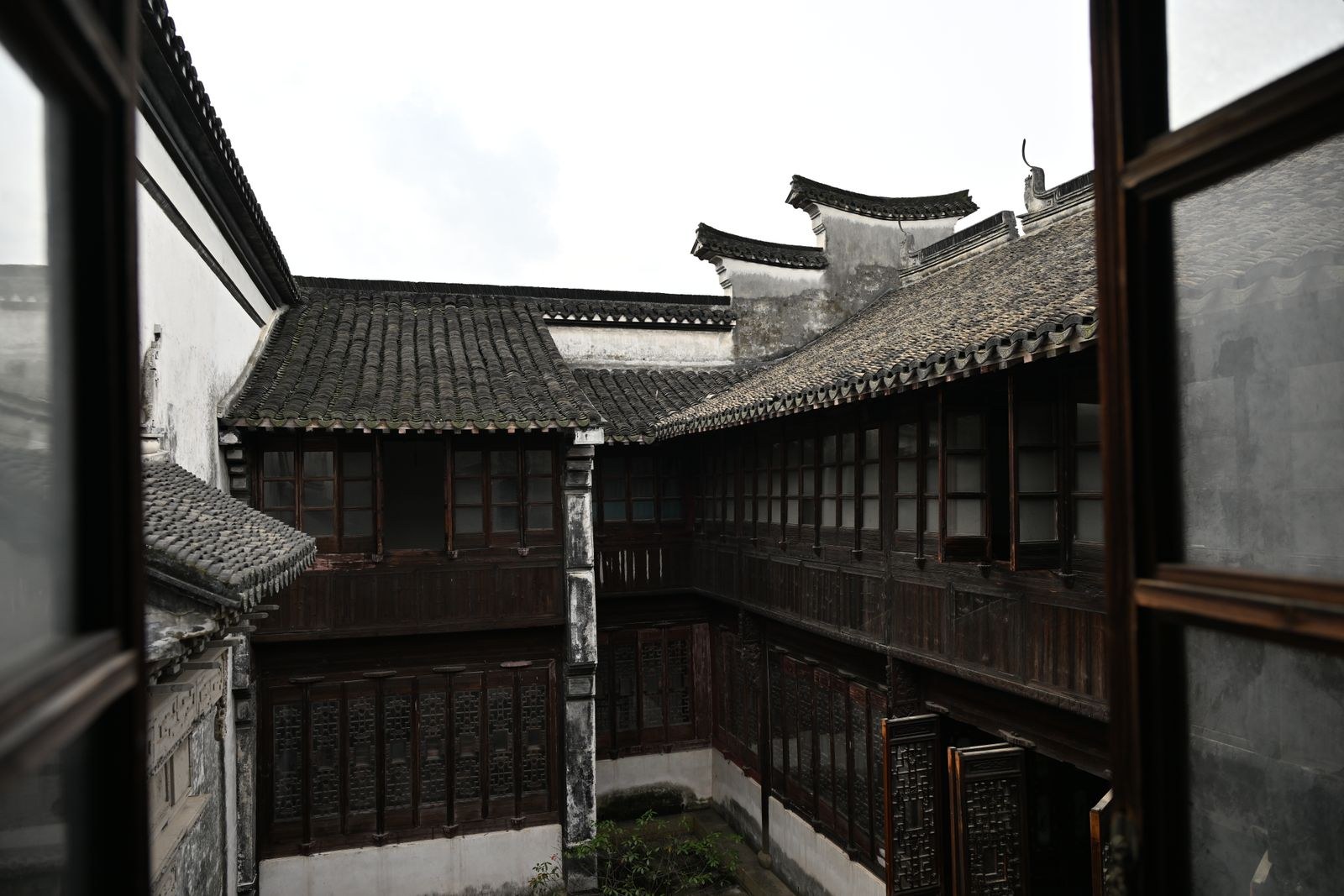
The architecture is the reason to come, and a night’s stay is the only way to see it properly. The compound was begun in the Ming dynasty by a man named 张谷英 Zhāng Gǔyīng, an official from Jiangxi who moved his family here, and it has been extended by his descendants ever since. The result is a warren of 天井 tiānjǐng, sky wells, around which rooms are arranged so that every room gets light from above and rain drains into a stone basin in the middle of the floor that also serves as a fire reservoir. Corridors connect the courtyards so completely that the family story is that you can walk from one end of the village to the other without getting wet in the rain. Roofs shed water inward onto the same principle, which is why the village has never had a drainage problem in a region that has plenty of rain.
What the Rooms Are Like
Rooms in the guesthouses are converted family apartments, and they are plain. A bed, a small table, a bathroom that has been added into a corner of what was a storage room, an air conditioner that is essential in summer and inadequate in winter, and a window that opens onto a courtyard or, in the cheaper rooms, onto an inner corridor. Some places have kept the timber lattice screens and the raised thresholds; others have modernised without much care. What no room here can offer is silence in the courtyard after about seven in the morning, because that is when the villagers start moving through and the visitors arrive.
Practicalities
Price. A double room runs roughly ¥150 to ¥350 a night, and the spread has more to do with how much of the original structure the room retains than with size. Weekends in spring and autumn, and the 国庆 Guóqìng week at the start of October, push the top of the band up and are worth booking ahead; a weekday in winter can be had for the bottom of it. Many houses include a simple breakfast of congee, pickles and steamed buns, and almost all will cook dinner if asked in the morning.
Address. The village stands in 岳阳县 Yuèyáng Xiàn, in the hills about seventy kilometres southeast of 岳阳市 Yuèyáng Shì, and a little over two hours by road from 长沙 Chángshā. Bookings are made to the village itself; there is no street address in the usual sense, and drivers will know the 游客中心 yóukè zhōngxīn, the visitor centre, at the entrance.
Rooms. Ask for a courtyard-facing room rather than a corridor-facing one, and ask whether the room has its own bathroom or shares. Upper floors are quieter and get better light through the sky wells; ground floors are cooler in summer. Beds are firm, quilts are heavy, and hot water in the early evening can run thin when every room in the house showers at once.
Getting there. By car is by far the easiest way, and most visitors come from Yueyang or Changsha as a day trip that they then extend into a night. Buses run from Yueyang’s main coach station toward 渭洞 Wèidòng, the township the village belongs to, and from there it is a short taxi ride; the return service is infrequent enough that you should confirm the last departure when you arrive. Expect around two hours from Yueyang city centre and a little more from Changsha.
flowcloud would say that a night in Zhangguying is the only way to hear the place, since the courtyards amplify a family’s ordinary evening into something close to architecture, and no day ticket includes the evening.
Where to stay: inside the walls rather than in the newer buildings outside the gate, on a courtyard rather than a corridor, in one of the houses run by a family whose name is still Zhang. Ask whether dinner is available, whether the room has its own bathroom, and how early the courtyard gets busy, and if you can, book directly by phone rather than through a platform.