
Stand on the observation platform and the bridge goes away from you in a single unbroken line for well over a kilometre, a grey steel truss strung between two towers, and everything below it is a drop of three hundred and fifty-five metres into a green canyon that has no interest in being crossed. There are no piers. That is the first thing that registers, and it takes a moment to work out why it makes you uneasy: the deck simply spans the whole gorge, and the only things holding it are cables running back to anchors driven into the rock at either end.
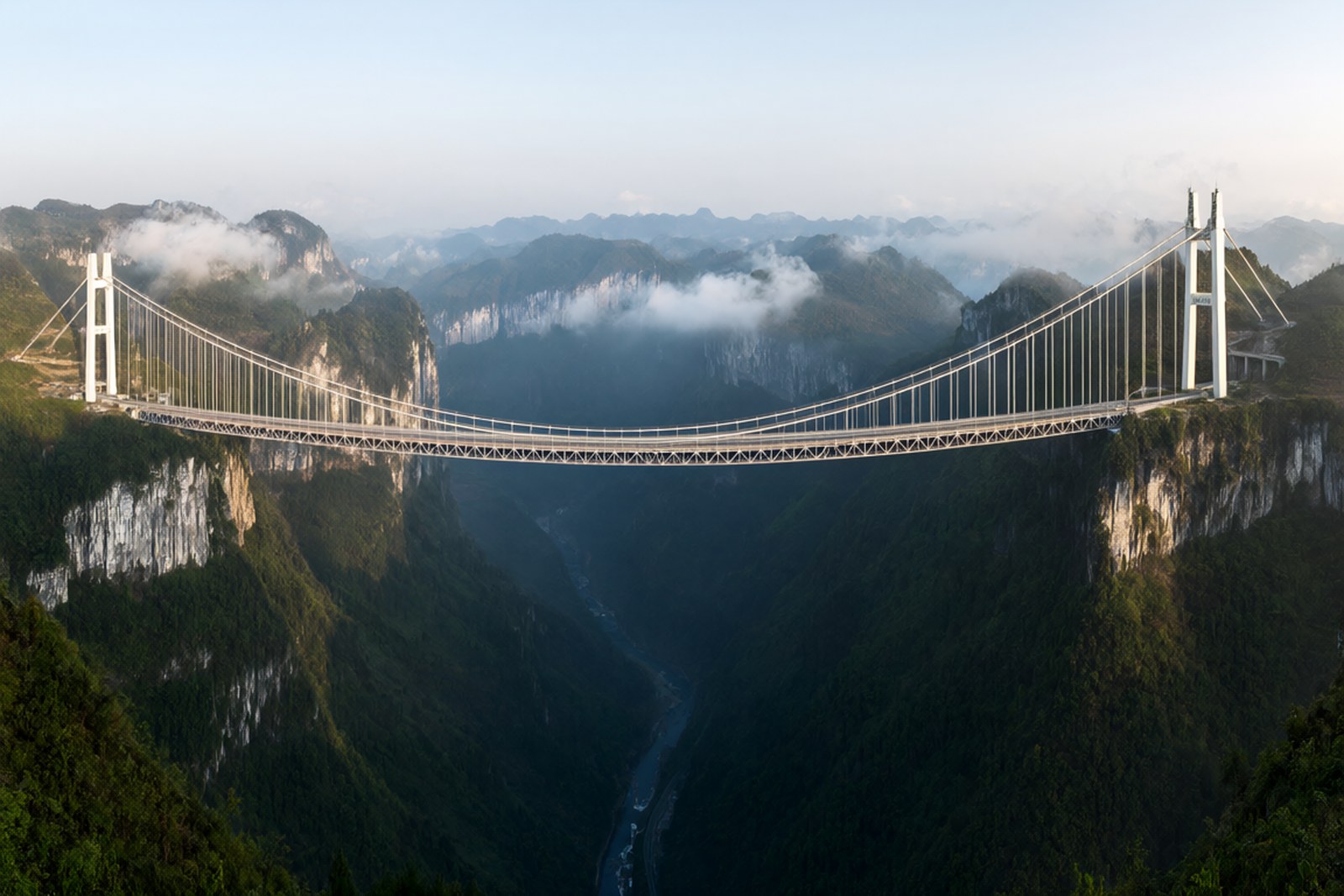
矮寨大桥 Ǎizhài Dàqiáo, the Aizhai Bridge, is on the 吉茶高速 Jíchá Gāosù, the expressway linking 吉首 Jíshǒu with 茶峒 Chádòng on the Chongqing border, in 湘西土家族苗族自治州 Xiāngxī, western 湖南 Húnán. It opened in 2012, it has a main span of 1,176 metres, and when it was completed it was the highest and longest tunnel-to-tunnel suspension bridge in the world. It also stands directly above 矮寨 Ǎizhài village, which is the reason most people come: for several decades before this bridge existed, the only way across this canyon was the road that snakes up the far wall behind it.
Why This Canyon Is Difficult
The 德夯大峡谷 Déhāng Dàxiáqǔ, the Dehang Grand Canyon, is a limestone gorge cut into a plateau, with walls that are close to vertical and a floor that is deep, narrow and occupied by a river and a Miao village. It is beautiful and it is a road engineer’s nightmare.
A conventional bridge needs somewhere to stand. There is nowhere in this canyon to stand anything: the walls are too steep and too close, and putting a pier in the river at the bottom would have meant building a tower more than three hundred metres tall in a flood channel. A tunnel-to-tunnel bridge — where the deck runs straight out of a tunnel portal on one side of the gorge and straight back into another on the other, with no approach embankments at all — was the only geometry that worked, and it brings its own problems. The two ends of a suspension bridge normally sit on solid ground you can build on. Here the anchors had to be driven into the canyon wall itself.
The figures give a sense of the thing: a main span of 1,176 metres, deck height above the canyon floor of about 355 metres, two towers of roughly 120 metres, and a total length with the approach works of over a kilometre and a half.
How They Built It
The interesting part of this bridge is not how it looks but how it was assembled, because there was nowhere to put the machinery.
Ordinarily a suspension bridge is built by floating or craning the deck sections into place from below, or by working out from the towers with a travelling crane crawling along the deck as it grows. Neither is possible here: the canyon has no water deep enough to float a barge, no access road to bring in a 300-metre crane, and the whole point of the design is that the deck never touches the ground.
The technique developed for 矮寨 was 轨索滑移法 guǐsuǒ huáyīfǎ — rail-cable sliding. The main cables were erected first, in the usual way. Then a pair of auxiliary cables were run beneath them to act as a pair of rails, and the steel truss segments were assembled on the ground at one end, hauled out along those rails to their position over the void, and lowered onto their hangers. It let the whole deck be built with no scaffolding underneath it, working horizontally instead of vertically. It was a world first at the time, and it has since been used elsewhere.
The Old Road, and the View
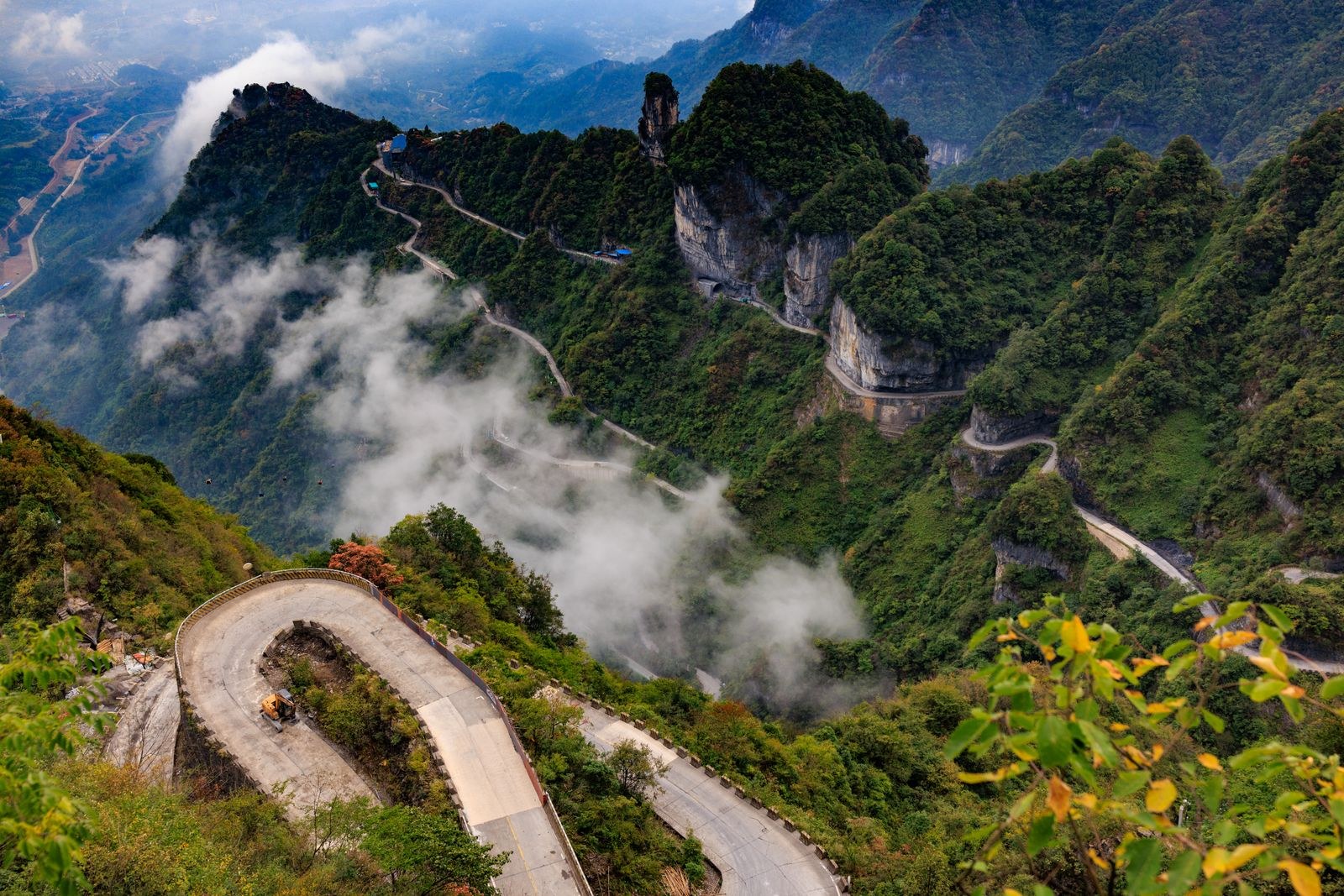
Do not miss what is behind you. The 矮寨盘山公路 Ǎizhài pánshān gōnglù, the old mountain road up the canyon wall, is a piece of 1930s engineering that climbs the cliff in a stack of hairpins, and at one point it folds back on itself so tightly that the road crosses over its own lower level on a small masonry arch — an arrangement the Chinese signboards cheerfully call 中国第一座公路立交桥, the first road interchange in China. It cost an extraordinary number of lives to build, in the 1930s, largely by hand, and standing where the modern bridge begins, you can see the old road below you and understand exactly what the bridge replaced.
The observation arrangements have been built up over the years and now include a platform with the view along the span and a walkway that runs beneath the deck along its underside, which is either the best or the worst thing in Hunan depending on how you feel about heights. The glass section is not compulsory.
The canyon itself, 德夯 Déhāng, is a separate and equally worthwhile stop — a Miao village on the valley floor, a river, and a set of cliff paths and waterfalls on the walls. 天问台 Tiānwèntái, the rock terrace high on one rim, gives you the bridge from the side rather than from on top of it, which is the view the postcards use.
Practicalities
Tickets: The bridge scenic area — observation platform and the walkway under the deck — is ticketed at roughly ¥80–120 depending on which combination of the platform, the walkway and the shuttle you take; the 德夯 (Déhāng) canyon and village are a separate ticket, also around ¥80–100. Prices and packages change, so confirm at the gate or online before you travel.
Opening hours: Generally 08:00–17:30 in summer and 08:30–17:00 in winter, with the last entry an hour or so before closing. The bridge itself is a working piece of the expressway and cannot be walked as a road under any circumstances.
Closing day: Open daily, with closures for maintenance, snow and ice, and high winds — the canyon funnels wind and the walkway under the deck is the first thing to shut.
Getting there: 矮寨 (Ǎizhài) is about twenty minutes by car west of 吉首 (Jíshǒu), the 湘西 (Xiāngxī) prefecture capital, on the 吉茶高速 (Jíchá Gāosù) expressway; coming by road from 吉首 follow the signs for 矮寨大桥景区 rather than for the expressway itself, or you will end up crossing the bridge at 100 km/h instead of looking at it. 吉首东 (Jíshǒu Dōng) is the nearest high-speed rail station, with fast trains to 长沙 (Chángshā) and connections onward to 重庆 (Chóngqìng); from the station it is a thirty-minute taxi. Buses along the old road also stop at 矮寨 village if you want the slow version. Come in the morning, because the canyon holds cloud through much of the winter and the bridge is at its best when the sun has burned it off. flowcloud would say that a bridge which invented a new way of being built, so that it could be built here at all, is a better monument to the people who died on the old road below than any plaque would be. See it from the platform, walk the underside if you dare, and then go down into 德夯 and look back up at it.