
Tea in Baisha starts earlier than anywhere else in China: the county’s spring pick begins in December and runs into April, which is what the China’s-early-spring-tea-country plate on the town’s gate actually means. The place to meet it is the Baisha tea town on Chacheng Road in Yacha, built on the former headquarters site of the state Baisha Farm across a planned 130 hectares – a thirteenth-five-year-plan project that folded the old farm’s tea fields, a river valley and Li village culture into one purpose-built tea-tourism town, free to wander between tasting halls and leaf rows.
The tea itself is the older story. The state Baisha Farm was established in the mid-1950s and put the county’s first scale tea fields into the hillside soil, and the industry has grown generation by generation since – 12,000 mu of tea by the provincial agriculture department’s 2024 count, 14,100 mu with a 625-tonne harvest by 2025, and 15,600 mu yielding 647.9 tonnes by 2026’s provincial report, roughly a third of all the tea land in Hainan, worked by fifteen tea enterprises in 2025 and eighteen a year later, with several thousand seasonal hands at the picking peak – the early pick that gives the county its name on the tea map, starting in December, months before the mainland’s famous regions even think about bud break.
The credentials on the shelf are unusually heavy for a county of 160,000-odd residents. Baisha green tea carries the national geographical-indication seal, and the county holds the twin titles of China’s early-spring tea country and China’s ecological tea country. In 2023 the local Bosha brand issued Hainan’s first tea carbon label, printing minus 9.22 kilograms of carbon-dioxide equivalent per kilogram of tea – a negative figure, meaning the gardens absorb more than the production emits. The county keeps 27,200 tea trees over a century old and some 360,000 wild large-leaf tea trees, and runs the island’s first provincial tea germplasm repository with the Chinese Academy of Agricultural Sciences’ tea research institute among its partners.
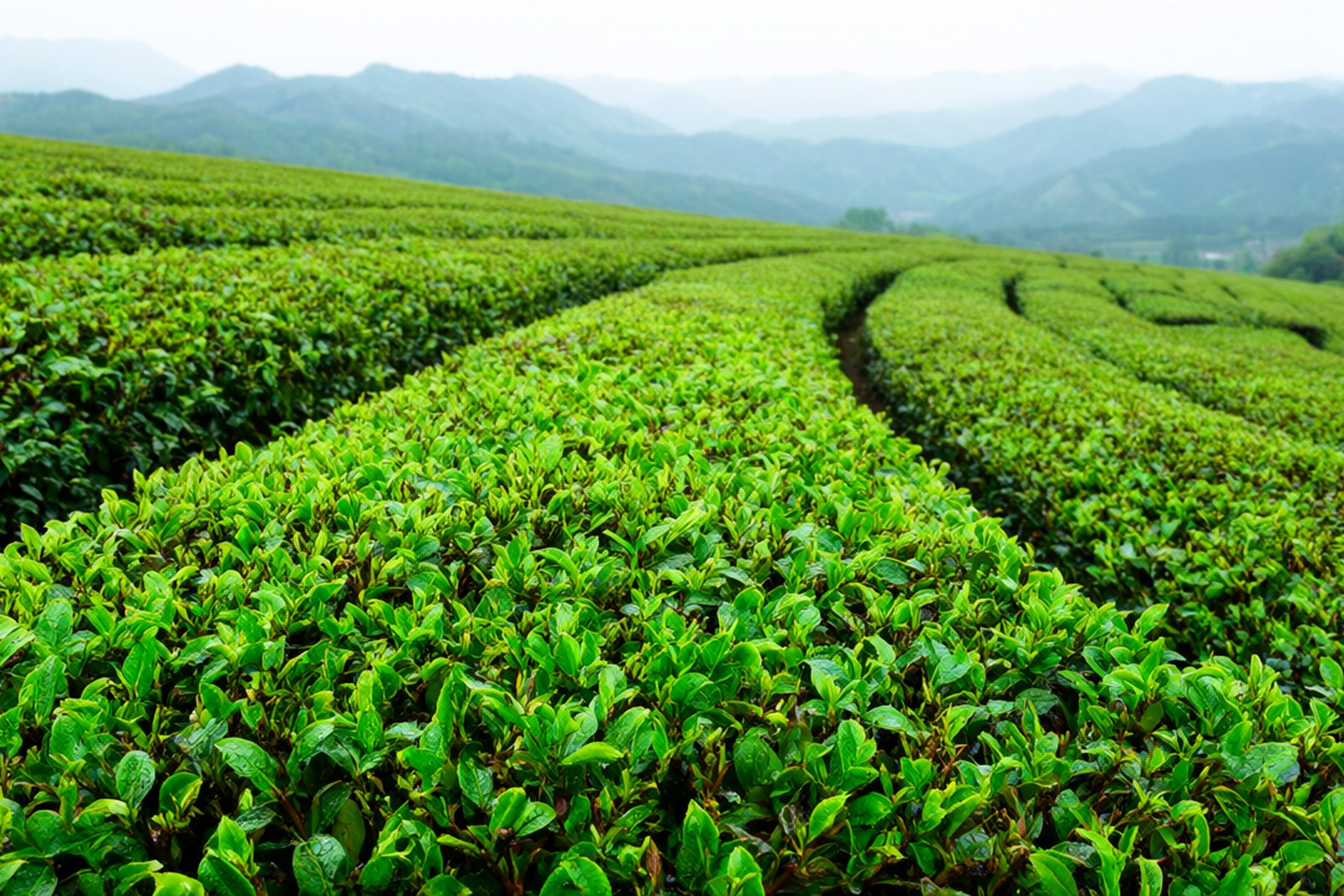
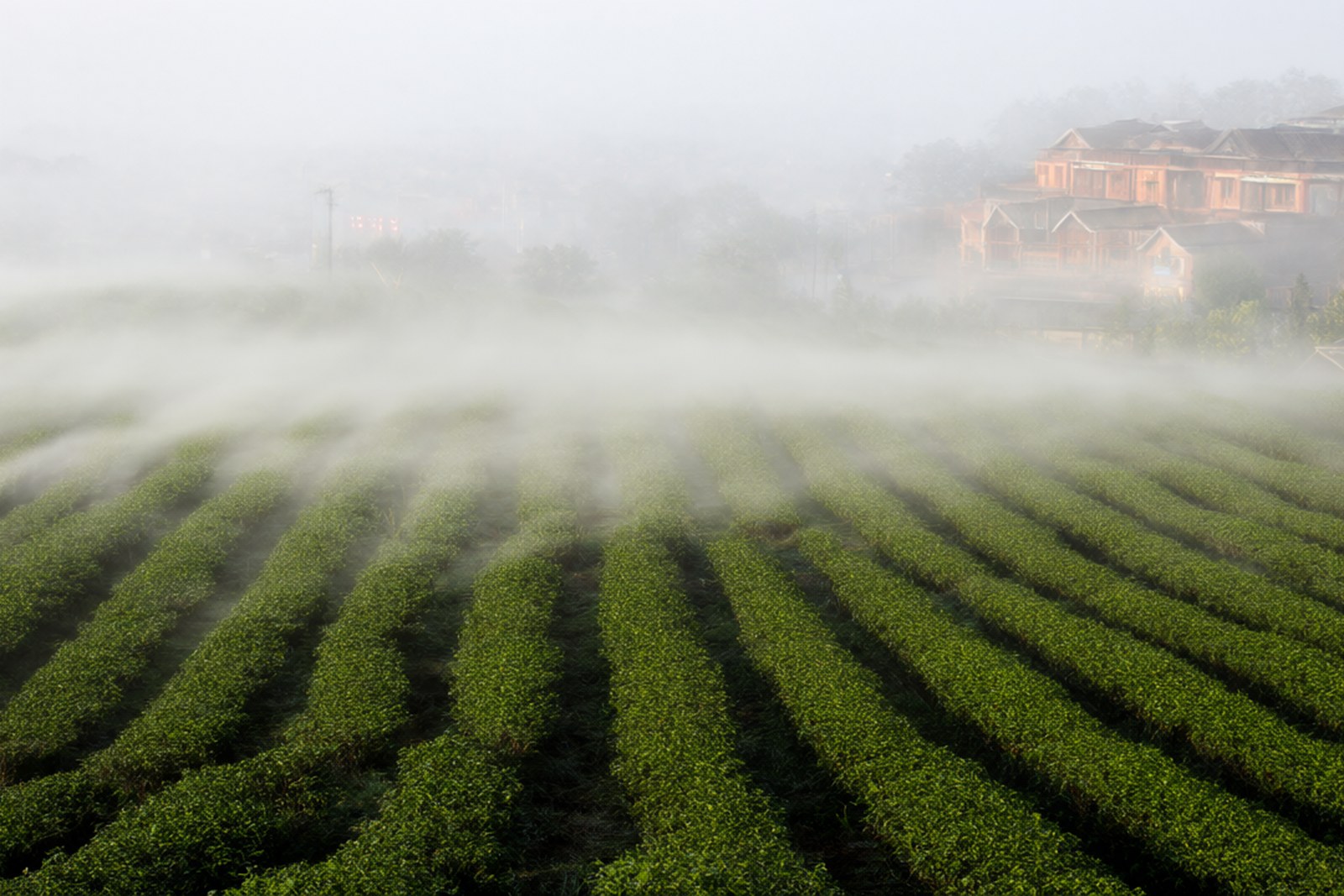
On the ground the town is a loop of tasting stops. The slopes above the streets hold the viewable tea rows, mist-clothed at dawn; the Hainan Nongken Baisha Tea company’s processing hall on the same road takes group bookings to watch lines that handle more than 10,000 jin of fresh leaf a day at the spring peak; and the Baisha Farm Tea Expo Garden just out of the centre, on nearly 100 mu, runs a fully automated kill-green-to-storage line of 600 tonnes a year behind its Knowledge Tea Garden, Fragrant Tea Corridor and tea museum. Down the S310 toward the crater, the Wulilu tea-rhythm shared farm – 2.5 kilometres from the impact point, organic-certified under EU and American schemes every year since 2015 by founder Fu Xiaofang, a four-coconut rural-tourism site since 2021 that helped 365 registered-poor households out of poverty – takes the story up-market with picking, frying and homestays among the rows.
Give the town two to four hours and go early: the fog sits on the rows at dawn, the photograph writes itself, and the workshops fill as the day warms – which is why the town smells of frying pans and leaf in the depth of the island’s mild winter, the picking season that runs from December through April. The standard circuit runs a morning of picking – one bud, one leaf, into a waist basket – then hand-frying, a tasting of the early-spring grades, lunch in town and the museum in between; December-to-April visitors get the fullest experience calendar. For souvenirs the shelves line up early-spring Baisha green tea, Baisha oolong, the carbon-labelled Bosha brand and Wulilu’s organic line – and the trade reaches further than the shelves: in August 2024 a consignment of Baisha tea left through Basuo customs for Nigeria, roughly nine to ten tonnes worth 295,000 US dollars, Hainan’s first tea export of its kind, while the island’s first oolong, Baisha oolong, opened markets in Oceania and Africa. One rating note, because listings disagree: the town’s official notch is a three-coconut rural-tourism grade awarded in 2018 under Hainan’s coconut scheme – no 4A scenic-area rating exists for it, whatever booking-site blurbs say.
Practicalities
Tickets. Free to wander – the town is an open-area district of streets and tea slopes with no gates, and no ticket is sold; picking sessions, frying workshops, tastings and homestays are charged on site by their operators. Checked October 2026, subject to change.
Opening hours. Open daily as an open-area town; individual venues – the Tea Expo Garden, the museum, the processing hall – keep their own hours, with no published uniform timetable.
Closing day. No published closing day – the streets and slopes are open all year, and the only scheduling variable is whether a given workshop is running on your day.
Getting there. The town stands on Chacheng Road immediately beside the county town, inside ten minutes of central Yacha by car or taxi and ten to fifteen minutes from the Dan-Bai expressway’s Yacha interchange; the crater rim is a further nine kilometres out the S310 toward Yuanmen, so the two make one day.
flowcloud would say that the tea town is the county’s second harvest – the leaf itself, and now the visitors who come to pick it – and that a place whose tea starts budding at Christmas has earned the right to call every other spring tea late.
Getting there: The Baisha tea town stands on Chacheng Road in Yacha town, Baisha Li Autonomous County, Hainan, within ten minutes of the county centre and ten to fifteen minutes from the Dan-Bai expressway’s Yacha interchange; it is free to wander as an open-area town with no published closing day, individual venues keep their own hours, and the crater rim lies a further nine kilometres out the S310 toward Yuanmen (checked October 2026, subject to change).