
白石岭 Bái shí lǐng is the ridge that stands over the 万泉河 Wàn quán hé plain about twelve kilometres south-west of 嘉积镇 Jiā jī zhèn in 琼海市 Qiónghǎi shì, and it is the only mountain of any kind within an easy hour of the county town. Its main summit, 登高岭 Dēng gāo lǐng, reaches three hundred and twenty-eight metres, which is not much until you consider that the ground around it is flat and at sea level, so the whole of it stands up on its own and the view from the top takes in the river, the plain and the coast. The name means White Stone Ridge and comes from the pale boulders at the summit; the county’s own tag for it, 琼崖奇观 Qióng yá qí guān, the marvel of Qiongya, is older than the cable car by a long way.
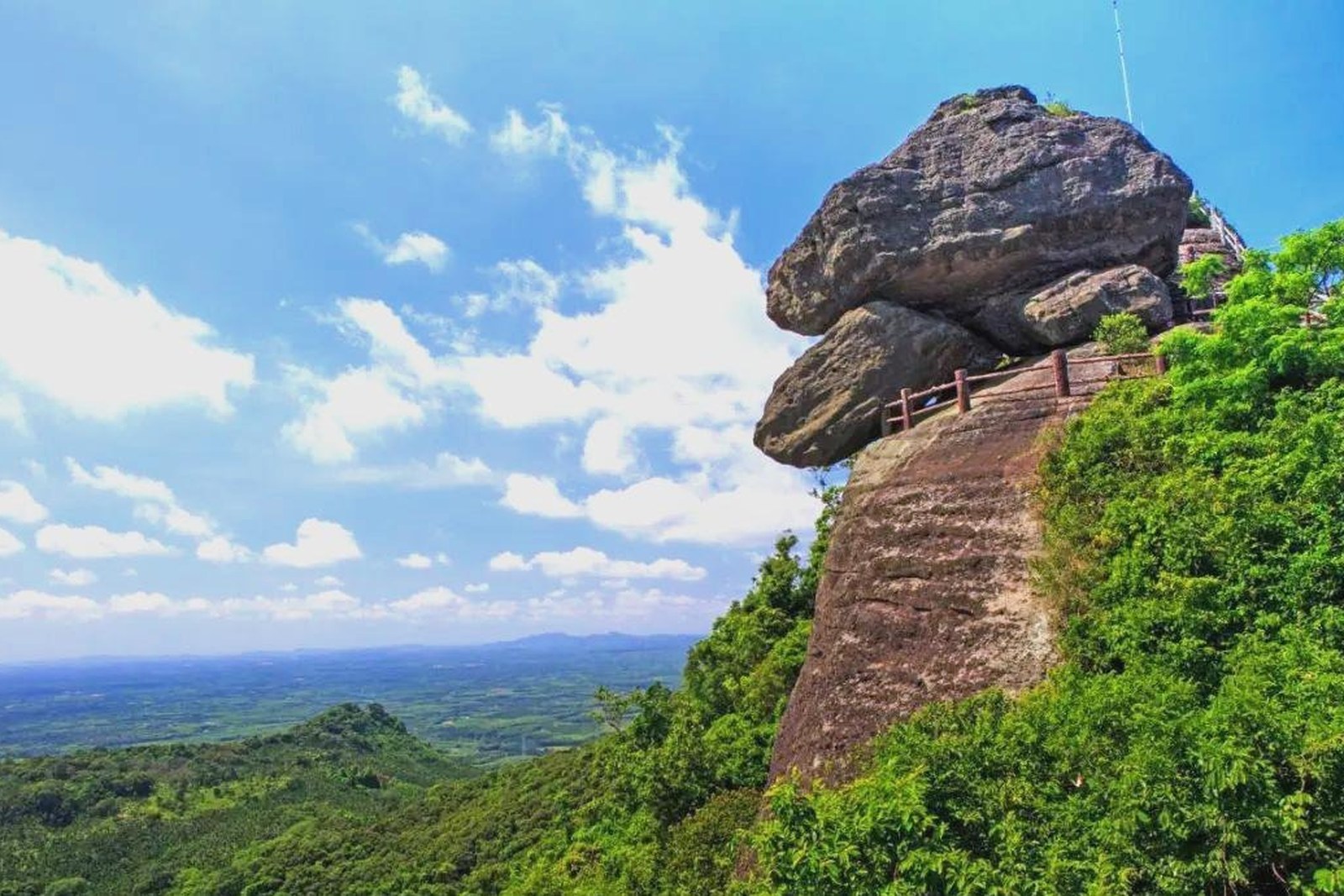
The rock is the reason geologists come. 白石岭 is Danxia – 丹霞地貌, the red-bed landform named after the mountains of northern Guangdong – and it is unusual on this island because most of Hainan’s uplands are granite or basalt. The sandstone here was laid down in the early Cretaceous, the beds were lifted and fractured into vertical joints, and then water running down the joints and blocks falling off the faces did the rest, which is why the ridge is a line of steep red cliffs and isolated towers rather than a single rounded hill. The county calls it 海南天然地质博物馆 Hǎinán tiān rán dì zhì bó wù guǎn, Hainan’s natural geology museum, and the named rocks do most of the explaining: 天外飞石, the stone that fell from the sky, balanced on its own; 悬石壁立, the overhanging wall; and the 三色石窟, a shallow cave in the cliff with a carved Guanyin in it that is the nearest thing to a rock-cut Buddhist shrine on the island.
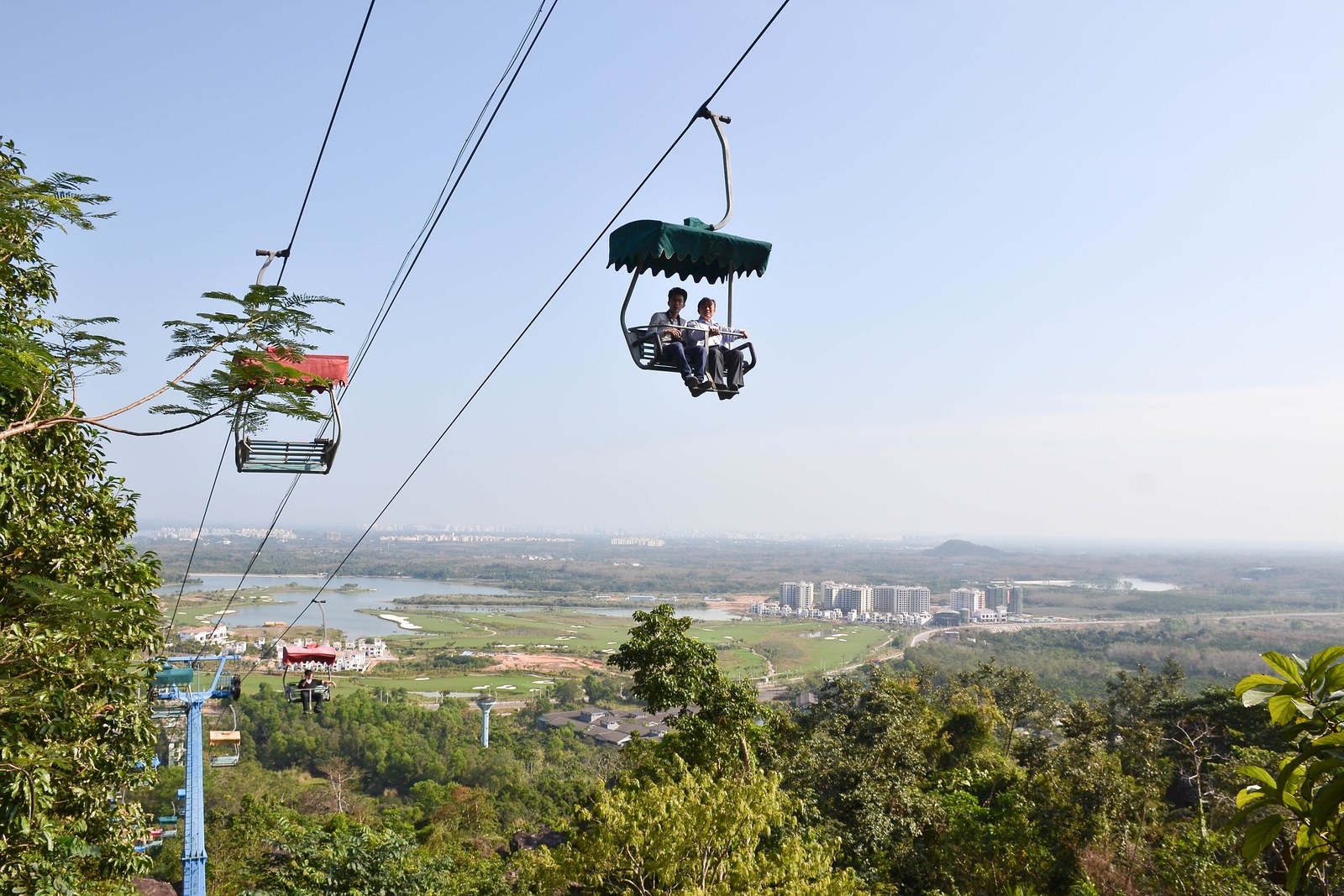
The ridge has been a place of worship for a long time as well as a place of geology. 青云寺 Qīng yún sì and the shrine to 谯国夫人 Qiáo guó fū rén – 冼夫人, the sixth-century woman who held the island for the Sui and is worshipped along the whole coast – are both on the walking route, along with an 空心通天树, a hollow tree that goes up through the rock, and a 百年莲理榕, a banyan whose trunks have grown into each other. The traditional way up is the footpath through 天门洞 Tiān mén dòng, the gate of heaven, which the local story treats as the line between the mortal world and the other one; the modern way is the enclosed cable car, which takes five to ten minutes and lifts you over the canopy with the river opening out below.
The top is now fitted out as an activity rather than a pilgrimage, and it is honest about it. There is a glass viewing platform cantilevered off the cliff, the 旭日悬廊, with the plain and the river under your feet; a 玻璃滑道 bō lí huá dào, a glass chute, for coming down from the halfway point; and a 飞拉达 fēi lā dá, an Italian-style via ferrata with steel rungs and cables along the cliff face, in an easy A line and a harder B line with vertical rock and a suspended net bed. A walker who takes the cable car up and the path down spends two hours; someone doing the via ferrata should allow most of a day. The best months are from November to April, when the air is dry and the summit is clear; from May to October the ridge is hot, wet and often in cloud, and the rock is slippery after rain.
Practicalities
Tickets. Adult admission is about ¥28, and the usual package of admission plus the return cable car is about ¥70. The glass viewing platform is charged separately at roughly ¥30 to ¥68 depending on the ticket, the glass chute about ¥38, and the via ferrata about ¥58 for the A line and more for the B. Residents of 琼海 get a discounted admission on production of an identity card.
Opening hours. Roughly 08:30 to 17:30, with the last cable car up about an hour before closing and the last down shortly after; the site closes earlier in the winter months and in bad weather. Two hours covers the ridge by cable car and foot, and four to six hours covers the via ferrata or a full walk up. Come in the morning, because the summit clouds over in the afternoon in the wet months.
Getting there. 白石岭 is about twelve kilometres south-west of 嘉积镇 through the 官塘 Guān táng hot spring district, on 白石岭大道 Bái shí lǐng dà dào. 琼海站 Qiónghǎi zhàn on the 东环 high-speed line is about twenty minutes away by road and the town centre about twenty-five; a dedicated bus runs from the town in about forty minutes, and a taxi for the round trip with waiting time is around ¥100. 琼海博鳌机场 Qiónghǎi Bó’áo jī chǎng is about forty minutes away.
Closing day. There is no closing day. The site is open every day of the year, including over the Spring Festival and the October week, when it is at its busiest. The cable car and the via ferrata are suspended in high wind or lightning, which in the typhoon season from July to October can close the ridge for a day at short notice.
flowcloud would say that a ridge of red sandstone a few hundred metres high, on an island where everything else is granite or basalt, has been given a temple, a legend, a cable car and a cliff ladder, and is still mostly worth visiting for the twenty minutes it takes to look at the plain from the top.
Getting there: 白石岭 is on 白石岭大道 in 琼海市, about twelve kilometres south-west of 嘉积镇 through the 官塘 hot spring district, twenty minutes from 琼海站 Qiónghǎi zhàn on the 东环 high-speed line and about forty minutes from 琼海博鳌机场.