
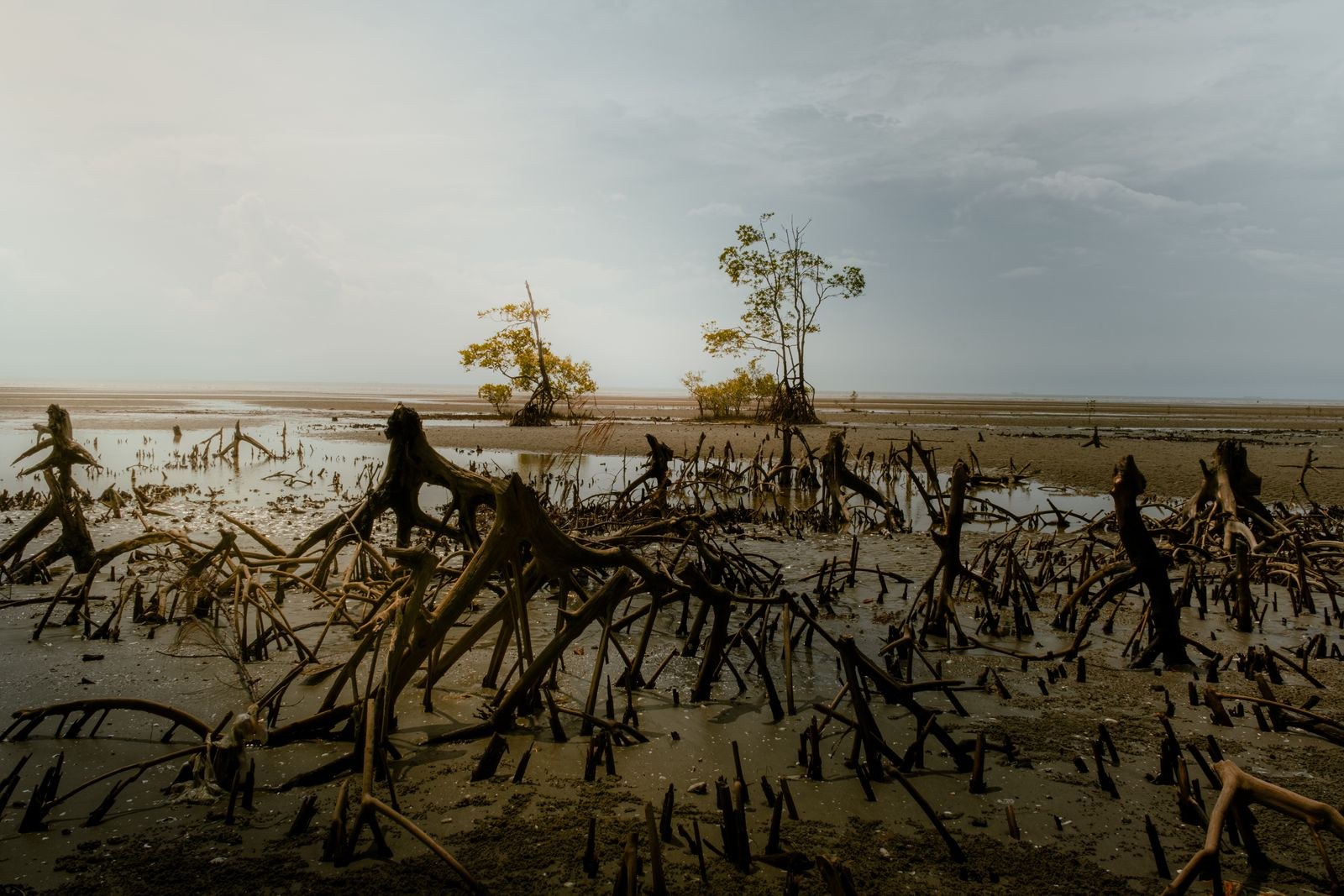
At low tide the trees appear to be standing on a forest of their own fingers. That is the image that stays with you from 八门湾 Bāménwān: a low green canopy on the edge of the water, and beneath it, on the exposed mud, a dense thicket of dark pneumatophores — breathing roots, thousands of them, each one a knuckle poking out of the ooze so the tree can get air while its feet are in salt water. Then the tide comes back in over about three hours, the roots go under, and the whole thing turns into a green wall with the sea lapping at its base. It is the same landscape, twice a day, and it is worth timing your visit to see both halves of it.
八门湾 Bāménwān, Bamen Bay, is the estuary where the 文昌河 Wénchāng Hé meets the 清澜 Qīnglán inlet on the east coast of 海南 Hǎinán, in 文昌 Wénchāng — the same water that 清澜港 Qīnglán port uses, with the 清澜大桥 Qīnglán Dàqiáo crossing its mouth. Around the shallows and the tidal flats grow several hundred hectares of mangrove, which puts this among the larger mangrove stands left in China, and it is the reason there is a 自然保护区 zìrán bǎohùqū, a nature reserve, and a 国家湿地公园 guójiā shīdì gōngyuán, a national wetland park, strung over the same water.
A Forest That Lives in Salt
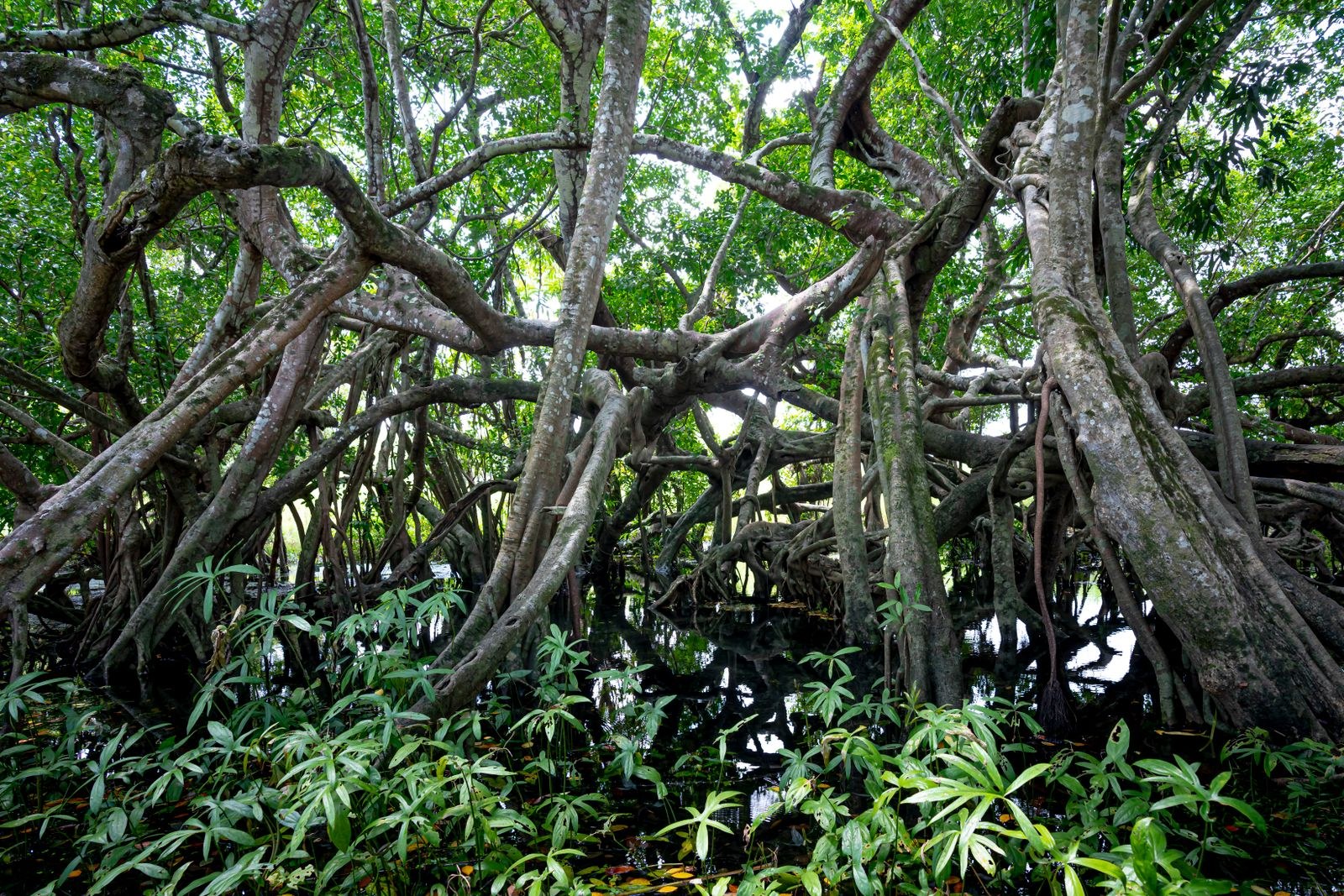
Mangroves are not one species but a club of about seventy unrelated ones that have each independently arrived at the same set of tricks, and 海南 Hǎinán has the richest collection of them in China. The tricks are worth knowing because they explain what you are looking at.
They breathe through their roots. The mud they grow in is waterlogged and airless, so mangroves send up specialised roots — pneumatophores, the fingers you can see at low tide — that take in oxygen from the air rather than from the soil. 秋茄 qiūjiā, the kandelia that dominates here, produces a dense crop of them; 桐花树 tónghuāshù does the same with a thinner, more crowded bristle.
They drink salt and dump it. Salt water will kill most plants. Mangroves either block it at the root — 秋茄 uses an ultrafiltration membrane on its root surface, keeping more than ninety per cent of the salt out — or take it in and push it out through their leaves, which is why some of them feel crusted and gritty if you touch the upper foliage in the dry season. 白骨壤 báigǔrǎng does the second.
Their seeds start life on the tree. Most mangrove species are viviparous: the seed germinates while it is still attached to the parent, producing a long green propagule that looks like a pencil and eventually drops off to fall into the mud and root. If you visit in late summer, the propagules are hanging under the branches and the ground beneath is covered in them.
The whole system is a nursery. Fish, prawns and crabs spend their juvenile stage in the tangle of roots where larger predators cannot follow, which is why the fishing village on the same shoreline has been there for centuries and why 清澜 Qīnglán port is where it is.
The Boardwalk and the Greenway
There is a boardwalk through the mangrove at the bay’s edge, low over the water on timber piles, with a couple of small towers for looking out, and it is the easiest way in. Walk it at low tide if you have the choice: the mud is alive, and the mud is the show. 弹涂鱼 tántúyú, mudskippers, are everywhere — fish that have decided to do without water, propped on their front fins, hopping across the flats, and when one is startled by your shadow it flips and skitters and looks genuinely ridiculous. Fiddler crabs, half the size of a fingernail, wave one oversized claw. Faint blue-grey shapes hanging in the branches turn out to be 池鹭 chílù pond herons or 小白鹭 xiǎobáilù little egrets, standing still in the way herons do.
The other good way to see the bay is on a bicycle. There is a 绿道 lǜdào, a cycle greenway, that loops around the bay through the villages along the edge of the mangroves, flat and quiet and about as pleasant a ride as exists in Hainan. You can hire a bike in 清澜 or in 文城 Wénchéng, and a half-day loop is easily done even at a conversational pace with stops.
Practicalities
Tickets: The boardwalk and the greenway are free; if you enter through one of the small managed wetland sections there may be a modest charge of around ¥20–40, and bike hire runs about ¥30–60 for a day depending on the shop. There is no charge for riding the greenway itself.
Opening hours: The greenway is open continuously. Boardwalks in the managed sections generally run roughly 08:30–17:30, but the tide, not the clock, decides what you will see; check a tide table for 清澜 (Qīnglán) before you go, and aim for the two hours either side of low water.
Closing day: None for the greenway and the shore. Managed sections may close for wetland maintenance or typhoon warnings, and the whole bay is shut when a typhoon is approaching, which in Hainan means roughly July to October.
Getting there: 八门湾 (Bāménwān) is at the 清澜 (Qīnglán) inlet in 文昌 (Wénchāng), north-east 海南 (Hǎinán), immediately north of 清澜港 (Qīnglán port) and the 清澜大桥 (Qīnglán Dàqiáo). 文昌 (Wénchāng) station on the island’s east high-speed loop is about twenty minutes from 海口美兰 (Hǎikǒu Měilán) airport, and from the station it is a twenty-minute drive to 清澜; the greenway has several marked access points and the boardwalk is signposted off the port road. By car from 文城 (Wénchéng) it is barely fifteen minutes. Bring mosquito repellent, a hat without a strap for the wind, and shoes you do not mind getting mud on — and leave the drone, because the reserve has restrictions and the herons do not enjoy it. flowcloud would say that a forest which decided to live in salt water, breathe through its feet and give birth on its own branches is the best argument you will ever see for the idea that adaptation is not a metaphor. Go at low tide, walk the boardwalk slowly, and then ride the greenway with the mangroves on your right.