
菩提山 Pútí Shān, Bodhi Mountain, rises five hundred and ninety-eight metres directly above the city of 长寿区 Chángshòu Qū, Changshou District, and the district has turned its slopes into a single sustained metaphor: the climb for long life. A district named Longevity keeps its mountain in the middle of its own street grid, and the hill answers with temple forests, cliff inscriptions and a stair that counts its way to the summit in steps. This page is the mountain’s walking day – the ladder, the temples, the quiet forest spines off the main route, and the panorama that pays for every flight of stone.
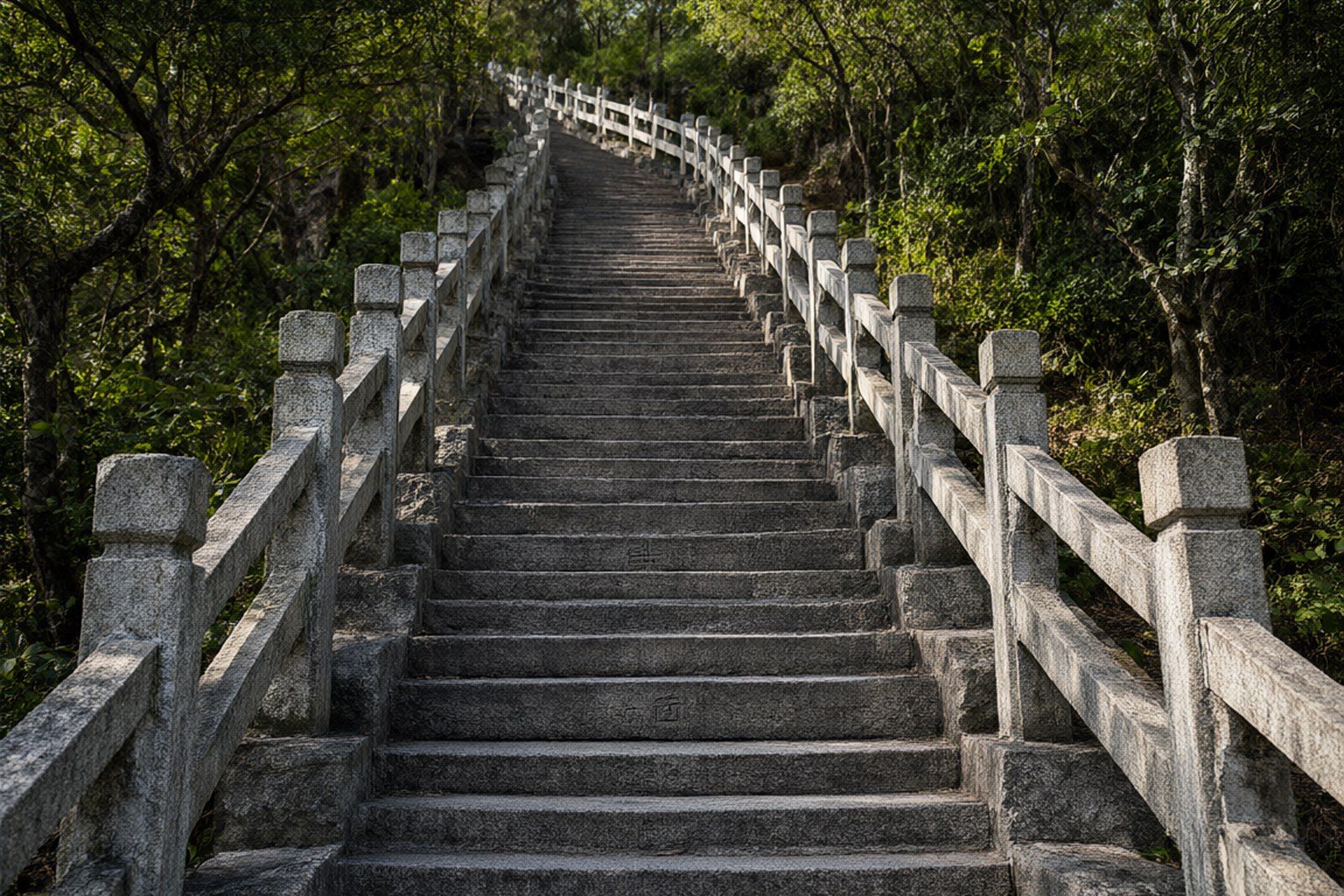
The ladder is the mountain’s spine and the district’s favourite argument. The 万寿天梯 Wànshòu Tiāntī, the ten-thousand-step longevity ladder, counts its way from the gate to the summit temples in flights marked with characters and blessing stones, so the climb is legible the whole way up – every flight a number, every number a small wish. Locals treat the dawn ascent as their morning exercise, moving up in the grey light with the steadiness of habit, and visitors soon fall into the same rhythm, because the stair sets its own pace and refuses to be hurried. The count is the entertainment: somewhere past the halfway flights the legs stop negotiating and the mind settles into the steps, which is, the district would say, the whole point.
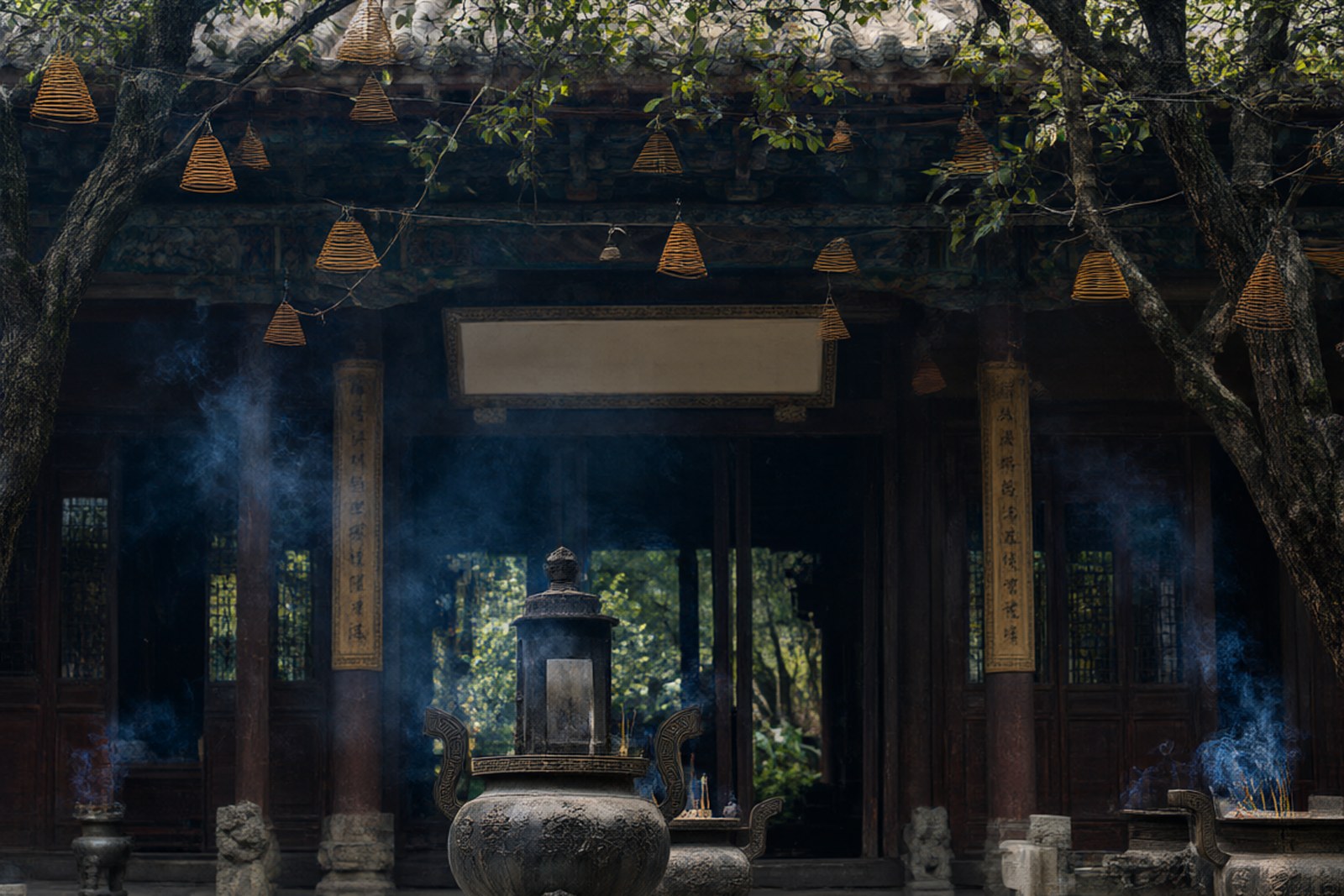
The legend is what the stair climbs toward. The hill carries the story of 达摩 Dámó, Bodhidharma, the patriarch who lends the mountain its name and its temple courts their gravity; halfway up, the temple courts sit under old banyans with incense smoke moving through the leaves and cliff inscriptions weathering into the stone beside modern prayer walls. The old carving and the new offerings share the same rock face without argument, which is its own kind of longevity – a hill that has been collected into, generation after generation, and shows every layer of it.
The summit is the payoff and the orientation. The top opens a full panorama over the Yangtze plain – the city laid out below, the river’s plain running to the horizon – and on clear days the distant glitter of 长寿湖 Chángshòu Hú, Changshou Lake, shows on the northern edge of the view, a frame that puts the district’s two headlines in a single look. What the record supports is the height of five hundred and ninety-eight metres, the ten-thousand-step ladder, the Bodhidharma legend, the temple forests, the cliff inscriptions and the summit panorama; what it does not support is any entry figure or posted hours table, and none is invented here – the gate posts its own arrangements, and the page leaves the reader to them rather than quoting numbers it does not have.
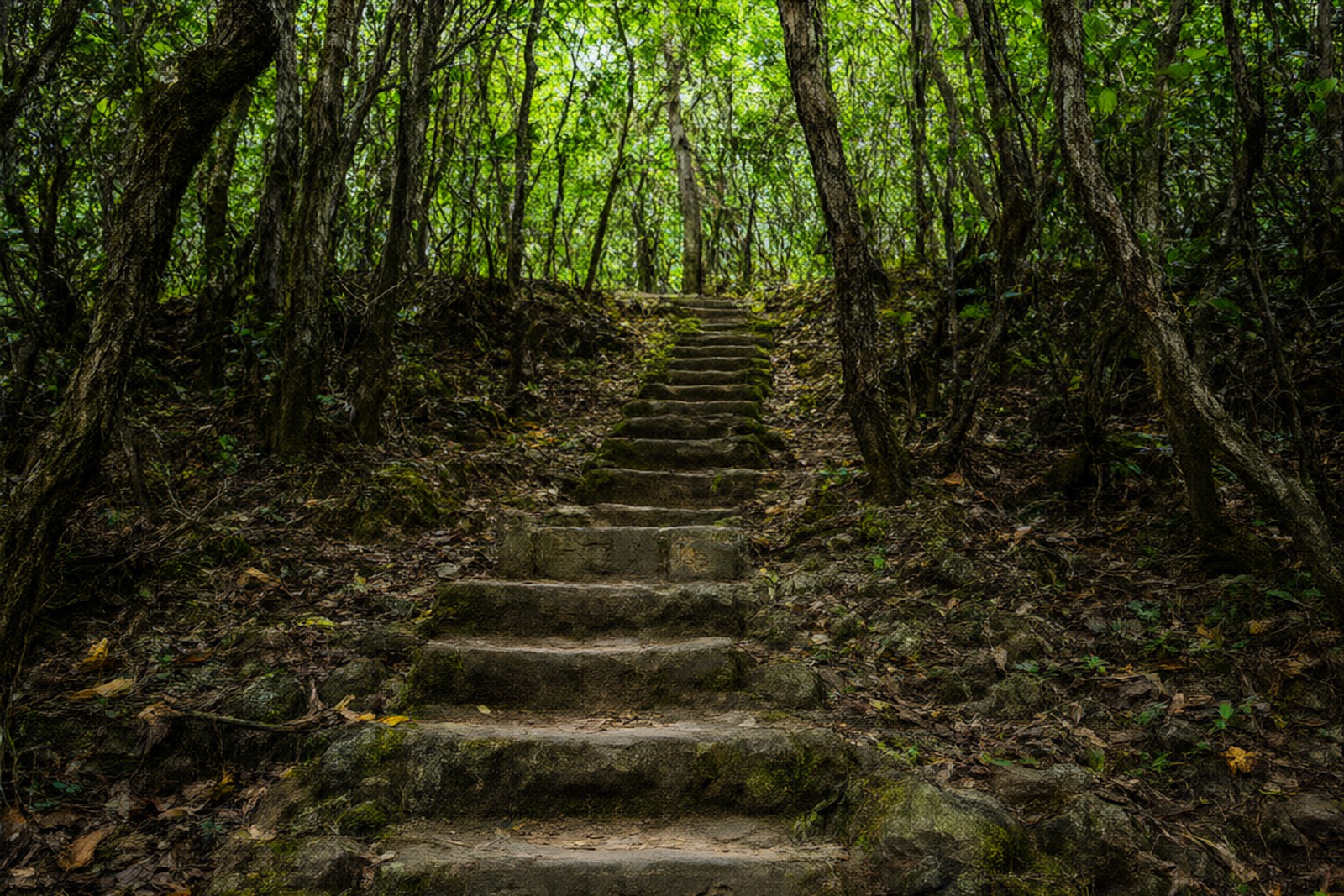
The forest paths are the mountain’s quiet alternative. Trails drop off the ladder’s spine into cooler, moss-stepped ground, climbing the same hill without the counting – softer underfoot, darker under the canopy, and largely left to the walkers who know them. The honest way to take the mountain is to choose one temperament per visit: the ladder for the number and the crowd rhythm, the forest spines for the smell of wet leaves and the sound of nothing much. Both reach the same summit, and the descent is easier than either.
Words and Names
菩提山 Pútí Shān, Bodhi Mountain, in 长寿区 Chángshòu Qū, Changshou District: a five-hundred-and-ninety-eight-metre hill rising directly above the city, tied by legend to 达摩 Dámó, Bodhidharma. The 万寿天梯 Wànshòu Tiāntī, the ten-thousand-step longevity ladder, climbs from the gate to the summit temples in flights marked with characters and blessing stones; the temple courts halfway up stand under old banyans with cliff inscriptions weathering beside modern prayer walls, and the summit opens a panorama over the Yangtze plain with the glitter of 长寿湖 Chángshòu Hú on clear days. No entry figure or posted hours table is on the record consulted, and none is invented here; the gate posts its own arrangements.
What the Locals Know
The local knowledge is the hour, not the route. The locals climb at dawn, when the ten thousand steps are empty, the air is cool and the temple forests smell of incense and wet leaves; by mid-morning the stair belongs to visitors and the morning-exercise crowd has long since gone down to breakfast. Weekend mornings are the busiest climb of the week, so a quiet ascent means a weekday alarm. Shoes matter more than gear – the stone flights are worn smooth in the middle – and water can be carried rather than bought by the bottle at every landing. The forest spines off the ladder stay quiet all day, which is why the locals keep them to themselves.
Practicalities
Tickets: The mountain is a developed scenic hill with its arrangements posted at the gate; no entry figure is on the record consulted, so the page declines to quote one. The forest paths that leave the ladder’s spine are walking ground once on the hill. Opening hours: Daylight as the working norm – the dawn climb is the district’s own habit and the descent wants light on the worn stone. No posted hours table is on the record consulted; the honest clock is the daylight’s, and the locals’ alarm is earlier than any gate. Closing day: None posted – a hill that doubles as the city’s morning-exercise ground does not close its weeks, and no published rest day is on the record consulted. The variable is weather: rain makes the smooth stone flights slick, which is a postponed climb rather than a cancelled one.
flowcloud would say that Bodhi Mountain is the district’s name turned into a staircase – a five-hundred-and-ninety-eight-metre hill above the city where the ten-thousand-step 万寿天梯 counts its flights past temple courts and cliff inscriptions to a summit panorama over the Yangtze plain, with quiet forest spines for walkers who would rather climb without counting – and that the correct visit is the dawn one, because the ladder belongs to the locals before breakfast. All checked October 2026.
Getting there: the mountain stands inside the 长寿区 Chángshòu Qū district seat’s own street grid, the gate reached on foot or by a short ride from anywhere in the city, with the rail stations close enough to make a climbing stop painless; no entry figure or posted hours table is on the record consulted, so none is invented here. Pair this page with the bodhi-mountain-stays page in the stay column for the dawn climb from the mountain’s foot, and with the changshou-ancient-town page for temple morning and town evening. All checked October 2026.