
Boyue Cave, the Grotto That Played the Monkey King’s Mountain
波月洞 bō yuè dòng is the smallest of the great caves of central 湖南 húnán and the one with the best story. It is cut into the western foot of 太一山 tài yī shān on 波月路 bō yuè lù in the northern suburbs of 冷水江市 lěng shuǐ jiāng shì, three kilometres or so from the middle of the city and close enough that people from the town treat it as an afternoon rather than a trip. The name comes from a legend rather than from the rock: the fairy 月香 yuè xiāng, the scent of the moon, and the fisherman 波儿 bō ér, the little wave, whose story ends with the pair of them living on the shore of the 资江 zī jiāng and the cave named for the two of them, though it was called 芙蓉洞 and then 神仙洞 before that.
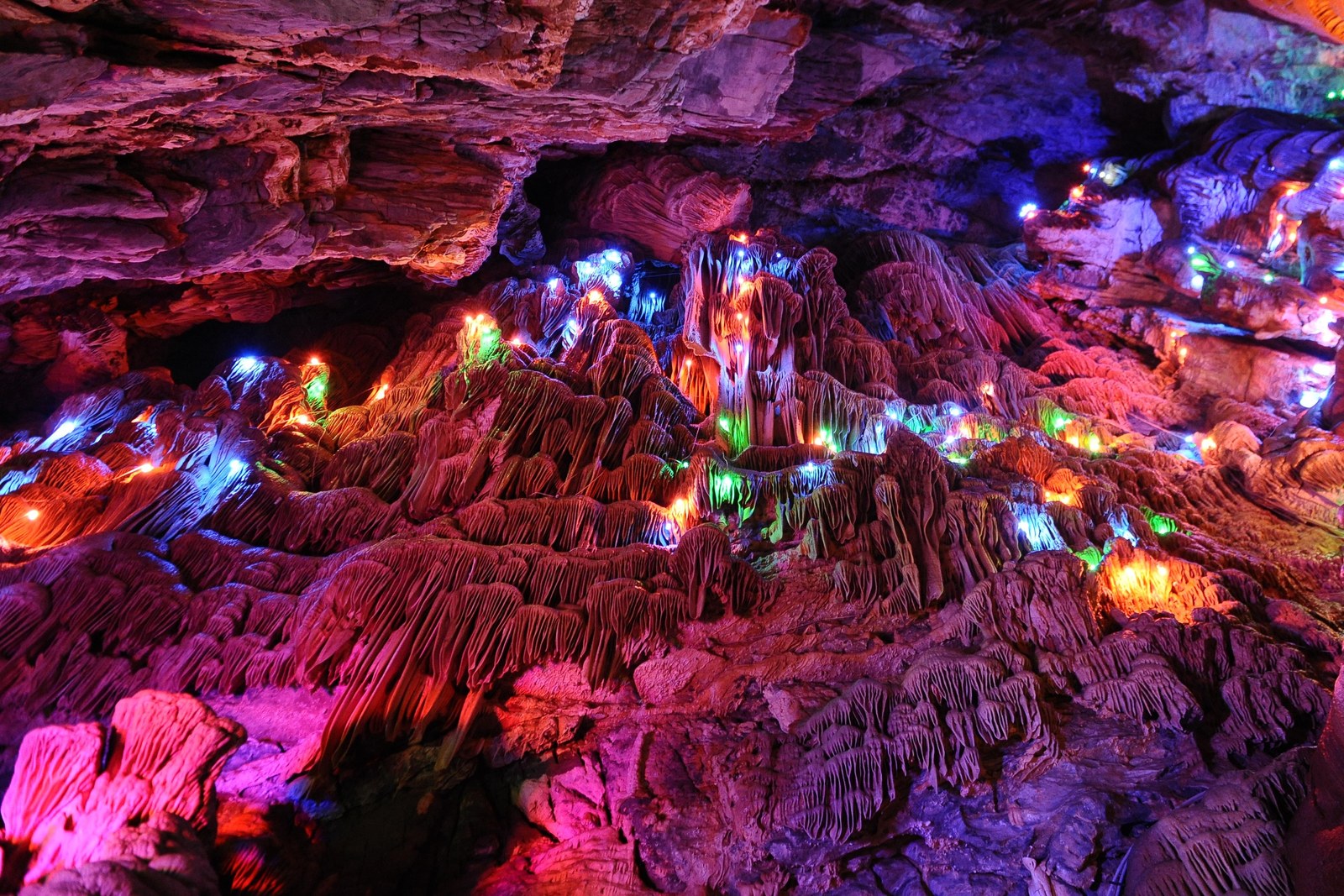
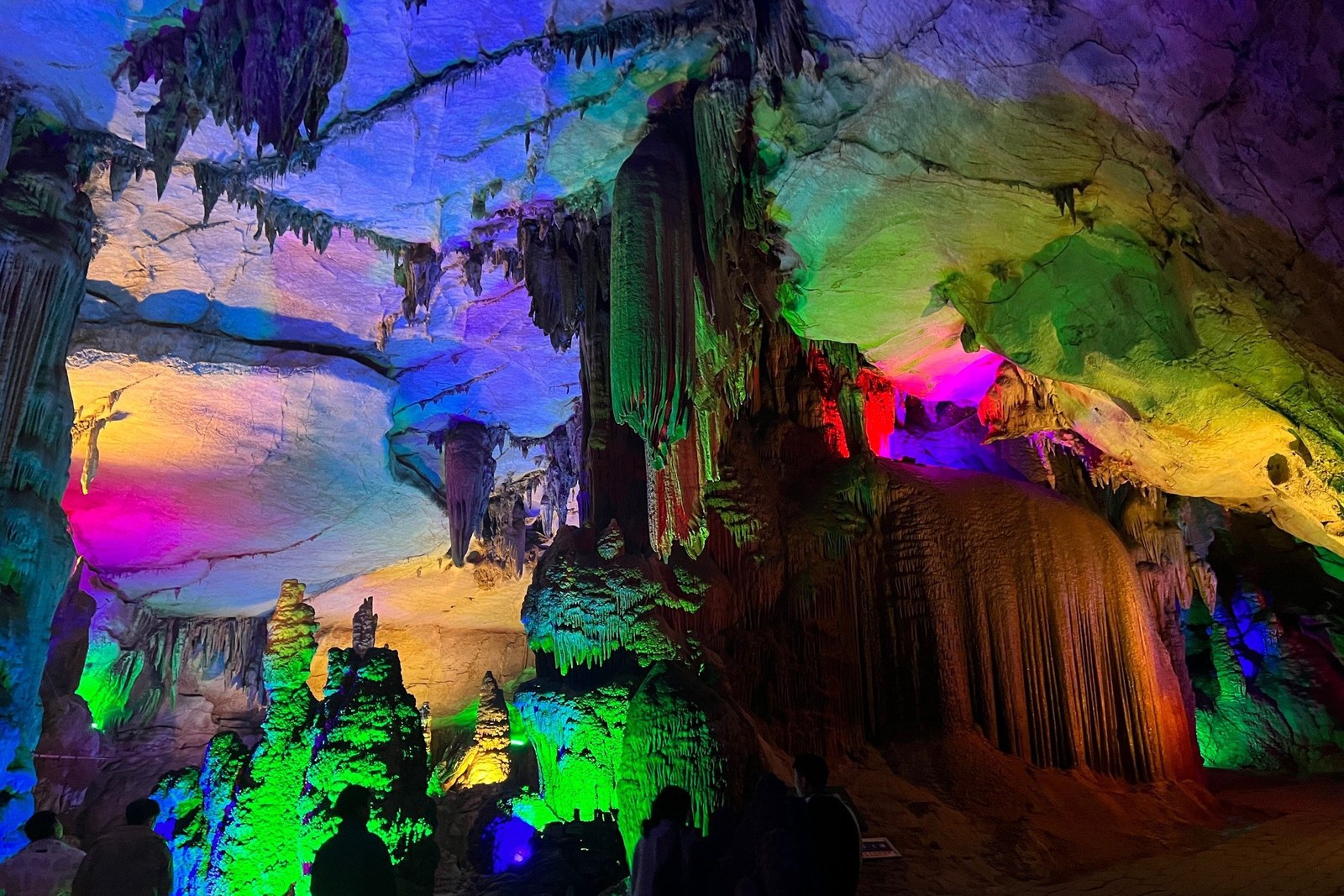
Inside, the cave runs on three levels, with around 1,800 metres of walkway threaded through twenty-seven halls and eighty-one named sights in more than forty thousand square metres of floor. The route is not long; what the cave has is the density of the ornament and three records. The first is the 鹅管 é guǎn, the soda straws: hollow translucent tubes a few millimetres across that grow from a ceiling one drip at a time, and this one is 1.1 metres long, forty-four centimetres longer than the record holder it displaced. The second is a 巨型石坝 jù xíng shí bà, a travertine barrier built across the flow of the underground water until it stands 1.98 metres high. The third is a 网状石槽 wǎng zhuàng shí cáo, a network of channels dissolved into the roof and 1.5 metres deep, hanging there rather than standing on the floor. Around those three the cave does everything caves do: 海天揽胜, a hall of columns worth the walk in itself, 翠屏金塔, where three jade-green stalagmites stand in a screen before a golden pagoda of dripstone, and 千丘田, a staircase of dammed basins like a rice terrace.
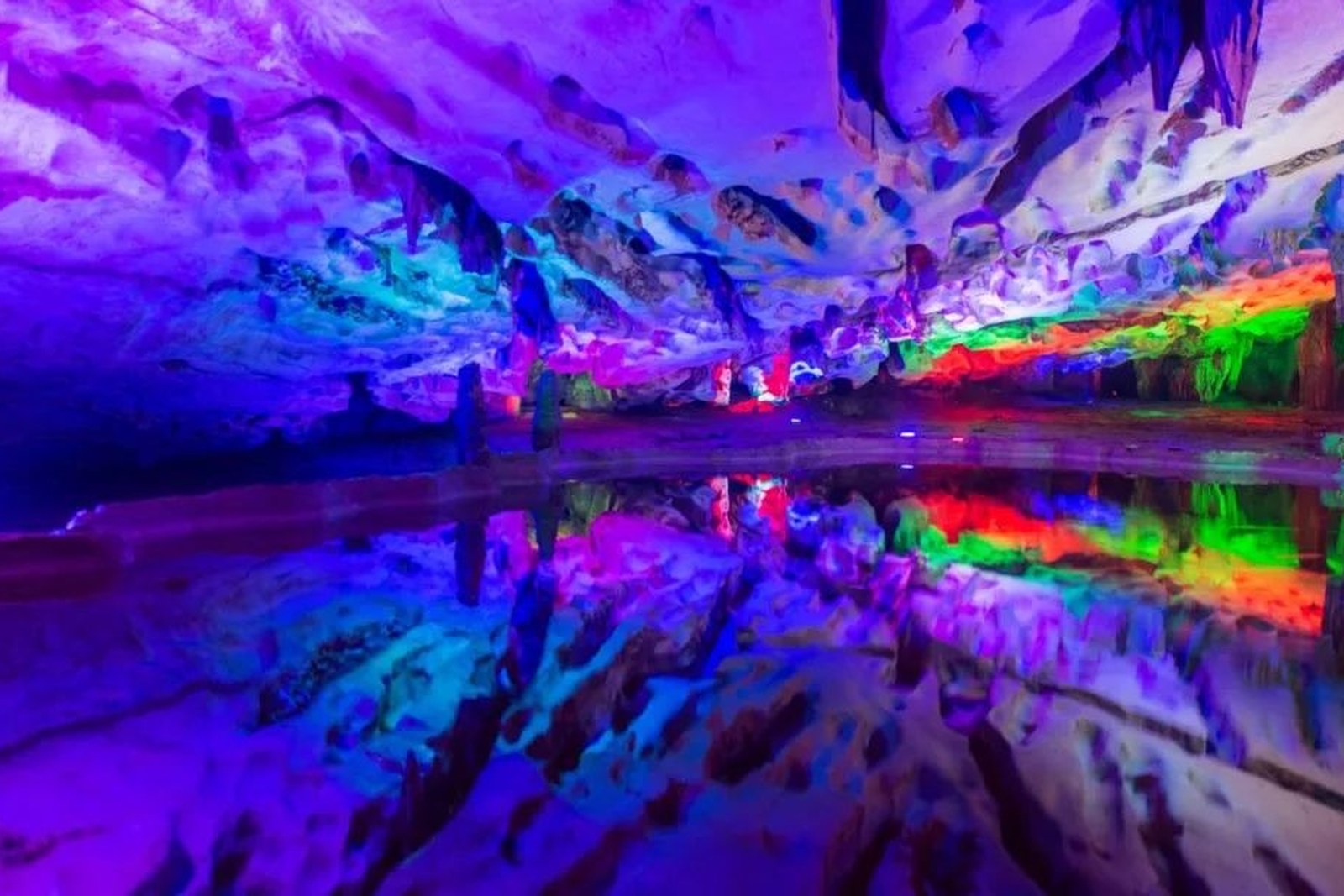
A visit is a guided walk of an hour or two, and it is worth knowing how the lighting works: the lamps ahead of the group are switched on and the ones behind switched off as you move, so the cave is dark behind you and the route is a sequence of set pieces rather than a gallery, and a well-attended departure gets longer at each sight than a private one. The cave’s fame rests on a camera crew. When 杨洁 yáng jié came to film the 1986 television 西游记 xī yóu jì, the adaptation every Chinese viewer of a certain age knows scene by scene, her team toured the country looking for the 水帘洞 shuǐ lián dòng, the cave behind a curtain of water that is the monkey king’s mountain, and chose 波月洞. The entrance they used is eight metres high and three metres across, and the 水帘洞 and 白骨精 bái gǔ jīng scenes were shot in these chambers, including the stone bed under 翠屏金塔 where the White Bone Demon rested. Yang Jie wrote the search up in her memoir of the series, which is why the claim hangs on the county’s literature with a director’s name rather than as folklore.
What makes it a good half day rather than a good hour is the town. 冷水江 is a working Hunan city on the 资江, with an antimony history that goes back to the 1890s, a riverside promenade that fills up after dark and a food culture the rest of the prefecture borrows from: the 三合汤 sān hé tāng, the tripe-and-blood soup, is 新化’s by origin and 冷水江’s by adoption, and the restaurants along the bank are where the town eats in the evening. The cave is three kilometres from the centre, so a taxi takes ten minutes and the number 2 bus goes most of the way. It is the least known of the four attractions in this batch and the easiest to fit into an afternoon, where 梅山龙宫 up in 新化 is two hours away and takes most of a day. There is no closing day and no season, and since the county relit the chambers the place has become a cool, dark, theatrical hour and a half on the edge of a town.
Practicalities
Tickets. A ticket in the sixty-to-eighty-yuan band for an adult depending on where you buy it, with half price for students in full-time education and for the sixty-to-sixty-four bracket, and free entry for children under about 1.2 metres and for visitors over sixty-five. The online channels are cheaper than the window and it is the same ticket, so buy it on a phone at the gate.
Opening hours. The cave opens every day at half past eight and shuts at five, and the last entry is at four, which is tighter than it sounds because the walk through takes between one and two hours and departures run roughly every half hour. The lights go off behind the group, so an arrival at half past four is an arrival at a closed door.
Getting there. The cave is at 波月路 bō yuè lù in the north of 冷水江市 lěng shuǐ jiāng shì, about three kilometres from the city centre, and the two easy ways in are a ten-minute taxi and the number 2 bus, which runs out towards the site and stops near the gate. By rail, 冷水江东站 lěng shuǐ jiāng dōng zhàn on the Shanghai-Kunming high-speed line is six minutes away by taxi, and the car park at the site is free and takes around a hundred cars.
Closing day. There is no closing day and the cave opens every day of the year, which makes it the most reliable of the four attractions here for anyone whose itinerary is at the mercy of the weather. The only closures are for maintenance and for the days when a television crew has hired it, and heavy rain occasionally floods the lowest part of the route, in which case the walkway past the water is shut.
flowcloud would say that a cave kept off the national lists by the size of its neighbours was made famous instead by a 1986 television crew looking for a waterfall with a room behind it, and that the soda straws and the metre-and-a-half crawl of dissolved stone in the roof were extraordinary for a very long time before anybody pointed a camera at them.
Getting there: 波月洞 is at 波月路 bō yuè lù in the north of 冷水江市, 娄底市, about three kilometres from the city centre, ten minutes by taxi or a ride on the number 2 bus; 冷水江东站 lěng shuǐ jiāng dōng zhàn on the Shanghai-Kunming high-speed line is six minutes away by car. By road it is roughly forty minutes from 娄底 lóu dǐ and two and a half hours from 长沙 cháng shā, and the promenade on the 资江 zī jiāng is the obvious place to go afterwards.