
Chaozhou Guangji Bridge
The strange thing about 广济桥 is that for part of every day it is not a bridge. Twenty-four stone piers march out into the river from each bank, and between the last two of them, in the middle of the water, there is nothing at all — just a line of eighteen wooden boats tied end to end, decked over with planks, holding the crossing up. At half past five in the afternoon the boats are untied and pulled apart, the gap opens, and the river goes back to being a river. It has been doing this, on and off, for eight hundred years.
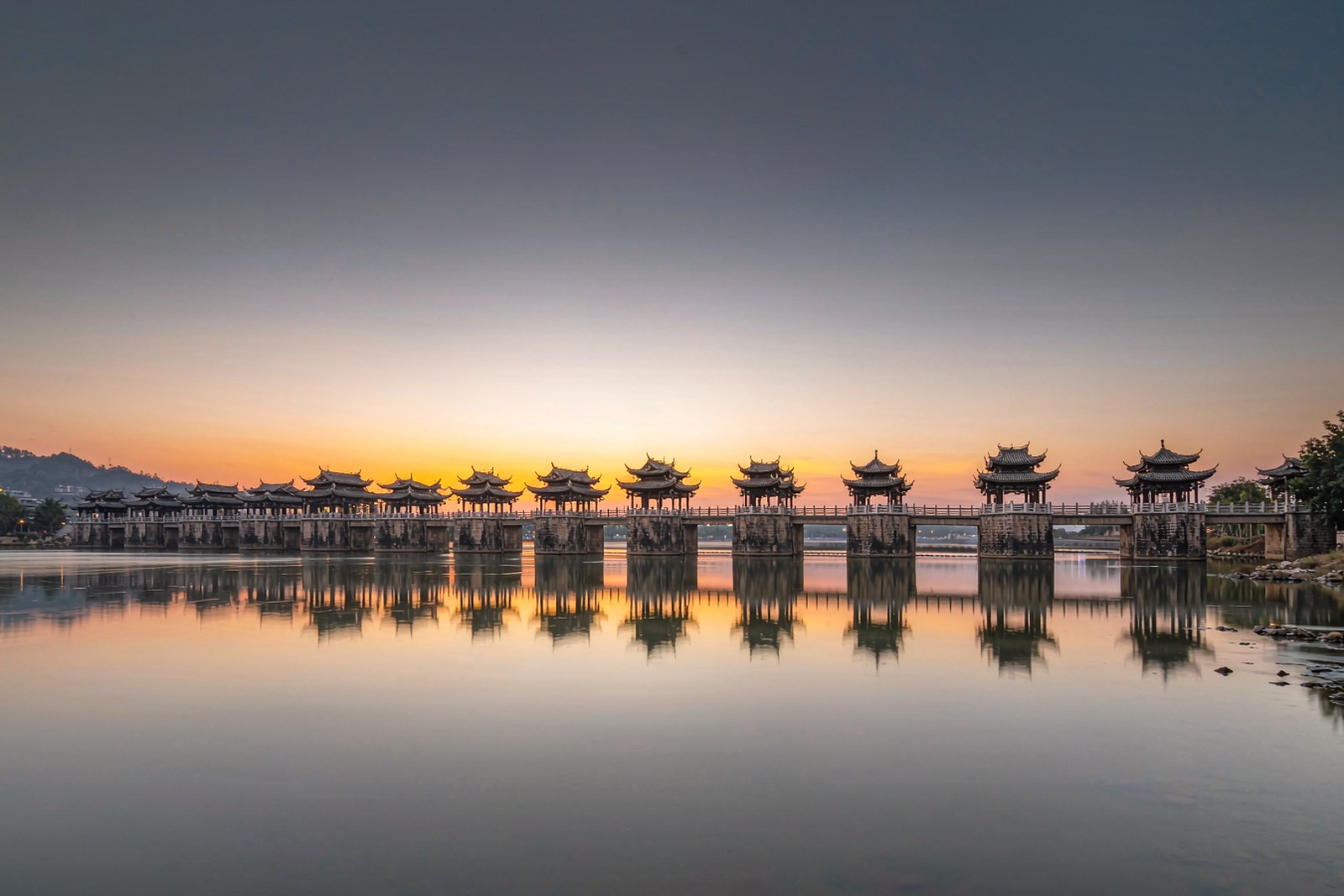
广济桥 (Guǎngjì Qiáo), also called 湘子桥 (Xiāngzi Qiáo), is in 潮州, in the far east of Guangdong, and it is one of the four great ancient bridges of China — it keeps company with 赵州桥, 卢沟桥 and 洛阳桥. Each of those is remarkable for a different reason. This one is remarkable for being a hybrid: half stone beam bridge, half pontoon, with a section that opens. Nothing else in the history of bridge-building has done it, and the local rhyme that everyone in Chaozhou knows counts it out — 十八梭船廿四洲, eighteen shuttle boats, twenty-four piers — before adding a line about the two iron oxen that used to guard the ends, one of which was carried away by a flood and never found.
Why It Was Built This Way
The 韩江 (Hán Jiāng), the Han River, is wide here, deep, and comes down out of the hills with a serious flood season. A pure stone bridge was beyond what the Southern Song engineers could span across the main channel; a pure pontoon was at the mercy of every spate. So they did both, and put the joint in the middle where the current is fastest. The fixed piers and stone beams carry the crossing over the shallower water on each side; the boats carry it over the deep middle; and because the boats can be separated, the bridge can open for shipping and can be dismantled ahead of a flood.
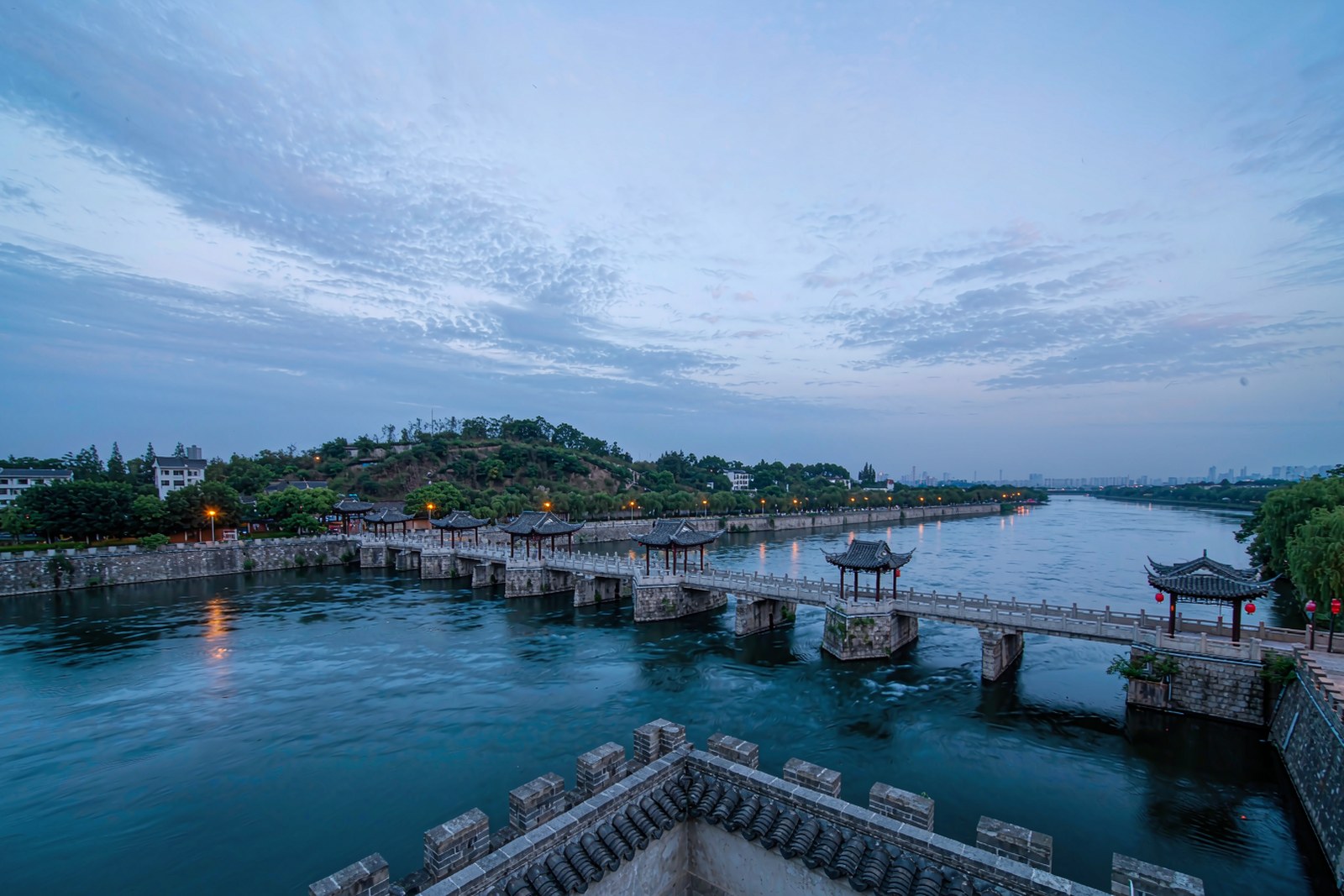
They also made it beautiful, which was not necessary. Each of the piers carries a pavilion — a different one on each pier along the whole crossing, with names and couplets and plaques in the hands of officials and scholars, so that walking across is not a walk across a bridge but a walk down a street of small buildings standing in a river. From the 广济楼 gate tower on the city side you get the whole thing in one frame: the piers, the pavilions, the boats at the joint, the 笔架山 behind, and the water going underneath all of it. Chaozhou’s own view of itself is this composition.
The Old Town Around It
The bridge is the front door of a city that is, quietly, one of the best-preserved in Guangdong, and the reason is 韩愈 (Hán Yù). The Tang essayist and official was exiled here in 819 AD for eight months and is remembered by a grateful city as though he had stayed forty years — for driving out a crocodile, for founding schools, and for being the reason the river is called 韩江 and the hill 韩山. 韩文公祠, on the slope of 笔架山 on the far bank, is his shrine: free but requiring a booking a day ahead, closed on Mondays, with a view back over the river at the bridge.
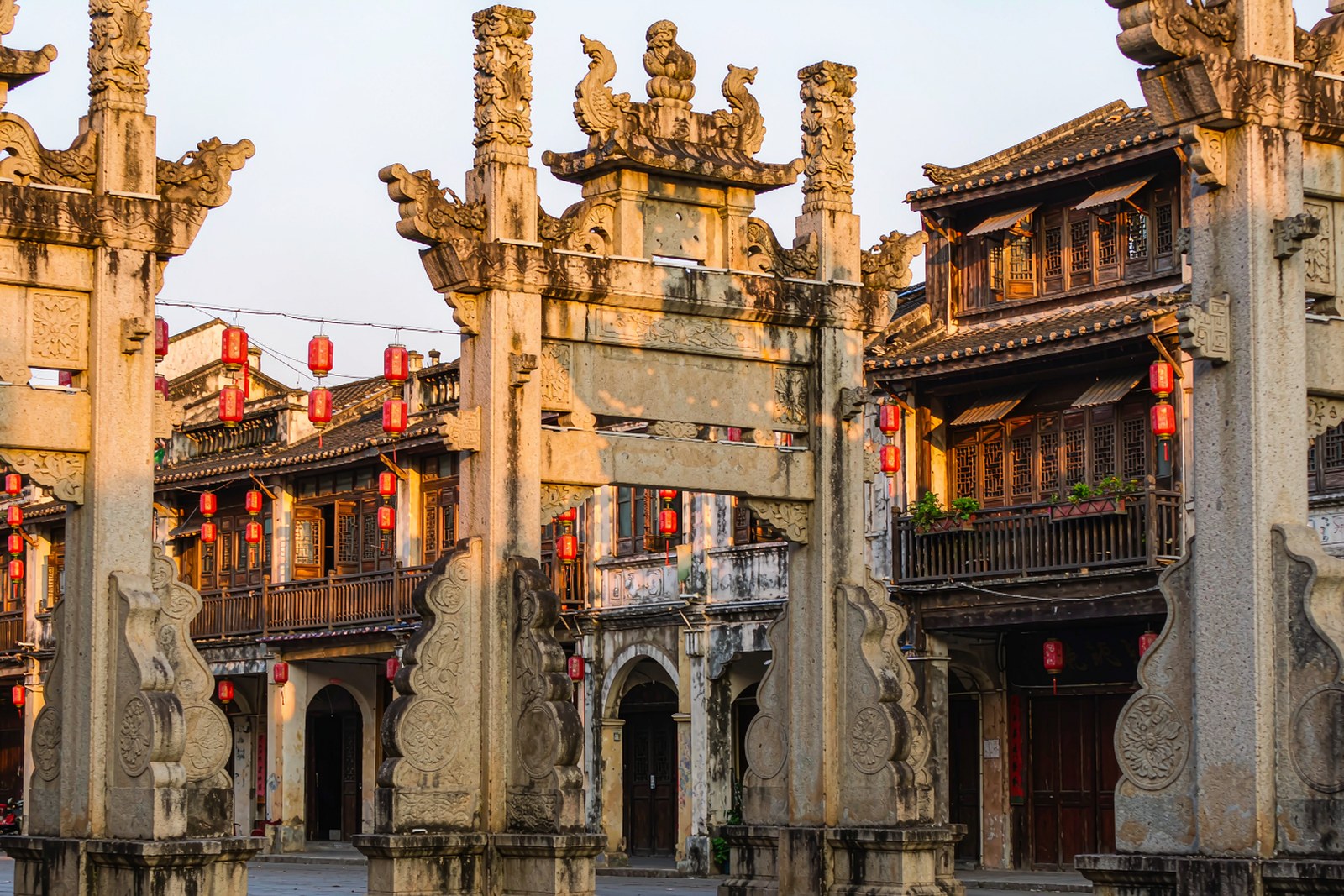
牌坊街 is the spine of the old town: 太平路, running north from the 广济楼 gate, lined with twenty-three stone memorial arches — 牌坊 — erected from the Ming and Qing for officials, scholars and virtuous widows, under a continuous colonnade of 骑楼 (qílóu) arcade shophouses with a Nanyang accent. It is free and open round the clock. Before ten in the morning it is a working street; after ten it is a slow river of people; at eleven at night, in the lamplight, it is at its best. Step off it into 甲第巷 or 义井巷 and you are in the 唐宋 lifang grid of the old walled city, low grey-brick courtyards, carved doorways, nobody about.
开元寺, on 开元路, is the great temple of eastern Guangdong, founded in 738 AD, with black-and-white 嵌瓷 (qiàncí) — cut-and-paste porcelain mosaic — on the roof ridges, Song stone pillars in the courtyard and a great deal of red. Free, and closing for lunch between 12:00 and 13:00.
广济楼 is the gate tower itself, the first of the old city’s seven, and climbing it costs ¥10 and gives you the postcard view of the bridge and the river. If you buy one ticket in Chaozhou, this is the one to buy in the late afternoon.
Practicalities
Tickets. 广济桥 is ¥20 for a single adult ticket, which is one of the fairer prices in Chinese tourism, and it lets you walk the full crossing including the boat section. 广济楼, the gate tower, is a separate ¥10 and the view is the reason to pay it. Other old-town sights: 己略黄公祠 ¥10, 许驸马府 ¥20, and a combined ticket covering 广济桥, 北阁佛灯, 己略黄公祠 and 许驸马府 at about ¥42 — but note that 北阁佛灯 has been under renovation, so check before buying the combination. The introductory tours and guided packages sold online (¥290–¥500 for small groups) are unnecessary for a site of this size. 牌坊街, 开元寺 and 甲第巷 are free.
Do you need to book? No. Buy at the gate. The only thing you need to plan is timing, because of the pontoon: you can only walk the full bridge, including the boat span, during the day. If you turn up after the boats are separated you will be looking at the bridge, not walking it.
Opening hours. 09:00 to 17:30 for the bridge, with the pontoon section dismantled at about 17:30 each day — this is the single most useful fact about visiting, because the separation itself is worth watching from the 广济楼 side. The old town’s streets are open all day and most of the night; the temple closes in the early evening.
Closing day. There is no closing day for the bridge or the old town — both are open every day of the year. The exception in the district is 韩文公祠, which closes on Mondays and requires a free booking a day ahead; everything else in the walled city runs daily.
The light show. On Friday and Saturday evenings the bridge and the river are lit for a short show — commonly at 20:00 and lasting about a quarter of an hour, occasionally running a second slot. The published schedule shifts with the season and with events, so ask at your guesthouse on the day rather than trusting a guidebook. Even without the show, the bridge is floodlit every night and the 江堤 promenade is the place to watch it from.
Getting there. Chaozhou has no airport and no mainline station of its own; you arrive via 潮汕站.
- By high-speed rail: 潮汕站 is the gateway. From the station the K1 or K2 express bus reaches the old town in about 40 minutes for ¥9; a taxi is about ¥50 and takes 35 minutes. There are frequent trains from Shenzhen, Xiamen, Guangzhou and Shantou.
- By car: parking is outside the walled city, because private vehicles are not allowed inside it. Use the car park on the perimeter of 牌坊街, about ¥15 a day, and walk in.
- Inside: everything is walk on stone slabs. No vehicles, no bikes, no need for any.
What to eat. The rule that locals will give you is to eat on 西马路 rather than on 牌坊街 main street: same food, lower prices, fewer people. Street level, ¥10–30 a head: 花生酱肠粉 (rice-noodle rolls with peanut sauce, a Chaozhou variation), 蚝烙 — the oyster omelette, crisp outside, served with fish sauce — 猪肠胀糯米, 粿汁, 腐乳鸡翅 and 糖葱薄饼. For a proper meal, ¥60–90 a head, order a 卤鹅拼盘 (braised goose), 潮汕牛肉火锅, 鱼生 or 生腌虾蟹 — the raw-marinated crab and shrimp, which is a Chaozhou religion and not for the faint-hearted. Chaozhou is also the home of 工夫茶 (gōngfū chá), the small-pot, many-infusion tea service, and any teahouse on 牌坊街 will sit you down for an hour for the price of a pot.
How long. A full day. The bridge and the gate tower in the late afternoon, 牌坊街 at dusk, dinner on 西马路, the light show if it is a weekend. Two days if you add 韩文公祠, the 甲第巷 lanes and a run out to 龙湖古寨, the Southern Song village at 潮安 with its walls, gates and 三街六巷 grid still intact; 凤凰山, inland, is where 凤凰单丛 tea comes from and is worth a half-day for anyone who cares about tea at all.
Getting there: 广济桥 (Guǎngjì Qiáo, Guangji Bridge), also called 湘子桥 (Xiāngzi Qiáo), 湘桥区环城东路, 潮州 (Cháozhōu), Guangdong — one of China’s four great ancient bridges, with 24 stone piers and a middle span of 18 linked boats that is separated at about 17:30 each day. Admission ¥20; 广济楼 gate tower ¥10; a combined ticket with 北阁佛灯, 己略黄公祠 (¥10) and 许驸马府 (¥20) about ¥42. Open 09:00–17:30 daily with no closing day; 韩文公祠 closes Mondays and needs a free booking a day ahead; 牌坊街 and 开元寺 are free. Weekend evening light show, commonly 20:00. Reach it via 潮汕站 by high-speed rail, then bus K1/K2 (¥9, 40 minutes) or a taxi (¥50, 35 minutes); private cars park outside the walled city at about ¥15 a day. Walk the bridge before the boats come apart, climb the gate tower for the view, then eat on 西马路 — 蚝烙, and a plate of braised goose.
We are still eating our way through Chaozhou Guangji Bridge. Guides are on the way.