
赤坎 Chìkǎn was a river port before it was anything else. The 潭江 Tán jiāng runs from the hills of 恩平 down through 开平 to the sea, and 赤坎 sits on a bend where the water is deep enough to take the boats that carried rice, sugar and people down to the delta and out to Hong Kong. In the 1920s and 1930s the money that 开平 families had earned in North America and Southeast Asia came back, and it was spent along both banks of that bend in the form of 骑楼 qí lóu, arcade shophouses, until there were close to three kilometres of them: a continuous colonnade on both sides of a street, with the upper floors cantilevered out over the pavement on columns so that you can walk the whole length of the town in the shade, or in the rain, without ever getting wet.
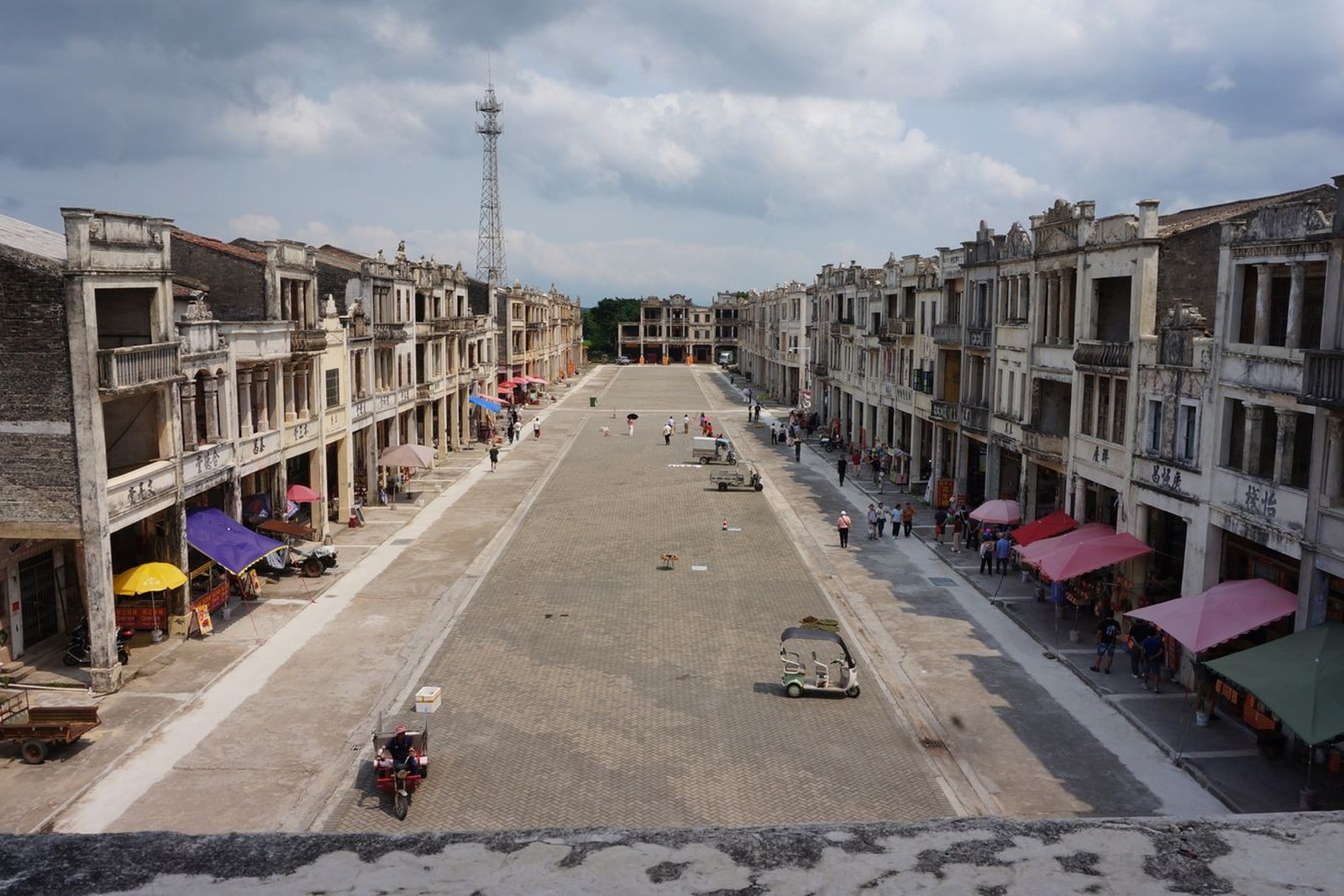
The architecture is a hybrid and was meant to be. The 骑楼 qí lóu form came from the British Straits Settlements, where 开平 men had worked as carpenters and shopkeepers, and it was brought back together with the idea of a shophouse; the decoration on the facades is a mixture of Chinese and European motifs, pilasters and parapets with scrollwork, pediments, balustrades, and occasional Greek columns standing next to a Chinese couplet carved into the wall above the door. Every building is slightly different because every one was commissioned separately by a family that wanted to look modern and also to look like itself, and the effect of the row is an accidental composition that no single architect would have produced. Look at the parapets: the 1920s ones are flat and geometric, the 1930s ones grow baroque, and the last few before the war have gone plain again.
Two buildings are worth the trip on their own. The 司徒氏图书馆 Sītú shì tú shū guǎn, the library of the Situ clan, was finished in 1925 at the top of the 下埠 xià bù, the lower quay: a three-storey block with a clock tower, funded by an overseas association of the clan and opened to any member of it who wanted to read. The 关族图书馆 Guān zú tú shū guǎn, the Guan clan library of 1929 at the other end, is its counterpart and rival, built by the competing lineage on the other bank with a different tower. Two family libraries built by emigrant money within four years of each other, in a river town of a few thousand people, says as much about the society that produced them as any monument to the watchtowers does. Between and beyond them the quays survive, the 上埠 shàng bù and the 下埠, with the boat steps cut into the stone and the waterside restaurants now filling the ground floors.
Practicalities
Tickets. The restored core of 赤坎古镇 Chìkǎn gǔ zhèn is ticketed, with day admission in the region of ¥60 to ¥120 a person depending on season and which sites it covers, and separate small charges for the two clan libraries and for the film set area. Guests staying in the town’s inns are generally admitted on the inn’s arrangement, which is worth confirming when you book. Prices at the time of writing.
Opening hours. The old town opens around 08:30 and closes at 22:00, with the arcades walkable outside those hours for anyone staying in the town; the libraries keep roughly 09:00 to 17:00 and shut for lunch in the traditional way. The boats and the evening light over the river are best from about an hour before sunset.
Getting there. From 开平市 Kāipíng shì take the 赤坎 Chìkǎn bus from the main bus station, about forty minutes; from 江门 the coach takes an hour and a half. The 江湛 railway stops at 开平南站 Kāipíng Nán zhàn about twelve kilometres away, with taxis at the exit. By car the town is twenty minutes from the 沈海高速 Shěnhǎi gāosù, and cars are parked at the edge of the old town because they are kept out of the arcades.
Closing day. The old town is open every day of the year with no weekly closing day; only individual site buildings take a day off, and the libraries are the ones that do, so check which before travelling for them specifically. Typhoons in summer and early autumn are the one time the town shuts down, as it did in the past when the river rose into the arcades.
Getting there: 赤坎古镇 Chìkǎn gǔ zhèn lies in 开平市 Kāipíng shì, about fifteen kilometres south-west of the city centre on the 潭江 Tán jiāng, an hour by road from 江门 and two from 广州. The bus from 开平 bus station is the simplest approach, and the 开平南站 Kāipíng Nán zhàn railway station is twelve kilometres away with taxis waiting.
flowcloud would say that a colonnade is a promise that no one will get wet walking to work, and that two rival family libraries standing at opposite ends of the same river bend are a better description of what money did to this delta than any account of the watchtowers.