
Dahua Jiao, Wanning’s Boulder Cape
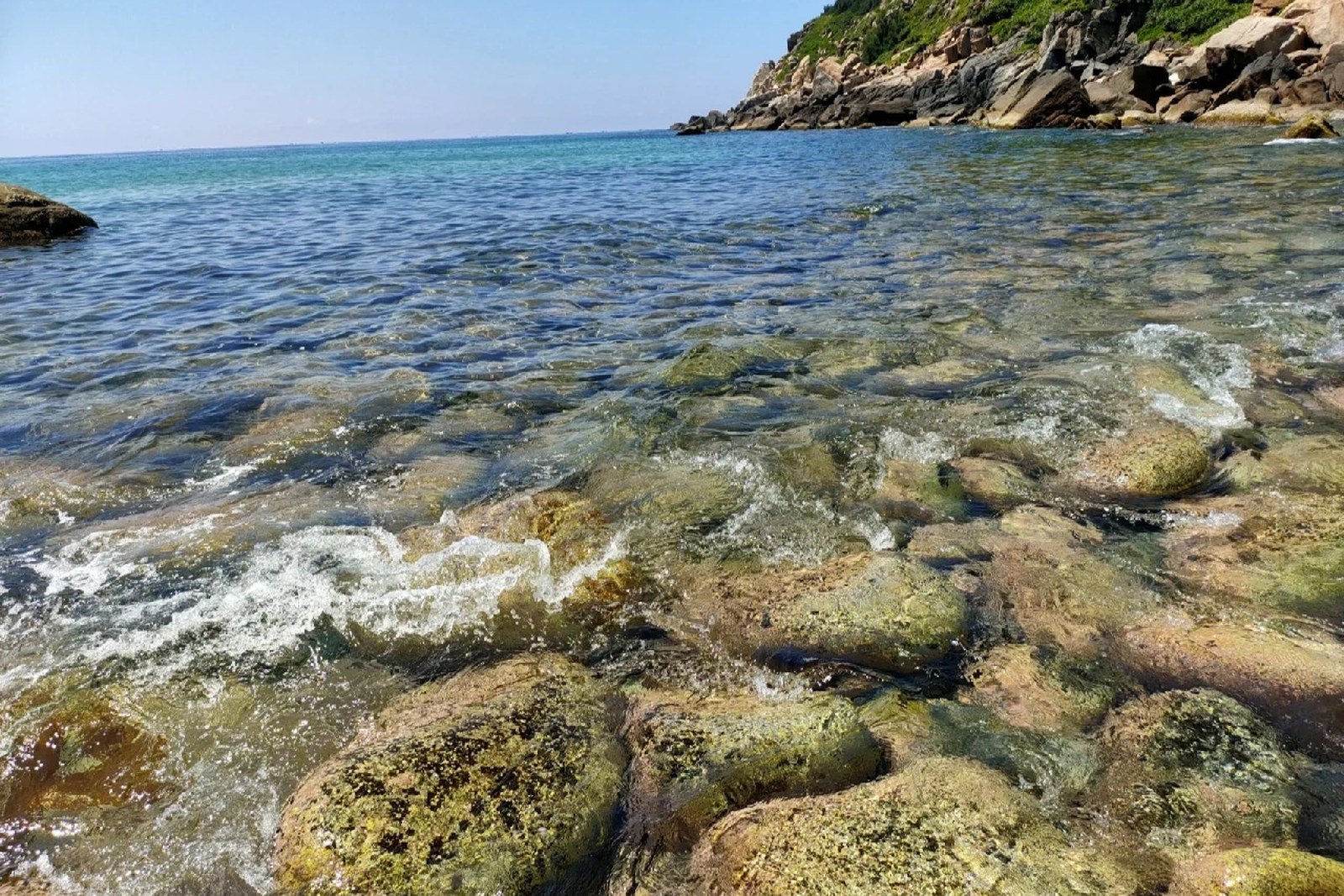
There is no sand here at all. You come over a low rise of scrub and earth, hearing the sea before you see it, and then the ground in front of you is a slope of stones — thousands of them, from the size of a fist to the size of a car, grey and buff and faintly pink, all rounded smooth, piled against each other in a way that looks unstable and has been stable for a very long time. The swell comes in underneath them with a boom you feel through your feet and then hisses back out through the gaps. 大花角 Dàhuājiǎo, on the south-east coast of 万宁 Wànníng in 海南 Hǎinán, is one of the strangest shorelines on the island, and almost nobody is standing on it.
It is about eighteen kilometres from 万城 Wànchéng, the town that serves as the seat of 万宁 Wànníng, on a stretch of coast that has been left alone. There is no gate, no ticket office, no boardwalk, no souvenir stall. There is a track, a small parking area someone has flattened, and then the sea.
Two Headlands and a Boulder Beach
The shape of the place explains everything about it. 大花角 Dàhuājiǎo is formed by two ridges that run down into the water and enclose a small bay between them, and because the two ridges are roughly parallel and roughly the same height, the whole formation reads from above as a saddle, or a shallow M. The southern ridge is 前鞍岭 Qián’ānlǐng, the front saddle ridge, and the water it holds is 前鞍海 Qián’ānhǎi; the northern ridge is 后鞍岭 Hòu’ānlǐng, the back one, with 后鞍海 Hòu’ānhǎi behind it. Between them, in the notch, is the boulder beach itself.
That gives you three quite different places in a walk of about a kilometre, and the order you visit them in changes the day.
前鞍海 Qián’ānhǎi, on the south side, is the gentlest. The ridge shelters it, so on a calm day the water sits flat and the fishing boats moor in the deeper water offshore, and the near shore is sandy and shallow enough to swim. It is the only part of the cape that behaves like a normal beach.
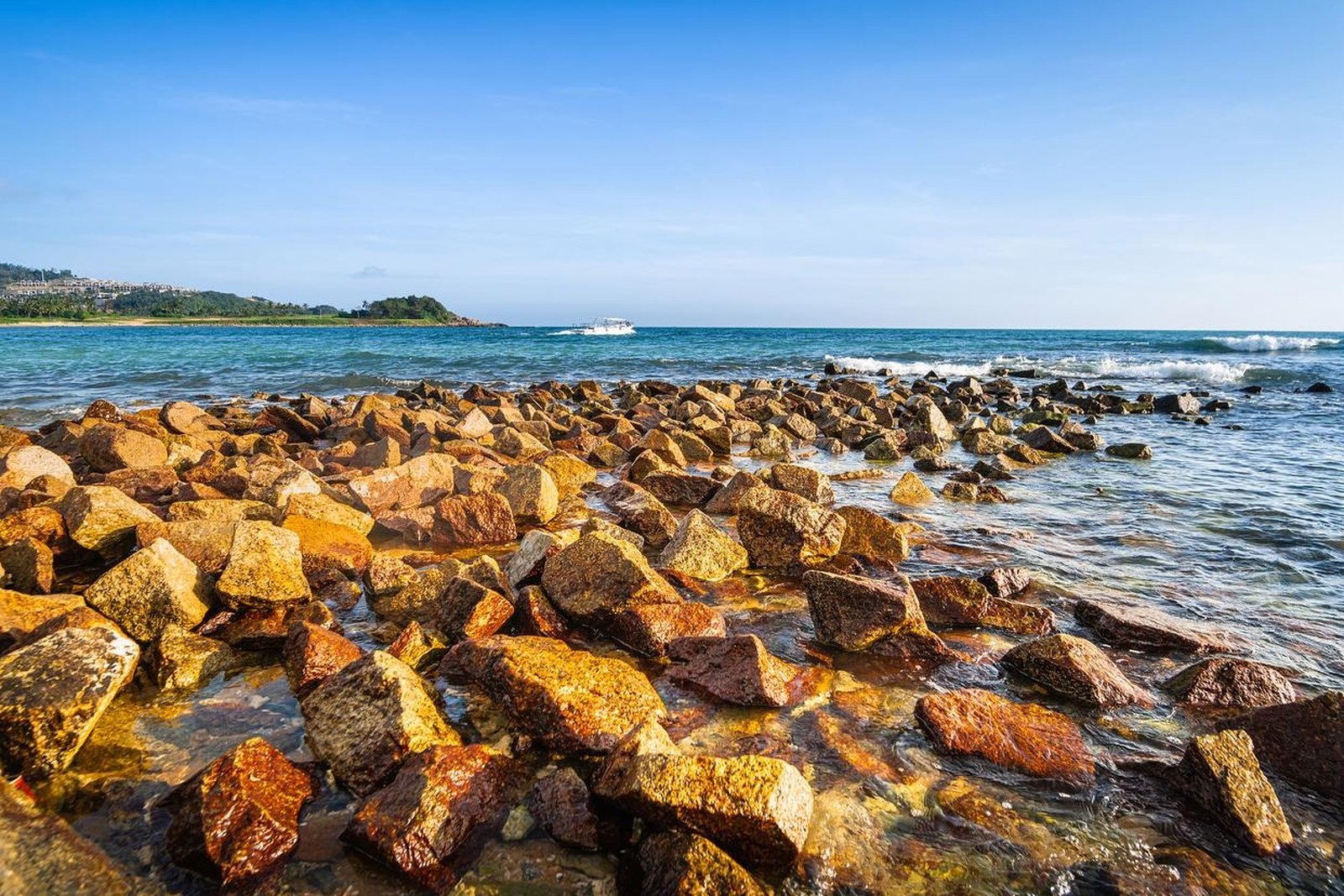
The boulder beach is what you came for, and reaching it is half the experience. You go to the northern end of the sandy bay and follow a small path that appears to dead-end against the ridge — the local description of the moment is the old line about the road running out and the village appearing after the willows, and it is accurate, because you climb over a low earth bank and the ground simply changes character. Below you, the stones. The water between them is violent in a way the sheltered bay is not: this side takes the full swell, and the waves hit the rock and go up rather than in, throwing spray that drifts across the boulders and leaves them wet and shining.
The stones themselves are granite, rounded by the same slow process that makes every granite coast in the world look like a heap of eggs, then sorted and stacked by surf into something more deliberate-looking than random. They are astonishing in colour up close — banded grey and cream and rust and a greenish tinge where the rock has been wet for a long time.
后鞍海 Hòu’ānhǎi, the northern bay, is the third and least visited. It has no boulders, just a broad beach of fine sand with a steep, energetic shorebreak, and no boats, because there is nowhere to moor. It is the place to walk barefoot after scrambling over rocks for an hour, and it is almost always empty.
The ridges above the bays are worth some time too. They are covered in scrub and low trees, and the rock among them has weathered into shapes people have been naming for generations — figures, animals, and one outcrop on 前鞍岭 Qián’ānhǎi that looks from a particular angle like a sentry standing at the edge. There are caves in the slopes and a population of wild macaques that lives in them and comes down to forage, and if you leave anything edible on a rock while you swim you will come back to find it gone.
Why the Stones Are Like That
The geology is straightforward and satisfying. The rock is granite — magma that cooled slowly underground, which gave it three sets of roughly perpendicular fractures. Weathering works into fractures from the outside, rounding the corners, which is why granite landscapes everywhere end up as piles of spheres. Then the sea takes over: as the coast retreated and the water worked at the base of the outcrops, boulders were undermined, freed, rolled, and gradually piled up by a swell that pushes from the same direction for most of the year. Geologists describe the result as a granite marine-erosion landscape, and the cape is protected as a provincial nature reserve precisely because it is a clean example of one.
Local tradition, as it tends to, has a better story. Two sea turtles, it says, saved a starving fishing village by laying eggs until the villagers had enough to eat; the female laid so many that she could not get back to the sea, and the male refused to leave her, and the two of them became the two ridges. The eggs, scattered along the shore, became the boulders.
What to Bring and How to Move
This is a wild coast with no services, and the practical requirements are simple but real.
Footwear is the whole thing. Granite that has been in salt water goes slick, and the gap between two rounded boulders is exactly the size to take an ankle. Trainers with tread or, better, the cheap rubber-soled canvas shoes sold everywhere in 海南 Hǎinán. Do not do this barefoot and do not do it in sandals.
Water, sun and insect repellent. There is nowhere to buy anything. The sun at 18 degrees north is a serious instrument even when it is cloudy, and the scrub near the path holds mosquitoes.
Watch the sets before you step down. The waves arrive in groups, and the last one in each group is the big one. If the water has just reached the stone you were standing on, move up.
Do not swim at the boulder beach. Swim at 前鞍海 Qián’ānhǎi, which is sheltered, or at 后鞍海 Hòu’ānhǎi with attention to the shorebreak. The middle bay has no beach, no lifeguard, and underwater rocks.
Bring a car. There is no bus service of any use and no taxi to be found at the cape; you have to drive yourself in and you have to be comfortable leaving the car on an unpaved lot for a couple of hours.
When to Go
The light is the whole game here. In the middle of the day the stones are bleached flat and the photographs look like gravel. In the two hours before sunset the wet surfaces take the colour of the sky and the shadows fall into the gaps between the boulders, and the whole slope becomes a single sculpted object. Early morning is nearly as good and much cooler. The autumn and winter months — roughly October to March — bring steadier weather and a lower sun; summer is hot, humid and prone to sudden squalls off the sea, and the local advice through the summer is to check the forecast before committing to a long drive.
Practicalities
Tickets: Free. 大花角 (Dàhuājiǎo) is an unprotected open coast with no gate and no admission charge; the small parking area is unpaved and unstaffed.
Opening hours: Open all day, every day. The best light is from about four in the afternoon until sunset, and the worst at noon, when the rock reflects the heat and there is no shade anywhere on the cape.
Closing day: None. There is no closure, no fence and no staff — which also means nobody is watching the water or the weather for you.
Getting there: 大花角 (Dàhuājiǎo), south-east coast of 万宁 (Wànníng), east 海南 (Hǎinán), about 18 km from 万城 (Wànchéng) — a 40-minute drive. Self-driving is effectively the only way in: take the coastal or inland road south-east out of 万宁 (Wànníng) town, follow signs for the cape, and leave the car on the dirt lot at the end. From 万宁 (Wànníng) high-speed rail station it is roughly an hour by taxi with prior arrangement, and there is nothing to hail on the way back. Wear shoes with grip, carry water, and allow two hours on the shore. flowcloud would say that a coast with no ticket office and no railings is worth more than one with both, and that the correct response to a pile of enormous stones at the edge of the sea is to sit on it quietly for a while rather than photograph it. Go late in the day, walk north from the sandy bay, and stay until the light goes.