
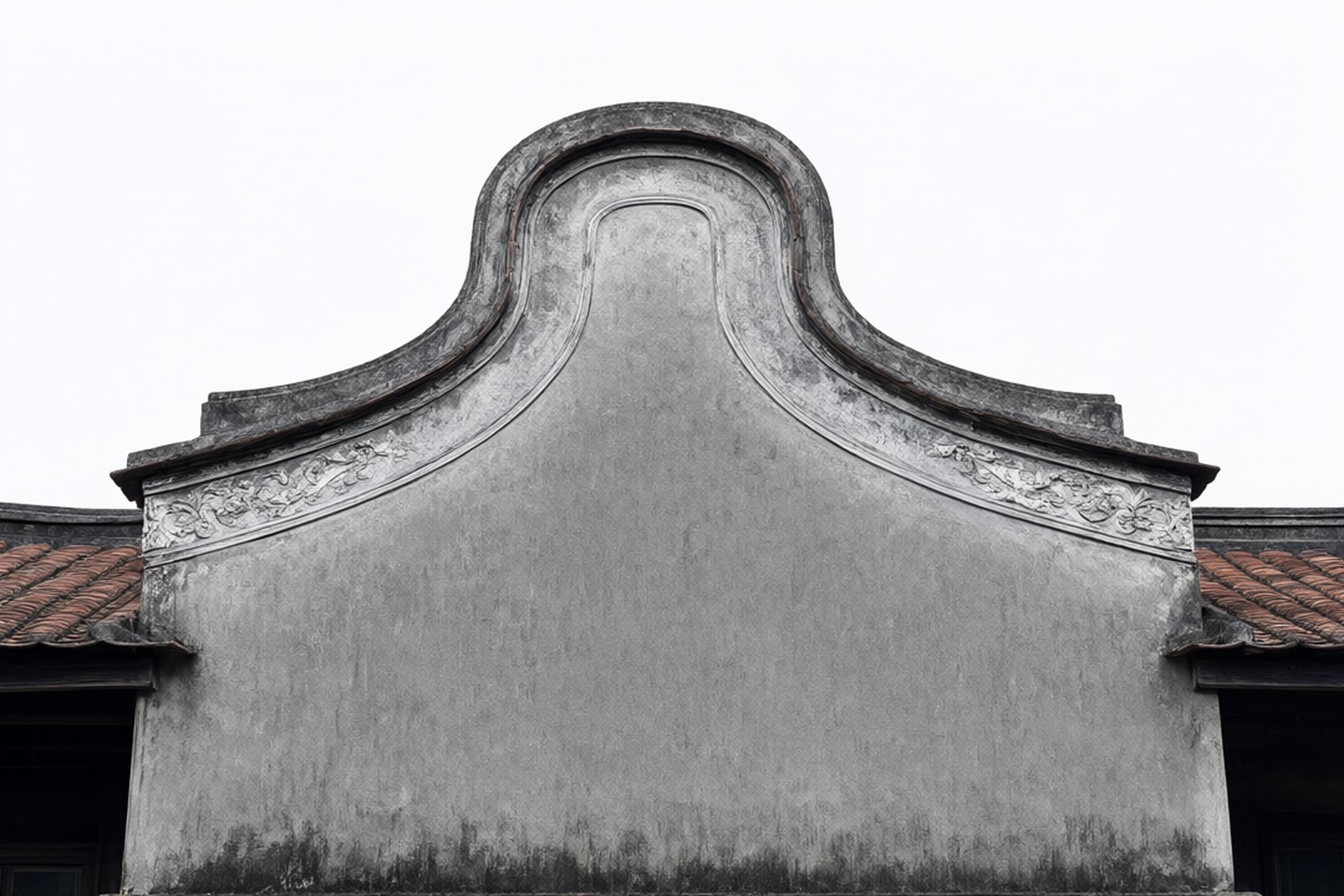
The 大湾古建筑群 Dà wān gǔ jiàn zhù qún, the group of old buildings at 大湾镇 Dà wān zhèn, stands along 508 乡道 508 xiāng dào in the south of 郁南县 Yù nán xiàn, in the west of 云浮市 Yún fú shì, and it is the largest surviving concentration of Ming and Qing houses in the county. The count the county publishes is 47 old buildings still standing, and what they represent is a particular kind of wealth: not the imperial or the monastic but the mercantile, accumulated by families who traded on the 南江 Nán jiāng – the South River, which is the 罗定江 Luó dìng jiāng of the maps and was the water road of this whole valley – and who then spent it on houses, halls and ancestral shrines. The two architectural signatures are the 镬耳山墙 huò ěr shān qiáng, the wok-ear gable, and 灰塑彩绘 huī sù cǎi huì, lime-plaster moulding with painted decoration. The wok-ear is the easiest of all Guangdong vernacular features to spot once you know it: the gable wall rises past the roof ridge and then curves up and over in a shape like the handle of a wok, in a run of three or five steps, which is both a firebreak – the flue-shaped profile stops a fire in one house jumping to the next – and a statement of standing, because the number of ears a household was allowed to build was regulated. The lime-plaster work is the finer art: reliefs built up in lime putty, coloured, and set along the eaves, over the doorways and above the windows in a repertoire of figures, flowers and calligraphy. The one house named in the published material is 李耀汉大屋 Lǐ Yào hàn dà wū, the great house of Li Yaohan, which is described as combining 广府 Guǎng fǔ, Cantonese, and 客家 Kè jiā, Hakka, building practice – a combination one sees all over the west of Guangdong where the two populations settled into the same valleys – and whose woodcarving of the 福禄寿 fú lù shòu, fortune, emoluments and longevity, figures is dense and elaborate enough that the local description of the whole group is 岭南民间艺术博物馆 lǐng nán mín jiān yì shù bó wù guǎn, a folk art museum of Guangdong. The report flags honestly that no authoritative list of the 47 buildings by name could be found beyond that one, so this article describes the type rather than pretending to a register: what is here is a walled village or several of them, in the phase that Guangdong’s river towns reached when the trade was good, and the lime mouldings on the outside walls have survived better than almost anywhere else in the region because the valley was never industrialised.
The river is the other half of the story, and it explains why this valley has the buildings it does. The 南江 runs south through 郁南 and into the 西江 Xī jiāng at its lowest reach, and the whole 南江流域 Nán jiāng liú yù, the Nanjiang basin, has been treated by the provincial authorities as a distinct cultural-geographic unit – the county’s own phrasing is that 郁南 is the 腹地和发祥地 fù dì hé fā xiáng dì, the hinterland and the birthplace, of 南江文化 Nán jiāng wén huà, Nanjiang culture. That is a marketing register and it is worth flagging as one, but the underlying claim is real, and the reason is that a river valley with its own trade network develops its own dialect, its own architecture, its own food and its own ritual calendar, and the Nanjiang did. The city’s own published route through it runs 磨刀山遗址 Mó dāo shān yí zhǐ, then the 大湾古建筑群 once you get past the 摩刀山 and down the valley, then 连滩古镇 Lián tān gǔ zhèn, the 光二大屋 Guāng èr dà wū and 兰寨古建筑群 Lán zhài gǔ jiàn zhù qún, and then out to the 长岗坡渡槽 Cháng gāng pō dù cáo and the academy and pagoda at 罗定 – one line, one river, and a sequence of sites that explains itself. The opening item on that list is the one that should change the way a visitor looks at all the rest. The 磨刀山遗址 is at 和都村 Hé dū cūn, 河口镇 Hé kǒu zhèn, also in 郁南, and it was found in January 2013. In April to July 2014 the provincial institute of archaeology, working with 北京大学 Běi jīng dà xué and the city and county museums, excavated 200 square metres of the first locality and recovered, from the primary reticulated red earth of a fourth-level river terrace, two phases of ancient human activity and close to four hundred stone objects – choppers, picks, scrapers, hand axes, cores, flakes and debris. The dating came out at roughly 600,000 to 800,000 years before the present, in the early Palaeolithic, which makes it the earliest cultural remains ever found in Guangdong. What that did was push the province’s human history back from the 马坝人 Mǎ bà rén horizon of about 130,000 years to the time of 北京人 Běi jīng rén, 500,000 to 800,000 years ago, and close the gap that had left Guangdong looking like a province with no million-year human record. It was one of the 2014 全国十大考古新发现 quán guó shí dà kǎo gǔ xīn fā xiàn, the year’s ten great national archaeological discoveries, was listed as a provincial protected site the same year and among the eighth batch of national protected sites in 2019, and was named in 2022 among 广东省十年十大重要考古发现 Guǎng dōng shěng shí nián shí dà zhòng yào kǎo gǔ fā xiàn, the province’s ten most important finds of the decade. The 展示馆 zhǎn shì guǎn at the site has about 3,000 square metres of building on 1,500 square metres of ground, with more than two hundred photographs and sixty-odd objects across five sections, and the park around it is planned at some 6,000 亩 mǔ with a budget of about a billion yuan. The reason to put that paragraph next to the houses is the contrast it creates: the 大湾 buildings are the end of a very long story about this valley, and the terrace at 磨刀山 is its beginning, and both are in the same county, forty-odd kilometres apart.
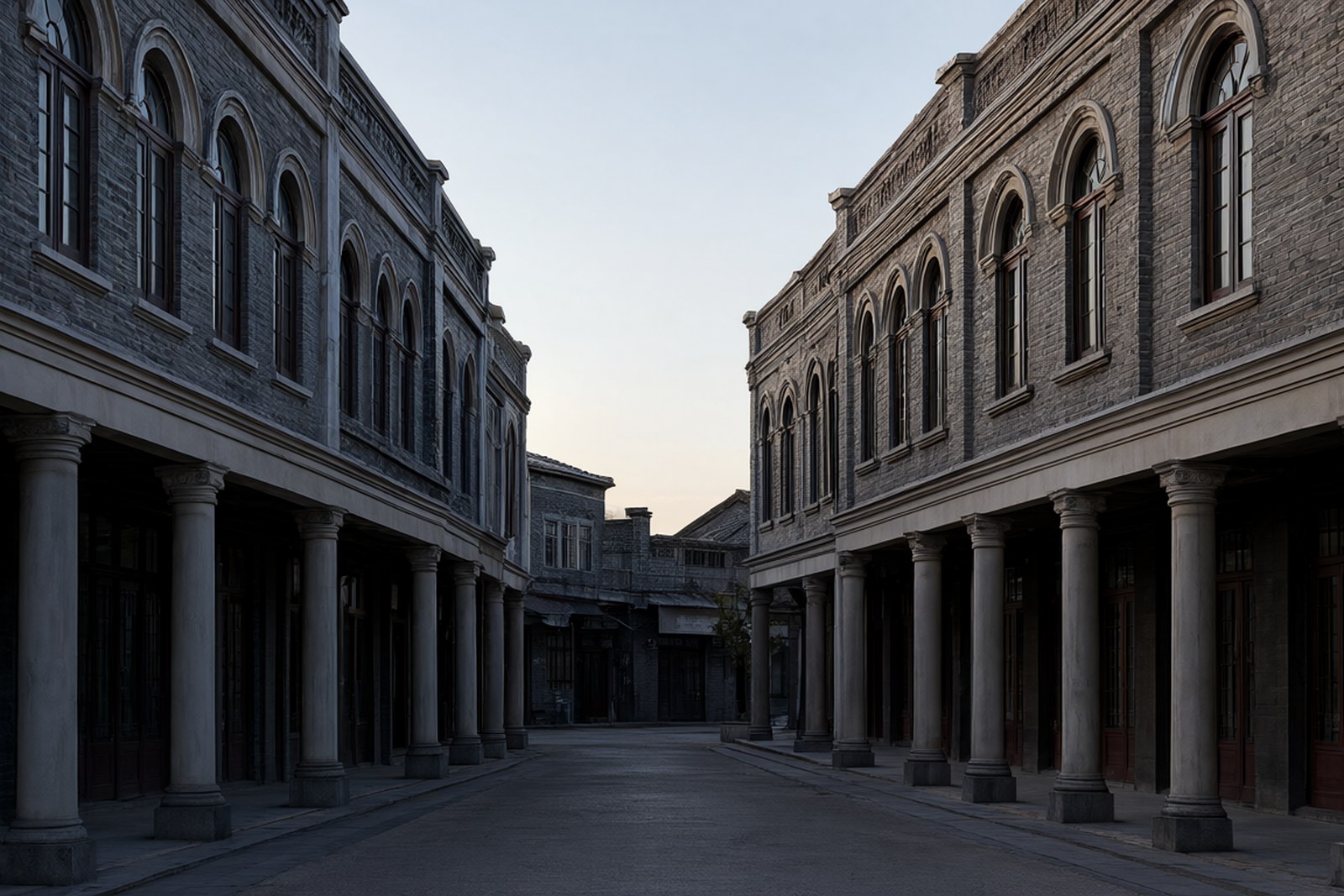
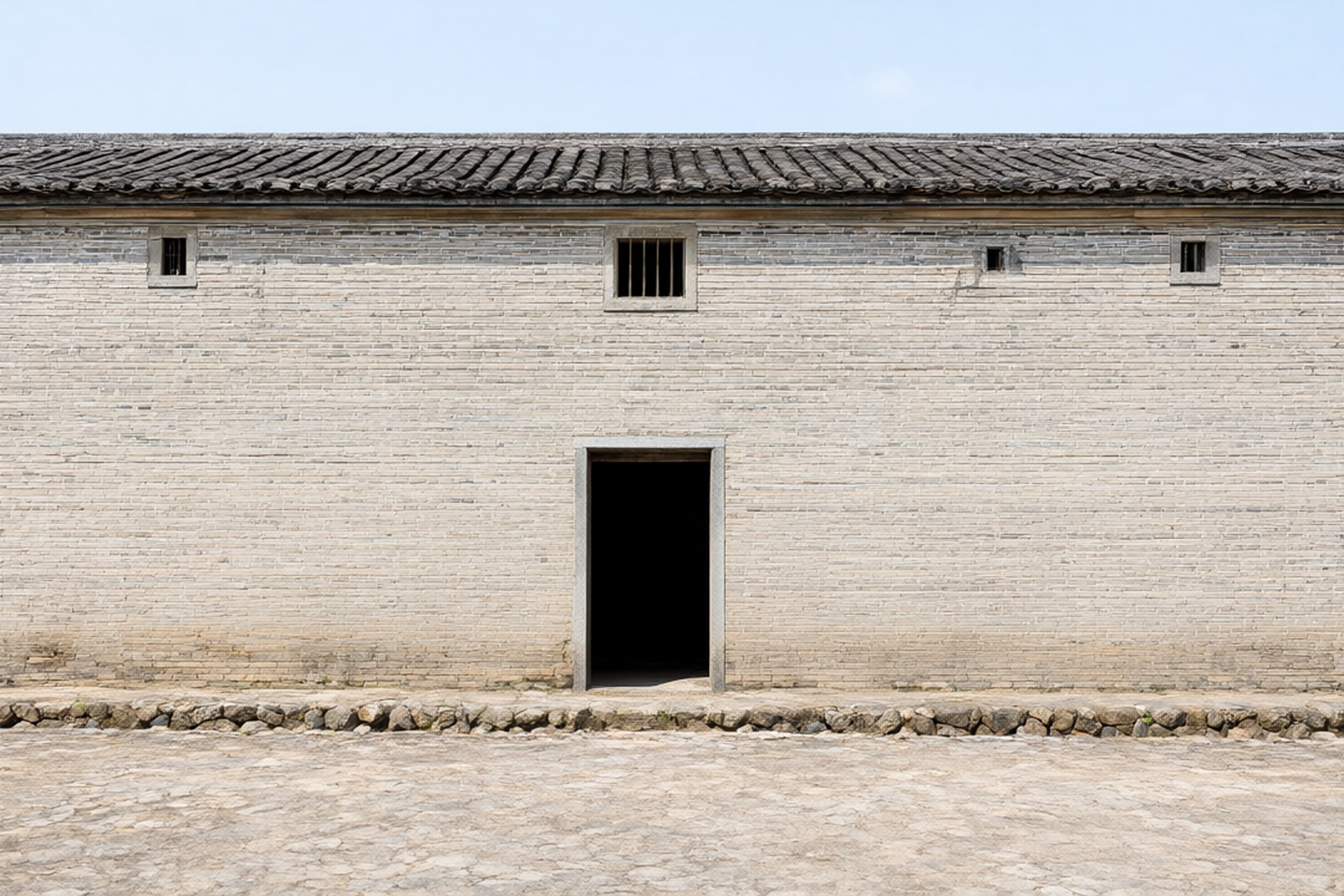
The other part of the group is 连滩 Lián tān, the old town downstream, and it is a different proposition: not a village of houses but a river port that ran on trade. It is described as having a history of about four hundred years, and what survives of its centre is the 骑楼街 qí lóu jiē, the arcade street, in the form it took in the last decades of the Qing and the first of the Republic – two and three storeys of 青砖灰瓦 qīng zhuān huī wǎ, grey brick and grey tile, with the ground floor set back behind an arcade of columns so the whole street is walkable under cover, and above the arcades the 中西合璧 zhōng xī hé bì, Chinese-and-Western, arched openings and glazed windows that the treaty-port decades put on every trading street in the south. A town like this is best walked in the late afternoon, when the arcade is in shade and the street is at its liveliest, and the architecture is one part of it; the other parts are the shops and the food. Two more buildings in the 连滩 area are worth the detour. The first is the 张公庙 Zhāng gōng miào, a Ming building a short way from the town, which is dedicated to a 水神 shuǐ shén, a water deity, of the Nanjiang – and which carries a set of stone carvings recording the old flood-control traditions of the river, which is the sort of thing that matters more than any legend: a river valley that lives by trade lives or dies by its banks, and the shrine is a record of the relationship. The report is explicit that no reliable founding year for the temple was found, and the honest formulation is simply that it is a Ming building – which is unusual in itself, since most of the shrines of this kind on the lower Nanjiang were rebuilt in the Qing. The second is the 光二大屋 Guāng èr dà wū, the great house of Guang’er, described as a late Qing 客家围屋 Kè jiā wéi wū, a Hakka walled compound, and as a defensive masterpiece of the type. Its numbers are unusually complete: ten 亩 mǔ of ground, five ranges 进 jìn deep by five 横 héng across, 72 rooms arranged in the 回 huí shape of a hollow square, outer walls a metre thick, gun ports and a watchtower, and an internal courtyard drainage system that the local material calls ingenious. The metre-thick wall and the gun ports are the point: this was not a house that expected to be comfortable first. The Hakka communal principle states it as 聚族而居,御患为先 jù zú ér jū, yù huàn wéi xiān, live as a clan together and put defence first, and the 光二大屋 is that sentence built out of brick. A third site, 兰寨 Lán zhài, is a village rather than a building, about five kilometres out along the river; it is called an old 状元村 zhuàng yuán cūn, a village of top examination graduates, and its ancestral hall of the 林 Lín lineage has a 十德门 shí dé mén, a gate of ten virtues, and a carved panel in the main hall, the 九狮图 jiǔ shī tú, nine lions, whose openwork timber carving on the frames is the reason the place gets called a living fossil of Guangdong woodcarving. The village keeps its wok-ear houses and its stone-stepped lanes, and the terrace at the back of the hill looks down over the river’s layers of paddy – mirror-bright in May after planting and a solid gold sea in October. The one custom worth knowing before you arrive is that on certain days the villagers make a dragon out of rice straw, stick burning incense into it and dance it in front of the shrine, which is a fire-dance variant of the 禾楼舞 hé lóu wǔ, the ritual dance of the old Nanjiang harvest – a local tradition with a long pedigree and no interest in being a performance for tourists. It is also, for a visitor, the least convenient thing to plan for: it happens when it happens.
The valley is best understood as a set of strata rather than a list. In the hills at 河口镇 Hé kǒu zhèn there is a river terrace with stone tools on it that nobody has improved since, and forty kilometres downstream at 大湾镇 Dà wān zhèn and 连滩 Lián tān there is everything the same river bought when the trade came in – the lime mouldings, the wok-ear gables, the arcades and the metre-thick walls of a Hakka compound that expected to be attacked. The county has put all of it on one route and calls it 南江文化 Nán jiāng wén huà, and the label is fair: what the visitor is looking at, from the terrace to the old town, is one river working on one population over a very long time, and the honest way to see it is to start at the bottom of the sequence rather than the top. A car makes it a day; without one, the choice is between the houses and the arcade, and the arcade at 连滩 is the one that can be reached on a coach.
Practicalities
Tickets. The 大湾 group and the arcade street at 连滩 are village and town streets rather than gated attractions, and the usual arrangement is free or nominal with a charge that varies by site – the 光二大屋 and 兰寨 are the two most likely to ask for a small fee, and neither has anything to book in advance. Opening hours at the 大湾 group are given as about 08:00 to 18:00. The practical cost of this day is transport rather than admission: the sites are spread over twenty or thirty kilometres of county road and there is no useful public service linking them, so a hired car or a driver is the real budget line.
Opening hours. Town streets and village lanes can be walked at any hour that is not dark, and the houses of the 大湾 group are best in the morning, when the light is off the lime mouldings on the front walls. The 连滩 arcade is at its best from about four in the afternoon, when it is in shade and the town is out on the pavement. The season that matters is the wet one, March to June, because the Nanjiang valley is at its greenest and the terraces at 兰寨 are flooded and reflecting; the autumn rice harvest in October is the other good window, for colour rather than for light.
Getting there. 郁南县 Yù nán xiàn sits on the 广昆 Guǎng kūn expressway, and the 连滩 Lián tān and 东坝 Dōng bà exits put you about ten minutes from the old town; from 广州 Guǎng zhōu it is under three hours by road. The county town is 都城镇 Dū chéng zhèn, upriver, and 南江口 Nán jiāng kǒu is the station on the 南广 Nán guǎng high-speed line, which is the fastest way in from Guangzhou or Nanning; from there the sites are a car ride of half an hour to an hour. The 磨刀山遗址 at 河口镇 Hé kǒu zhèn is in the opposite direction from 连滩, so the two halves of the valley’s history need a car and a full day if they are to be done properly, and a driver who knows the county roads is worth more here than anywhere else in Yunfu.
Closing day. No weekly closing day at any of the sites. Individual houses in the 大湾 group are lived in and are opened or shut according to who is at home, which is normal for a protected village and means that the group is best understood as a place people live rather than a monument with a turnstile. The 兰寨 shrines ask for quiet and restrict photography in some areas, and the ancestral halls are family property, so the rule is simply to ask – the villagers are used to visitors who are interested and indifferent to those who are not.
flowcloud would say that the west of Guangdong is where the province keeps the things it has not yet decided how to sell, and that the 南江 valley proves it twice over: a river town of grey-brick arcades and metre-thick walls that traded its way into a comfortable, undemonstrative kind of architecture, sitting forty kilometres from a red-earth terrace holding the chipped stone tools that push the province’s human story back to eight hundred thousand years, neither of which anybody outside the county has heard of.
Getting there: the 大湾古建筑群 is at 大湾镇 Dà wān zhèn on 508 乡道 508 xiāng dào in the south of 郁南县 Yù nán xiàn, 云浮市 Yún fú shì, and 连滩古镇 Lián tān gǔ zhèn is downstream of it with 光二大屋 Guāng èr dà wū, 兰寨 Lán zhài and the 张公庙 Zhāng gōng miào all within a few kilometres of the old town; the 广昆 Guǎng kūn expressway has 连滩 and 东坝 exits about ten minutes out, 南江口站 Nán jiāng kǒu zhàn on the 南广 Nán guǎng high-speed line is the nearest railhead, and 广州 Guǎng zhōu is under three hours by road, with the 磨刀山遗址 Mó dāo shān yí zhǐ at 河口镇 Hé kǒu zhèn lying in the opposite direction and needing a car of its own.