
北山 Běishān Beishan, just outside the town of 大足区 Dàzú Qū Dazu District in Chongqing, holds the finest early carving of the 大足石刻 Dàzú Shíkè Dazu Rock Carvings, the UNESCO World Heritage cliff sculpture inscribed in 1999. Where Baoding Mountain was built as one great devotional walk, Beishan is a long seam of caves and niches cut into a hillside over the Tang and Song dynasties, the work of officials, monks and local families who each sponsored a niche, so the cliff reads as centuries of private devotion layered one beside another. The result is smaller in scale than Baoding but unsurpassed in refinement: the stone here carries the soft, poised faces that mark the maturity of Chinese Buddhist carving.
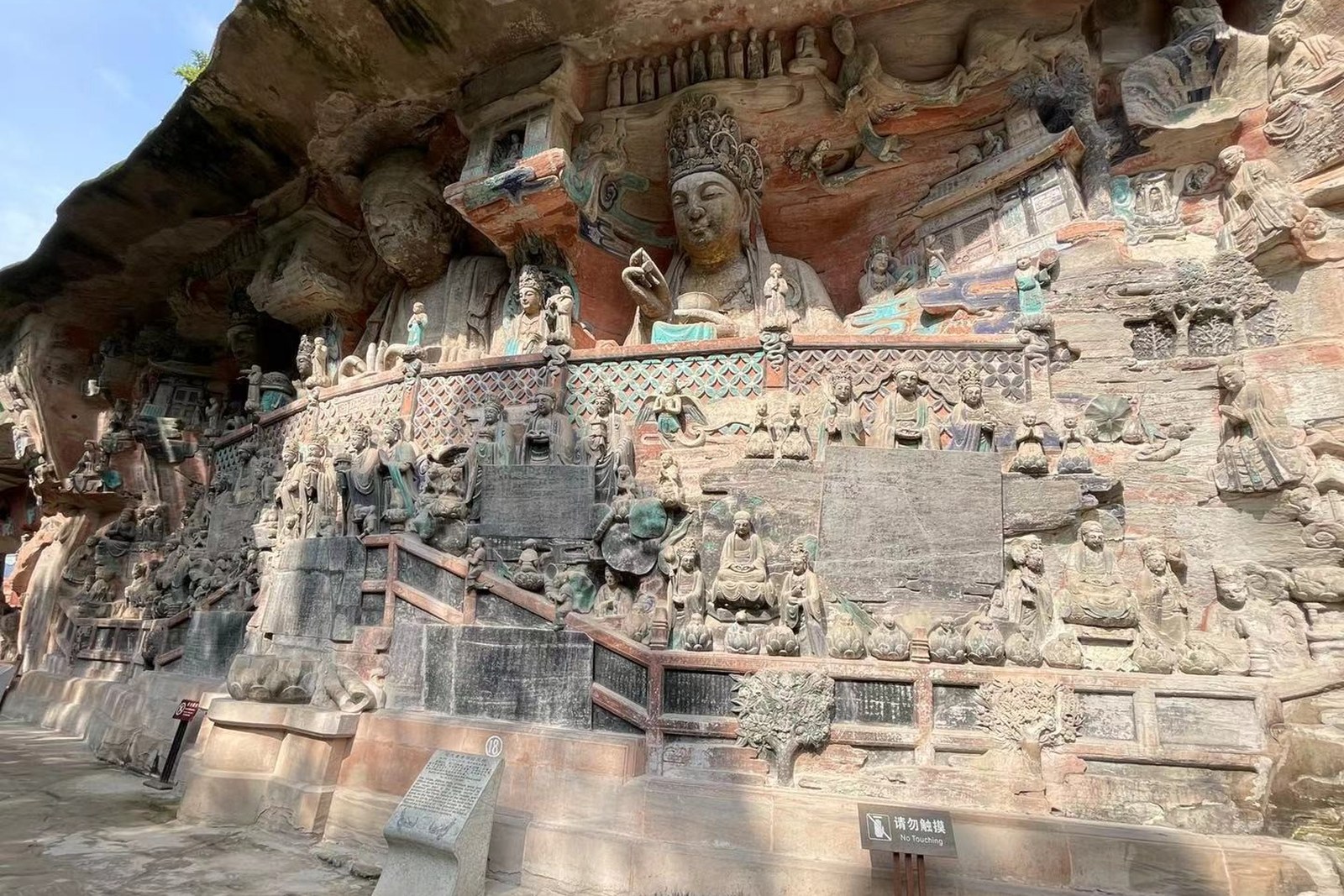
The heart of Beishan is 佛湾 Fó Wān Buddha Bay, a curved stretch of cliff packed with hundreds of niche figures where the artistry peaks in the Song-period carvings. The standout is the 日月观音 Rìyuè Guānyīn Sun-Moon Guanyin, a bodhisattva of extraordinary calm holding the sun and moon, its features so finely cut that the face seems to breathe; carvers of the period prized exactly this restraint, a beauty held in stillness rather than in motion. Nearby the 转轮经藏 Zhuànlún Jīngzàng revolving-sutra cave, a stone pillar carved as a rotating scripture cabinet, shows the engineering cleverness of the site, a circular relief meant to turn the merit of reading without a monk ever lifting a page.
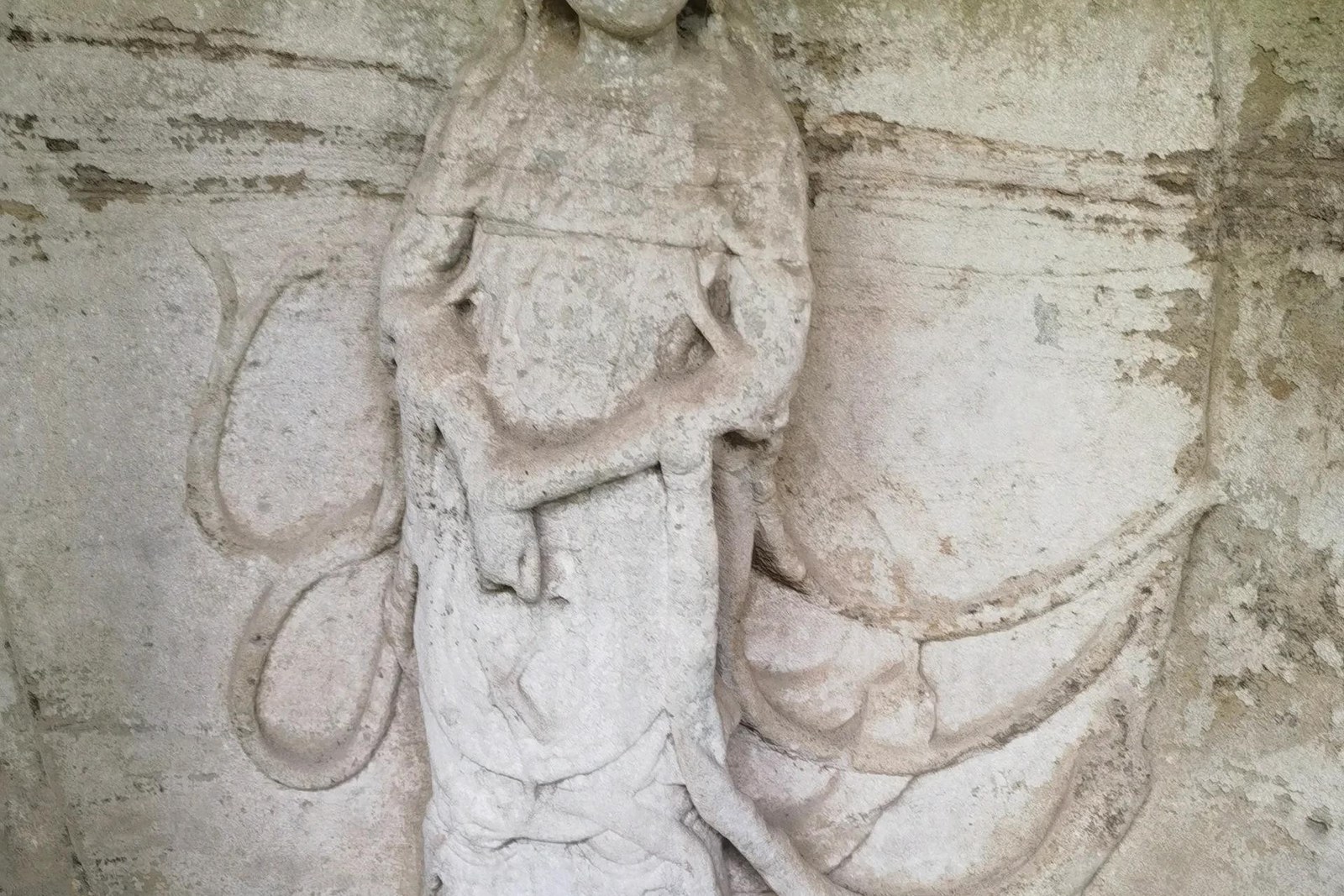
Beishan rewards close looking more than Baoding does, because the carvings are intimate and the differences between an early Tang face and a late Song one are the whole interest. The niches are lit unevenly and some sit deep in shadow, so the eye learns to read form rather than detail, and the weathering that has softened many figures only adds to the quiet. Visitors who hurry the bay miss the point; the place is a cliff of small wonders, and the masterpieces are found by walking slowly past niches that at first look alike.
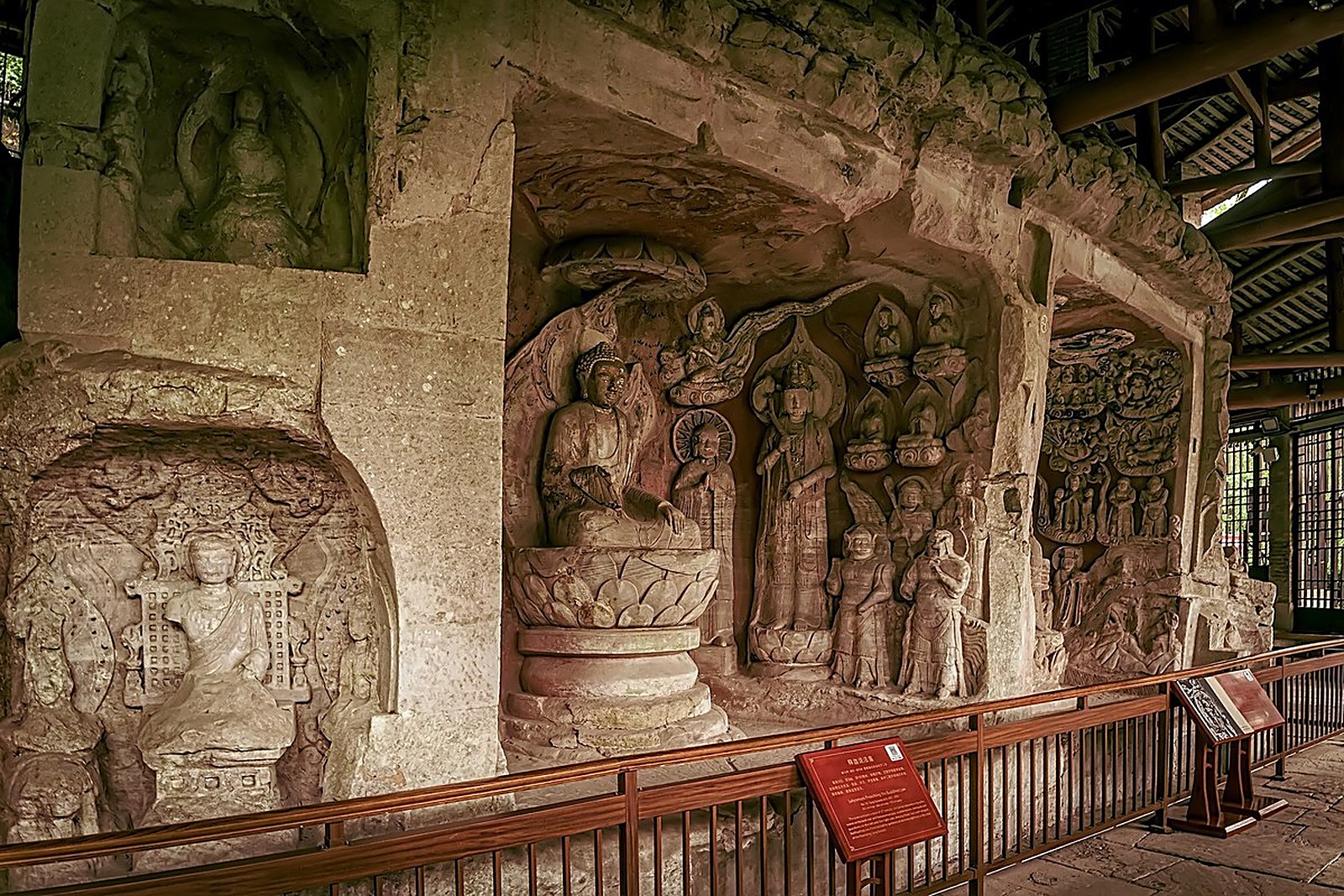
Give the bay time and the order of the centuries becomes visible. Start at the older Tang niches and walk toward the Song refinement, notice how the faces grow softer and the bodies more natural, and save the Sun-Moon Guanyin for last when your eye is trained. A torch or phone light helps in the deep niches, but the best reading comes from the softer daylight hours.
Words and Names
大足石刻 Dàzú Shíkè is the Dazu Rock Carvings, the UNESCO World Heritage cliff sculpture of 大足区 Dàzú Qū Dazu District, Chongqing, inscribed in 1999. 北山 Běishān is Beishan, the hillside site holding the district’s finest early Tang-to-Song carving. 佛湾 Fó Wān is Buddha Bay, the curved cliff of niches at the heart of Beishan. 日月观音 Rìyuè Guānyīn is the Sun-Moon Guanyin, the supremely calm bodhisattva holding sun and moon. 转轮经藏 Zhuànlún Jīngzàng is the revolving-sutra cave, a stone pillar carved as a turning scripture cabinet.
What the Locals Know
Beishan is smaller and quieter than Baoding, which is why locals who have already seen the famous reclining Buddha come here for the carving itself; go early or on a weekday if you want the niches to yourself. The bay is a hillside walk with steps and uneven ground, and some niches sit in deep shadow, so a phone light or small torch genuinely helps read the fine faces, and comfortable shoes are the honest kit. No specific ticket price, opening hour, vendor name or guide is stated here; confirm those at the gate on the day. One honest caveat: the figures are weathered and many lack the bright restoration of Baoding’s Guanyin, so expect soft old stone rather than gilded spectacle.
flowcloud would say that Beishan is the finest early carving of the Dazu Rock Carvings, a Tang-to-Song seam of family-sponsored niches at Buddha Bay in Dazu District crowned by the serene Sun-Moon Guanyin and the revolving-sutra cave, where the interest is in reading centuries of refinement across small weathered figures rather than in one grand statue. All checked October 2026.
Where to find it: the Beishan carvings are the older hillside cluster of the 大足石刻 Dàzú Shíkè Dazu Rock Carvings in 大足区 Dàzú Qū Dazu District, Chongqing Municipality, a short distance from the district town and usually visited together with the 宝顶山 Bǎodǐng Shān Baoding Mountain complex; the 佛湾 Fó Wān Buddha Bay niches, 日月观音 Rìyuè Guānyīn Sun-Moon Guanyin and 转轮经藏 Zhuànlún Jīngzàng revolving-sutra cave are all on the one hillside. No specific address, ticket price or operator is invented here; the carvings are a district-wide heritage site rather than the property of one named gate. All checked October 2026.