
Ding’an Old City, the Jianlong Pagoda and the Yamen
定安故城 Dìng’ān gùchéng, the old county seat, stands on the south bank of the lower 南渡江 Nán dù jiāng in 定城镇 Dìng chéng zhèn, facing Haikou across the water about 28 km away. The wall is the reason to come, because this is the only county town wall left in relatively good condition on Hainan: two surviving gateways, basalt blocks, stone lanes, a street of Republican-era arcades and the only surviving county magistrate’s office on the island. County tradition compresses its age into three numbers: a town of more than seven hundred years, a yamen of six hundred and a wall of five hundred. Ding’an has no railway station, so the approach is by bus or car from Haikou East or Meilan.
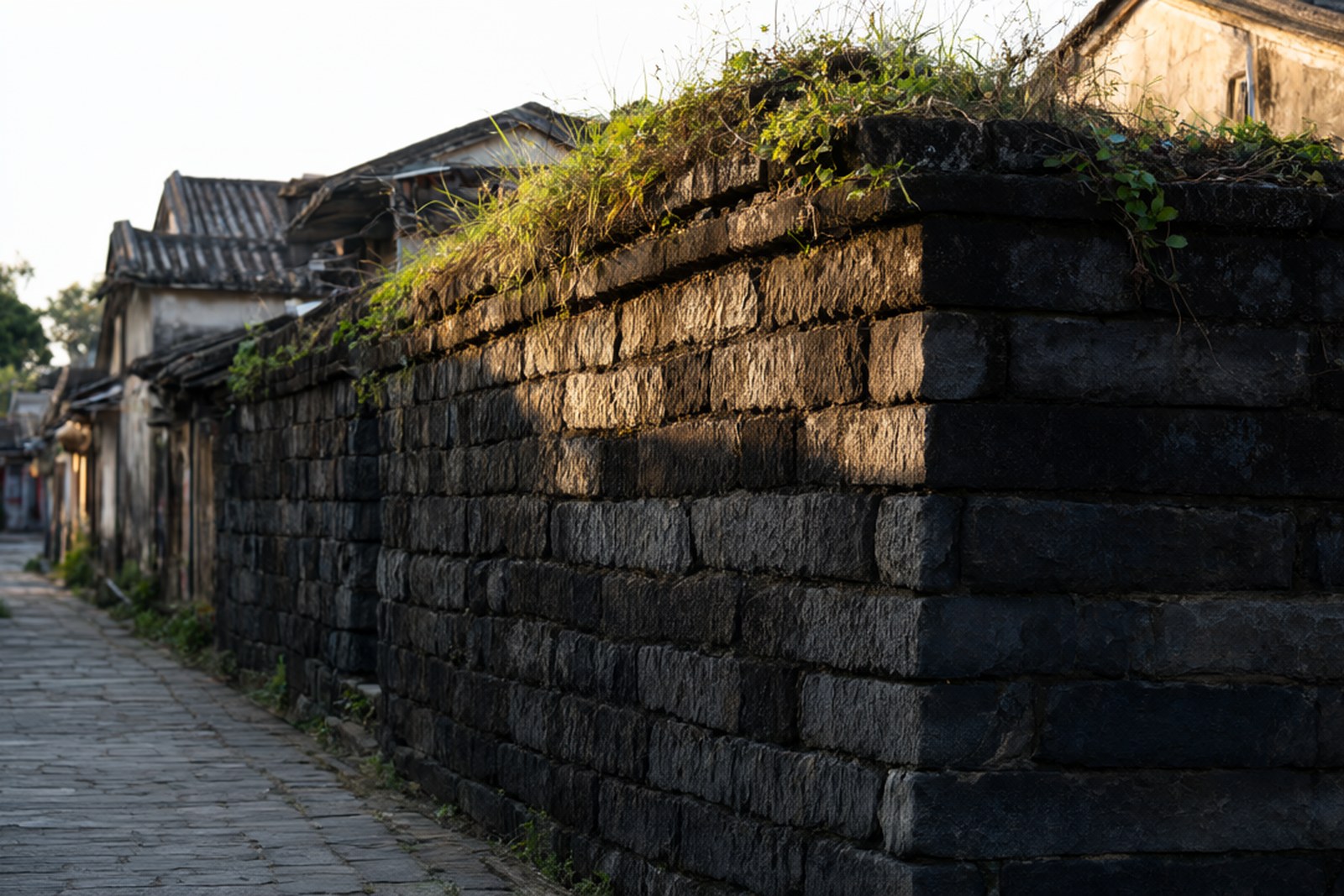
The wall’s dates are the first thing to fix, and they are contested. The county government, quoting the 光绪 and 宣统 gazetteers, gives planning from 1466, work beginning in 1513 and completion in 1519; two other accounts circulate, one having the magistrate 罗昌 Luó Chāng build it from 1466 over six years, the other running 1466 for the plan, 1472 for the start and 1478 for the finish. About 593 zhang, roughly 1,700 metres, went round an irregular square plan, with 1,192 crenellations, three gates each with a tower, and a moat on three sides, the river closing the north. The north gate was opened in 1545, shut because of raiders, and reopened in 1690.
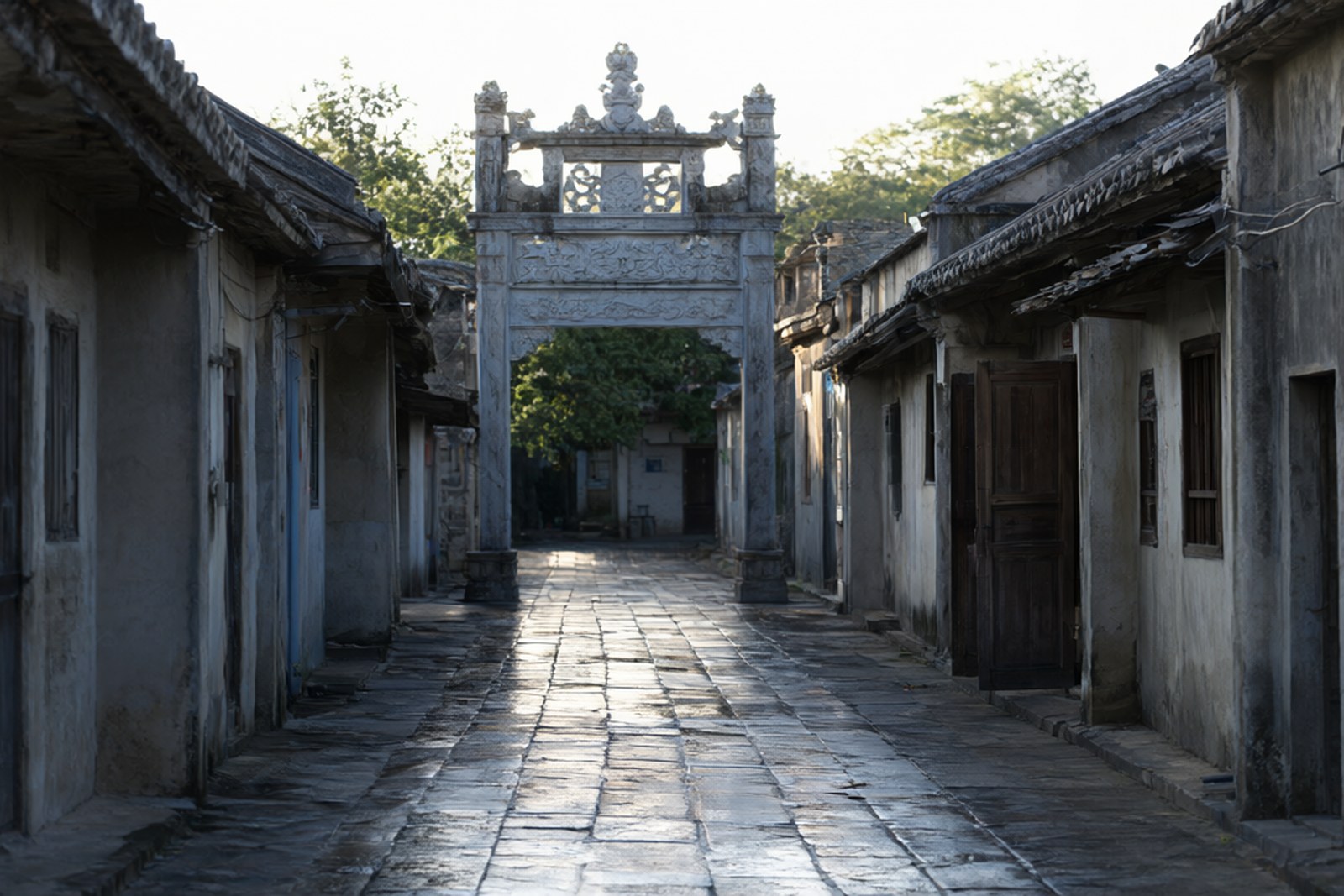
Inside the surviving circuit the inventory is dense: the yamen site, the arches for the provincial and second-place graduates, the house of 胡濂 Hú Lián, the 见龙塔 Jiànlóng tǎ, a Confucian temple and the arcade street, threaded on four stone-paved lanes that form the shape of the character 广 seen from above. Roughly thirty Republican arcade buildings stand mostly in West Gate Street, and a provincial assembly paper notes that some are classed as grade-D dangerous structures, the honest counterweight to the heritage notices. The yamen began in 1369 and is the only Hainan example left: protected at provincial level in 2015, restored between 2015 and 2019 with ten million yuan, and raised to a national 2A area in 2020.
The pagoda stands twenty minutes out of town, in the 塔岭 Tǎ lǐng new district inside the Hainan tropical bird park. 见龙塔, also called 仙沟塔, was begun in 1751 by the magistrate 伍文运 Wǔ Wényùn and was completed under the magistrate 吴先举 Wú Xiānjǔ, in 1767 on one account and 1768 on another. Its name comes from the Book of Changes line about the dragon appearing in the field and the great man being seen. Brick and stone, seven storeys, twenty-five metres high with a minority account giving twenty-seven, octagonal by the compass, with twenty-eight real and false doorways and no cement, no nails and no scaffolding: the bricks are bedded in glutinous rice and plant ash.
The pagoda’s afterlives are more instructive than its construction. Six years after it was finished, in 1773, 张岳崧 Zhāng Yuèsōng was born at 高林村 in the same county and grew up to be the only tanhua Hainan has produced. The bird park around the tower now shows more than three hundred species and thirty thousand birds over 466 mu, and eight bronze statues of Confucius and the other sages stand at its foot; it was rated national 3A in March 2025, having been a 2A area since 2006. Two things need care: the county’s material and one news outlet disagree about which son of 张岳崧 passed the metropolitan examination, and the pagoda’s position is described in three ways.
Practicalities
Tickets. The county’s own page from 2014 gives the old city as open all day and free, and no later notice has been found that changes it, so the wall, the gates, the lanes and the riverbank cost nothing. The yamen museum, a national 2A area since 2020, publishes no price either. The bird park that contains the pagoda does charge, but its price list was not on any government page found.
Opening hours. For the old city the hours are the hours of a lived-in town, and the county’s 2014 statement of all-day access still reads true. For the yamen museum no unified official timetable was found, so it is worth a telephone call or an on-site notice. The one firm time in the article is the bird park’s, given officially as 07:30 to 17:30 all year, and since the pagoda stands inside that park, the pagoda is a daytime visit by definition.
Closing day. No closing day is reported for the old city and none is published for the yamen. The bird park reports no weekly rest day either, though it does keep a record of temporary closures: it shut on 1 October 2018 for three months of upgrading, reopened for trial on 31 January 2019, closed again with the epidemic and reopened on 1 October 2020. The pattern to expect is a park that stays open and occasionally shuts for works rather than one that rests on a Monday.
Getting there. The county bus station sits in the old town, so arriving by bus puts you inside the walk. The park with the pagoda is on Fumin Avenue in the Taling district and is reached by local bus or by about ten minutes in a car. Within the town everything in this article is walkable in an afternoon, and driving is the practical choice for anyone combining the old city with 仙沟 Xiān gōu, about eight km out, where the cattle market and the beef street sit.
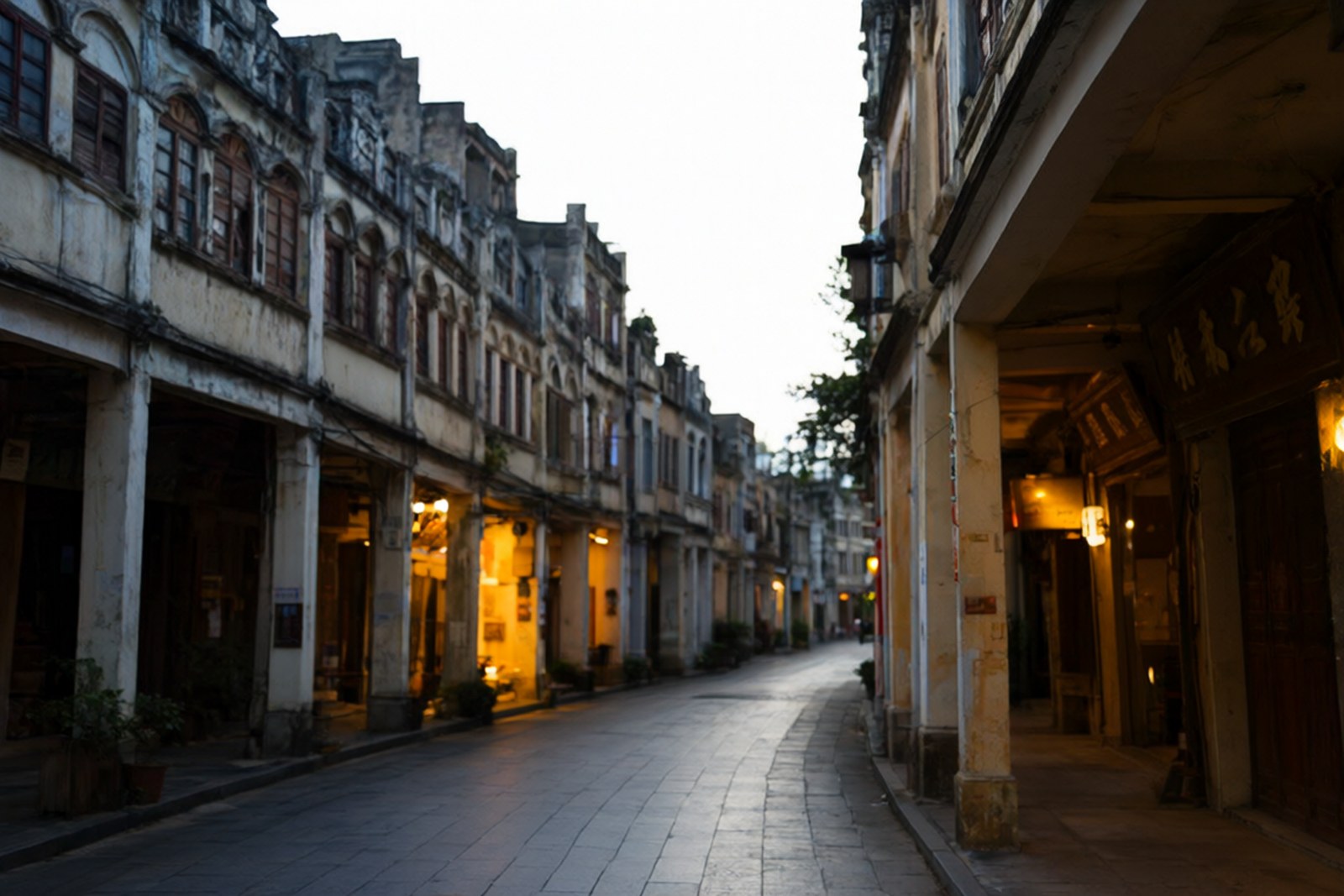
Come for the texture and the record: here the paperwork and the masonry both survive. The yamen holds two exhibitions, one on the county’s metropolitan graduates and one on its opera, which between them explain why the place calls itself a little Suzhou. The figure for the surviving wall, 1,319.86 metres, is the county’s measurement of two sections, against a provincial assembly figure of a thousand-odd metres. And the phrase about seven hundred years describes the county, not the wall: 1292 for the founding, 1369 for the yamen and 1519 for the finished circuit.
Getting there: 定安故城 lies in 定城镇 in 定安县 on the south bank of the lower Nandu river, about 28 km from Haikou, with the county bus station inside the old town and the intercity line from Mingzhu Square ending nearby; the old city is open all day and free by the county’s own statement, the yamen museum has been a national 2A area since 2020 with no published price or timetable, no closing day is reported for either, and the 1751 pagoda stands inside the Hainan tropical bird park on Fumin Avenue in the Taling district, open 07:30 to 17:30 all year.