
The fog does not lie on the water, it stands on it. Between four and seven in the morning, from roughly April to October, the surface of the 小东江 Xiǎo Dōngjiāng — the stretch of river immediately below the dam — disappears under a layer of white that is flat on top and moving at walking pace downstream. It is not mist rising into the air; it is a slab of vapour sitting a metre thick on a cold river, generated by a temperature difference of about fifteen degrees between water released from deep in the reservoir and the humid air above it. A boat crossing it looks like a brushstroke. A fisherman casting from the stern looks like a piece of theatre, and usually is: the local has been paid to be there. Photographers come from all over the province with tripods and 300-millimetre lenses, and the boardwalk built for them, the 观雾栈道 guānwù zhàndào, is now one of the most photographed structures in Hunan.
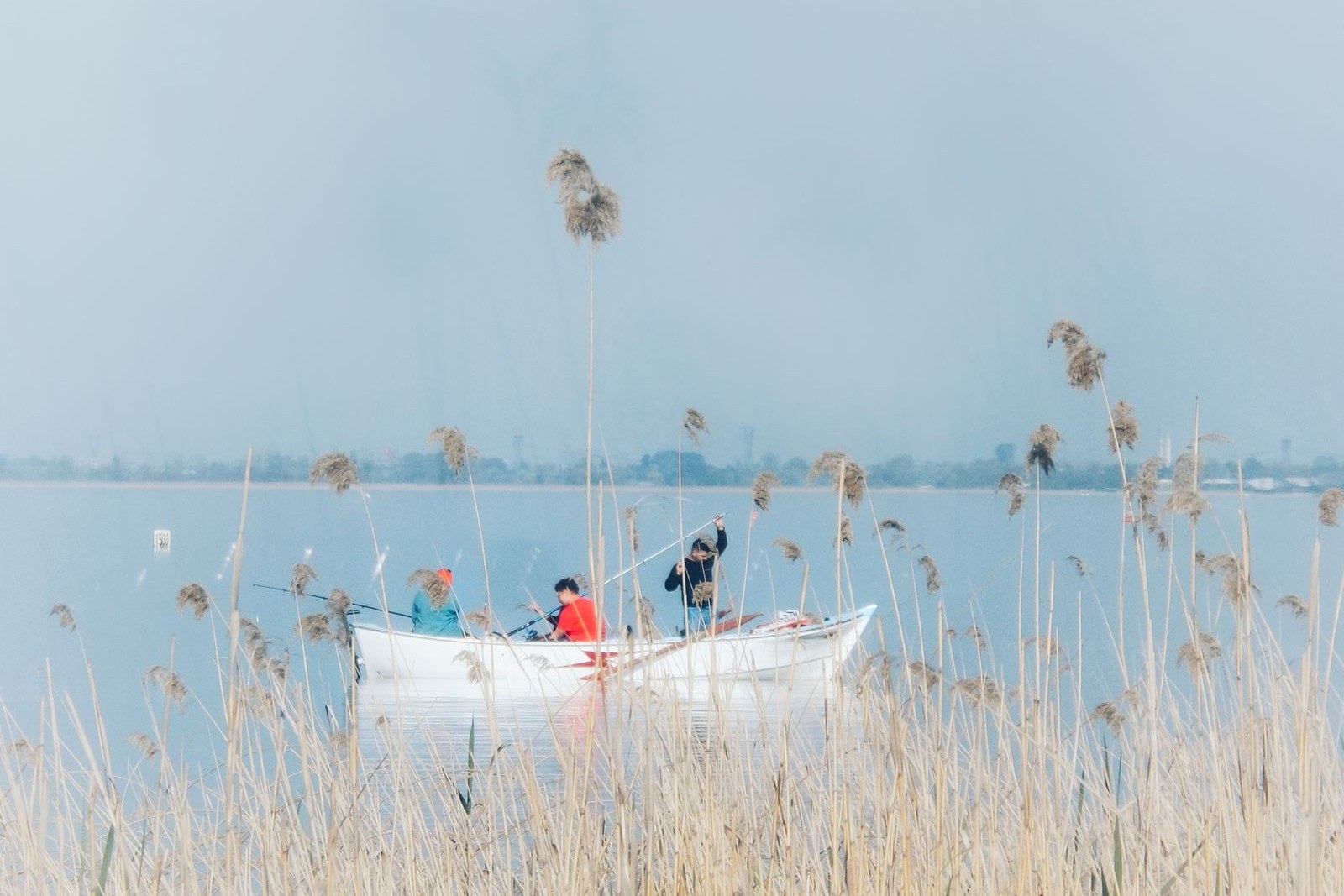
The lake itself is a reservoir, and a large one: the 东江 Dōngjiāng dam was built between 1958 and 1986 and holds back 8.12 billion cubic metres of water across some 26,000 mu of surface, making it the largest body of fresh water in the province and the reason 资兴 Zīxīng has a county-level city’s worth of hotels. The comparison everyone reaches for, 人间天上一湖水,万千景象在其中 — a lake of heaven on earth, with ten thousand scenes inside it — is tourist-board poetry, but the underlying geography is genuinely odd for Hunan: forested hills falling into deep cold water, islands in the middle distance, and a shoreline that runs for hundreds of kilometres in and out of every bay. It is a 5A-rated scenic area, the highest classification China awards, and it carries the crowds that go with it.
The lake’s name is also attached to the fog’s opposite: 兜率岛 Dōushuài Dǎo, an island in the middle with a limestone cave system that runs for kilometres underground, and the 龙景峡谷 Lóngjǐng Xiágǔ, a gorge on the inflow side with a chain of waterfalls and a measured negative-ion count — nine thousand per cubic centimetre — that the local authorities cite as the highest in the country. Whether or not you believe the number, the air in the gorge is noticeably different from the air in the car park.
Practicalities
Tickets. The scenic area sells several combinations. The cheapest, 观湖线 guānhú xiàn, is ¥68 and covers the lakeside viewpoints and the fog boardwalk. The 游湖线 yóuhú xiàn at ¥178 adds the boat out to 兜率岛 and the gorge. A premium package with a private car, a chartered boat and a photographer runs to ¥328. Tickets for children, students and the over-65s are discounted, generally to around half.
Opening hours. The main gates open around 08:00 and close at 17:30, but the fog boardwalk is accessible much earlier, which is the entire point: the best window is 05:30 to 07:30, and by nine the vapour has burned off and the show is over.
Closing day. There is no closing day. The scenic area operates every day of the year, and the boardwalk in particular is open continuously because it is also a public riverside path. Heavy rain occasionally closes the boat services and the gorge.
Getting there. From 郴州西站 Chēnzhōu Xī zhàn it is about half an hour by car to 东江街道 Dōngjiāng Jiēdào; from the city centre, 40 minutes, or a local bus to 资兴 Zīxīng and then a taxi. The scenic area’s own 游客中心 yóukè zhōngxīn — visitor centre — is on 沿江东路 Yánjiāng Dōng Lù. Driving yourself is the practical choice if you intend to be there before dawn.
flowcloud would say that the fog is the only reason a 1980s hydroelectric project in a landlocked province has a photography industry, and that the correct way to see it is to arrive in the dark, stand still, and not talk.
Getting there: allow ninety minutes from central 郴州 Chēnzhōu if you want to be on the boardwalk before first light, and two hours if you are coming from the high-speed rail station during the morning peak. In summer, arrive by 05:00; the photographers get there at 04:30 and take the front row.