
丰盛 Fēngshèng, Fengsheng, is the one town in this district that stands on three county lines at once – Banan to the west, 涪陵区 Fúlíng Qū, Fuling, to the east, 南川区 Nánchuān Qū, Nanchuan, to the south – and it kept the buildings that go with that position: fifteen watchtowers, eighteen forts, a Ming-dynasty guild hall built by merchants from Hunan and Hubei, and a Republican landlord’s house with three entrances and four courtyards. It was rated a national AAAA site in December 2016. It charges nothing to enter and it never closes. The oldest surviving structure goes back to the Song dynasty, the historic building stock is 26,900 square metres at 89 percent intact, and the smoke-dried firm tofu the town is also known for is at least a century old, smoked three to five hours over a dozen kinds of local herbs and brushwood. This is the only town in Banan where a walk is the whole visit and nothing needs buying.
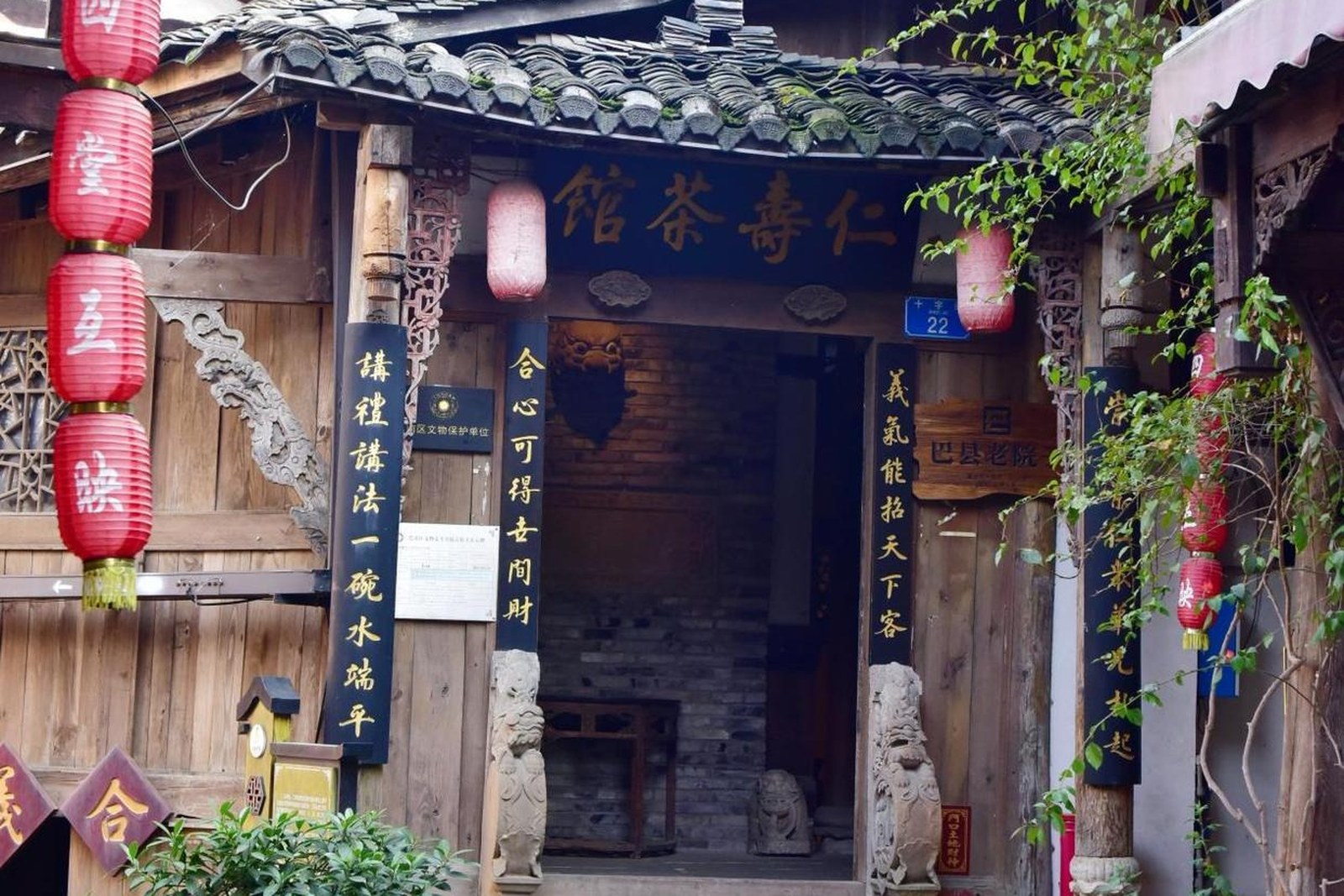
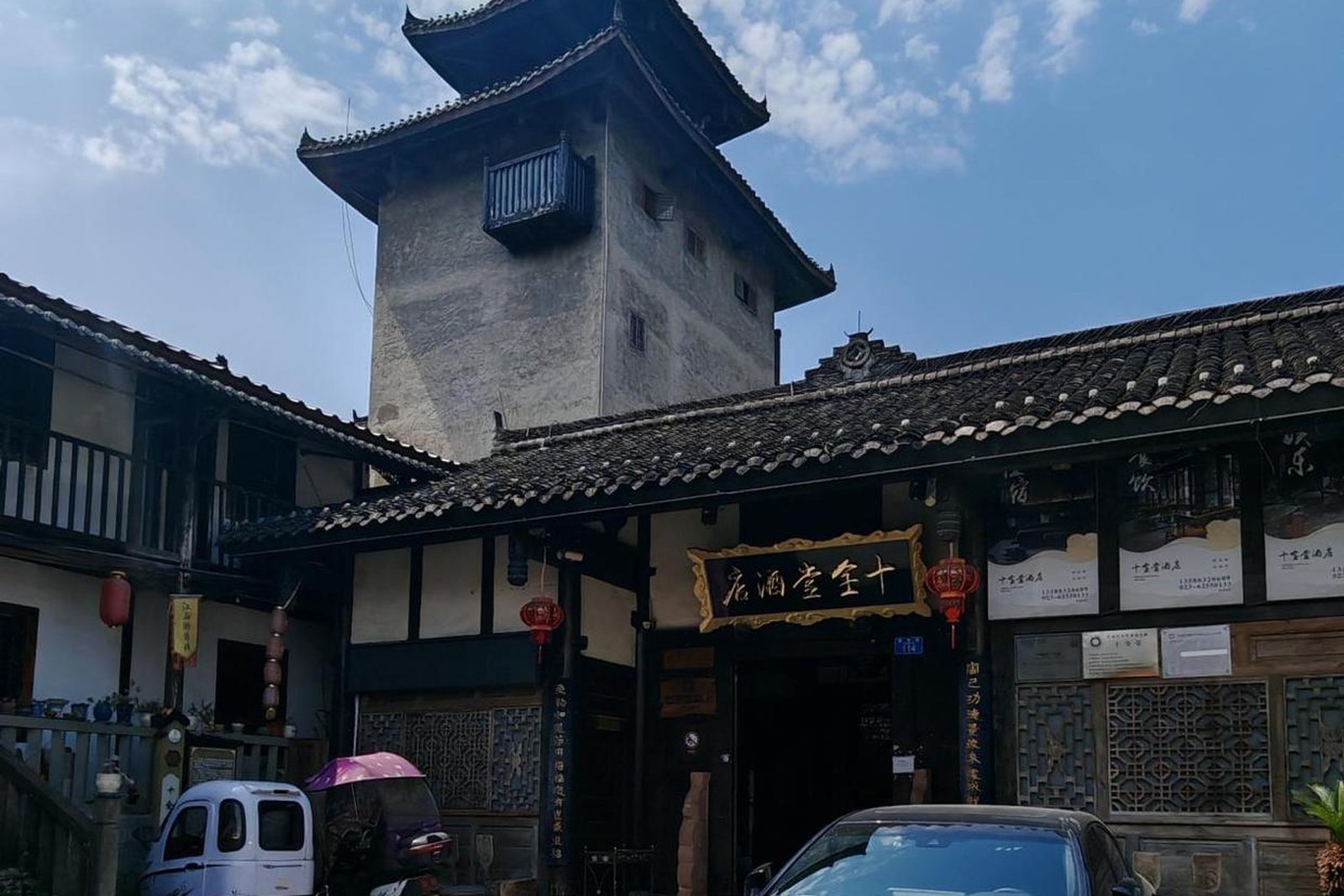
The town is laid out along three named streets – Fushou Street, Shizi Cross Street and Jiangxi Street – and the two sights worth walking to are the tallest and the smallest. 禹王宫, Yuwang Palace, is the Ming guild hall of the Hunan and Hubei natives, built with a hard gable, a fire wall and Huizhou proportions. A lane off Shizi Cross Street is about 20 metres long and 2.5 wide and was named Chongqing’s prettiest alley in 2011. 十全堂, Shiquantang, was built for the Liu family, Liu Zhushan among them, in the Republican period, with three entrances, three progressions and four courtyards, and it now takes guests into those courtyards. The largest single house is 大房子, the Big House, from the Xianfeng reign of the Qing: 12,000 square metres, laid out as one watchtower, two great courtyards and five open courts, and it still housed thirty households, about a hundred people.
Around the street grid the ground rises into a valley. 枫树湾, Maple Bay, is 13.33 hectares of naturally grown maple and the largest such stand near the main city; the Colorful Forest covers about 667 hectares with 200 hectares in its first phase. Three-Tides Spring, Xiangshui Lake at 515 metres above sea level in the trough valley, a twelve-stage waterfall and 紫云山, Ziyun Mountain, complete the list. The titles run in a tidy sequence: first batch of Chongqing historic towns in April 2002, a national historic town in December 2008, national AAAA in December 2016, and a national health town in 2017. Position is published as distance rather than as a route – 50 kilometres east of the central city, 70 kilometres from the Banan district seat at Longzhouwan, 10 kilometres from Mudong – with Dongwenquan beyond it to the south, Shuanghekou to the north and Fuling’s Zengfu Town across the eastern boundary, which is what a town on three county lines looks like on a map.
One discipline belongs with that, because it is easy to get wrong here. Several booking-platform posts quote prices for the watchtower group, for an underground cave called Chaoyin, for a Ziyun Mountain walk and for bamboo-weaving and indigo craft sessions. Those are user posts, not a published tariff, and this article names them as unverified rather than repeating them as prices you should budget for; the town has published nothing of the kind. What is published is simpler: no admission charge, and a booking platform listing the town as open all twenty-four hours, which is the arrangement that makes a late arrival straightforward.
Practicalities
Tickets. Nothing. The town itself charges no admission, and no source publishes a ticket for the town, for Yuwang Palace, for Shiquantang or for the watchtowers as a group. What you spend is fuel or a fare, and what you will find quoted online instead is a set of user-post prices – a watchtower pass, a cave descent, a guided mountain walk, a craft session – which belong to the people who posted them rather than to the town, so treat them as leads and not as a tariff. A national AAAA rating here is a quality designation, not a gate charge. If you are budgeting a day, the number that matters is the journey out and back.
Opening hours. The town has none, because it is not gated and does not close: the published description is open round the clock, every day of the year. What follows a clock instead is the light, since the streets, the alley and the valley walks are morning or late-afternoon things, while the shops keep their own hours. If you are combining this with the paid sites elsewhere in Banan, remember that the museums there do keep a clock and that most of them close on Mondays – which makes the town the useful half of a Monday here.
Closing day. None, and this is the one line in the article that carries no qualification at all: no source describes a weekly rest for Fengsheng, and a town that never closes cannot have one. The distinction worth keeping is between the town and the things people pay for inside it, because a craft session or a cave descent may keep its own hours and its own weekly rest without that touching the streets. The Monday closing days in Banan belong to the museums, the water post museum and the district museum among them, and none of them is here. Coming on a Monday costs you nothing here and everything in Longzhouwan.
Getting there. Fengsheng is published by distance rather than by route: 50 kilometres east of the central city, 70 kilometres from the Banan district seat at Longzhouwan, 10 kilometres from Mudong, with the town sitting where Banan, Fuling and Nanchuan meet. Its neighbours give the shape of the approach – Dongwenquan to the south, Shuanghekou to the north, Mudong to the west – and there is no rail station in the sources, so treat it as a road destination and give the town name rather than a single gate, since the streets run into each other (checked October 2026, subject to change).
flowcloud would say that Fengsheng is the one town in Banan that can be visited for nothing at any hour of any night, which makes it the rarest thing in a district full of ticketed sites – and that the honest warning is not about the road but about the price list, most of which is written by other travellers rather than by the town.
Getting there: 丰盛古镇, Fengsheng Ancient Town, lies in the north-east of 巴南区 Bā’nán Qū, Banan District, Chongqing, a municipality of southwest China, where Banan, 涪陵区 Fuling and 南川区 Nanchuan meet – rated a national AAAA site in December 2016, free to enter and open all twenty-four hours, with the oldest surviving structure from the Song, 26,900 square metres of historic building at 89 percent intact, fifteen watchtowers and eighteen forts, the Ming Hunan and Hubei guild hall 禹王宫, the Republican Shiquantang with three entrances and four courtyards, the Big House of the Xianfeng reign at 12,000 square metres laid out as one watchtower and five open courts, and a 20-metre lane named Chongqing’s prettiest alley in 2011. It was a Chongqing historic town in April 2002, a national one in December 2008 and a national health town in 2017, and sits 50 kilometres east of the central city, 70 kilometres from Longzhouwan and 10 kilometres from Mudong, with prices for the watchtowers, an underground cave, a mountain walk and craft sessions circulating only as user posts rather than as published rates (checked October 2026, subject to change).