
Foshan’s Ancestral Temple, Roofs Full of Ceramic Figures
Look up rather than in. 佛山祖庙 Fóshān Zǔmiào, the ancestral temple of Foshan, is famous among Chinese architects for its roofs, and the reason is a technique peculiar to the Pearl River delta: 石湾 Shíwān pottery, made a few kilometres away, was pressed into service as roof ornament, and the ridges of the halls carry dense processions of glazed ceramic figures, dragons, lions, immortals, opera scenes and whole narrative panels fired in colour and mounted above the tiles. From the courtyard the effect is almost too much, a line of figurines silhouetted against the sky along every ridge. It is also the clearest possible statement of what the town was: a place that made ceramics and iron, and that put both of them into its temple, including a courtyard full of cast-iron objects and a pair of iron pillars.
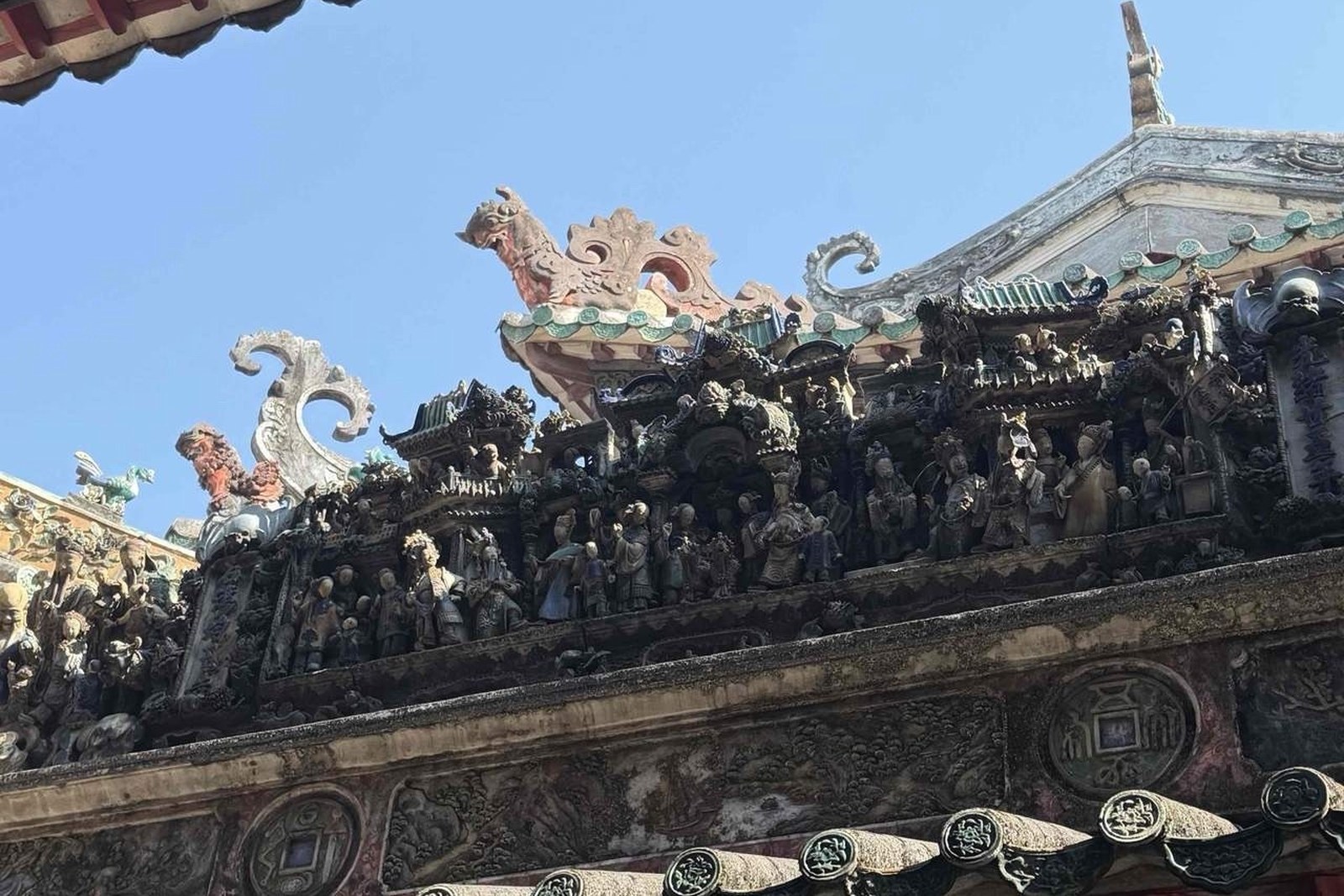
The temple is dedicated to 北帝 Běidì, the Northern Emperor, the god of water and the martial protector of the north, which in a river town meant protection from flood and from fire. It was founded in the eleventh century and rebuilt and extended repeatedly, most substantially in the Ming, and it has remained a working place of worship rather than becoming a museum, with incense, offerings and worshippers through the day. Around the halls are the objects that made it the social centre of the town as much as a religious one: a stone stage facing the main courtyard, where Cantonese opera was performed for the god, and a collection of iron and stone pieces donated by the guilds and the foundries. The whole complex is a compact statement of Foshan’s self-image, and it is worth an hour and a half rather than the twenty minutes a tour allows.
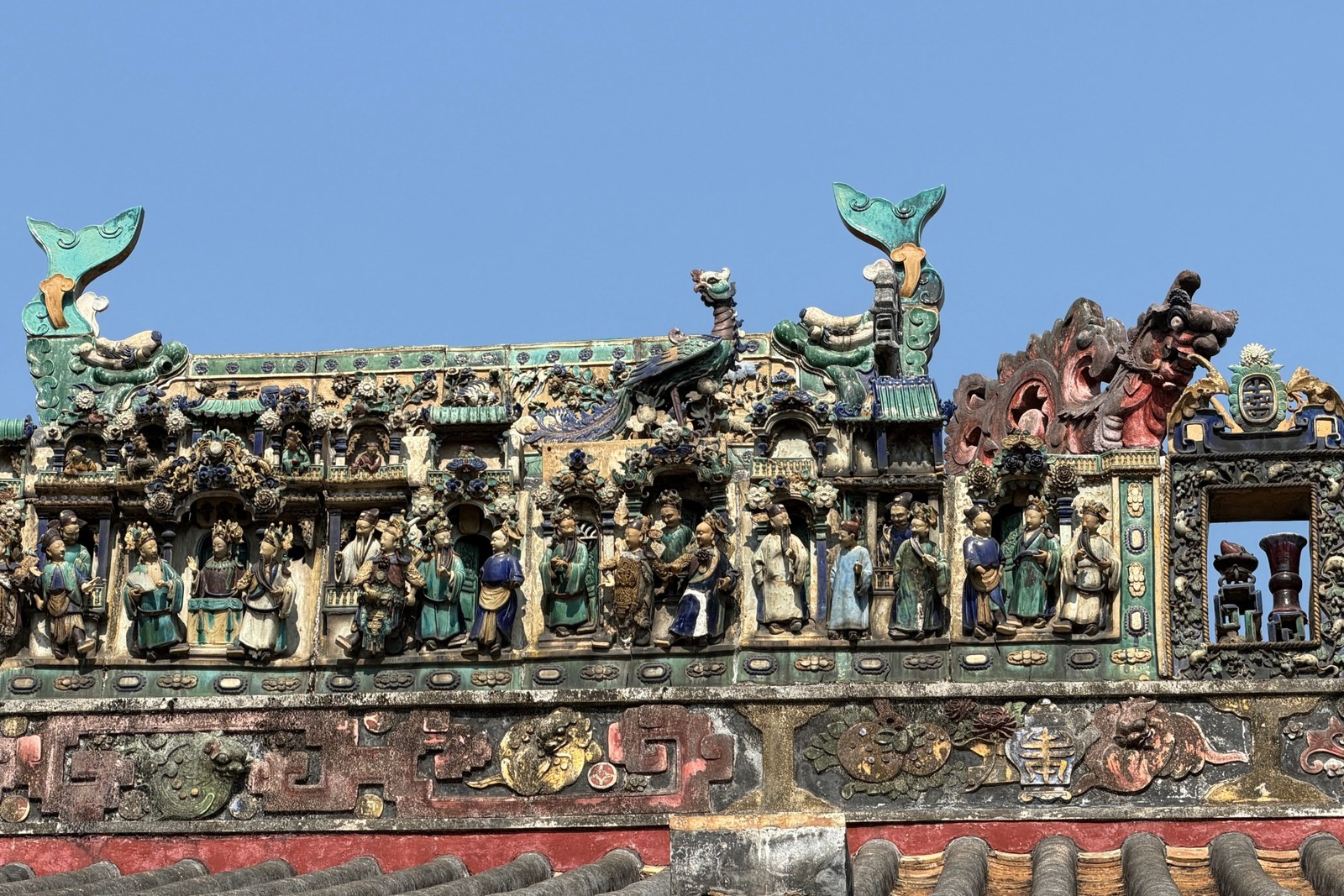
What You Actually See
The main axis runs through gate, courtyard, hall and inner hall, and the architecture is Lingnan throughout: deep eaves for the rain, timber frames, stone plinths and a plan built around shade. The glazed ridge figures are the thing to study, and they reward looking at from several angles, since the best panels are on the ridges of the side halls rather than the main one. The stone stage in the courtyard is a rare surviving example of a temple theatre and is worth a slow circuit. Inside, the temple holds a collection of local craft: 石湾 Shíwān ceramics, iron castings, wood carvings and 木版年画 mùbǎn niánhuà prints from the region, which together explain the trades the temple was built with.
The streets immediately around the temple are also part of the visit. To the west and north the 岭南天地 Lǐngnán Tiāndì redevelopment has restored a grid of old lanes and shophouses, and the older commercial streets beyond it still run markets and small workshops. Taken together the temple and the lanes fill half a day, and the remainder of the old core – 梁园 Liáng Yuán, the pottery quarter at 石湾 Shíwān – will fill another.
Practicalities
Tickets. Admission is around ¥20, with the usual reductions for students, children and the elderly and free entry for very young children. Prices are set locally and have moved over the years, so confirm at the gate. The iron and stone pieces in the courtyard and the craft collections inside are included in the ticket.
Opening hours. The temple is generally open from about 08:30 to 18:00, with last admission an hour or so before closing. It is an active temple and is busiest in the early morning, when worshippers come, and again in the afternoon. Daylight matters for the roof figures, which read best in the middle of the day.
Closing day. There is no fixed weekly closing day and the temple is open daily. It is extremely busy during 春节 Chūnjié, when the whole city seems to pass through it, and during the 国庆 Guóqìng week. Parts of the complex occasionally close for conservation work, so it is worth checking before a long trip.
Getting there. The temple is in the old core of 佛山 Fóshān, in 禅城 Chánchéng, immediately beside the 祖庙 Zǔmiào metro station on the 广佛线 Guǎngfó xiàn, the Guangzhou-Foshan line, which makes it the easiest major sight in the city to reach without a car. It is about twenty minutes by taxi from 佛山站 Fóshān Zhàn and around forty minutes by metro and taxi from 广州南站 Guǎngzhōu Nán Zhàn. There is very little parking in the lanes, so arriving by metro is much simpler than driving.
flowcloud would say that the ancestral temple is the only building in the city where the pottery trade got to write its own scripture, since the gods are guarded by dragons the town fired itself and the pillars are cast iron by local foundries.
Getting there: by metro, in the middle of the day, when the light is high and the ridge figures are readable from the courtyard. Walk the main axis once quickly and then go back and study the side halls and the ridges slowly, spend time on the stone stage, and finish in the lanes of 岭南天地 Lǐngnán Tiāndì rather than leaving straight from the gate, because the quarter around the temple is part of the same visit.