
Furong Town
You hear it before you see it. Walking down the stone street you are aware of a low continuous roar on your left that has been getting louder for ten minutes, and then the lane turns and the ground opens and there is a river falling sixty metres off a cliff straight through the middle of the town, with wooden houses on stilts standing on both sides of it at different heights, and a path cut into the rock that goes behind the water. There is no other old town in China that does this. There are prettier ones, better preserved ones, more famous ones. None of them has a waterfall coming out of the middle of it.
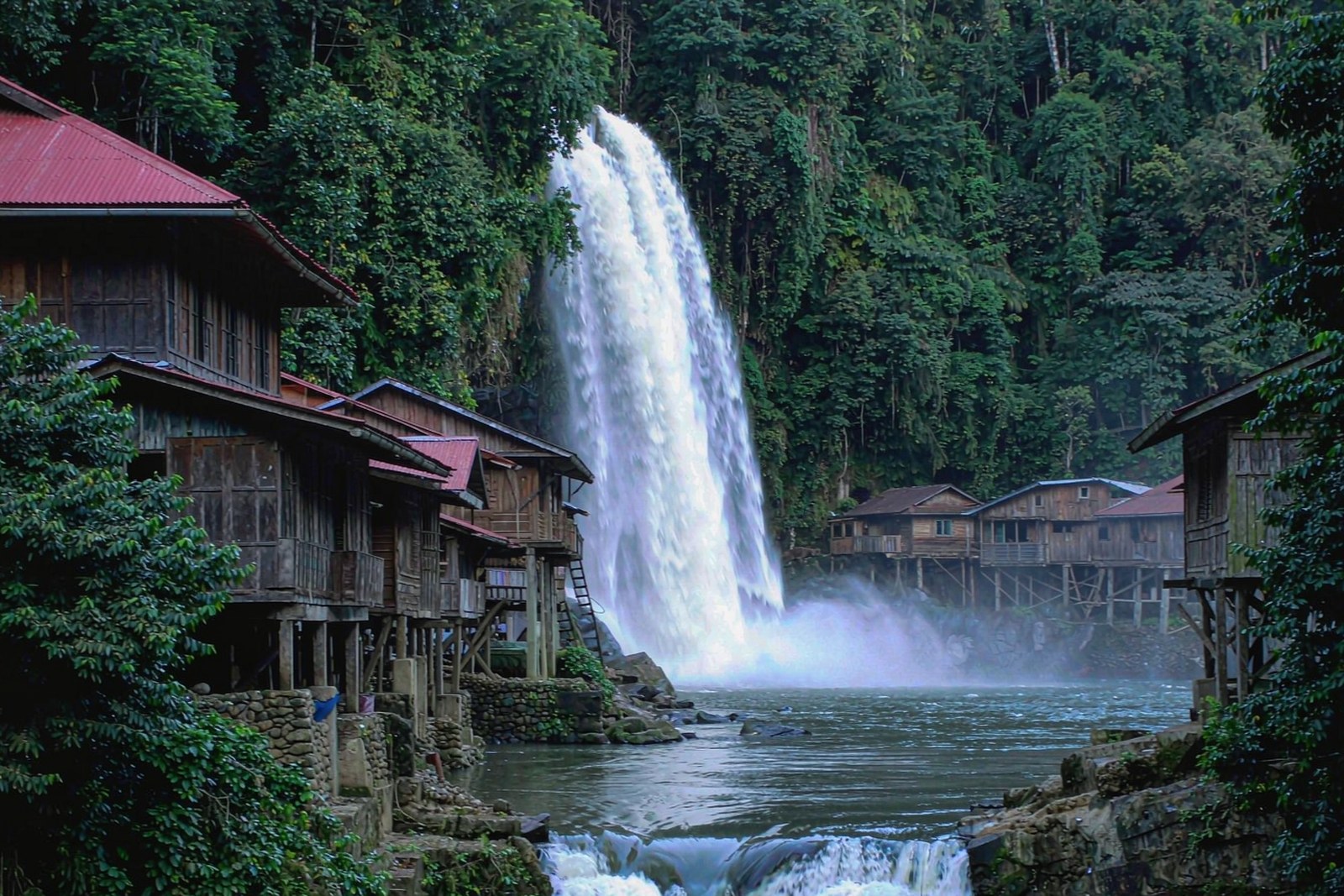
芙蓉镇 (Fúróng Zhèn) — Furong Town — is in 永顺县, inside 湘西土家族苗族自治州 in western Hunan, on the 酉水 river, the Tujia people’s “mother river”. It was called 王村 for most of its history: a river port on the trade route between the interior and the Dongting basin, prosperous, and by the twentieth century a small town of stone lanes and stilt houses hanging over the water. In 1986 谢晋 shot a film here — 《芙蓉镇》, with 刘晓庆 and 姜文 — and the film was so thoroughly identified with the place that the place eventually took its name. The old name is still on the signage of the railway station’s predecessor and in the mouths of older people.
The reason for the waterfall is the geology. The 酉水 cuts a gorge here and the town is built on a shelf beside it, with a tributary stream running through the settlement and dropping off the shelf edge into the river below. The 土家族 (Tǔjiāzú), the local minority people, built on both banks and both levels: the upper town with the streets, the lower town with the mills and the boat jetties, and the water going over the edge in the middle of all of it.
The Streets and What Is on Them
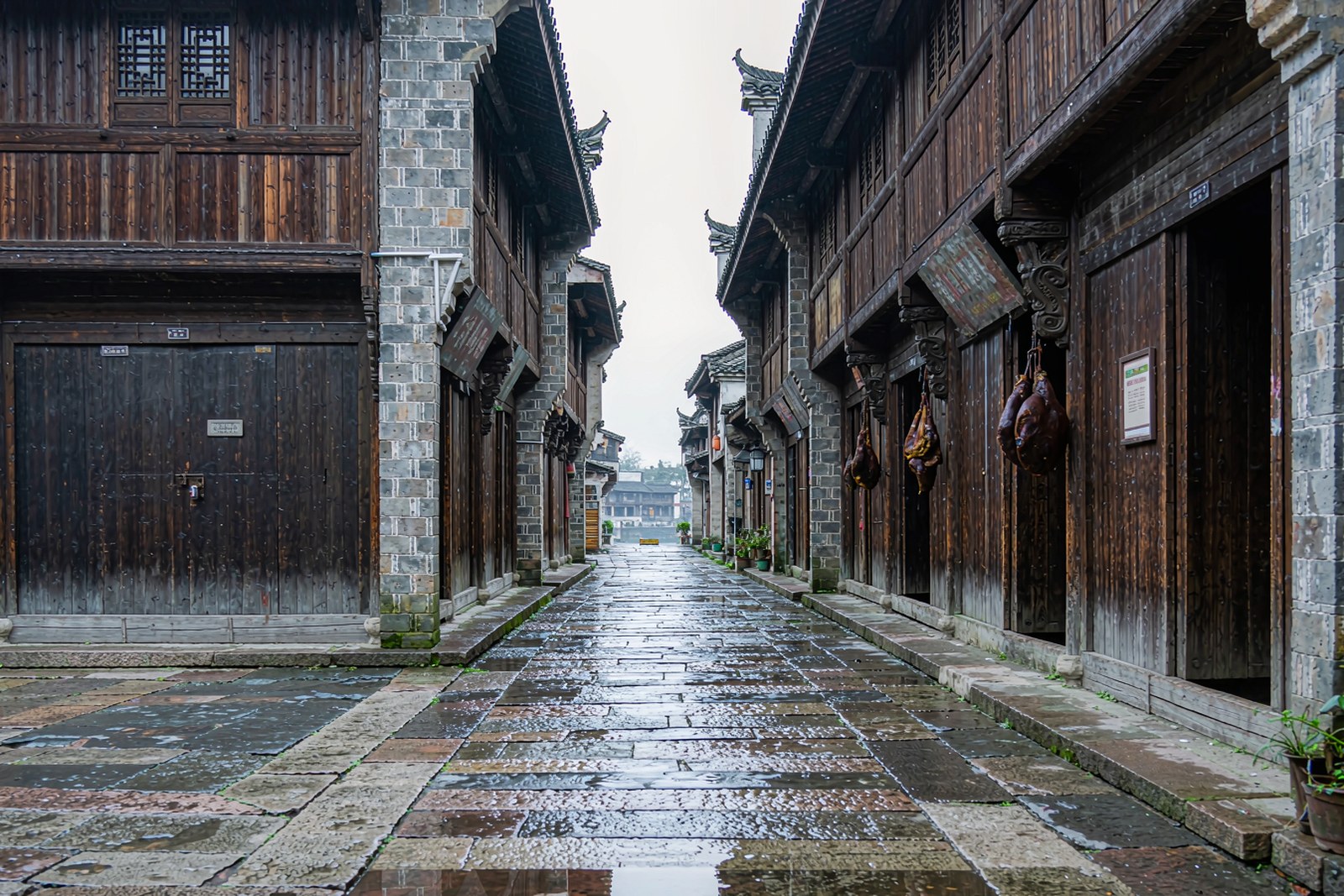
五里石板街 — five li of stone slabs, so about two and a half kilometres, running the length of the town. It is polished by a few centuries of feet to a dull shine, and it is the spine of everything: tea shops, 米豆腐 stalls, cured-meat shops with whole hams hanging in the doorway, and the occasional house with a carved Tujia balcony that makes you stop.
土王行宫 — the Tujia chieftain’s palace, on the cliff above the falls, largely reconstructed from old photographs and records, with a theatre, a council hall and a view down onto the water. It is the best position in the town for photographing the waterfall in the evening. The chieftains here ruled the 溪州 region as hereditary lords, relatively independent of the Chinese state, from the tenth century until the 清 dynasty reforms of the eighteenth.
溪州铜柱 — the bronze pillar, in the 溪州铜柱园. Cast in 940 AD to record the peace agreement between the Chu ruler 马希范 and the Xizhou chieftain 彭士愁, it is one of the most important surviving documents of China’s frontier history, and it lives in the eaves of a wooden building rather than behind glass. You have to look up. It is a national treasure sitting under a roof in a village in western Hunan.
摆手堂 — the Baishou Hall, where the Tujia 摆手舞 (bǎishǒuwǔ), the hand-waving dance, is still performed. If there is a performance on while you are there, it is worth the twenty minutes; the drumming carries.
酉水画廊 — the boat trip upstream from the town jetty, through karst hills and past Tujia fishing villages. It is described as a gallery and for once the description is accurate, which is the only reason to take a boat trip anywhere.
土王桥 across the stream, the 观瀑台 above the falls, and 水帘古栈道, the walkway behind the curtain of water. Do this last, and do it in a raincoat.
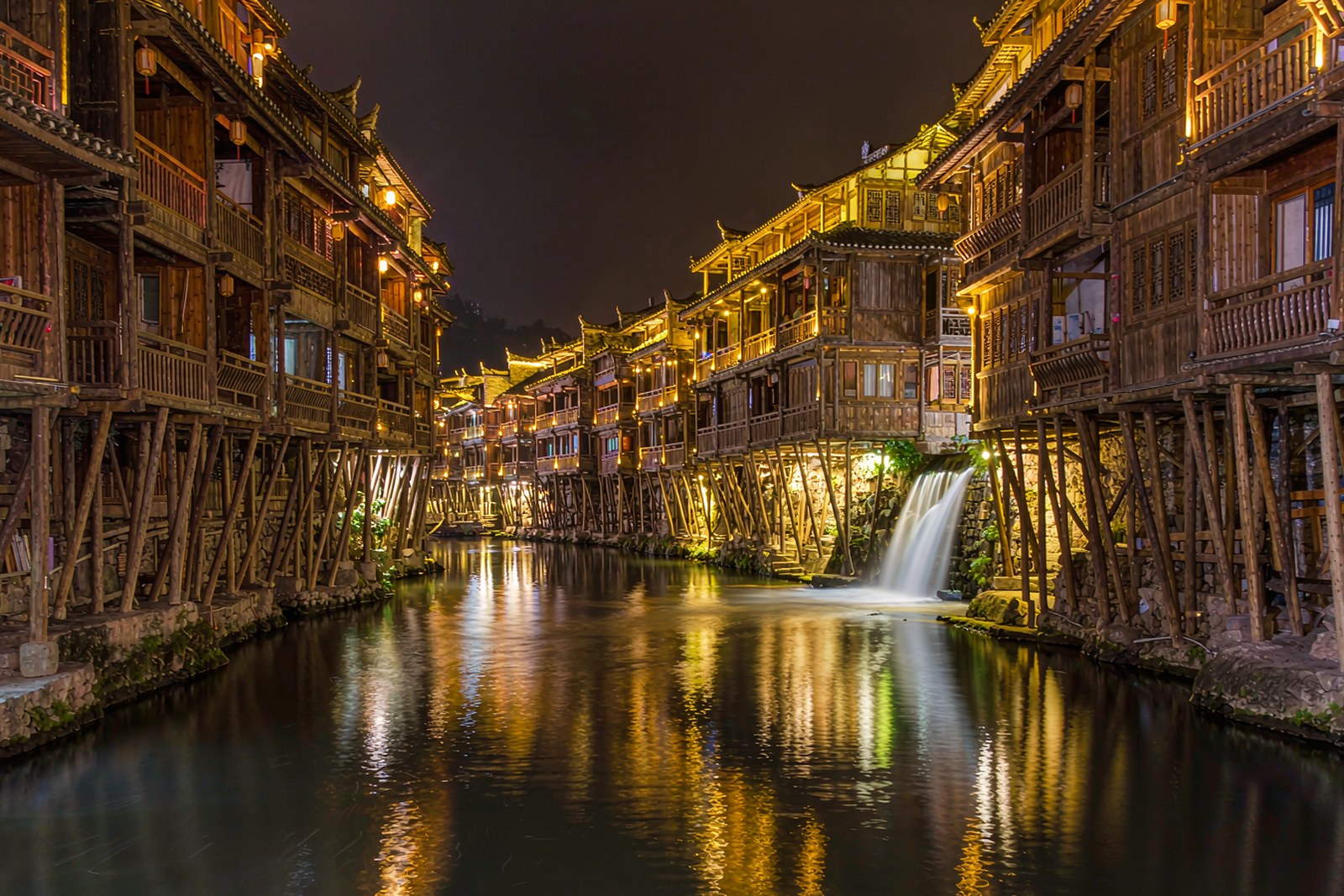
The Night, Which Is the Actual Attraction
Most Chinese old towns are better at night and this one is much better. From about 19:30 the floodlights come on and the water turns gold and green as it falls, the stone street takes the light from the shopfronts, and the whole town appears to be floating slightly above the river. The best hour is 19:30 to 21:00, and the best thing to do with it is to walk the length of the stone street once, slowly, and then go and stand on the 观瀑台 and stay there.
Practicalities
Tickets. Adult ¥108 at the gate, and this is one of the odd ones, because the channels disagree with each other. Booked online in advance it is commonly ¥98–100, and third-party platforms list packages from around ¥80; some sources describe the ¥108 as including the internal shuttle bus, others list it bare. Plan for ¥100–108 and treat anything cheaper as a platform discount. Half price at ¥54 for students and for visitors aged 60 to 64; free for children under 14, visitors over 65, serving military and disabled visitors, on production of ID at the ticket office.
The important line is this: the ticket is valid for three days from first use, with unlimited re-entry, and it scans against your ID card. With a three-day ticket and a town this small, the sensible plan is to arrive in the afternoon, go in for the evening, sleep, and go back in the morning for the parts you missed.
Do you need to book? Not for entry — you can buy at the gate. Book online if you want the discount, and if you are coming over Spring Festival, May Day or National Day, book a room first and the ticket second, because the guesthouses fill weeks ahead.
Opening hours. The site runs from 08:00 until around midnight, which is unusually generous and is a direct consequence of the place being worth more after dark. The lighting comes on at about 19:30. Most people do the day shift and leave before dinner; the argument for staying overnight is entirely about the two hours after it.
Closing day. There is no closing day. It is open every day of the year, and the winter version is worth seeing — the waterfall runs thinner in January but the town is empty and the light on wet stone is better than any photograph taken in July.
Getting there. This is where the 张吉怀 (Zhāng-Jí-Huái) high-speed railway changed everything.
- By high-speed rail: the line has a station at 芙蓉镇 (Fúróng Zhèn) of its own. From 张家界西 it is 73 km and 23 minutes, second class ¥40. From 凤凰古城 it is about 40 minutes and ¥40. From 怀化南 roughly an hour. From the station it is a short taxi or shuttle ride to the old town — check the last service of the evening if you are arriving late, and if your guesthouse offers a pickup, take it.
- By road: the old route from Zhangjiajie winds through the mountains with tunnels and hairpins, and takes a good deal longer than the train. Take the train.
- Onward: 张家界西 is about 20 minutes away, 吉首东 around 45, 凤凰古城 under an hour. The natural two-day pairing is Zhangjiajie, then here, then Fenghuang.
What to eat. 刘晓庆米豆腐, the film’s dish — 米豆腐 is a rice-flour jelly, closer to a savoury 凉粉 than to tofu, served with a sweet, salty or chilli dressing, and the salty version is the local one. You will pass a hundred shops using the name; the one that matters is at 113号, by the 贞节牌坊, because that address is the film location. Cheap, a few yuan a bowl. Then 土家腊肉, smoked cured pork, which is the backbone of every proper meal here, and 蒿子粑粑, mugwort rice cakes with cured-pork dice inside, made only in spring.
What to bring. A raincoat, not an umbrella — the 穿瀑步道 puts you inside the spray, and an umbrella will simply be inverted. Grippy shoes, because the stone slabs are polished and the walkway behind the falls is permanently wet. A backpack rather than a wheeled case, because there are a lot of steps and you will hate your suitcase. A light layer for the evening, as the valley cools fast.
Nearby, if you have another day. 红石林国家地质公园, twenty to thirty minutes away, is red karst formed from a seabed five hundred million years old and sells a combined ticket with the town at about ¥180. 坐龙峡, ten minutes away, is a narrow gorge marketed as the finest in south-central China, and it is a scramble rather than a walk. 凤凰古城 is forty minutes by rail.
Getting there: 芙蓉镇 (Fúróng Zhèn, Furong Town), 永顺县, 湘西土家族苗族自治州, Hunan — formerly 王村, the old river town on the 酉水 with a 60-metre waterfall running through its centre. Tickets ¥108 at the gate, about ¥98–100 booked online, from roughly ¥80 on third-party platforms; half price ¥54 for students and 60–64s; free for under-14s, over-65s, military and disabled visitors. The ticket is valid three days with unlimited re-entry. Open 08:00 until about midnight every day with no closing day; the floodlights come on around 19:30 and the best hour is 19:30–21:00. Reached by the 张吉怀 high-speed railway to 芙蓉镇站 — 23 minutes and ¥40 from 张家界西, about 40 minutes from 凤凰古城 — then a short taxi to the town. Walk 五里石板街, climb to 土王行宫 above the falls, look up at the 溪州铜柱, take the 酉水 gallery boat, and eat 米豆腐 at 113号 by the 贞节牌坊. Bring a raincoat and grippy shoes.
We are still eating our way through Furong Town. Guides are on the way.