
The village is shaped like a chair — three sides of mountain and a river along the fourth, which is why it is called 高椅 Gāoyǐ, the high chair — and it is laid out inside that shape as a five-petalled plum blossom, with 104 buildings from between 1380 and 1881 arranged in five clusters around a temple, connected by lanes that double back on themselves until outsiders cannot tell which way they came in. 高椅古村 Gāoyǐ Gǔcūn is the best-preserved Ming and Qing village in western Hunan, it is still lived in by 594 households of whom about 85 per cent are surnamed 杨 Yáng, and it is quiet enough that in the middle of a weekday afternoon you may see nobody at all.
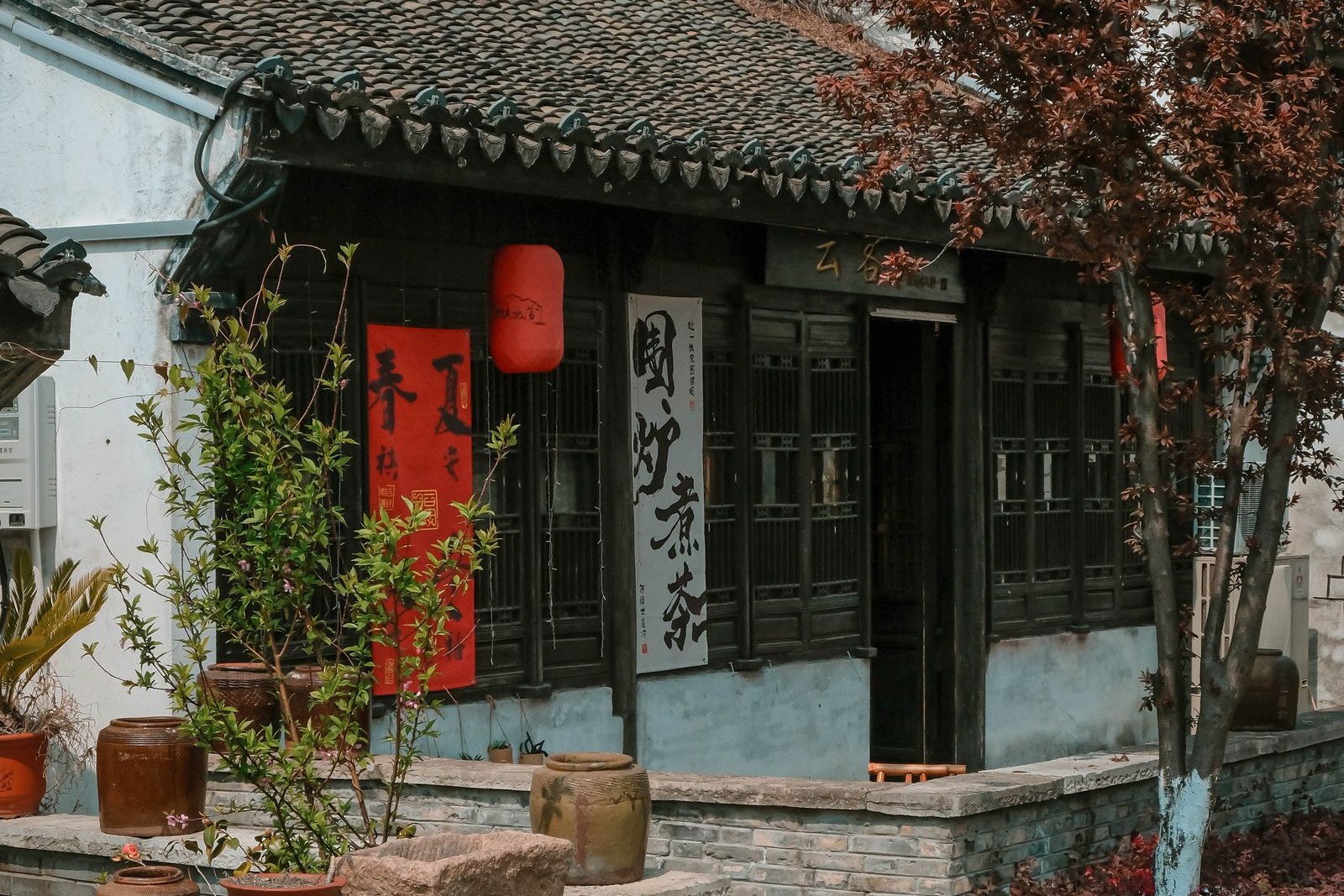
The Yangs claim descent from 杨再思 Yáng Zàisī, a chieftain of the late Tang given the title 威远侯 Wēiyuǎn Hóu, who held this border country for the collapsing dynasty. Their ancestor 杨盛隆 Yáng Shènglóng is traced further back to 杨震 Yáng Zhèn, the Han official known as 关西夫子 Guānxī Fūzǐ, “the Master of the West of the Pass”, for his refusal to take bribes; and that lineage is written on the village: above many doors are the words 关西门第 Guānxī Méndì, the house of Guānxī, and 清白家声 Qīngbái Jiāshēng, a reputation for honesty. The family’s other motto is 耕读传家 gēngdú chuánjiā — farm and study, hand it down — and this is a village of 五通庙 Wǔtōng Miào at the centre and a 醉月楼 Zuìyuè Lóu, a moon-viewing pavilion, at the literary end of things.
The architecture is genuinely unusual, and the surprise is that it is a hybrid. These are Dong-style timber houses — 穿斗式 chuāndòushì, a frame of tenoned posts and beams — but each one is wrapped in 马头墙 mǎtóuqiáng, the stepped brick gables of Jiangnan merchant architecture in Anhui and Jiangsu. The walls rise above the roofline and enclose the courtyard; the only openings below the first floor are small. This is a firebreak that works: the village has, by local record, never had a fire spread from one house to another, and the 火砖 huǒzhuān at the base of each wall is stamped with the year it was built, which is how the building history has been dated. Underfoot, the foundations are cut stone raised 60 centimetres off the ground over a drainage system that still functions, which is why the timber has lasted six hundred years. The drainage is worth seeing on its own: 48 fields, 48 wells and 48 ponds were laid out with it, and the pair of ponds called 红黑鱼塘 hónghēi yútáng — one red, one black, dug at the end of the 嘉庆 period — are both fishponds and cisterns, connected to the system and still in use.
Practicalities
Tickets. The village is a ticketed 景区; expect around ¥50–70. There is a car park and a visitor centre below the village, and the walk up into it takes about ten minutes.
Opening hours. Roughly 08:00–17:30. The village remains inhabited and you can walk the lanes outside those hours, but the interpretation and the indoor houses close.
Closing day. Open every day; quietest on weekday mornings.
Getting there. 会同站 Huìtóng Zhàn on the 焦柳 line is about forty minutes by road; 怀化南站 Huáihuà Nán Zhàn is about two hours. Buses from 会同县 Huìtóng Xiàn towards 高椅 Gāoyǐ drop you at the village entrance. Parking is limited and the last stretch is a narrow hill road.
What to Look For
The 铭砖 míngzhuān, dated bricks. At the base of each fire wall. The sequence from 1380 to 1881 is the village’s own archive and it is not reconstructed.
The 排水系统 páishuǐ xìtǒng. Ask where the lanes drain. The whole settlement is a hydraulic design as much as an architectural one, and it is the reason the buildings are still standing.
The 醉月楼 Zuìyuè Lóu and the 月光楼 Yuèguāng Lóu. Two buildings associated with the village’s poetry society; in the right conditions moonlight comes down through the lanes and lands on the stone floor, which is what they were built for.
The inscribed doors. 关西门第 Guānxī Méndì, 清白家声 Qīngbái Jiāshēng, 耕读传家 gēngdú chuánjiā. Of all the things in the village these are the ones that most plainly say who lived here and what they thought they were doing.
Getting Around
Walk it slowly, for two hours, in the morning or late afternoon. Do not skip the 观景台 guānjǐngtái, the viewpoint on the hillside above, before you enter: the plum-blossom layout and the chair-shaped site are only visible from there, and the difference between the plan and the experience of being in the lanes is the whole point of the place. Bring cash; the village shops and the homestays do not reliably take cards, and there is no restaurant as such — you eat with a family or you eat in 会同 Huìtóng. Combine it with 黔阳古城 Qiányáng Gǔchéng and 洪江古商城 Hóngjiāng Gǔshāngchéng on the same loop, all three within two hours of each other.
flowcloud would say that the most impressive engineering in a six-hundred-year-old village is always the boring part — the drains — and that a family which put a date stamp on every fire wall and the words “honest reputation” over every door was building a house for an audience of its own descendants, which is a longer view than most building budgets allow.
Getting there: 高椅古村 (Gāoyǐ Gǔcūn), 高椅乡 (Gāoyǐ Xiāng), 会同县 (Huìtóng Xiàn), 怀化市 (Huáihuàshì), 湖南 (Húnán). Tickets around ¥50–70; open roughly 08:00–17:30 daily. About forty minutes by road from 会同站 (Huìtóng Zhàn), about two hours from 怀化南站 (Huáihuà Nán Zhàn). Climb the viewpoint first, look for the dated bricks at the base of the walls, bring cash, and eat with a family rather than looking for a restaurant.