
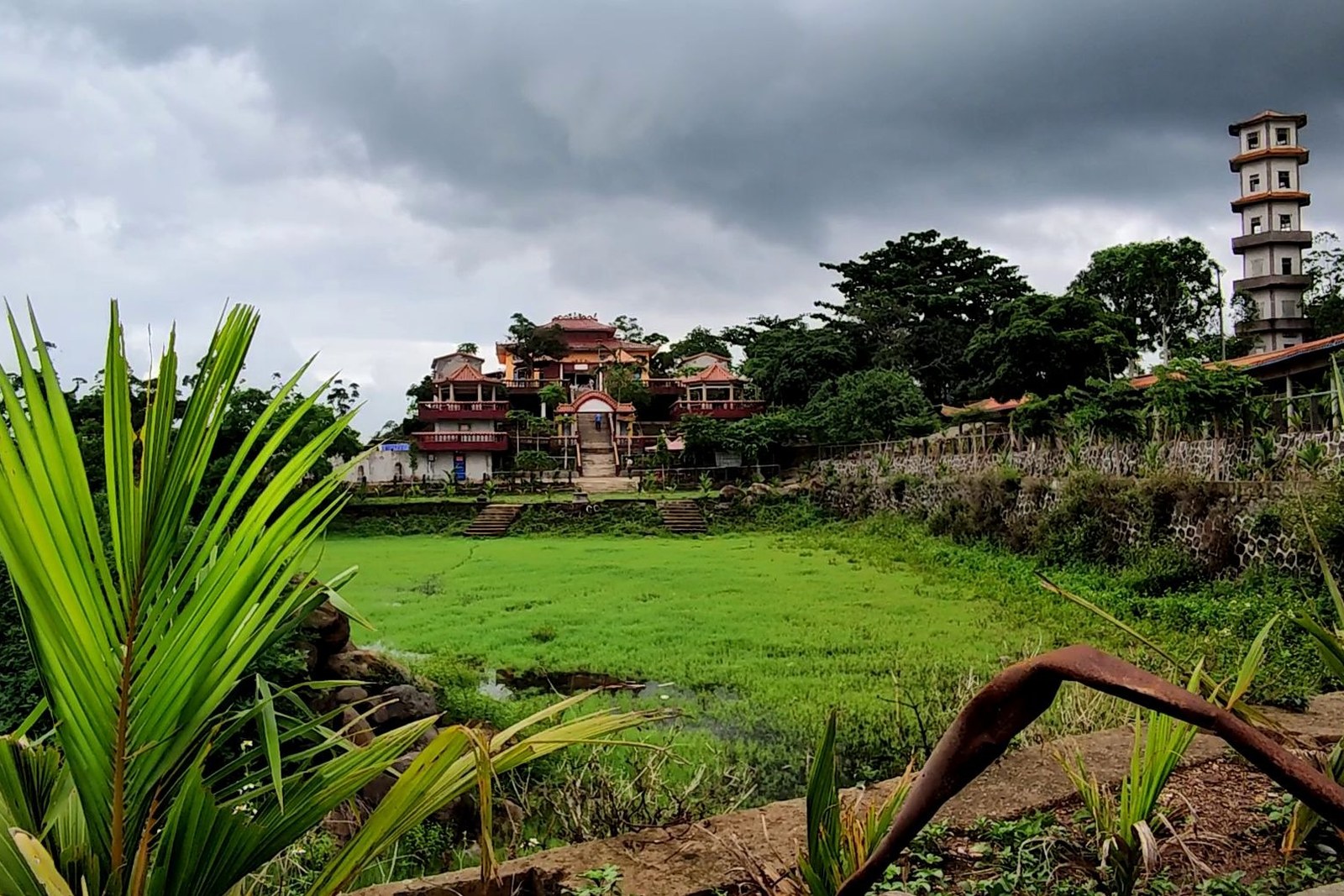
On a coastal plain as flat as Lingao’s, a hill of any size looks like an accident, and Gaoshan Ridge Gāo shān lǐng is a large one. It rises 193 metres out of the level ground three and a half to four kilometres northwest of the county town, though the national encyclopaedia entry carries a parenthetical 191 metres in the same article, which makes it the highest point for a long way in every direction and, on a clear morning, the best balcony in northern Hainan. The sources disagree about which township owns it, giving Lincheng in most places and Dongying in one, so the useful fact is simply the distance: 3.6 to 4 km out of town, on the left. Its old name is more interesting than its new one. Gaoshan Ridge was 毗耶山 Pí yē shān, sometimes written with the neighbouring character for evil, and that name reaches back further than the county itself. The Kangxi-era gazetteer of Lingao records that when the Sui dynasty established a county below this hill in the Kaihuang period, the county took its name, 毗善 Pí shàn, from the mountain, which puts the hill in the founding paperwork of local government in the sixth century. An earlier geographical compendium, the Taiping Huanyu Ji Tài píng huán yǔ jì of the Song, offers a stranger explanation for the name: there is a creature on the summit that looks like a crawling insect, and the Li people of the coast called such things 毗邪. Whichever etymology you prefer, this is a hill whose name has been argued about for a thousand years, and there is a second argument waiting at the top of it. Three shallow lakes sit in its folds, all of them products of the same volcanic activity that raised the hill, and all of them said never to dry out: Thousand Mirror Lake Qiān jìng hú, Weng’ang Lake Wēng áng hú and Turtle Dove Pool Bān jiū chí. The old provincial gazetteer lists only two of them and spells the first with a different character, which is the kind of detail that tells you how lightly these places have been surveyed. Around the water the hill is rocky, thickly wooded and full of animals: mountain turtles, pangolins, frogs, lizards, barking deer, civets, hares, ground birds, doves, owls, partridges and snakes. A figure of 95 per cent forest cover circulates in the encyclopaedia entries and appears nowhere official, so it is safer to say the ridge is close to completely covered and leave the number alone.
The boulder is what people actually come for. The story, as the county’s own material tells it, begins in the Han dynasty with a family named Wang who moved here from Qingzhou in the north, and with a hunter named Wang Qi Wáng Qí who sat down on a large flat rock and, according to the legend, was swallowed by it. His companion Wang Jujie hacked at the stone with a knife, and a voice came out of the rock: I am the great spirit Piyie, it said, and I live inside this stone; from now on you may worship me with the three sacrificial offerings of ox, sheep and pig. The boulder became the Piyie Spirit Stone Pí yē líng shí, the hunter was honoured as the great spirit in it, and the countryside, in the phrasing every retelling uses, enjoyed full granaries, thriving livestock, growing families and peace. Near the shrine there is a worn old stele that tradition says was cut by an Indian Brahmanical master named Piyie who came here in the Han dynasty, and the sources cannot even agree on how to write its name, giving two different orders for the same two characters. This is the point at which the visitor should slow down. There is no scholarly consensus that the stone is a Han artefact, and the most persuasive field account of the hill describes standing in front of it and concluding that it looks like a later copy of a much later notion; other writers have taken the step further and suggested the ridge may be one of the early points at which Buddhism came into China from the south by sea, which is a hypothesis and not a fact. What is certainly true is that the name of the place is Buddhist vocabulary, that a Daoist god and a Daoist priest ended up in charge of it, and that village worshippers have been coming with offerings for a very long time. A visitor walking the hill in search of the stone once found it not at a shrine but beside a pond, four characters cut into a few loose blocks on the bank. That is probably the most honest image of the place: a sacred site that has been rebuilt, renamed and re-explained so many times that its holiest object can end up sitting by the water.
The temple on the hill has two birth certificates, and both are usually printed as if the other did not exist. One line of sources, drawing on the Ming geographical records, says that Lingao’s earliest Daoist abbey, the Everlasting Flourishing Abbey Yǒng xīng guān, was founded on this hill in the Yuanfeng period of the Song, between 1078 and 1085, which would make the hill’s religious history a hundred and fifty years older than the temple’s. The other says the temple was built in 1314, the first year of Yanyou in the Yuan, to sacrifice to the great spirit of the mountain. The two are easy enough to reconcile once you notice that they describe different buildings doing different jobs, and a visitor who accepts both gets a better story: an abbey first, a spirit hall second, and the two merging in the local memory. The rest of the timeline reads well as a single sentence of Chinese provincial history. In 1370, the third year of Hongwu, the Ming court enfeoffed the god with a title, a rank of marquis, and the sources spell the second character of that title two different ways, so it is safest to give it as Written Response Marquis, noting the variant. In 1614 the magistrate Zhang Hongyi built an official pavilion at the foot of the hill. In 1677 a monk named Dongming raised money and moved the shrine to stand beside the god it served. In 1830 the magistrate Dong Fan repaired the whole thing, adding a pavilion in front and side halls on either flank, and settled it on the hill. The buildings standing today are later work by local people. The final renaming came in the autumn of 2003, when a Daoist priest ordained at Laoshan in Shandong, invited to the province by the religious affairs office, examined the shrine, ruled that it belonged to the Daoist tradition, and changed the temple’s name from Gaoshan God Temple to Gaoshan God Palace Gāo shān shén gōng. Buddhist name, Daoist institution, imperial title, village offerings: this hill is a layer cake, and every layer is still visible.
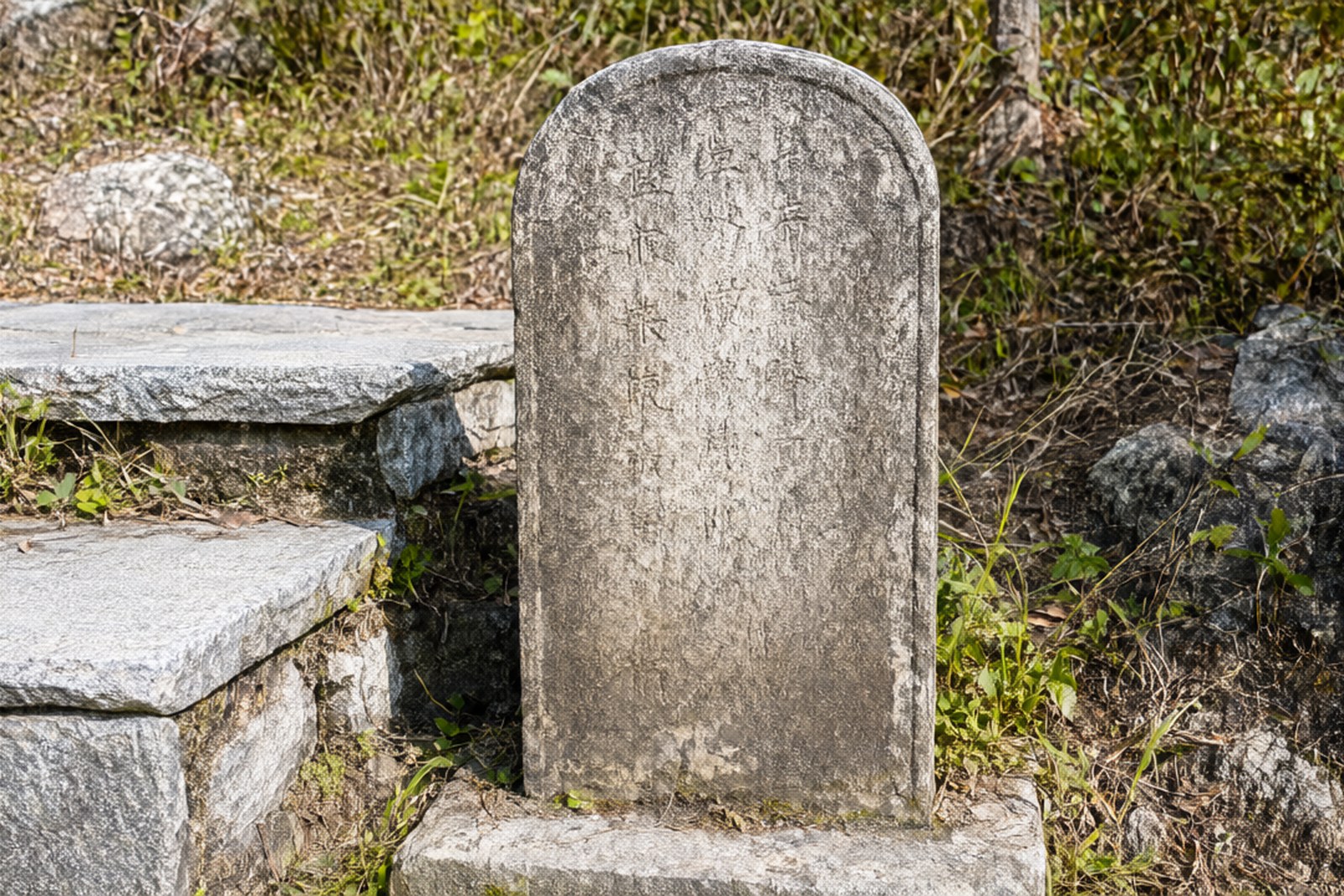
The literary record here is unusually good because the hill kept attracting officials who wrote well. Fan Peng Fàn Pēng, one of the four great poets of the Yuan and an inspector on the Hainan circuit, composed an account of praying for rain at the shrine and getting it, in which he asked what use the famous peaks were compared with a hill that had a god who answered, and what use the talking stones of legend were compared with a stone this responsive. Wang Zuo Wáng Zuǒ, the Ming poet from the same county whose shadow falls across every historical site in Lingao, wrote about the spirit in his notes on his home district and left two poems, one of which ends on the trouble of looking north towards a distant court. The Kangxi-era magistrate Fan Shu composed a sacrifice text at the mountain, beginning with the plain statement that the hill has existed since the world was divided and the god’s power has protected the county and kept its people safe. In 1812 a visitor from Zhejiang named Pan Shixian wrote a couplet for the hall that still reads as a small joke at the expense of everyone who has ever governed here: whoever rules this district well is a good official, and sea and mountain alike will share the blessing; whoever governs it honestly will find that every blade of grass and every tree belongs to him. The most quoted lines are the most recent. In 1962 the playwright Tian Han Tián Hàn, in Lingao for other reasons, climbed the hill and wrote eight lines on the view, the empty temple and the grass growing on its steps, the strange clouds over the gulf, the spray off the cape, and the soldiers who crossed the water in 1950 and the difficulty of building something and then holding on to it. A stele inside the temple, recording the establishment of the god, is one more piece of the same paper trail.
What the hill gives you that no document can is the frame at the top. To the north the water of the Beibu Gulf breaks in long lines with the fishing sails scattered on it; to the east the Wenlan River runs past the county town like a strip of white cloth laid across the plain; to the west the harbour at Xinying is bright with moving traffic; and directly below, the villages sit in their fields in a grid of roofs and paths that stretches to the horizon without a rise in it anywhere. Locals call the effect three views in one frame, and it is the reason the hill is one of the eight classical sights of the county. On a normal day, according to people who go up often, the temple has a steady queue of worshippers drawing lots and asking questions, families arriving with incense even in cold weather, which is worth knowing before you assume this is a museum piece. The top of the ridge carries a viewing structure of some kind, and here the sources part company again: one describes a six-storey forestry lookout tower, another describes two viewing platforms and a pagoda-like tower, and no single authority resolves whether these are one building or three. Take the view and leave the inventory. Below the hill, at Duoxian village in Bolian town, is the former headquarters of the west-line liaison command, where Han Xianchu came inland from the landing at the cape on the evening of 17 April 1950 to redeploy the 40th Army and the Qiongya Column together, which is why the hill appears in the military history of the island as well as its poetry.
Practicalities
Tickets. There is no charge. Sources that list a price for the hill all list it as free, and there is no gate, no ticket window and no booking system. The hill is also a provincial nature reserve, which is the reason nothing commercial has been built on the summit, and it is worth remembering that the reserve status is not decoration: the county has been pushing since 2021 to thin out the eucalyptus and replant with a mix of native species, so the woodland you walk through is being actively managed.
Opening hours. Travel platforms list the hill as open all day, all year, with the caveat that they add themselves, which is that the actual state of opening depends on the day. No official announcement of hours exists, and there is nothing to open or close in the ordinary sense: the road up, the paths and the viewpoints are simply there. The temple buildings have their own opening practice set by the people who keep them, and worshippers are usually about early. Walking up is best in the first two or three hours of daylight, before the heat builds on a bare ridge with little shade, and the light for photography is best in the late afternoon when the river below catches the sun.
Closing day. No closing day is reported for the hill, the road or the viewpoints, and there is no weekly rest day anywhere in the sources. The shrine follows the practice of the people who tend it rather than a published timetable, so if the temple itself is the reason for your visit, go early in the day and on a date that is not a major festival, when the courtyard will be full of people making offerings.
Getting there. There is no documented bus route and no official transport notice for the hill, which leaves two practical options. Long-distance coaches run from Haikou to Lingao and the local encyclopaedia entry notes that motorcycle taxis in town will take visitors out to the hill, which is fine for the trip up. The better plan is a self-drive or a hired car, since the hill is only four kilometres from town and visitors report that the road runs all the way to the top, so the walking is optional and the view is not. Cycling out and walking up is also entirely reasonable, since the whole round trip from the county town is under ten kilometres. There is no published information on parking, on a cable car or on any reservation service, because none of them exists, and no telephone number for the site is published either.
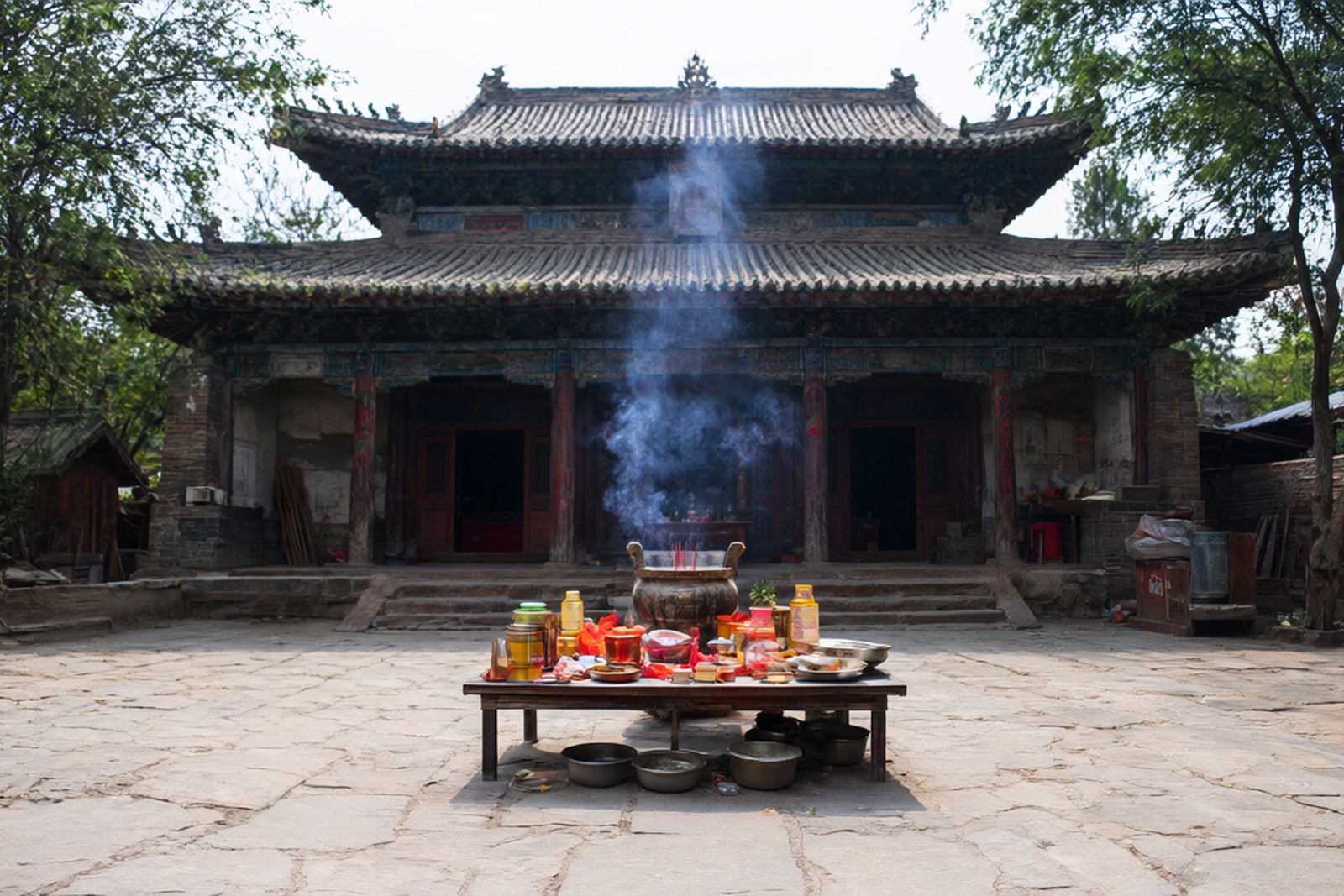
Go up in the late afternoon with an hour to spare and this is what you get: a volcanic hill on a plain, three small lakes that fill from the rock, a stone that is supposed to have eaten a hunter and answered him afterwards, a Buddhist name on a Daoist temple with a Ming title over the door, and a view that runs from the gulf to the harbour to the river in a single turn of the head. Give it two hours, which is what the sources suggest, and spend one of them sitting on the summit instead of photographing it. The best thing in the county’s historical record about this hill is not the god or the stele; it is the judgement of a Yuan-dynasty poet who had seen better-known mountains and said, in effect, that a hill is worth what its people have made of it. Nine hundred years later you can stand where he stood and check the arithmetic.
Getting there: About 3.6 to 4 km northwest of Lingao county town, reached by a road that reportedly runs to the summit; coaches from Haikou plus a local motorcycle taxi is the documented public route, self-drive is easier, and no bus route, parking notice, cable car or official telephone number is published.