
Guaishiyu: A Sea of Stone Carved by Wind and Time, More Shapes Than the Eye Can Sort
风雕石海亿年功 Fēng diāo shí hǎi yì nián gōng – Wind carved this stone sea over aeons
Thirty-eight kilometers north of Bole’s downtown, in low hills, hides a granite world polished by wind and sand for hundreds of millions of years. Guaishiyu Guàishíyù ranks among Asia’s grandest assemblages of strangely shaped rocks: across tens of square kilometers of ridgeline, wind and temperature swing have sculpted rock into camels rearing, frogs crouching, a colossal mushroom – the most lifelike ones carry names, recognized at first glance from the trail.
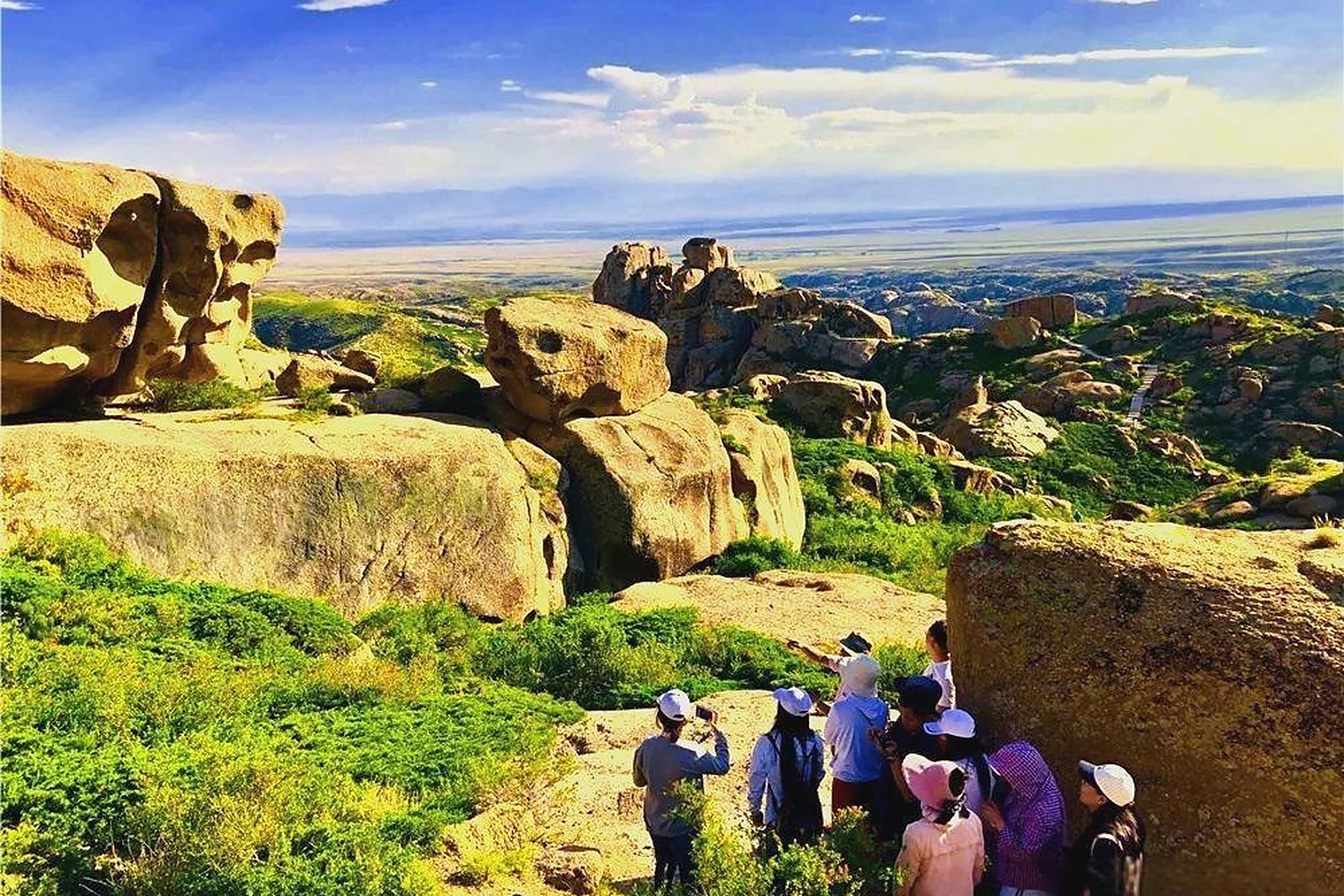
Unlike the fenced geoparks of the interior, most of Guaishiyu keeps its wild state: boardwalks cover only the core, and the side gullies still demand hands and feet. That is precisely its charm – press a palm to the rock face and feel wind-etched layering, rest in a boulder’s shadow under a sky framed in stone. The management performs minimum maintenance each year, deliberately leaving wind and sand as the resident sculptor.
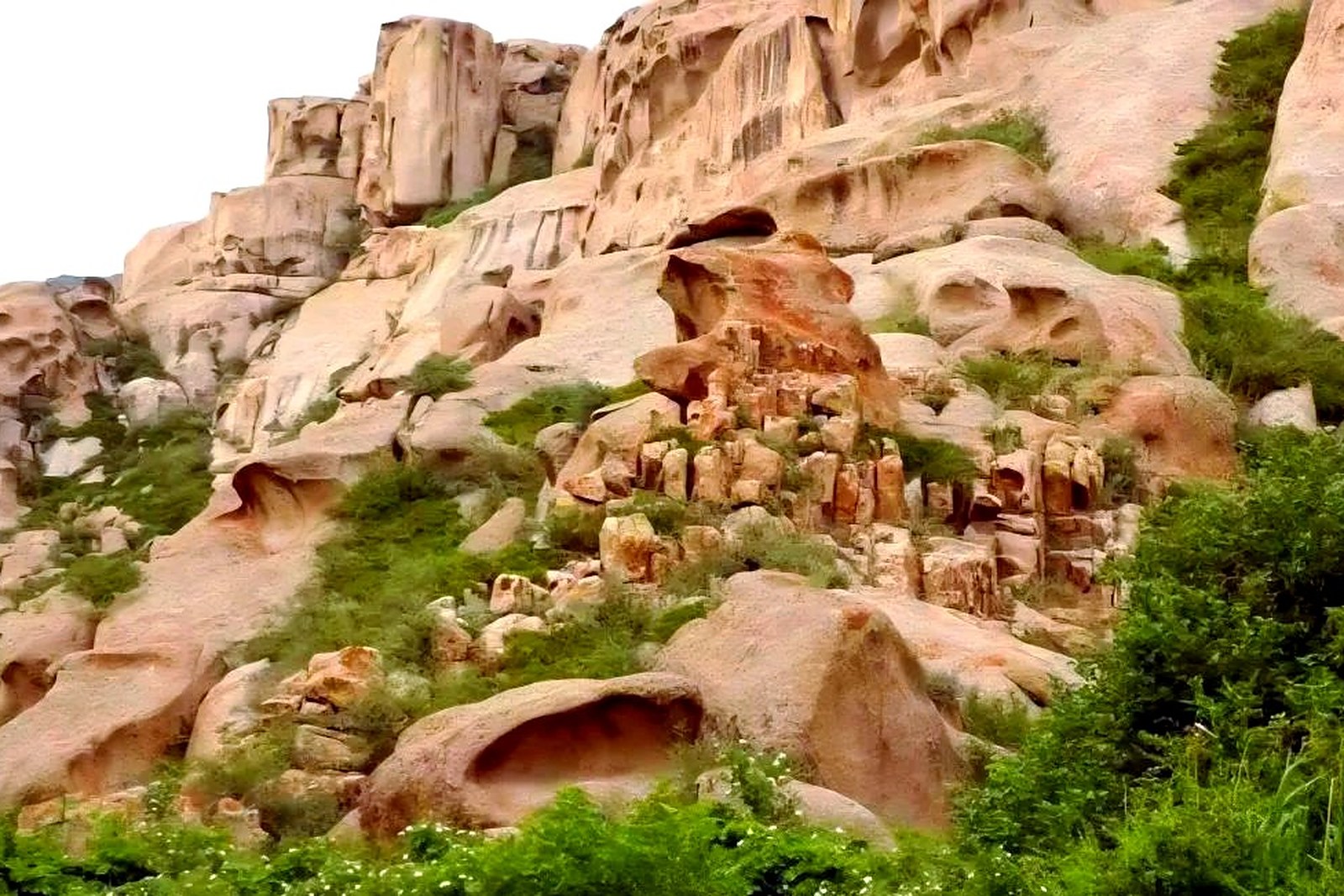
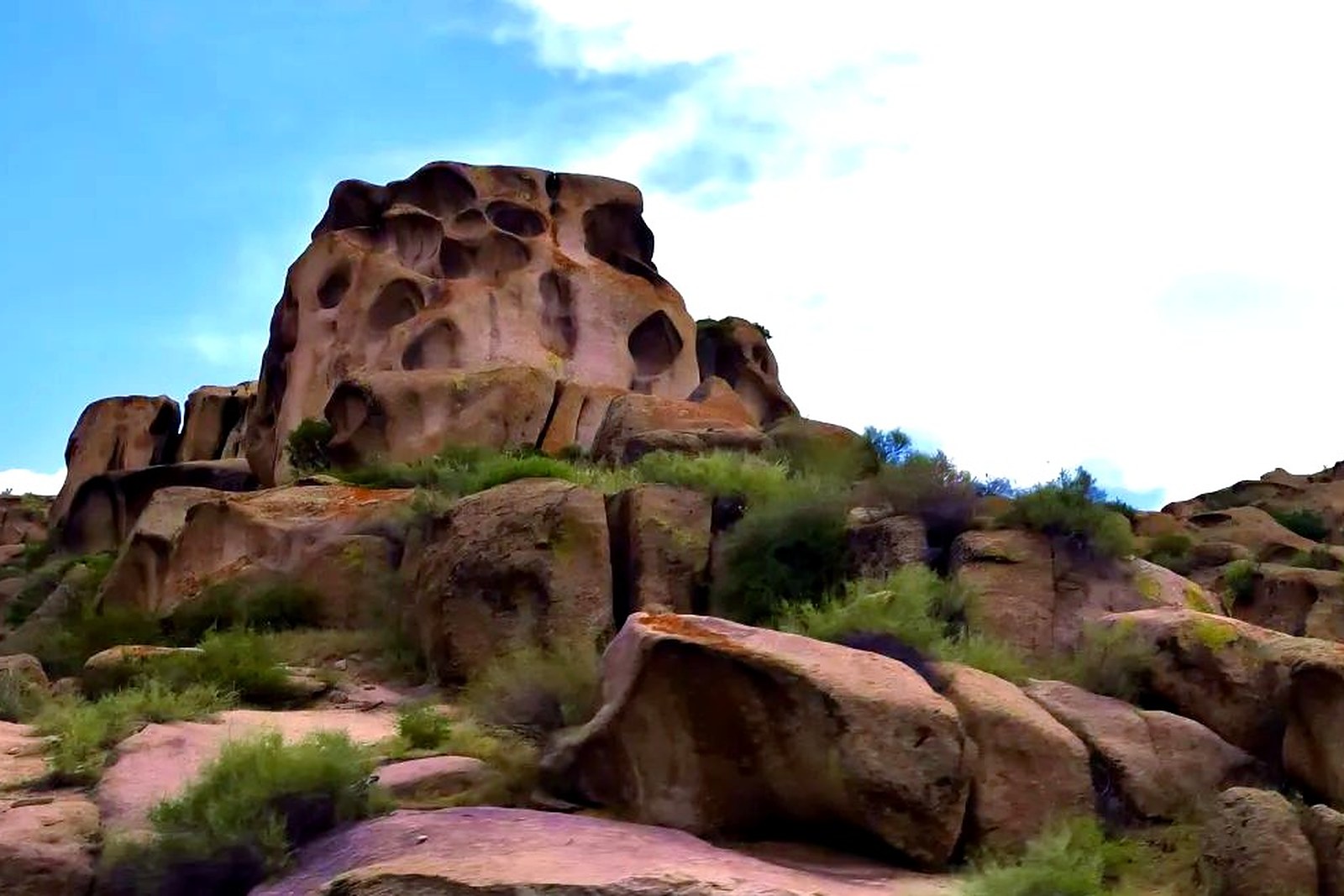
The masterpiece is the through-mountain hole: a boulder hollowed by nature into a round window. Stand beneath it and the sky is trimmed into a tidy circle; when sunlight slants in, the walls warm to amber, and any snapshot comes out a natural painting frame. The honeycomb surfaces are the second sight – pores dense across whole cliff faces, gnawed out by eons of day-night swing and wind, rough as eternity under the fingertip.
Legends crowd the stones: the best-known says Genghis Khan reviewed his army here on the western campaign, and when the host moved on, the rocks remained standing guard in the shapes of soldiers. Provenance aside, from the high point the stone sea does read as a frozen legion on parade. Mongolian and Kazakh each keep their own toponymy for these rocks, and guides recite it like family history.
Geologically, this is a textbook display of spheroidal granite weathering: day-night swings expand and contract the surface skin, wind carries off the shed fragments layer by layer, and across uncountable ages the whole mass emerges as living shapes. The geology room at the entrance explains the process panel by panel – see it first and the valley reads completely differently.
Boardwalks and a summit trail thread the area; look back from the high ground and the entire stone sea lies along the ridge like a frozen migration of beasts. Spring brings wildflowers into the gullies, autumn turns the shrubs in the crevices red – the stones stay, the light restages the play on every visit. Close to Bole, half a day suffices, making this the best leg-stretch between gobi highway legs.
Photographers keep a golden schedule here: an hour after sunrise for warm side-light on the stone arrays, noon for macro work on honeycomb texture, the two hours before sunset for silhouettes of the shape-rocks. Night is the hidden assignment – far from city glow, the Milky Way shows to the naked eye, and one strange rock in the foreground completes a natural starfield landscape.
The shape-rocks scatter along several side gullies; the largest takes an hour to walk. Between stones squeeze gaps that admit exactly one body – sideways, with the mountain pressing close and wind roaring past, a live narration of geological time. Families turn it into a game of 「find the animal」, laughter all the way.
The road from Bole runs between gobi and farmland, cotton fields and sunflowers in passes. Time your departure for three or four in the afternoon: the slant light stretches the rocks’ relief to maximum, and after sunset the drive home lands you in the city night market – the stones may fill the eye, but the stomach still wants its turn.
The geological value here is that it is live – weathering continues today. Wardens renew the warning boards every few years because rocks shed in the night unseen. The park keeps long-term monitoring stations with research institutes, tracking the deepening of the honeycomb stone and the stability of the through-hole. For a visitor all this science compresses to one sentence: come early, because every glance is a billion-year work in progress. A few kilometers from the gate, a herding village runs homestead guesthouses – honest food and beds, and at dawn you enter the valley ahead of the tour buses, the whole stone sea’s morning light to yourself.
Do not miss the 「stone market」 outside the gate: herders lay out wind-ling stones, agate nodules, and petrified wood, prices negotiable – a paperweight with a story, better than any souvenir shop. Beside the stalls a naan pit bakes sesame naan; tear it hot around a fresh-baked baked bun and you have the local standard breakfast for rock viewing. If you stay until dark, bring a flashlight – the paths between crevices carry no lighting, but the Milky Way will light the sky for you.
Practicalities
When the stones tire the eye, the same 博尔塔拉蒙古自治州 Bó’ěrtǎlā Měnggǔ Zìzhìzhōu Bortala Mongol Autonomous Prefecture holds other sights: 赛里木湖 Sàilǐmù Hú Sailimu Lake, 阿拉山口国门 Ālāshānkǒu guómén the Alashankou gate, 哈日图热格 Hārìtùrègé Hazireteg, and 圣泉景区 Shèngquán jǐngqū the Sacred Spring scenic area – four more doors into the same 博尔塔拉蒙古自治州 Bó’ěrtǎlā Měnggǔ Zìzhìzhōu Bortala Mongol Autonomous Prefecture. With the stones strung into a line, our Bortala food map fills the eating hours.
Practicalities
Words and Names
flowcloud would say Guaishiyu is northern Xinjiang’s most underrated geology playground: no queues, no noise, just wind, stone, and your own imagination.All checked November 2026.
Getting there: The stone valley begins about thirty-eight kilometres north of Bole city on the S205 and a paved park road, roughly an hour by car; seasonal buses run from Bole’s bus station in the warm months, and a shuttle links the main rock fields inside the gate – carry sun protection, as shade is scarce between the boulders. All checked November 2026.