
「六寺七阁八庙」 liù sì qī gé bā miào — “six monasteries, seven pavilions, eight temples”: the old count for a Kunming ferry town that once stood on the shore of Dianchi.
官渡古镇 Guāndù Gǔzhèn Guandu Ancient Town is a free, AAAA-rated old town at the junction of 广福路 Guǎngfú Lù Guangfu Road and 云秀路 Yúnxiù Lù Yunxiu Road in 官渡区 Guāndù Qū Guandu District, about 8 km southeast of central Kunming and once on the north shore of 滇池 Diānchí Dianchi Lake. The honest first fact is that the lake has retreated: the ferry the town was named for no longer touches water, and what a visitor walks today is a grid of restored streets with one genuinely ancient stone pagoda at its centre. The ground here was 蜗洞 Wōdòng “snail hole”, a mound of discarded shells piled by Dianchi harvesters some 4,000 years ago, later a mooring for Nanzhao boating parties in the Tang. The name came with the Song: around 1180–1190 the local officer 高生世 Gāo Shēngshì moored his boat here so often that the crossing took the name 官渡, the official ferry. A 官渡县 Guāndù Xiàn Guandu county was established alongside Kunming’s own under the Yuan, and by the Ming and Qing this was a market and fair town the old sources call 小云南 Xiǎo Yúnnán “little Yunnan”.
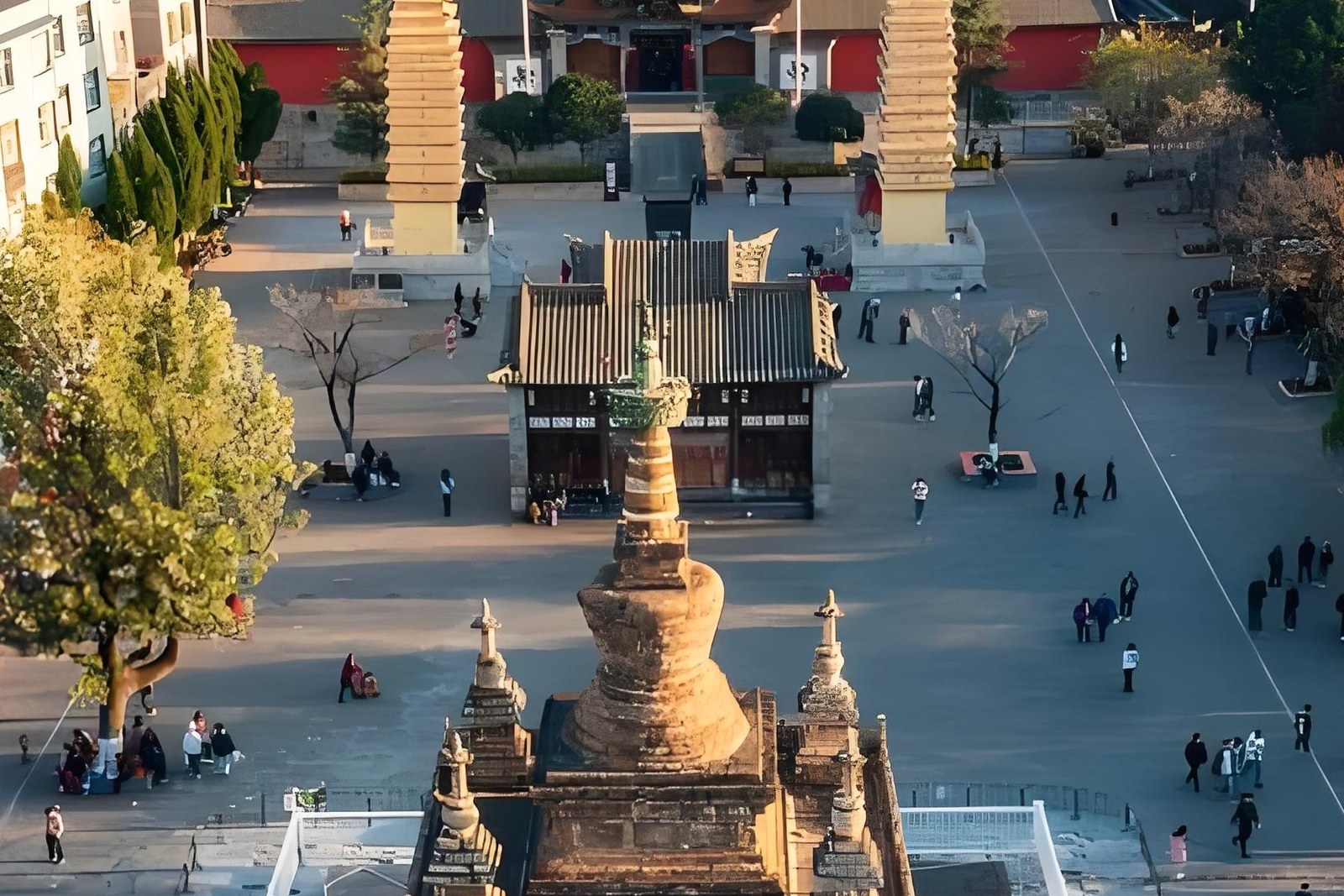
The town turns on a single stone tower. 妙湛寺金刚塔 Miàozhàn Sì Jīngāng Tǎ the Miaozhan Temple Diamond Pagoda – 穿心塔 chuānxīn tǎ, the wear-through tower, because you can walk straight through its base – stands in the square on the central axis of 妙湛寺 Miàozhàn Sì Miaozhan Temple. Built in 1458, the second year of the Tianshun reign, promoted by the Ming commander 沐璘 Mù Lín and funded by the eunuch 罗珪 Luó Guī, it is the earliest and best preserved of the ten-odd 金刚宝座塔 jīngāng bǎozuò tǎ vajra-throne pagodas surviving in China, a type descended from the seat of enlightenment at Buddh Gaya in India. The form is exact: a square sandstone base 10.4 m a side and 4.7 m high, four arched gateways crossing at the centre, carrying five towers – one central stupa of 16.05 m with four companions of about 5 m – one tower for each of the five Dhyani Buddhas. It is the only pagoda in China built entirely of sandstone, and the only vajra-throne pagoda with a Tibetan lama-stupa body. An earthquake in 1666 took the upper works; the 1696 rebuild left its seams; in 2002 the whole 1,350-tonne structure was jacked 2.6 m clear of the groundwater that had sunk it. A national key cultural relic since 1996, and free to stand under.
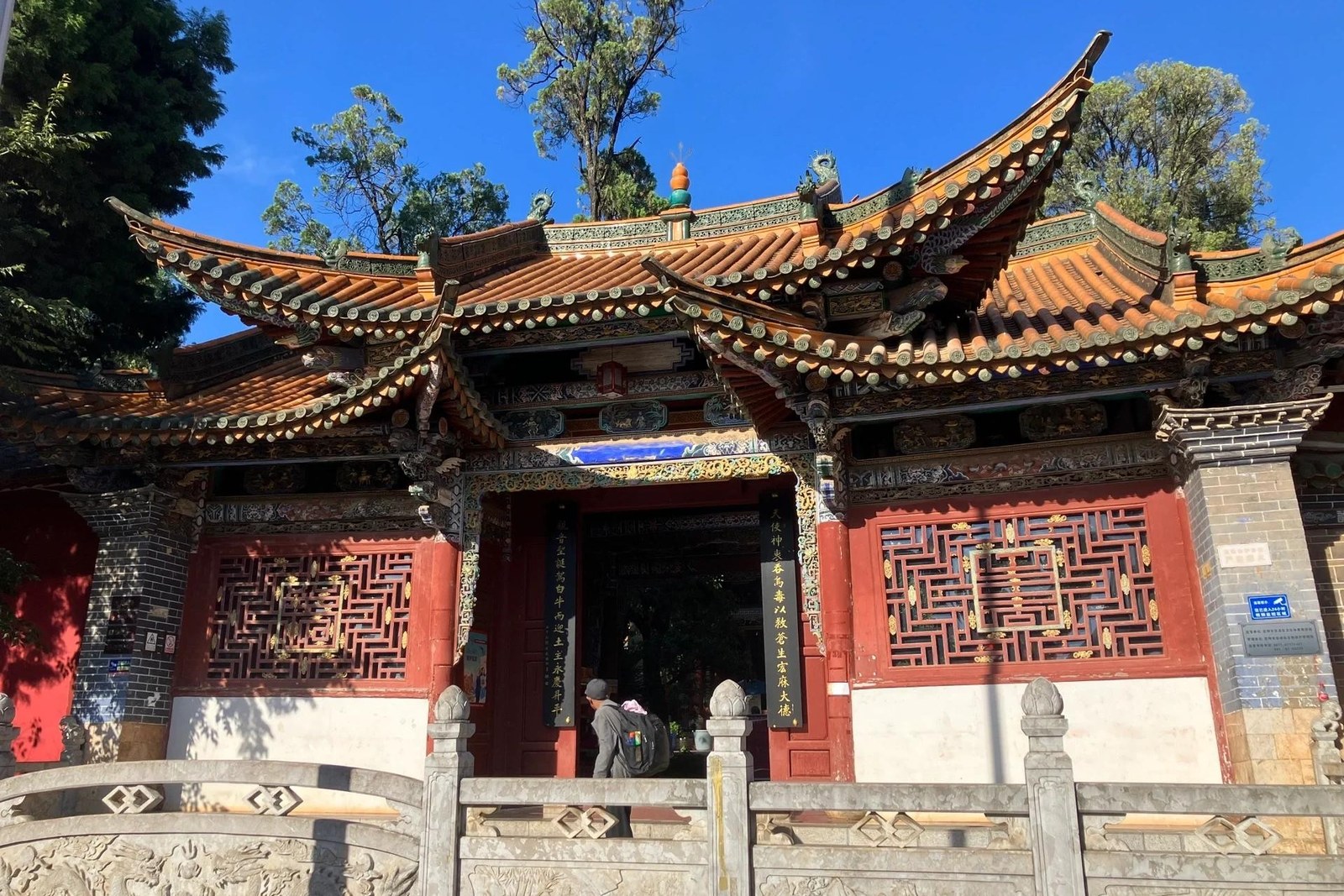
The temples around the tower are the town’s second layer. 土主庙 Tǔzhǔ Miào Tuzhu Temple, founded in the Tang under Nanzhao and rebuilt in 1895, enshrines 摩诃迦罗 Móhējiāluó Mahakala – 大黑天神 Dàhēitiānshén, the great black god – of the 阿吒力 Āzhālì Azhali esoteric school, and its fair on and around the nineteenth of the second lunar month has drawn central Yunnan since the Ming. 法定寺 Fǎdìng Sì Fading Temple, founded under Nanzhao, keeps Song-style woodwork – the 双凤朝阳 shuāng fèng cháo yáng double-phoenix carving over the central bay – in halls largely rebuilt in 1895. 妙湛寺 itself was founded under the Yuan in 1290 and moved to this site in 1325 after a flood; one of its pair of thirteen-storey brick towers, 17.4 m and standing about 15 m from its lost twin, survives as one of the 官渡八景 Guāndù Bājǐng Eight Views of Guandu. The historic town was counted as five hills, six monasteries, seven pavilions and eight temples inside less than 1.5 square kilometres; much is gone, and the 2001–2003 restoration rebuilt what the record allowed. What remains beyond the relics is the 一颗印 yī kē yìn “one-seal” courtyard house and walls rammed from snail shell and clay.
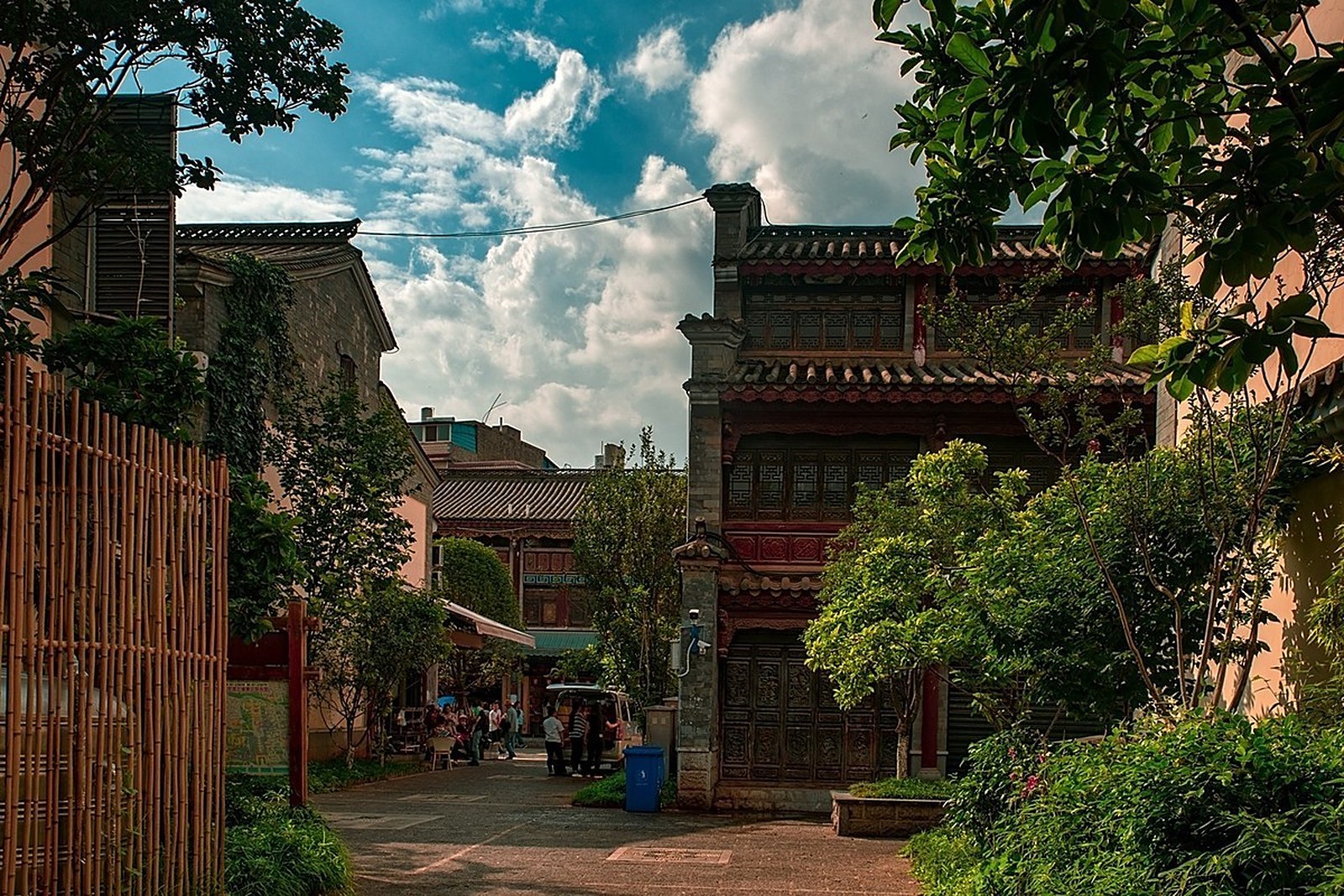
The living craft is 云子 yúnzi, the Yunnan go stone. The 云南围棋厂 Yúnnán Wéiqí Chǎng Yunnan Weiqi Factory works in the old town’s second phase, and the recipe is mineral: 南红玛瑙 nánhóng mǎnǎo southern-red agate, 黄龙玉 huánglóng yù Huanglong jade, 翡翠 fěicuì jadeite, 紫英石 zǐyīng shí amethystine quartz, borax and quartz sand, melted at furnace heat and hand-dripped one stone at a time, no mould, so a black stone shows a jade-green ring against the light. The Ming recipe was lost in the early Republic years and recovered by trial in 1974; the craft – 云南围棋子(云子、永子)制作技艺 Yúnnán wéiqīzǐ (yúnzi, yǒngzi) zhìzuò jìyì – entered the fifth national intangible cultural heritage list in 2021. The 云子棋院 Yúnzi Qíyuàn Yunzi chess courtyard shows and sells the stones, and the town’s other listed crafts run alongside: 乌铜走银 wūtóng zǒuyín black-copper silver-inlay (national, 2011), 官渡饵块 Guāndù ěrkuài Guandu rice cakes (municipal, 2005), plus 滇剧花灯 Diānjù Huādēng Dian opera and lantern theatre, snuff-bottle interior painting and dough figurines in their workshop halls.
The honest shape of a visit is a half-day rhythm, not a monument queue. The town is free, open around the clock and unbooked, and its best hours are early, before the tour coaches, and late, after four, when the square returns to tea and chess under the pagoda; the main street between is snack stalls and 官渡粑粑 Guāndù Bābā Guandu Baba, the baked sesame-and-rose cake sold hot off the griddle. The natural pairing is across the road: the 云南省博物馆 Yúnnán Shěng Bówùguǎn Yunnan Provincial Museum at 广福路6393号 Guǎngfú Lù 6393 Hào Guangfu Road 6393, about 700 m from the old town’s archway, free, Tuesday to Sunday 9:00 to 17:00 with last entry at 16:30, closed Mondays and booked ahead online, with the 云南大剧院 Yúnnán Dàjùyuàn Yunnan Grand Theatre next door. The J12 shuttle from 星耀路站 Xīngyào Lù Zhàn Xingyao Road station links old town and museum in one ride. The honest frame is the article’s last word: a ferry town the lake left behind, kept alive by a stone tower, a go stone and a free museum opposite.
Practicalities
Tickets: Free entry, and that is the standing offer rather than a gap: 官渡古镇 Guāndù Gǔzhèn Guandu Ancient Town is an AAAA-rated old town that the Kunming tourism board lists as open all day, free, no reservation. No source publishes a separate charge for the 妙湛寺金刚塔 Miàozhàn Sì Jīngāng Tǎ Diamond Pagoda, which is viewed from the square, and the 云子棋院 Yúnzi Qíyuàn Yunzi chess courtyard exhibition is listed free. Craft workshops charge for hands-on sessions, with no published tariff – ask at the door. The honest shape is that the town asks nothing at the gate.
Opening hours: Open around the clock, per the city’s own listing (全天开放 quántiān kāifàng open all day), with no gate to shut. The temples inside keep their own hall hours, which vary hall by hall – check at the gate. The practical split is the day’s rhythm rather than a clock: the main street fills with tour groups from about 10:00 to noon, and the quiet windows are early morning and after 16:00, when the tea-and-chess traffic returns to the square.
Closing day: None published, and the reason is the town’s model rather than an editorial silence: a free street town with no weekly rest named, open every day the light allows. The one weekly rhythm in the neighbourhood belongs to the 云南省博物馆 Yúnnán Shěng Bówùguǎn Yunnan Provincial Museum across Guangfu Road, closed Mondays and open Tuesday to Sunday 9:00 to 17:00 (last entry 16:30, free with advance booking). The old town ignores that clock, which is the caveat: do not plan the museum for a Monday.
Getting there: Metro Line 1 to 星耀路站 Xīngyào Lù Zhàn Xingyao Road (exit A1/C), 1.2–1.5 km out, then the J12 shuttle or a shared bike; 珥季路站 Ěrjì Lù Zhàn Erji Road (exit B) is a 10-to-15-minute walk. Buses to 官渡古镇(广福路)站 Guāndù Gǔzhèn (Guǎngfú Lù) Zhàn: 31, 165, 174, 185, 186, 253, 255, 908, A12, K15, C85; 169/J12 to 官渡古镇(云秀路)站 Guāndù Gǔzhèn (Yúnxiù Lù) Zhàn. Driving: the Guangfu Road P3 car park charges a few yuan an hour with a daily cap around 20 yuan; navigate to 官渡古镇牌坊 Guāndù Gǔzhèn Páifāng the archway, 8 km southeast of the centre.
Words and Names
官渡古镇 Guāndù Gǔzhèn Guandu Ancient Town · the free AAAA-rated old town at the Guangfu–Yunxiu junction, about 8 km southeast of central Kunming
官渡区 Guāndù Qū Guandu District · the Kunming district that keeps the old ferry’s name
滇池 Diānchí Dianchi Lake · the plateau lake whose north shore the town once touched and has since lost
妙湛寺金刚塔 Miàozhàn Sì Jīngāng Tǎ Miaozhan Temple Diamond Pagoda · the 1458 five-tower sandstone vajra-throne pagoda, national key cultural relic since 1996
金刚宝座塔 jīngāng bǎozuò tǎ vajra-throne pagoda · the Indian type, one central tower with four companions for the five Dhyani Buddhas
穿心塔 chuānxīn tǎ wear-through tower · the local name for the pagoda whose base you can walk through
土主庙 Tǔzhǔ Miào Tuzhu Temple · Tang-founded hall of the great black god, with its fair around the nineteenth of the second lunar month
大黑天神 Dàhēitiānshén Mahakala · the great black god of the Nanzhao Azhali school, kept at the Tuzhu Temple
法定寺 Fǎdìng Sì Fading Temple · Nanzhao-founded hall with Song-style woodwork, largely rebuilt in 1895
妙湛寺 Miàozhàn Sì Miaozhan Temple · Yuan-founded “first of the six monasteries”, twin brick towers beside the pagoda
官渡八景 Guāndù Bājǐng the Eight Views of Guandu · 古渡渔灯 gǔdù yúdēng fishing lamps of the old ferry and 笔写苍穹 bǐxiě cāngqióng the brush-written sky among them
云子 yúnzi Yunnan go stones · mineral stones hand-dripped to a Ming recipe, national intangible cultural heritage 2021
乌铜走银 wūtóng zǒuyín black-copper silver-inlay · Yunnan metalwork with silver flooded into chased lines, national intangible cultural heritage 2011
官渡粑粑 Guāndù Bābā Guandu Baba · the town’s griddle-baked cake, sesame or rose, eaten hot
flowcloud would say that Guandu Ancient Town is Kunming’s free old ferry town – an AAAA-rated grid of streets at the Guangfu–Yunxiu junction in Guandu District, about 8 km southeast of the centre and once on Dianchi’s shore, anchored by the 1458 Miaozhan Temple Diamond Pagoda (16.05 m, five towers on a walk-through sandstone base, national key cultural relic since 1996) with the Tuzhu and Fading temples and a Yuan brick tower around it – and that the honest move is to come early or after four, walk through the pagoda’s arched gateways, watch the yunzi stones being hand-dripped, then cross Guangfu Road to the free Yunnan Provincial Museum (Tuesday to Sunday 9:00–17:00, closed Monday, book ahead), because the town is a working market street that asks no ticket and the museum keeps the only weekly clock in the neighbourhood. All checked October 2026.