
观音桥 Guānyīnqiáo, Guanyinqiao, the Guanyin Bridge, is a name the north bank of Chongqing pronounces dozens of times a day – on shopping bags, metro announcements and dinner invitations – and almost nobody standing in the middle of it can find the bridge. Chongqing is a municipality of southwest China, and the Guanyinqiao commercial district is the shopping heart of 江北区 Jiāngběi Qū, Jiangbei District, a plain-level grid of pedestrian streets, malls and snack lanes a short ride inland from the river. The missing bridge is not a mystery but a habit of Chinese place names: the structure went, the name stayed, and the district built a granite reminder. This is a quarter of queues and neon rather than cliffs and stairs, and its best story is underground – an 1849 stone inscription, a 1790 engineering job and a legend about an old woman with wooden planks.
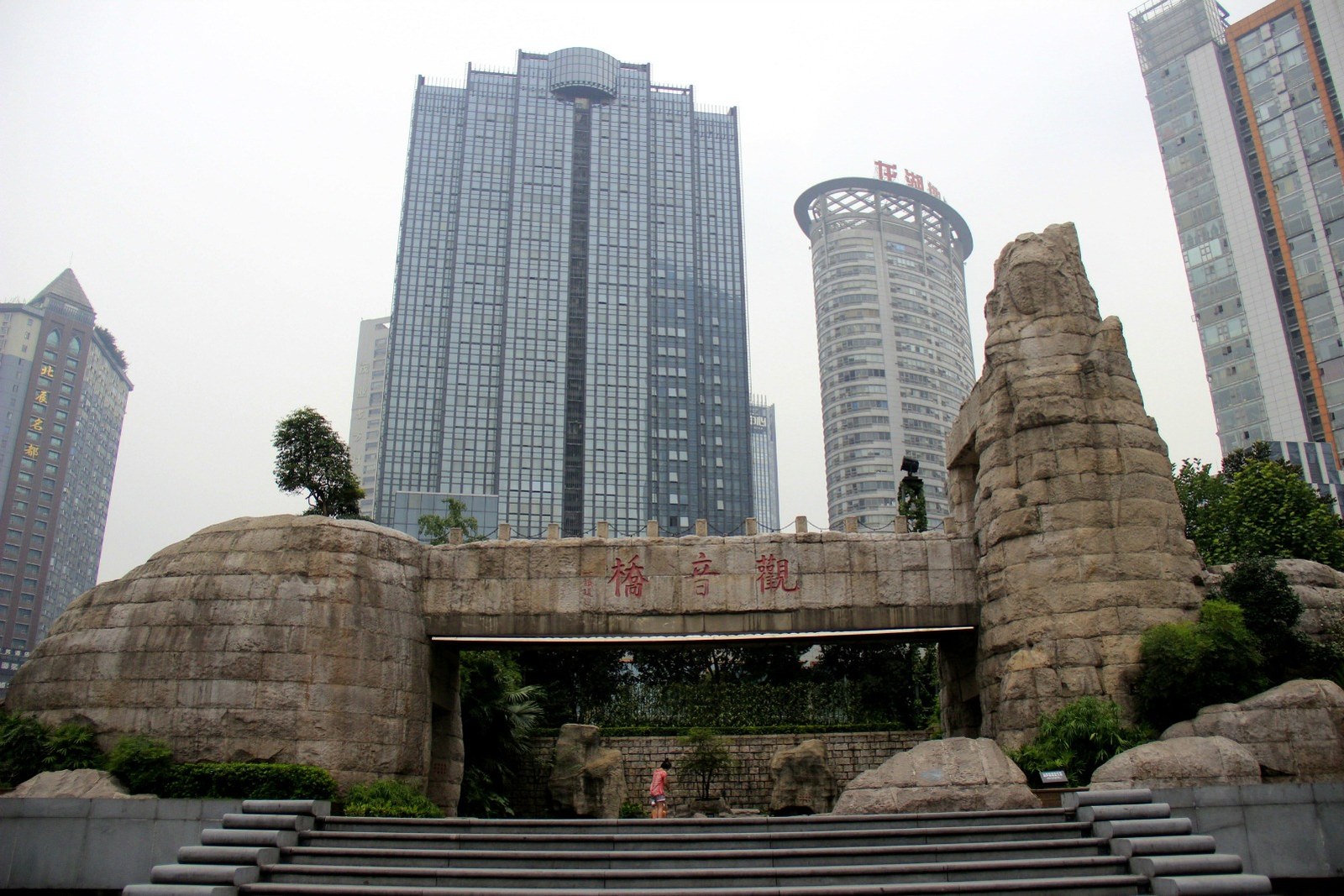
The paper trail is unusually tidy. 四川省重庆市地名录, the place-name register published in December 1984, records that in the mid-Qing two stone slab bridges crossed a stream here, taking their name from a temple to 观音 Guānyīn, Guanyin, the Bodhisattva of Compassion, that stood beside them. Better still, the 观音桥百字碑记, the Hundred-Character Inscription set up in 1849, the twenty-ninth year of the Daoguang reign, preserves the older name of the crossing – 接龙磴 Jiēlóngdèng, Jielongdeng – and records that in 1790, the fifty-fifth year of the Qianlong reign, the crossing was rebuilt as a flat stone bridge. Alongside the gazetteers runs a folk tale, told strictly as legend: as the story goes, a kindly old woman surnamed 田 Tián, Tian, laid wooden planks across the rain-swollen stream so travellers could cross, was honoured by the grateful as an old mother of Guanyin who saves the world, and the local gentry later raised the bridge and the temple in her memory. Gazetteer and legend sit side by side here, as they do all over Sichuan, and the honest reader keeps them in separate pockets.
The modern transformation has two bridge dates of its own. In January 1966 the Jialing River Bridge opened, and the district chronicles credit the new crossing with turning the vegetable fields of the north bank into a built-up urban quarter. The second date is a decision rather than a span: construction of the commercial district began in April 2003, and in February 2005 the pedestrian street formally opened, with 北城天街 Běichéng Tiānjiē, Beicheng Tianjie, and the other big malls opening in succession from 2003 to form the core of the district. The 2003 rebuilding also left two deliberate memories of the lost original: a granite sculpture group on the Guanyinqiao theme weighing more than 1,800 tonnes, and a granite bridge built in the old manner in the same year, so that the name would have something to stand on. Few shopping districts anywhere have gone to such lengths to apologise to their own name.

The honours shelf reads as a timeline rather than a trophy case. In August 2006 the district was named one of China’s famous commercial streets, the first in the southwest; in October 2010 it was graded a national 4A scenic area – an urban shopping district graded like a mountain, which tells you how the city values it; in October 2021 it joined the first batch of national night-time culture and tourism consumption clusters; and in November 2023 the Ministry of Culture and Tourism listed it in the third batch of national-level tourism and leisure streets. On the ground the honours translate simply: this is one of the busiest shopping districts in western China, and by night it belongs to locals. Hotpot restaurants run honest queues, 小面 xiǎomiàn, xiaomian, noodle counters steam behind glass, pop concerts occupy the square on weekend evenings, and the granite bodhisattva-bridge glows under strings of lights. Come on a weekday morning for the calm version, with the towers’ glass holding the early sun, or surrender to the evening and treat the queues as the review system the district deserves.
Practicalities
Tickets. There is no ticket: Guanyinqiao is a free public shopping district, open to anyone who can walk a pavement. The malls, restaurants and snack lanes charge on their own terms. As of October 2026, subject to change – check before you go.
Opening hours. The pedestrian streets are a public space open around the clock, and the evening lights are the district’s signature. Individual malls keep their own hours, commonly from about 10:00 to 22:00.
Closing day. There is no closing day: the streets do not shut for the calendar, and the night lighting is a standing feature rather than an event. Only individual shops and malls vary, so check a specific venue if your trip depends on it.
Getting there. Metro lines 3 and 9 both stop at 观音桥 Guānyīnqiáo, Guanyinqiao station, which empties directly into the pedestrian streets. From the river front at Jiangbeizui it is a short taxi or bus ride inland.
flowcloud would say that Guanyinqiao is the answer to a trick question – a bridge you cannot find, honoured by a replica, a sculpture and an 1849 inscription – and that a shopping street which keeps its own etymology on a stone has earned the crowds it gets.
Getting there: Guanyinqiao, the Guanyin Bridge, is the commercial heart of Jiangbei District, Chongqing, a municipality of southwest China; the name comes from mid-Qing stone slab bridges beside a temple to Guanyin, recorded in the 1984 place-name register and in an 1849 inscription that dates a 1790 rebuilding of the old Jielongdeng crossing, with the tale of the ferry-keeping old woman surnamed Tian told only as legend; the modern district began construction in April 2003 and opened as a pedestrian street in February 2005 after the January 1966 Jialing River Bridge urbanised the north bank, and it entered the national list of tourism and leisure streets in November 2023; it is free, open around the clock with no closing day, and reached by metro lines 3 or 9 to Guanyinqiao station (checked October 2026, subject to change).