
樟木头 Zhāngmùtóu, the only purely Hakka town in Dongguan and once nicknamed “little Hong Kong” in the delta’s first boom years, holds the strangest property title in Chinese forestry: 广东观音山国家森林公园 Guāngdōng Guānyīnshān guójiā sēnlín gōngyuán, the Guanyinshan National Forest Park, the country’s first national forest park run by a private company. The land story runs through a 50-year joint-development contract signed on 30 November 1999 between the entrepreneur 黄淦波 Huáng Gànbō and the village collective of Shixin; the state story runs through 23 December 2005, when the State Forestry Administration approved the “national” in the name over 657.18 hectares – and the two stories have been in conversation, and occasionally in court, ever since.
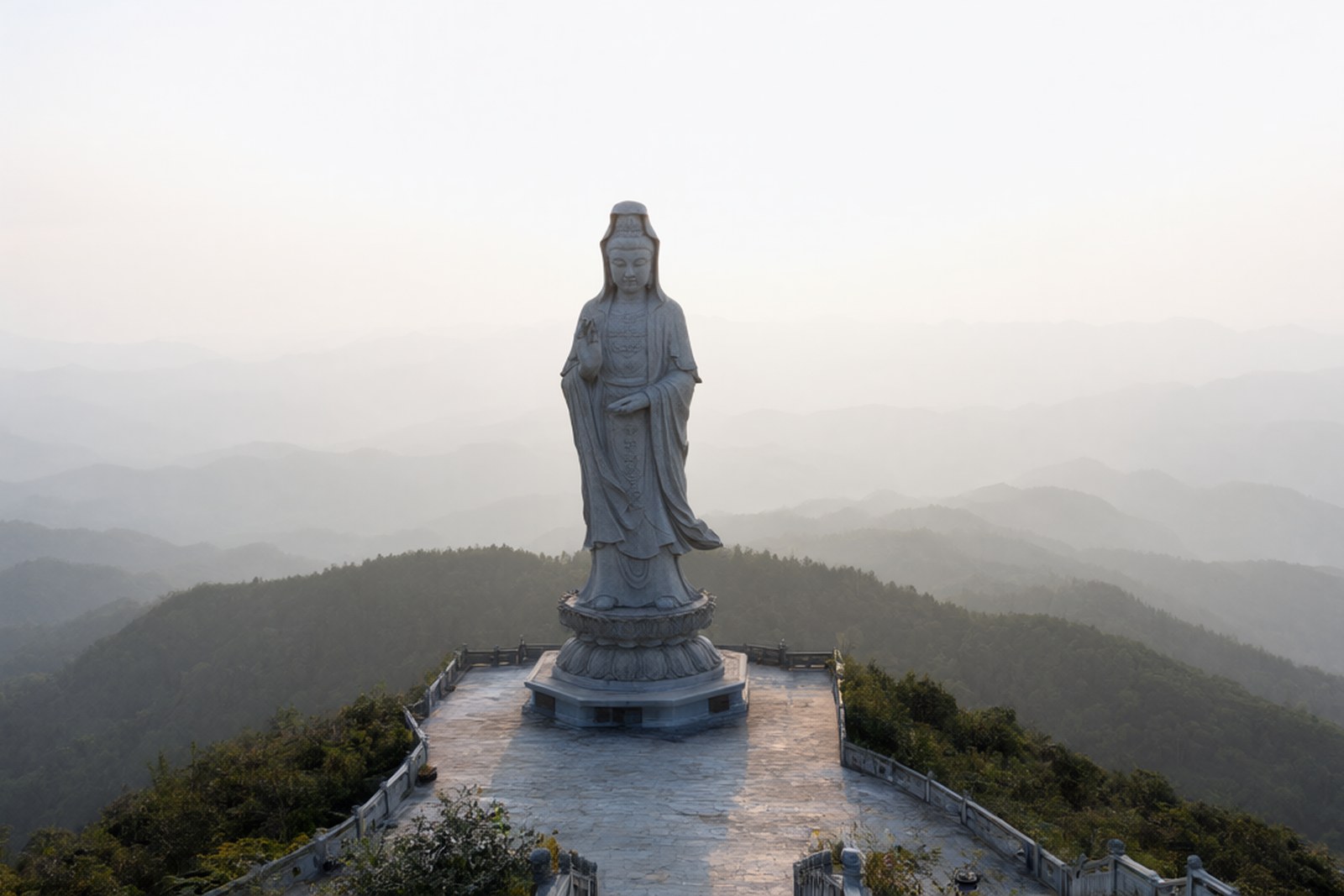
The summit figure is the Buddha. 观音圣像 Guānyīn shèngxiàng, the Guanyin statue, rises 33 metres over the summit plaza, assembled from 999 blocks of granite weighing more than 3,000 tonnes in all, carved in a Tang-inflected style by the Fujian master 陈宝如 Chén Bǎorú and consecrated on 4 November 2001 after two years of work by several hundred craftsmen. The park bills it as the world’s largest granite Guanyin statue, and “bills” is the right verb, since no third party has certified the superlative. The park holds a national 4A rating – the city’s 2017 register confirms it, though sources date the award to 2009 or 2010 – and the summit plaza alone covers more than 10,000 square metres.
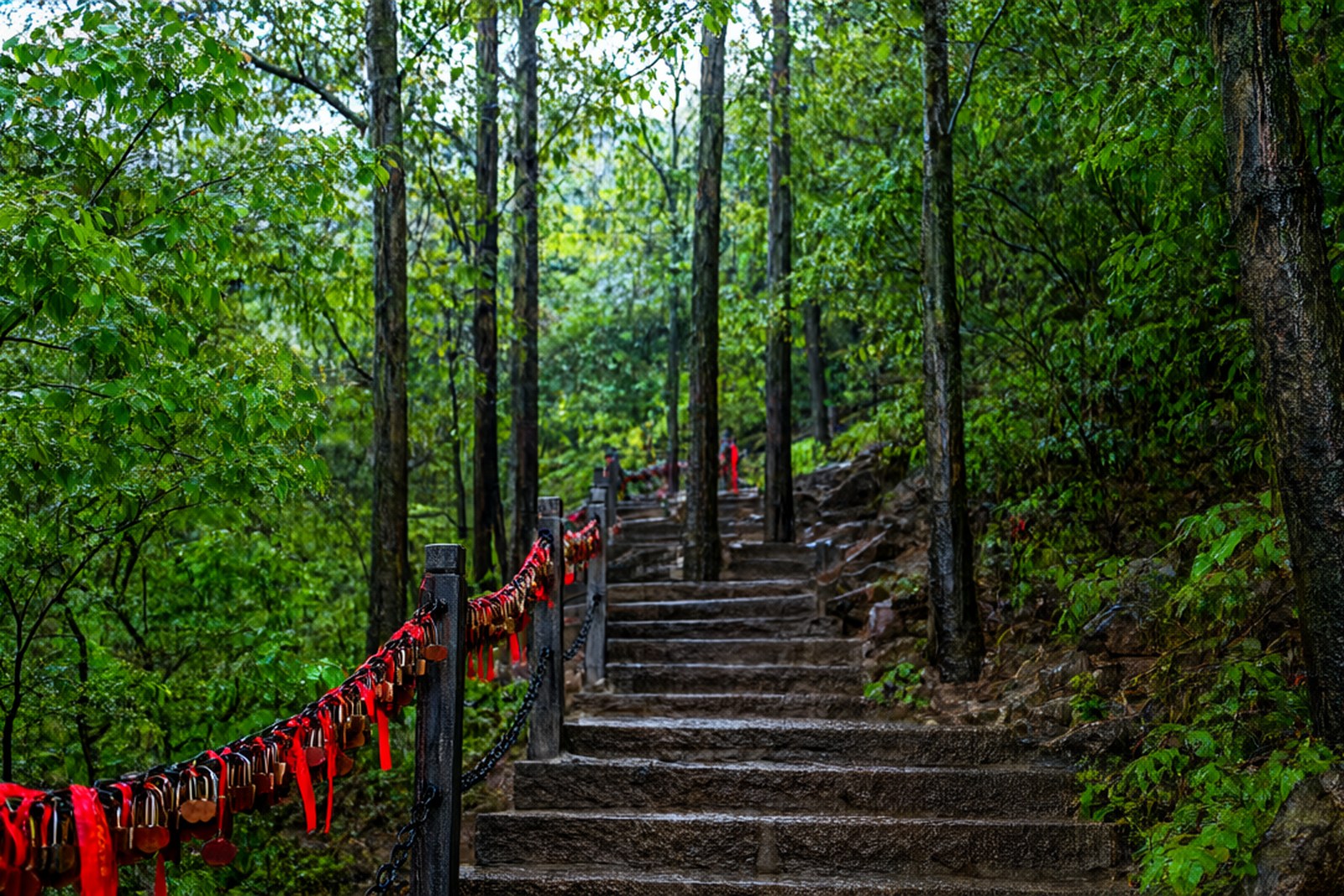
The park’s own menu is broader than the statue: a free-standing ancient-tree museum, the first of its kind in the country – check ahead, since its opening status has wobbled – the 感恩湖 Gǎn’ēn hú lake, and a full romance-themed circuit of the Moon Elder terrace, the Magpie Bridge, the Three-Lives Stone, the Marriage Path and the wall of love locks, an odd delta coupling of a Buddhist summit and a matchmaking fair. The activity list runs to zip lines, a forest slide, treetop courses and a 9D cinema, and the park says it stages fifty-odd cultural events a year; before the pandemic it counted about 1.3 million visits annually.
The disputes deserve their own paragraph, because they are part of the visit. The operator and the local authorities have fought over the 50-year contract for two decades – the town government moved twice to buy the operator out around 2006, the village committee sued to unwind the contract in 2010, a first-instance ruling upheld the contract, and in 2014 the Supreme People’s Court ended the litigation by maintaining it. The park’s master plan expired in July 2017 and its revision has been stalled for years, and Chinese media, in a 2023 in-depth report, have raised the possibility that the national designation could be at risk; the operator also says gas and power lines were routed through the park’s core, which Chinese media have reported. Facilities may show their age in consequence – check recent visitor feedback – but the court record stands, and the park keeps operating.
Half a day is the honest budget: the shuttle saves the climb (RMB 30 single from the gate to the Laoxianyan stop), the summit plaza closes earlier than the gates, and the park’s own notice asks hikers to be down before dark. One local quirk worth knowing: before 07:00 the gates open free to Zhangmutou residents for morning exercise, the cleanest single line between a national-branded park and the town that hosts it.
Practicalities
Tickets. RMB 45 for adults per the park’s own booking notice, half price at RMB 22 for minors and full-time students, free for small children, seniors, serving military and disabled visitors; the shuttle is RMB 30 single (RMB 25 concessionary) and is charged separately. Platform bundles pair the ticket with the shuttle or the cinema, and discounted online tickets are excluded on statutory holidays, so festival visitors may pay the window price. Checked October 2026, subject to change.
Opening hours. 07:00 to 18:00 on the park’s official booking notice, with the park’s own channel listing summer hours to 18:30 and the summit plaza shutting earlier than the gates; last entry as posted at the gate.
Closing day. No published closing day – the park runs all year, and the real closing force is daylight: the safety notice wants you off the mountain before dark.
Getting there. Bus 332 runs direct from Dongguan’s eastern bus terminal to Guanyinshan in Zhangmutou; the Guangzhou-Shenzhen railway stops at Zhangmutou station, close to town; drivers navigate to the park name, with free parking at the gate. The town sits inside the delta’s one-hour road and rail ring of Guangzhou, Shenzhen and Huizhou.
flowcloud would say that Guanyinshan is the delta’s most literal theme park, because its theme is a lawsuit – a private company, a national title, a Supreme Court judgment and 999 blocks of granite, all holding the same summit – and that whatever the planners next decide, the statute has already ruled on who runs the mountain.
Getting there: 广东观音山国家森林公园 Guāngdōng Guānyīnshān guójiā sēnlín gōngyuán stands at 樟木头 Zhāngmùtóu, Dongguan, Guangdong, reached by bus 332 direct from the eastern bus terminal or by the Guangzhou-Shenzhen railway to Zhangmutou station, with free parking at the gate; entry is RMB 45 with the shuttle at RMB 30 single (checked October 2026, subject to change); hours 07:00-18:00 per the official notice with summer variations to 18:30, and no closing day is published – be off the mountain before dark.