
国恩寺 Guó ēn sì stands at the foot of 龙山 Lóng shān beside 塔脚村 Tǎ jiǎo cūn in 六祖镇 Liù zǔ zhèn, 新兴县 Xīn xīng xiàn, in the south-east of 云浮市 Yún fú shì. Its alternative name is 龙山寺 Lóng shān sì, and the two names describe two different things: the hill it sits under, and the reason it was built. It is the monastery the 禅宗 Chán zōng – the Chan school of Chinese Buddhism – counts as one of its three 祖庭 zǔ tíng, its ancestral seats, alongside 光孝寺 Guāng xiào sì in 广州 Guǎng zhōu, where the sixth patriarch 惠能 Huì néng was ordained, and 南华寺 Nán huá sì at 曲江 Qū jiāng in 韶关 Sháo guān, where he taught for the greater part of his life. 国恩寺 is the third leg of that triangle for a different reason from either: it is where he was born, it is the house he grew up in, and it is where he died. The 六祖法宝坛经 Liù zǔ fǎ bǎo tán jīng, the Platform Sutra of the Sixth Patriarch, is recorded as having been compiled here, which matters because that book is the only Chinese text in the Buddhist canon to be called a 经 jīng, a sutra, rather than a treatise. The phrase the monastery and the county use for all this is 岭南第一圣域 lǐng nán dì yī shèng yù, the first holy ground south of the passes, together with 中国禅文化的发祥地 Zhōng guó chán wén huà de fā xiáng dì, the birthplace of Chinese Chan culture. Both are institution-speak, and both are worth hearing as institution-speak – what can be checked is the sequence of dates below, and the fact that the site has been a place of Buddhist practice, almost without interruption, since the seventh century.
The founding is the part that can be dated. 惠能 was born in 638 in 夏卢村 Xià lú cūn, a village a short way off in the same town, into a family of little means; his father died when he was three and his mother raised him. In 661, at twenty-four, he walked north to 黄梅 Huáng méi in what is now 湖北 Hú běi and presented himself to the fifth patriarch 弘忍 Hóng rěn, and the exchange of verses that followed – 神秀 Shén xiù writing 身是菩提树,心如明镜台 shēn shì pú tí shù, xīn rú míng jìng tái, the body is the bodhi tree and the mind a bright mirror stand, and 惠能 answering 菩提本无树,明镜亦非台,本来无一物,何处惹尘埃 pú tí běn wú shù, míng jìng yì fēi tái, běn lái wú yī wù, hé chù rě chén āi, there is no bodhi tree and no mirror stand, nothing exists from the beginning, so where would dust settle – is the single best-known passage in Chinese Buddhist literature. In the first month of 676 he showed the robe and bowl publicly at 法性寺 Fǎ xìng sì in Guangzhou, which is today’s 光孝寺, and was shaved under the bodhi tree in its courtyard on the fifteenth day of that month; the following spring he went up to 曹溪 Cáo xī at what is now 南华寺 and taught there for the next thirty-odd years. In the first year of 弘道 Hóng dào, which is 683, he built the monastery at his own birthplace in repayment of his parents’ kindness, and it is that act, not a foundation legend, that gives 国恩寺 its name: 报恩 bào ēn, repaying grace, is what the first version of the name meant, and the temple is recorded as having been called 报恩寺 Bào ēn sì before it was called anything else. The 龙山寺 name belongs to the hill.
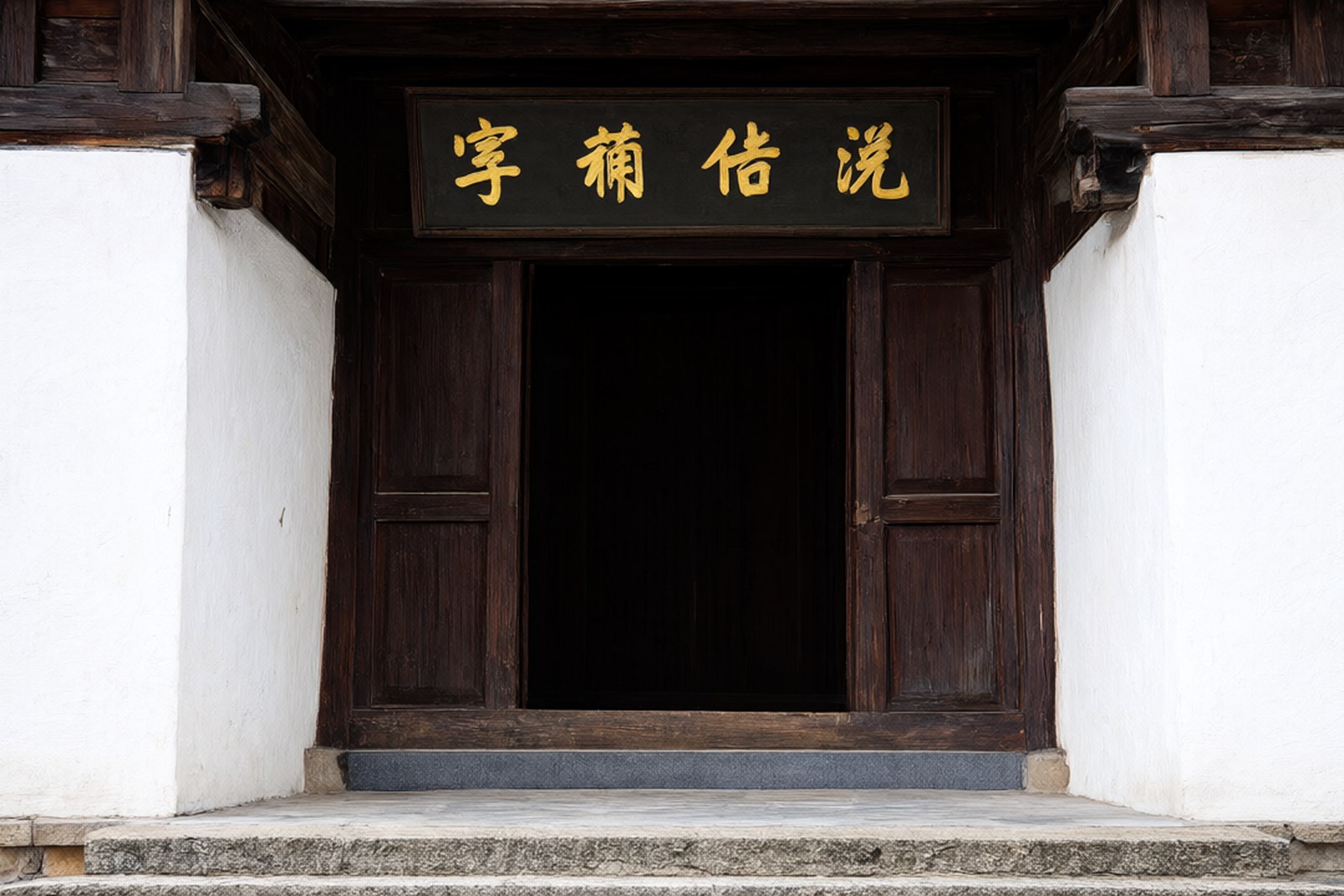
Then in 707 the court intervened directly, and this is the fact the place is most often introduced by. In the eleventh month of 神龙 Shén lóng 3 – 707, in the reckoning used by the county and by the 南方+ reports, though the reign name 神龙 ran from 705 to 707 and some accounts therefore write 708 – the throne granted the monastery the name 国恩寺 guó ēn sì and 武则天 Wǔ Zé tiān, Empress Wu Zetian, wrote the four characters 敕赐国恩寺 chì cì guó ēn sì, “by imperial grant, the temple of national grace”, in her own hand. The plaque now hangs at the main gate. The claim built on top of it, which comes from the official tourism material rather than from a document the visitor can inspect, is that 国恩寺 was therefore the first monastery in the country ever to be granted the character 国 guó – the character for “nation” – as part of its name. It is a good story and it is repeated everywhere; the honest way to carry it is as what the local authorities say, which is how this article carries it. What is not in doubt is that the grant happened and that the name has been in use since.
惠能 came home to die. In the seventh month of 713 he left 曹溪, travelling back to 新州 – the county was called 新州 Xīn zhōu then – with his disciples, and on the third day of the eighth month he died at 国恩寺. The report’s note on the dating is worth passing on: 713 is disputed by nobody, but the year carries two reign names because the emperor changed the era name in the middle of it, so some accounts call it the second year of 先天 Xiān tiān and others the first year of 开元 Kāi yuán. Both are 713. The pagoda at the left of the monastery is the other half of the same story. In 712, the year before, 惠能 had sent men from 曹溪 back to 新州 to build a 报恩塔 Bào ēn tǎ – a pagoda in repayment of grace, the same word as the temple’s first name – and it was finished in the summer of 713, after his death. It burned down, was rebuilt in the second year of 开禧 Kāi xǐ of the 宋 Sòng, which is 1206, and collapsed again. What a visitor sees now dates from 1990, when it was rebuilt as a seven-storey octagon: about 24 metres high, with a perimeter of about 17 metres, red walls and green eaves, and a board over the door reading 报恩塔 bào ēn tǎ in the calligraphy of 赵朴初 Zhào Pǔ chū. The old塔基 tǎ jī, the pagoda base, is still there beside it – roughly 30 square metres of it, with original bricks and a 地宫 dì gōng, an underground chamber, beneath. Seeing a 1990 tower standing next to a Tang footprint is the single most instructive thing at the site.
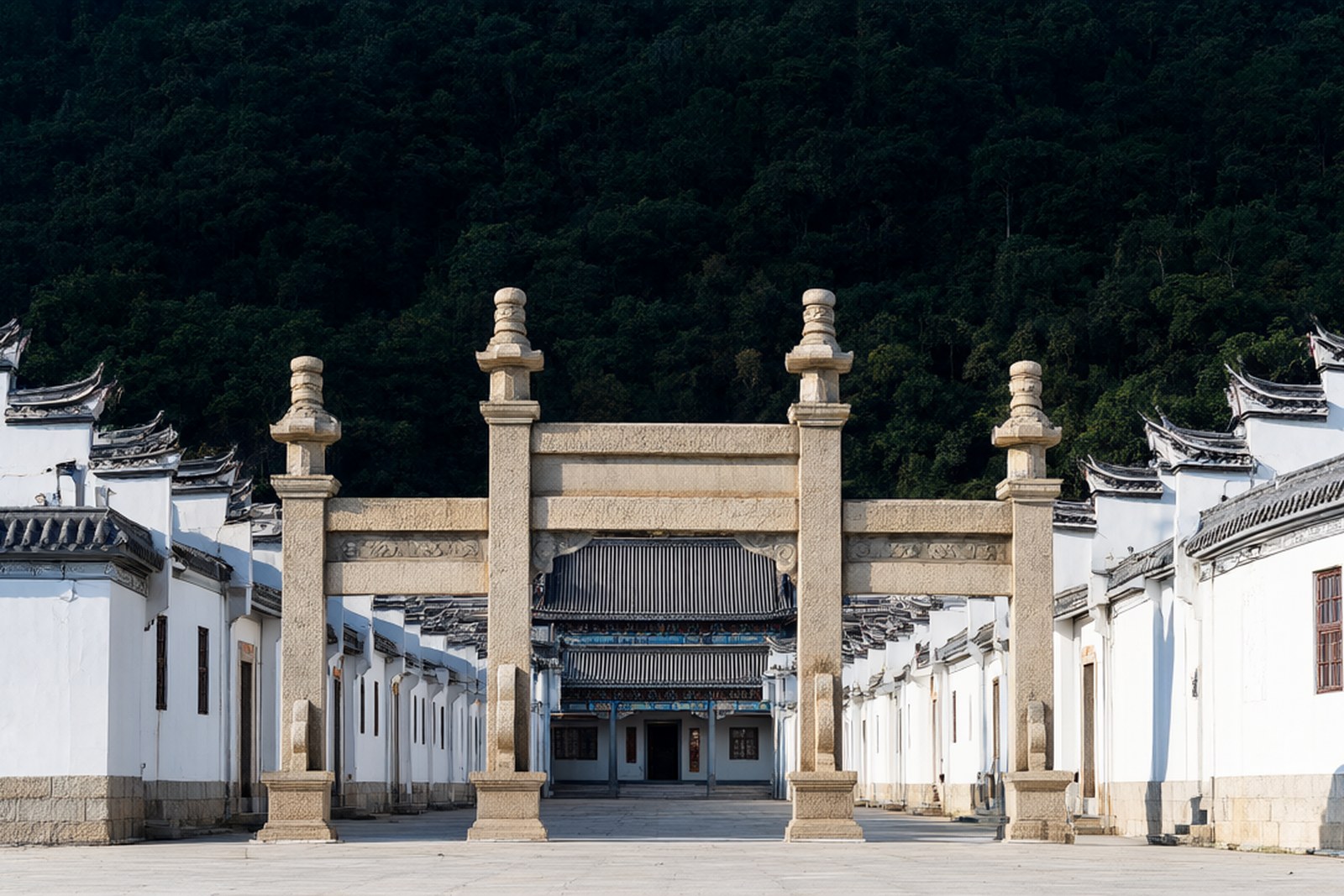
The plan of the monastery is a classic 坐东朝西 zuò dōng cháo xī arrangement – the axis runs east to west, so the buildings face west, down towards the plain – and it is laid out symmetrically on 天王殿 Tiān wáng diàn, the 大雄宝殿 Dà xióng bǎo diàn and the 六祖殿 Liù zǔ diàn as its spine, in a style the descriptions call typically Qing and typically 岭南 Lǐng nán. The 牌坊 pái fāng, the ceremonial archway, is earlier than the surviving halls: it is dated to the 万历 Wàn lì years of the 明 Míng, so late sixteenth or early seventeenth century. The 大雄宝殿 is a 面阔三间 miàn kuò sān jiān hall – three bays across – and inside it there are eight 唐代莲花覆盘石柱础 Táng dài lián huā fù pán shí zhù chǔ, Tang-dynasty column plinths carved as lotus pads with the petals turned over, and the main hall of the patriarch has four 宋 Sòng and four 清 Qīng plinths of its own. Those plinths are the oldest objects a visitor will actually touch, older than any of the walls standing on them. The area figures need care because the published ones are measuring different things: the built floor of the halls is given as about 9,200 square metres, the built footprint as more than 16,000 with some 80,000 square metres of garden, and the figure after the 1980 restoration as 10,000 square metres of monastery – so the enclosed built area is the smallest of the four numbers and the landholding the largest, and a piece that quotes one without its label will be wrong three times out of four. The way in follows the usual sequence: stone archway, then the 山门 shān mén, then 护法殿 hù fǎ diàn, the 放生池 fàng shēng chí – the release-of-life pond – 珠亭 zhū tíng, and the halls beyond. Over the gate is a couplet that is the best line at the whole site: 百城烟水无双地,六代风幡自一天 bǎi chéng yān shuǐ wú shuāng dì, liù dài fēng fān zì yī tiān – among a hundred cities of misted water there is no second ground like this, and six generations of wind-blown banners belong to one sky. The 风幡 fēng fān, wind and banner, is a deliberate quotation of the episode in the Platform Sutra where two monks argued about whether the flag was moving or the wind was, and 惠能 told them it was their minds that moved.
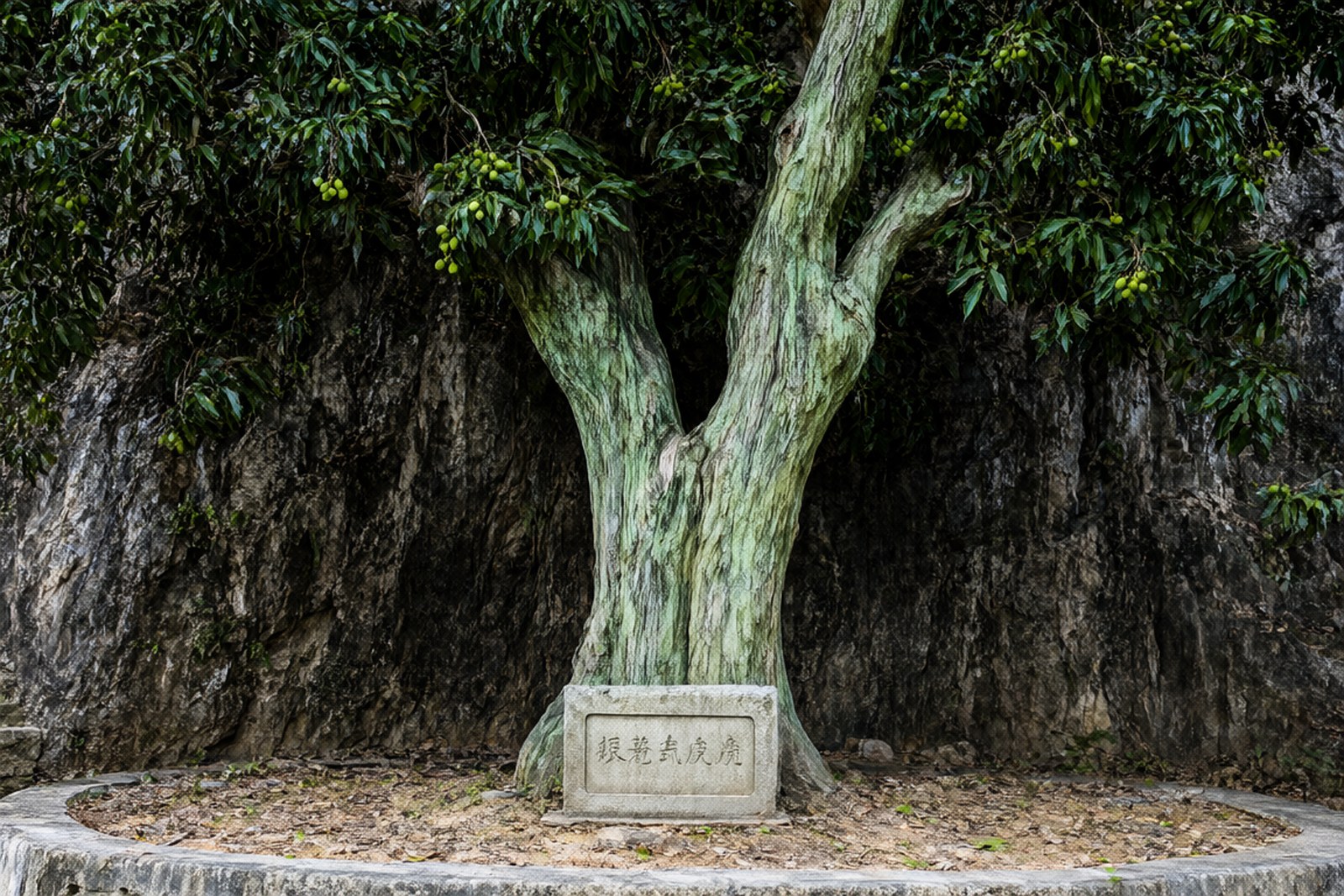
Six things at this site get called the monastery’s treasures, and the first of them is alive. The 六祖手植千年荔枝树 Liù zǔ shǒu zhí qiān nián lì zhī shù – the thousand-year lychee the sixth patriarch planted with his own hand – stands on the hill behind the monastery. Its age is given as more than 1,300 years and its height as 18.5 metres, and the thickness of the trunk is described locally as at least three people joining hands round it; it is counted among the eighteen notable ancient trees of 广东 Guǎng dōng, and in March 2003 the provincial afforestation committee published the finding that it is the longest-lived fruit tree among the province’s registered ancient trees. It still fruits, and the fruit is called 佛荔 fó lì, buddha lychee, with a stone tablet beside the trunk reading 六祖手植千年古荔 liù zǔ shǒu zhí qiān nián gǔ lì. The second is the 敕赐国恩寺 plaque of 707 already mentioned. The third is the most recent and the most interesting: in 2006 seven 舍利 shè lì, relic beads, were excavated at the monastery, ranging in diameter from 0.35 to 0.15 centimetres. The report is careful about what that find does and does not establish, and so is this article – the beads were found on the site, they are dated by context to the monastery’s own history, and the traditions attached to them hold that they may have belonged to 释迦牟尼 Shì jiā móu ní, the historical Buddha, or alternatively to one of the patriarchs from the second to the fourth generation. Which of those is true is not something the excavation settled. The fourth is the 六祖父母坟 Liù zǔ fù mǔ fén, the grave of 惠能’s parents on the right-hand side of the monastery, for which the throne granted a plaque in the Tang; the burial position is unusual enough that the local accounts all remark on it. The fifth is the 卓锡泉 Zhuó xī quán on the back hill, the spring that the tradition says he struck out of the ground with his staff – 以锡杖卓地,泉水自地下涌出 yǐ xī zhàng zhuó dì, quán shuǐ zì dì xià yǒng chū, he planted the tin staff in the earth and the water came up – which has run without drying for a thousand years and is still clear enough to drink. The sixth is the 浴身池 yù shēn chí, the bathing pool on the left, the stone tank that the tradition calls his wash basin; the pavilion over it has fallen down and the stones remain. In October 2019 the monastery entered the eighth batch of 全国重点文物保护单位 quán guó zhòng diǎn wén wù bǎo hù dān wèi, national key cultural relic protection units, which made it the first site in 新兴县 to hold that status, and between 2000 and 2020 it was assessed by the province as a civilised religious site every time the review came round. It is a working monastery as well as a monument – there are resident monks and daily services – and it is free to enter, which is unusual for a site with this much on the national list and worth knowing before you budget for it.
Practicalities
Tickets. Free. There is no admission charge and no booking system, and the donation boxes by the halls are the normal voluntary sort. The one thing to plan around rather than to pay for is time: the site is large enough that a proper visit – the axis, the patriarch’s hall, the pagoda and its Tang base, and the back hill with the lychee and the spring – is a good two hours, and the light on the front halls is best in the morning, when the sun is behind the visitor.
Opening hours. The gate is open through the day, and the hours most often published are around 08:30 to 11:00 and then 14:30 to 17:30, which is a midday closure rather than a long day. That split has the look of an older arrangement and is the kind of thing that changes with the season and the festival calendar, so anyone whose trip depends on it should confirm on the day, or simply arrive in the morning, when the monastery is at its most active anyway and the halls are lit from the east.
Getting there. 新兴县 Xīn xīng xiàn is in the south-east of 云浮市, and the monastery is at 六祖镇 Liù zǔ zhèn, a short way south of the county town; the county is served by the 三茂 Sān mào railway at 新兴县站 Xīn xīng xiàn zhàn and by coach from 云浮, 肇庆 Zhào qìng and 广州. From the county town it is a taxi or a local bus to 六祖镇, and the resort area around 龙山 Lóng shān – the hot springs, the lakes and the walkways – is immediately below the monastery, so the usual arrangement is to sleep at one of the springs and walk or take a five-minute car up to the temple in the morning.
Closing day. No weekly closing day. The monastery observes the ordinary Buddhist calendar rather than a museum one, which means the busiest days are the first and fifteenth of the lunar month and the major festivals, when the halls are crowded and the atmosphere is better for it. Individual halls are occasionally shut for conservation, and the 六祖殿 and the relic display are the ones most likely to be affected, so a visitor whose whole purpose is the patriarch’s hall should ask before a long journey.
flowcloud would say that a monastery which is a third of a triangle with 光孝寺 and 南华寺 is easier to explain than to feel, and that the two things which make 国恩寺 legible are the ones nobody advertises: a seven-storey tower of 1990 standing beside a Tang foundation of 712, and a lychee tree in the back garden whose age is the one number at the site that has been independently published rather than repeated, which is a strange kind of proof for a place built on a promise to somebody’s parents.
Getting there: 国恩寺 is at 塔脚村 Tǎ jiǎo cūn, 六祖镇 Liù zǔ zhèn, 新兴县 Xīn xīng xiàn, 云浮市 Yún fú shì, in the south-east of the prefecture; 新兴县站 Xīn xīng xiàn zhàn on the 三茂 Sān mào railway and the county coach station are both in 新城镇 Xīn chéng zhèn, from where it is a short taxi or local bus south to 六祖镇 Liù zǔ zhèn, and 广州 Guǎng zhōu and 肇庆 Zhào qìng both run coaches to the county through the day, with the 龙山 Lóng shān hot-spring resort immediately below the temple making the obvious place to stay.