
Haikou Volcanic Cluster Global Geopark
The steps go down into the ground and the air changes on the way. Thirty metres below the rim of the crater the temperature has dropped several degrees and there is a steady draught coming out of the rock, and the walls around you are black basalt with the flow lines still legible in them — the shape of a liquid that stopped moving. Above, on the rim, someone is taking a photograph of Haikou. From up there the city is a grey-white band in the haze and beyond it is the strait, and on a clear day, further again, the low smudge of the Leizhou peninsula on the other side. This is the highest point in Haikou, and it is 222.8 metres above the sea.
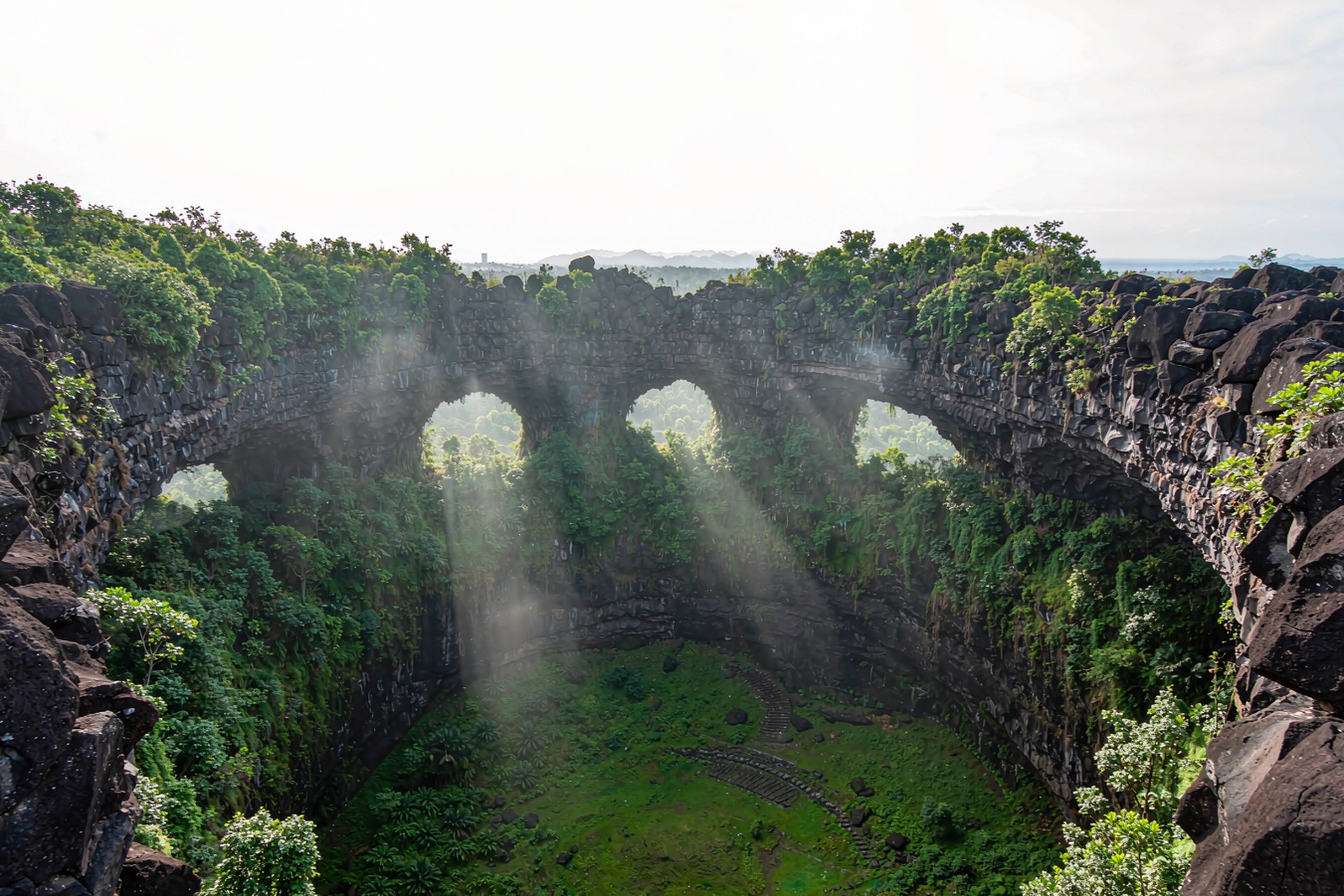
雷琼海口火山群世界地质公园 — the Haikou Volcanic Cluster Global Geopark — is out at 石山镇 in 秀英区 on the western edge of the city, about half an hour’s drive from the centre. It is part of a UNESCO Global Geopark, and the name tells you why it is unusual. 雷琼 is 雷州 plus 琼州: the same volcanic field straddles the Qiongzhou Strait, and the geopark has a park on each side — 海口园区 here in Hainan and 湖光岩 in Guangdong. One magma system, one geological story, two provinces, and a strait in the middle of it that the lava used to be under.
What Happened Here
Hainan’s north is volcanic, and the flat land around Haikou that everyone assumes is delta is mostly lava plain. The 琼北 volcanic group is Quaternary — young in geological terms and in human terms too: the most recent eruptions were roughly eight to ten thousand years ago, which is after people were already living in this part of the world. The cones number in the dozens, and under the surface there is a second landscape of lava tubes, some of them kilometres long, formed when the outer skin of a flow cooled and hardened while the molten interior kept running.
The park centres on 马鞍岭 (Mǎ’ānlǐng, “saddle ridge”), named for its twin peaks, which from the approach road really do look like a saddle. The higher of the two is 风炉岭 (Fēnglúlǐng, “bellows ridge”) — it is a genuine cone with a genuine crater, walkable, and the climb is twenty minutes of paved steps through forest, with handrails, not a hike.
The forest is the other half of the story. Volcanic soil is fertile and the rainfall here is heavy, so the slopes are covered in a dense tropical second growth — banyan, wild pineapple, and the occasional 见血封喉 (jiànxuèfēnghóu), the “blood-seals-the-throat” tree, whose sap is genuinely toxic and which the park thoughtfully labels. The forest cover means you do the whole climb in shade, which in July is the difference between a pleasant morning and a mistake.
The Walk Down and Around
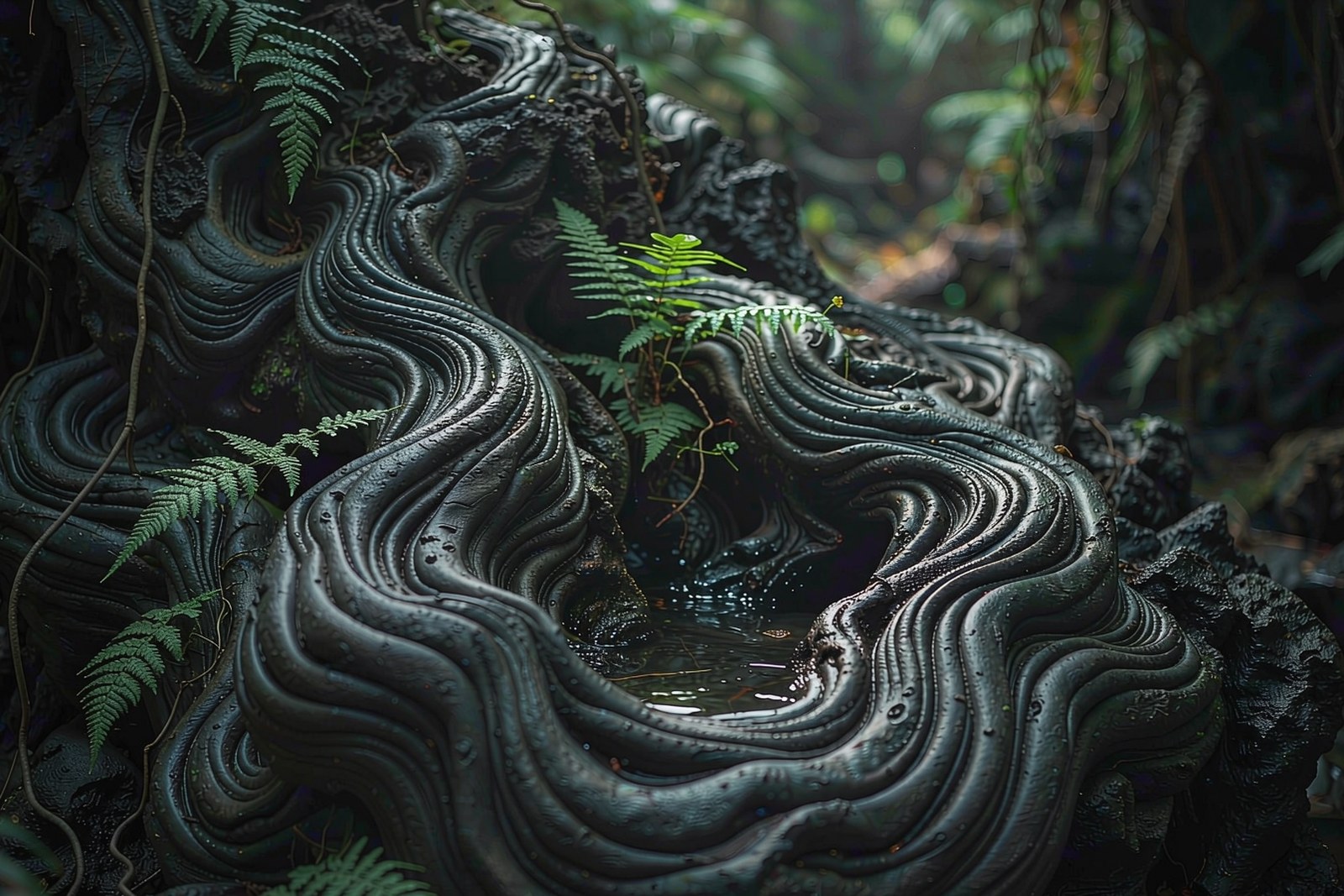
The standard route, and it is worth following because the park is laid out as a loop: entrance, 火山科普馆 (the science hall, with models and an explanation of how the island’s volcanism works), 玄武文化广场 with its 人字碑, the 古石屋 lava-stone house remains, 山前广场, then the ring path up to the summit and the 前朱雀 viewing platform, and then down inside the crater of 风炉岭 — the cool draught and the black walls. On the way back there are the lava tunnels 仙人洞 and 卧龙洞, the 火山神庙, a 火山石器文化园 with basalt querns, basins and rollers that people were using here for centuries, a tropical-forest boardwalk, and the 九曲玄武池, a chain of clear pools among black boulders.
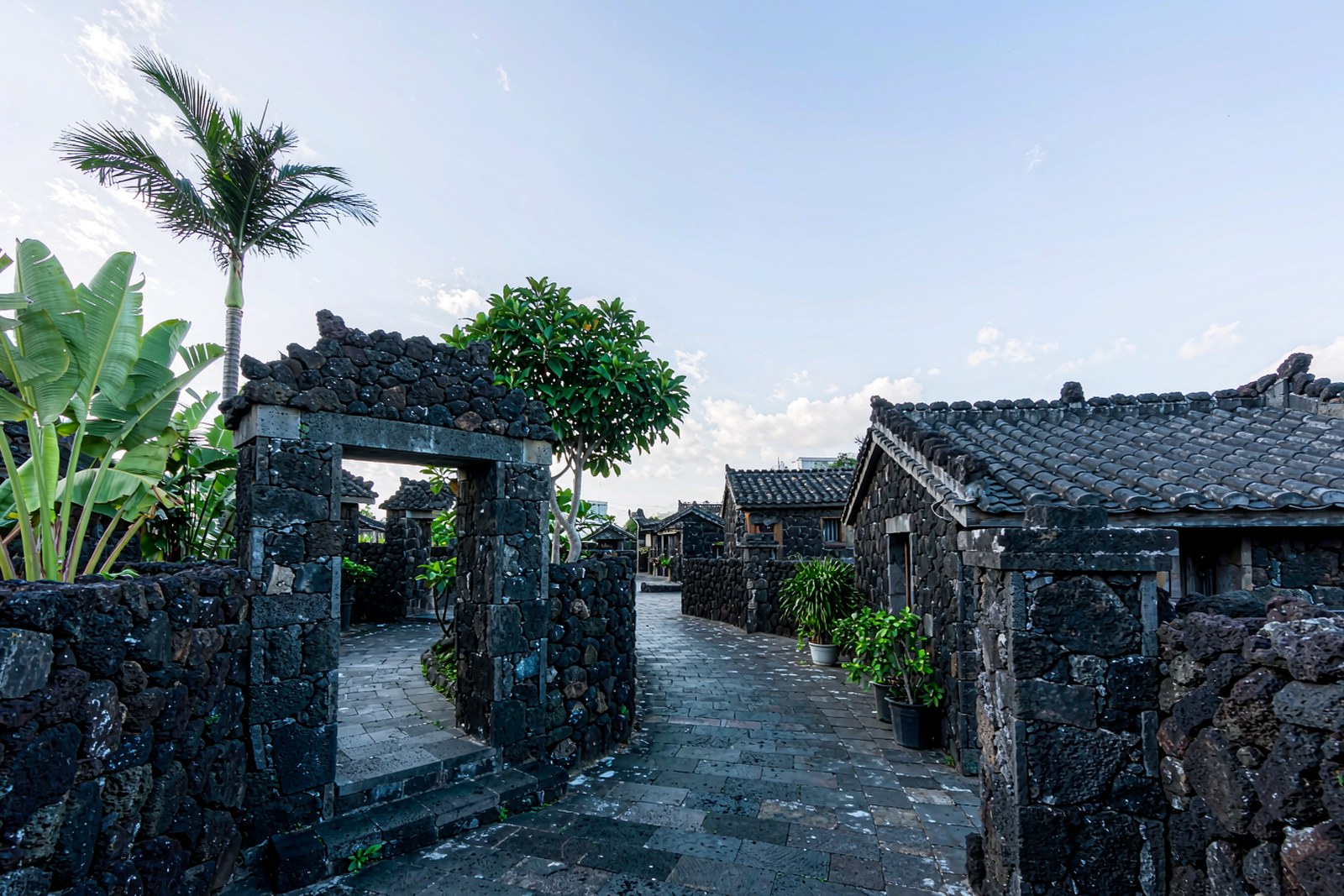
Everything you walk on was made by the volcano, including the villages. Just outside the park, 荣堂村 and 美社村 are built almost entirely out of volcanic stone — walls, gates, lanes, the lot — because when your farmland is a lava flow, the stone is what you have. 荣堂村 is also where you find 七十二洞, a long lava tube you can walk into, with a separate ticket. And 石山镇 itself, 石山 meaning “stone mountain”, is named for the hills you are standing on.
Practicalities
Tickets. Adults ¥54 in high season (October to April) and ¥45 in low season (May to September); the platform and travel-agency channels sell tickets from about ¥40, which is where the widely quoted figure of ¥40 comes from, and the gate price is the one to work from if you buy on arrival. Half price for visitors aged 60 to 69, full-time students, and children between 1.2 and 1.4 metres. Free for the over-70s, serving military, disabled visitors and children under 1.2 metres. The sightseeing shuttle is ¥20 and is worth it if you are short of time — it saves the walk up and the walk down. The 恐龙乐园 dinosaur attraction and the 荣堂七十二洞 lava tube are separate, cheaper tickets and neither is necessary.
Do you need to book? No. You can buy at the gate. Buying online in advance is slightly cheaper and lets you enter by scanning your ID, and it is worth doing on a public holiday weekend, but this is not a timed-entry site and it does not sell out.
Opening hours. 08:00 to 18:00, with last entry around 17:30. Allow two and a half to four hours. The best window is 08:00 to 11:00 — the light on the crater rim is better, the summit is clearer, and you avoid the full force of the afternoon sun. High summer afternoons are punishing even under the canopy.
Closing day. There is no closing day — the park is open every day of the year, including during Spring Festival.
Getting there. From Haikou it is straightforward, and the bus is genuinely viable.
- By bus: the 游1路 tourist line starts at 万绿园, costs ¥5 and takes about an hour to the park gate; alternatively take city bus 7 or 24 to 海玻市场 and change onto the 秀英–石山 minibus, ¥3 and about 25 minutes. Return buses are less frequent than you would like in the late afternoon.
- By car: the usual route is the 海秀快速路 followed by 火山口大道, 25 to 35 minutes from central Haikou. Parking is on site, ¥5–10, and there is plenty of it.
- By taxi: about ¥50 one way from the city, which makes sense if there are three or four of you.
What to eat. The village restaurants around 石山镇 and the 火山酒家 inside the park serve 火山石烤鸡 (chicken roasted with volcanic stone), 石山黑豆腐 — the local black tofu, which is a genuine speciality — and good 土鸡汤. If you are here in early summer, the 火山荔枝王, the huge volcanic-soil lychees, and 嘉宝果, the jaboticaba that fruits straight off the trunk, both come from these villages.
What to bring. Water, because the kiosks inside are few and overpriced. Sun protection for the rim and the open plaza, mosquito repellent for the forest. A light jacket for the crater floor, which is damp and cool year round. Trainers with grip, since the crater steps get slick.
How long. Half a day for the park proper. A full day if you add 荣堂七十二洞 and a walk round 美社村 and lunch in 石山镇.
Getting there: 雷琼海口火山群世界地质公园 (Leiqiong Haikou Volcanic Cluster Global Geopark), 海口市秀英区石山镇风景路 89 号, Haikou, Hainan. Adult tickets ¥54 in high season (Oct–Apr) and ¥45 in low season (May–Sep), from about ¥40 booked online; half price for 60–69s, students and children 1.2–1.4 m; free for over-70s, serving military, disabled visitors and under-1.2 m. Sightseeing shuttle ¥20. Open 08:00–18:00 every day with last entry about 17:30 and no closing day. Go early — the summit, at 222.8 m the highest point in Haikou, looks across the city to the Qiongzhou Strait. Reach it by 游1路 from 万绿园 (¥5, about an hour) or bus 7/24 to 海玻市场 then the 秀英–石山 minibus (¥3, 25 minutes); by car about 25–35 minutes via the 海秀快速路 and 火山口大道, parking ¥5–10; or by taxi for about ¥50. Allow half a day, and eat 石山黑豆腐 and 火山石烤鸡 before you leave.
We are still eating our way through Haikou Volcanic Cluster Global Geopark. Guides are on the way.